






























Which grasses should you choose for sandy soil?
Our selection of grass species adapted to sandy soil
Contents
Whether by the coast or inland, sandy soils often give amateur gardeners a real headache. It’s hard to imagine a lush garden there. Some plants adapt perfectly to these sandy soils, usually poor and dry. Starting with grasses which can go a long way to saving you from trouble. By their robustness and sobriety, grasses can be excellent allies of sandy soils. They will also bring lightness, structure and an undeniable touch of wildness.
Discover our selection of the eight best grasses capable of thriving in sandy soil, and our tips on planting them and looking after them.

What are the characteristics of sandy soil?
Sandy soil is, by definition, soil that consists of at least 60% sand. It is therefore particularly light and easy to work. It also warms up quickly in spring and is warmer in winter.
Nevertheless, it is a soil that is sometimes considered unforgiving due to its poor fertility and dryness. Indeed, in sandy soil, water and nutrients are not retained. This is simply because soil composed of a large amount of sand drains very quickly. Water and nutrients infiltrate very quickly and disappear into deeper layers of soil.
Finally, sandy soil is a soil that crumbles and does not bind.
Our selection of grasses suited to sandy soil
Planting and growing plants in sandy soil can be a real challenge. However, some grasses have adapted perfectly to these conditions and thrive in this type of soil. Often because they naturally grow in these soils commonly found along the coast. Among the grasses for dry soil:
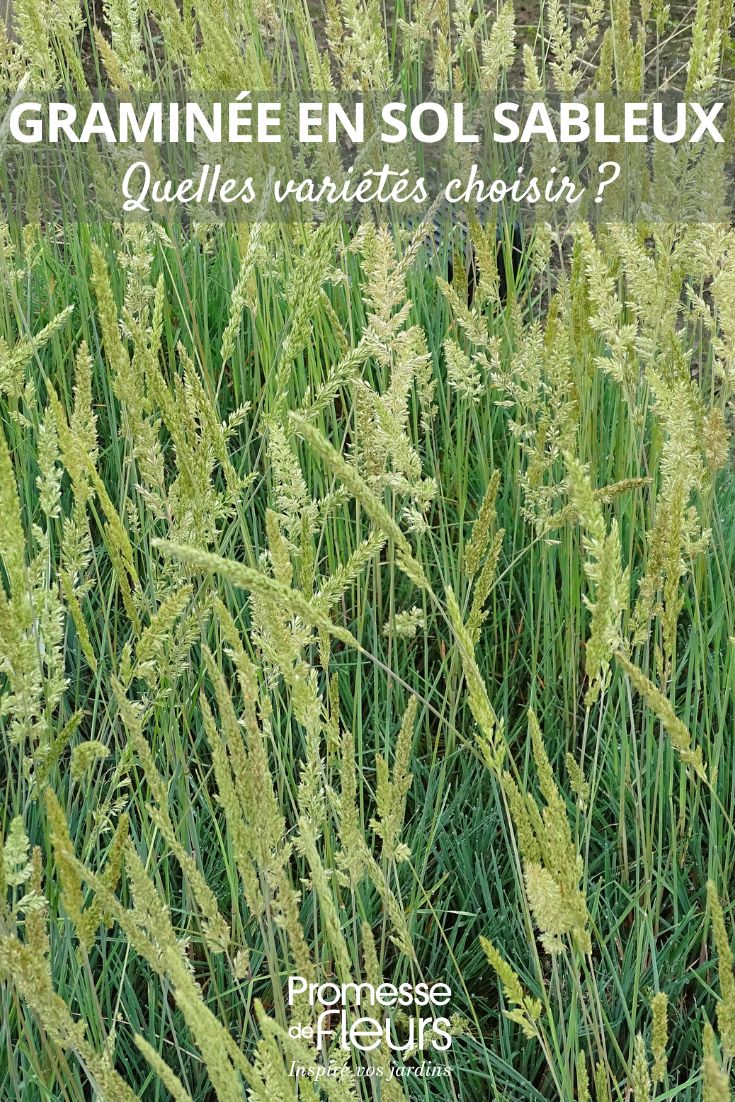
Blue Koeleria (Koeleria glauca)
Originating from Eurasia, Koeleria glauca, commonly known as sand koeleria, naturally grows in sandy, arid and sun-drenched lawns. It is a hardy grass forming compact, rounded clumps with blue-green linear, slender foliage. In summer, silvery-grey flower panicles appear, lending a plume-like, light appearance. They sway gracefully at the slightest breeze. It reaches only about 30 to 60 cm in height and width. 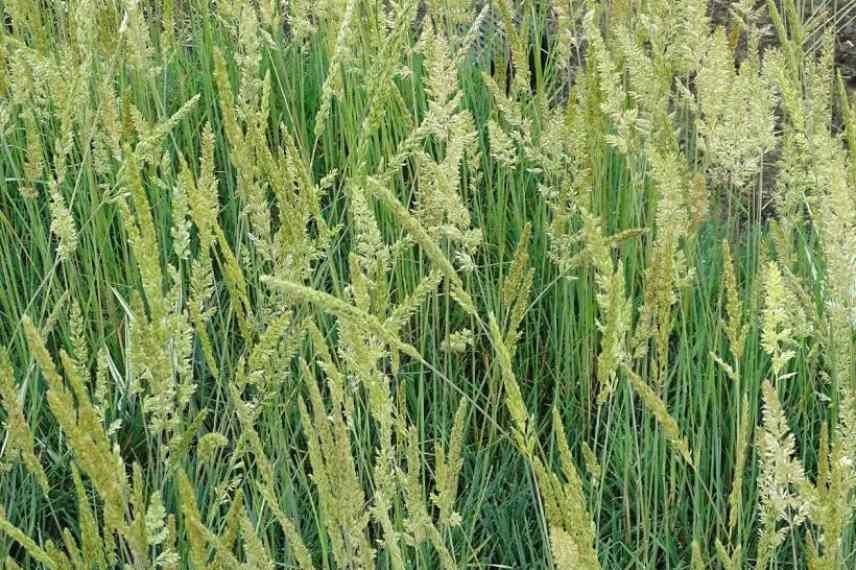
Very hardy, wind-tolerant and drought-tolerant, this grass is decorative throughout the year. It self-seeds very readily. It is perfectly suited to sandy, dry and calcareous soils, but also tolerates poor and stony soils. It prefers a sunny position and is fairly drought-tolerant once established.
It is a popular ornamental plant in rock gardens, borders and mixed beds, but it can also be used to stabilise soils and prevent erosion.
Azure Lyme Grass (Leymus arenarius)
Furthermore, known as sand Elymus, this grass is particularly well suited to coastal environments and dunes, where it plays a crucial role in stabilising soils and protecting against erosion. In other words, it thrives in sandy soil.
Leymus arenarius is distinguished by its bluish or grayish foliage, consisting of long, relatively broad leaves, coated with a bloom, often rolled up to reduce water loss. Its flowering stems, which can reach up to 1.2 metres in height, bear dense, cylindrical spikes, yellowish at maturity. Flowering generally occurs between June and August.
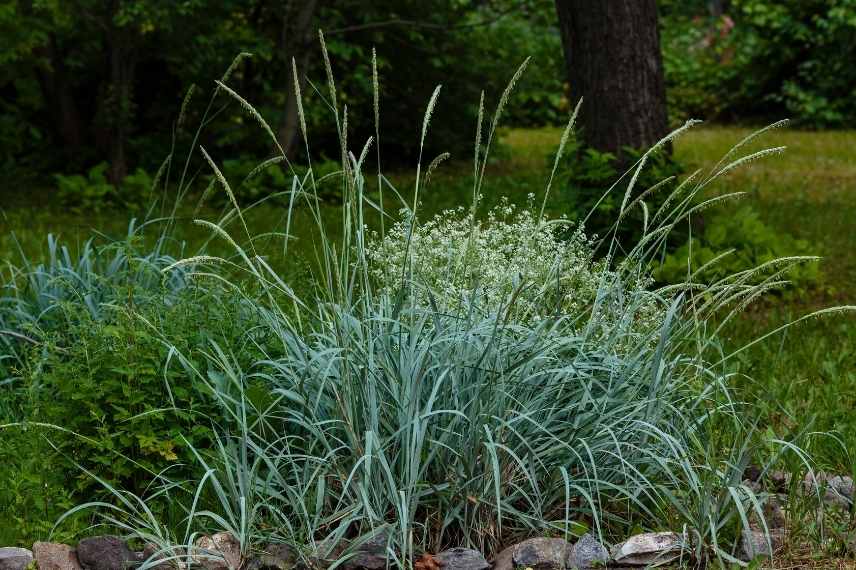
Azure Lyme Grass (Leymus arenarius)
With a deep and spreading root system, this grass can be invasive. It is perfect as a natural ground cover, but also adapts well to mass planting, borders or rockeries.
Sand marram (Ammophila arenaria)
Ammophila arenaria, commonly called marram grass or oyat, is a pioneer grass species of coastal dunes, well suited to sandy and arid environments. It features long, narrow, sharp-edged leaves, greenish-grey in colour, rolled up to limit water loss. From May to July, the inflorescences appear, grouped into dense spikes, yellowish to whitish, reminiscent of wheat. Its stems are robust and can reach up to 1.2 metres in height.
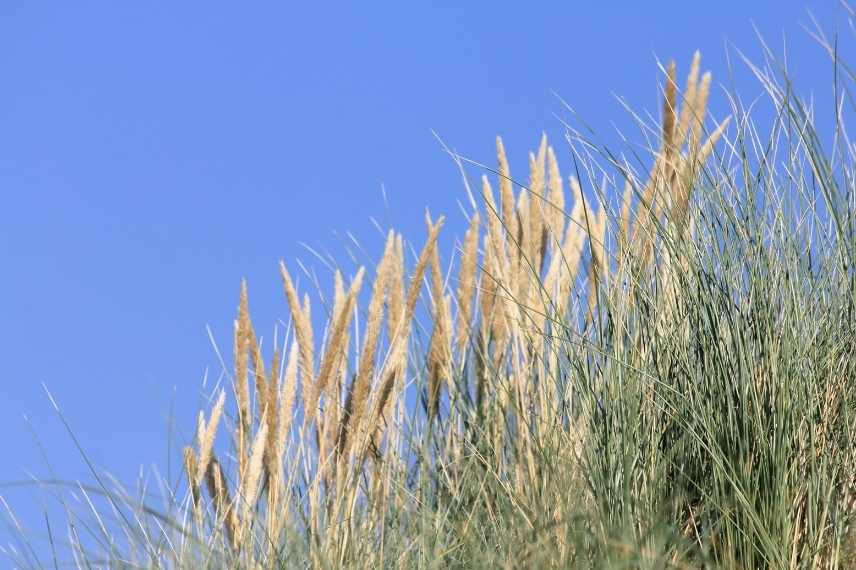
The marram grass (Ammophila arenaria)
Thanks to its deep and dense root system, marram grass fixes the sand and prevents its movement by wind or waves. It thus contributes to the formation and maintenance of dunes, giving it an undeniable ecological role. In your garden, this grass will enjoy a slope, a bed or a border. But it has a tendency to colonise soils…
Deschampsia flexuosa (flexuous canch)
The flexible canch, Deschampsia flexuosa, is a grass with evergreen foliage, discreet but charming. It is very useful in gardens for its light appearance and its ability to grow in challenging conditions. It naturally grows in dry and poor areas, often on acidic, sandy soils.
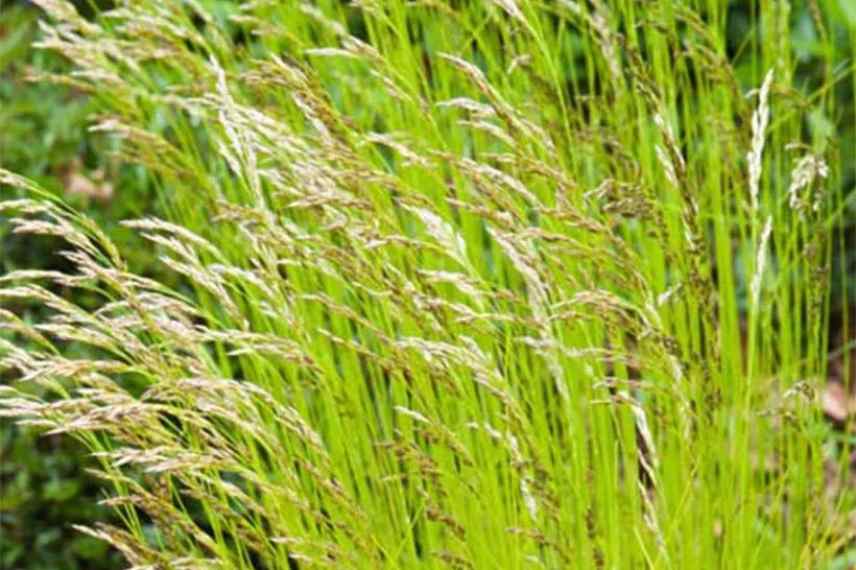
Deschampsia flexuosa
Deschampsia flexuosa forms small tufts of fine, evergreen leaves, usually dark green. Its stems are slender and flexible, bearing light, airy spikelets that bloom in summer. The inflorescences are initially greenish, then take on a golden, bronze-tinged hue as they dry. The plant as a whole is quite graceful and light.
This wild-looking grass is perfect for flower beds, borders, rockeries or even as a ground cover in difficult areas, where it brings a sense of lightness.
Love grass (Eragrostis spectabilis)
Eragrostis spectabilis is an ornamental grass native to North America, valued for its airy and colourful flowering. Love grass forms a tuft of fine, green leaves, from which, from July to October, long stems bearing light, aerial spikelets rise. The flowers, pink to purple, create a very aesthetic cloud or mist effect. They often persist into winter. It typically reaches between 50 and 70 cm in height, with a similar width.
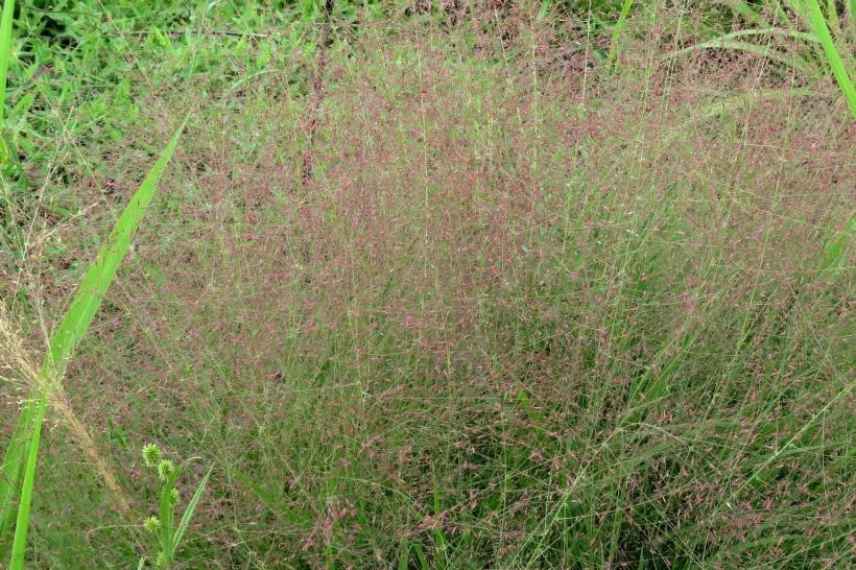
L’herbe d’amour (Eragrostis spectabilis)
Adept at well-drained soils, hardy to -15 °C, this grass adapts to different soil types, even poor and sandy. It prefers sun and tolerates heat and drought well once established. Love grass is ideal for bringing lightness and movement to flower borders or along path edges.
Angel hair grass (Stipa tenuifolia)
Stipa tenuifolia is a grass with silvery panicles of remarkable fineness that dance and gleam in the summer sun. In autumn, its panicles take on golden reflections, extending the magic until the first frosts. Its green foliage, like a fountain of undulating lines, also displays the same lightness. Its dense tuft adds a real touch of poetry to any space—rock gardens, border edges or beds. It also gives a gentle swish as you walk past.
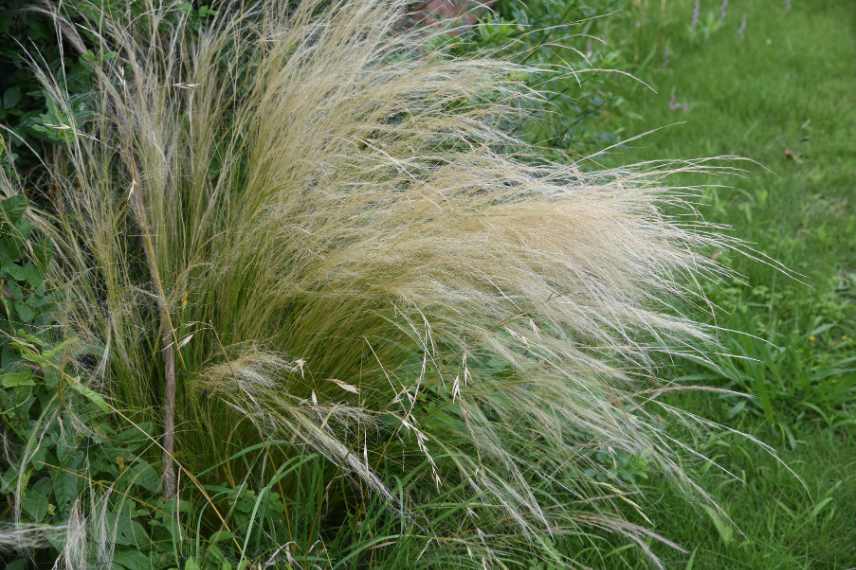
Les cheveux d’ange (Stipa tenuifolia)
Easy to live with, this grass loves sun and drought. No need for pampering; it thrives on little. Unfazed by tough conditions, it adapts perfectly to poor, dry and sandy soils.
Schizachyrium
Schizachyrium are grasses, admired for their colourful foliage and light, airy appearance. Their foliage, fine and linear, is often blue-green or green, taking on beautiful autumn colours around orange, red and purple. In summer, the inflorescences with plume-like spikelets form discreetly. These grasses form dense, upright tufts, ranging from 50 cm to over a metre.
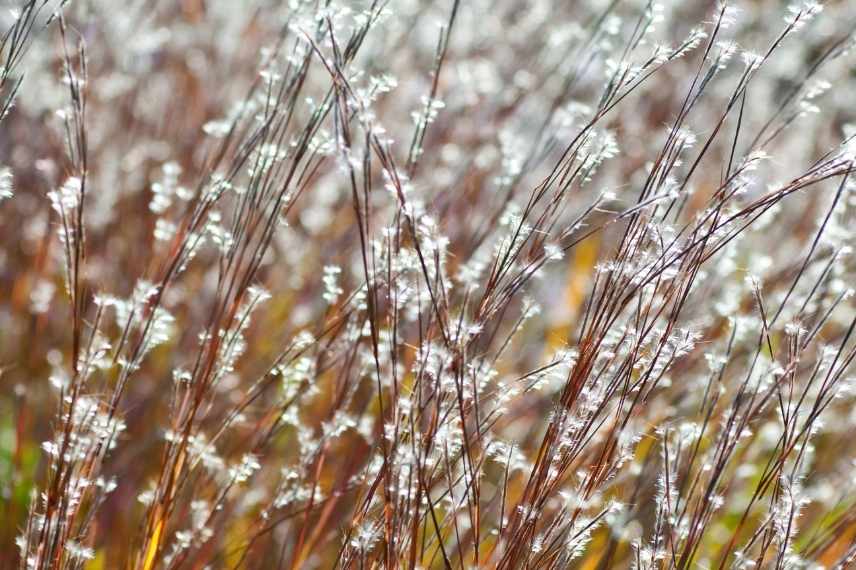
Schizachyrium scoparium
The Schizachyrium prefer sun, but tolerate partial shade. They adapt to a range of soils, even poor, sandy and dry, as long as well-drained.
The fescues (Festuca)
For those who love grasses, it’s hard to miss the fescues (Festuca), which form compact, hemispherical tufts of evergreen, particularly stiff foliage. They are prized for their diversity, adaptability and ornamental interest. The foliage generally displays green, blue-green or grayish tones. Their flowers are grouped into spikelets, forming light and airy panicles that appear in summer. The height varies considerably by species, from a few centimetres for dwarf fescues to over a metre for some taller species.
Among the reliable choices of this group, blue fescue (Festuca glauca) stands out for its ease of cultivation. It finds its place everywhere, including in sandy soil.
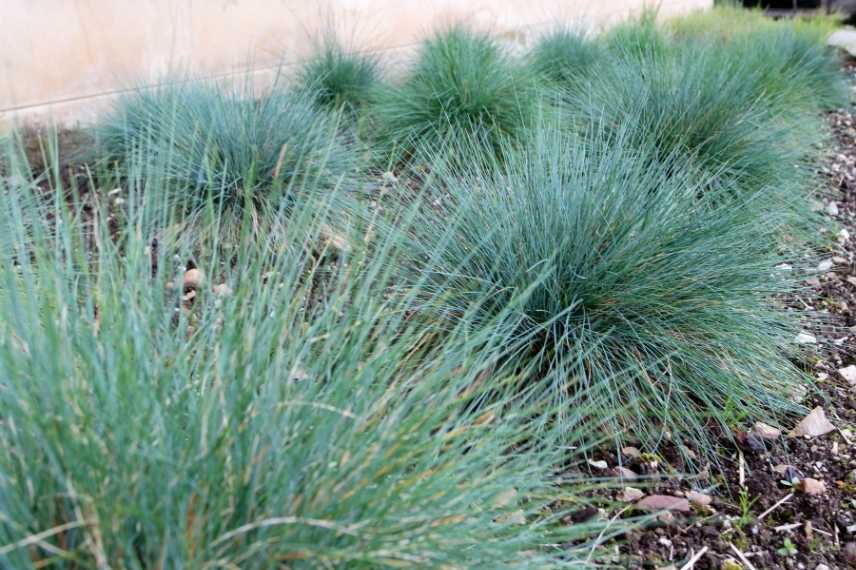
The blue fescue (Festuca glauca)
How to plant and maintain grasses in sandy soil?
Grasses are excellent options for gardens with sandy soil. However, they require the bare minimum.
Planting
As sandy soil is very well-drained, you will need to add some organic matter (compost or potting compost) at planting to improve water retention. You should also loosen the soil to a depth of 20 to 30 cm to facilitate the rooting of grasses.
After planting, firm the soil and water thoroughly. Mulching will help keep the soil cool.
Maintenance
To aid rooting, in the weeks after planting, watering should be regular. Thereafter, these grasses will manage without irrigation thanks to their resilience. Occasional watering can be beneficial during extended droughts.
At the end of winter, prune the dry leaves and withered culms to promote new growth. For some species, a light pruning during the season can help maintain a compact and attractive habit.
Fertilisation is unnecessary.
How should these ornamental grasses be combined?
To accompany grasses in sandy soil, you should choose plants that are drought-tolerant and not too demanding. Among the classics for this type of soil are perennials and Mediterranean shrubs such as the lavender, the rosemary, the Santolina, the thyme… To add a splash of colour, choose flowering perennials such as the blanketflowers, the coneflowers and the rudbeckias, or the tickseed, the achilleas, the mulleins…
The gauras and the Buenos Aires vervain pair well, by their lightness, with grasses. Obviously, in a dry garden, the sedums, the houseleeks and the delospermas thrive when grown alongside grasses.
And for an exotic touch, pair your grasses with the yuccas, the agaves and the opuntias, perfectly suited to dry and sandy soils.
- Subscribe!
- Contents
Comments