





























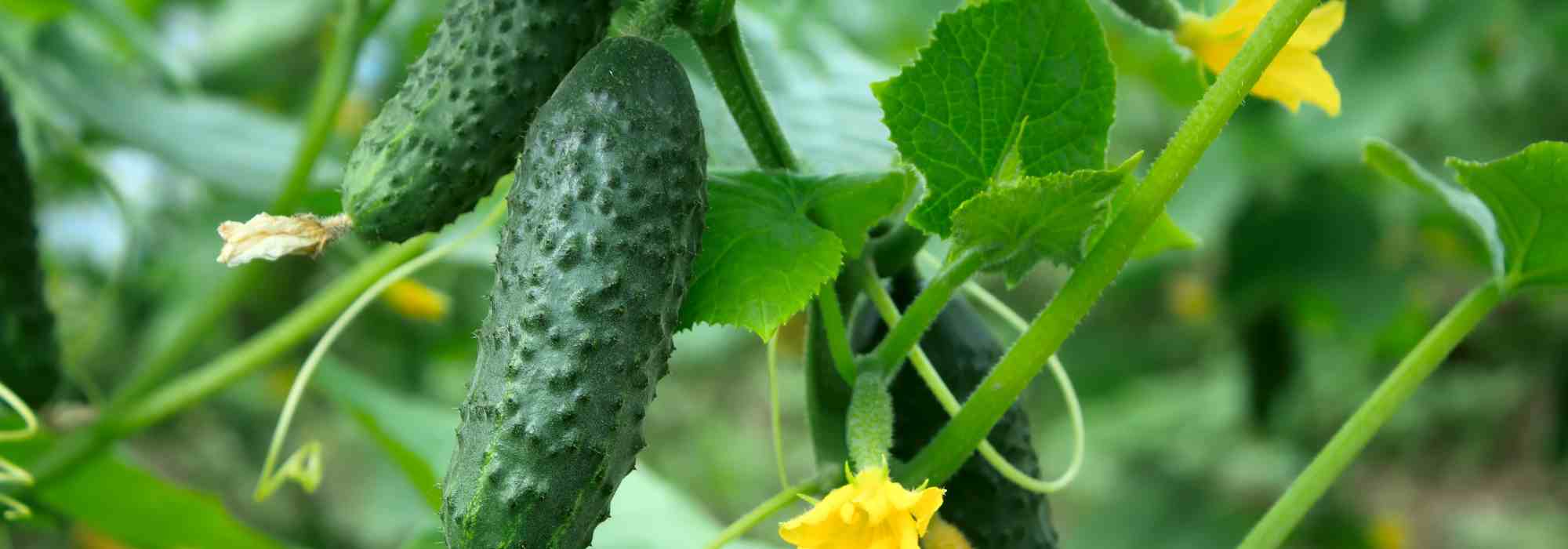
Which plants pair well with cucumbers?
Cucumber companion plants
Contents
A member of the beautiful Cucurbitaceae family, cucumber (Cucumis sativus) is a plant with a creeping growth habit that can develop its long, tendril-bearing stems over an area of 2 to 3 m². This is why, in small (or large) gardens, it is always best to grow it vertically on supports such as stakes or a trellis. This frees up space for growing other vegetables nearby. This is where the concept of companion planting or intercropping comes in. From then on, if you have planted a few cucumber plants in your garden, you may rightly wonder which vegetables to pair with them. Discover the vegetables, aromatic herbs and flowers that pair well with cucumbers.
For further reading: Cucumber and gherkin: sowing, planting, growing, pruning.

What is companion planting?
This method of cultivation involves growing certain plants side by side and keeping others apart. And this is for several reasons. On the one hand, plants interact with one another to protect and help one another. On the other hand, companion planting helps save time and space, two essentials for a gardener. Finally, many flowering plants attract insects that contribute to pollination and thus to fruiting. However, companion planting is not an exact science and yields results that are rather variable, depending on the soil, climate and cultivation conditions. And often, for anyone who would apply it verbatim, it quickly becomes a headache. Ultimately, companion planting is more akin to experimentation and common sense.
Radishes and lettuce for space-saving
The cucumber is equipped with tendrils that allow it to coil around any support. A boon for gardeners with limited space. Indeed, the cucumber adapts perfectly to staking or to trellising on a mesh or trellis. This vertical cultivation logically saves space. But it is also an excellent way to protect the foliage and fruit vegetables against rotting, because cucumbers do not touch the ground and are not subject to moisture. Moreover, to preserve humidity and optimise watering, essential for proper cucumber development, but also to prevent the proliferation of weeds, the use of mulch is recommended.
We can also pair this cucurbit with high-growing plants that have a low-growing habit and a short growing cycle. And this to save space and time. That’s why it is wise to transplant lettuce at the base of the cucumbers that grow upwards, such as the lettuce. It is also possible to sow radishes which, according to some gardening sites, have the ability to repel the cucumber beetle, a pest we will come back to. Even if this allelopathic property is not proven, the association of radishes with cucumbers also provides a gain in space and time. In addition, the cucumber foliage will shade the lettuces and radishes. And they will benefit from the water supplied to the cucumbers.
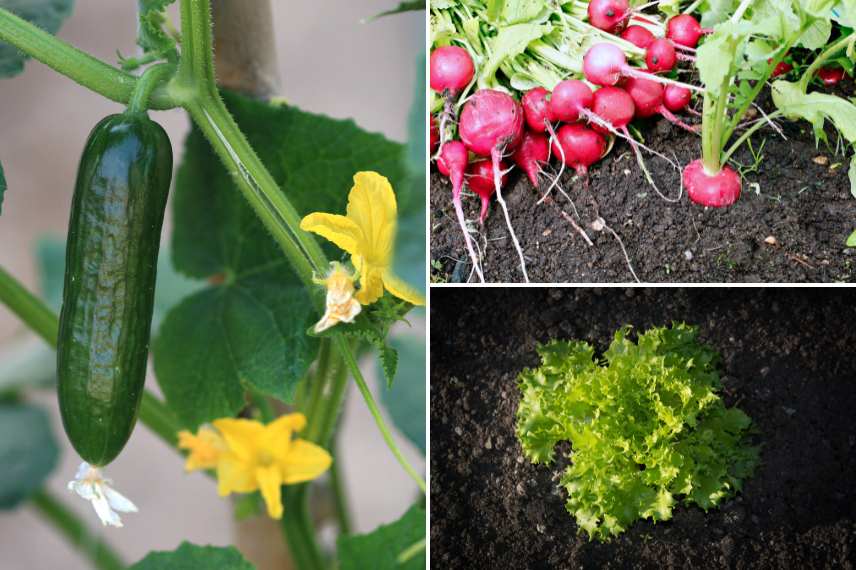
Growing radishes and lettuces at the base of cucumbers helps to save space
Broccoli and maize against the cucumber beetle
If you have already grown cucumbers in your vegetable plot, you may be familiar with the striped cucumber beetle (Acalymna vittatum). Otherwise, here is a quick portrait! This small elongated beetle, yellow with black stripes, attacks the stems, leaves and flowers of the young plant, attracted by the cucurbitacins, bitter compounds secreted by the cucumber. Adults and larvae that also attack the roots are to be feared. This beetle is also a vector for bacterial wilt, a disease to which the cucumber is relatively susceptible.
For biological control of cucumbers, the use of insect-proof netting proves relatively effective, as the striped beetles fly towards the cucumbers as soon as they detect its scent between May and June. Likewise, a thick mulch prevents them from laying eggs. This mulch also has the merit of sheltering the carabids, which are effective predators. There remains the use of pheromone traps. Nevertheless, scientists such as entomologist Bach demonstrated, in the 1980s, that the association of cucumber with the maize and the broccoli reduced infestation by 10 to 30 times. Similarly, corn silks would tend to attract them and thus divert them from cucumbers. Maize could also hinder their flight.
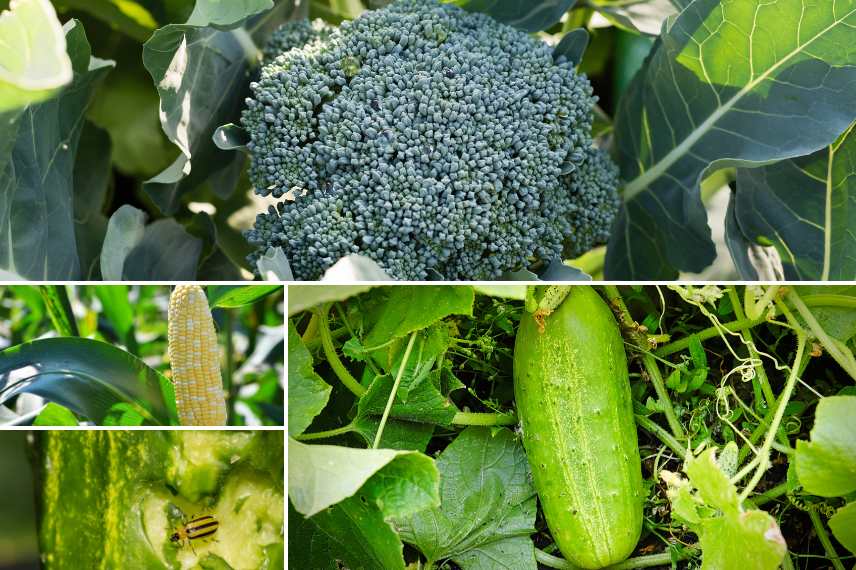
Broccoli and maize would slow the progression of the cucumber beetle
In short, there is every benefit to plant maize and broccoli near cucumbers, even if the striped cucumber beetle is not present. Broccoli and, more generally, the entire brassica family, are by no means harmful to cucumbers, unlike potatoes and tomatoes.
Read also
Cucumber and gherkin diseases and pestsBeans and peas for nitrogen inputs
Beans, peas, and broad beans belong to the Fabaceae family, also known as the legumes. These plants have the ability to fix nitrogen from the air instead of drawing it from the soil. Indeed, leguminous plants develop a symbiosis with a soil bacterium of the genus Rhizobium, to which they provide carbon compounds synthesised through photosynthesis. In exchange, the bacteria that fix on the nodosities of the roots of the legumes provide nitrogen to the young plant, taken up from the atmosphere. Thus, the soil becomes enriched with nitrogen. By cultivating these legumes in various spots in the garden, through a crop-rotation system, we progressively enrich the soil as a whole.
But planting heavy-feeding vegetables like cucumbers near the Fabaceae also offers a short-term advantage. For these cucumbers will benefit from this free and continuous supply of nitrogen. So do not hesitate to sow beans and chickpeas in close proximity to the cucumbers, or transplant your cucumber plants not far from garden peas, sugar snap peas, and broad beans… However, be mindful of their respective needs. Thus, cucumbers are thirsty, but chickpeas do not require water.
Aromatic plants to repel pests
Among the main enemies of cucumbers are aphids, the thrips and the whiteflies. If these pests are not necessarily fatal to cucumbers, they can still cause damage to their health and fruiting. Planting aromatic plants near cucumber plants can help prevent an invasion. And some plants are known for their repellent properties. By the odours emitted by their foliage and their flowers, they will, in a sense, confuse the pests’ trails. Thus, to deter aphids, some plants such as the dill, the basil, the thyme, the rosemary, the mint, the chervil, the lovage, the lemon balm, the summer savoury, the coriander, the lemon verbena are recognised. Be careful: some—including mint, lemon balm and lovage—can be quite invasive, so it’s best to grow them in pots.
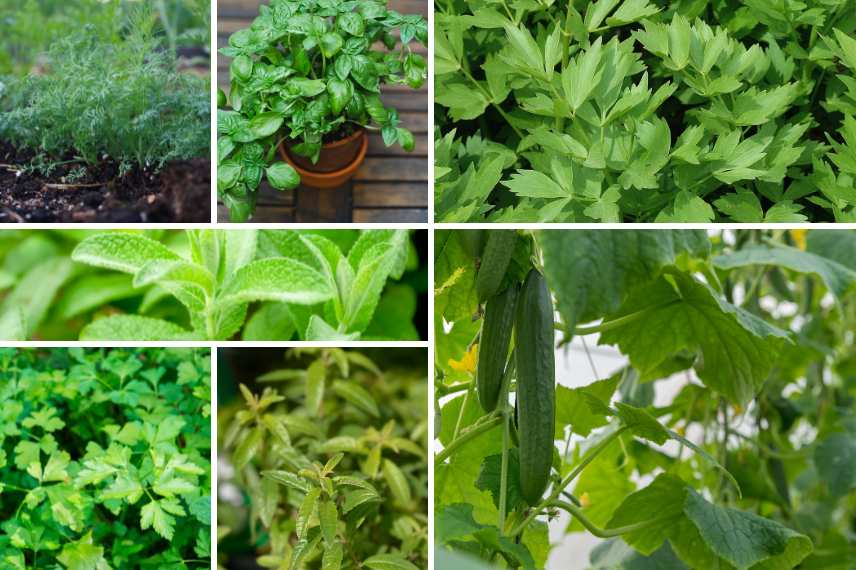
The association of cucumbers with aromatics helps limit invasions by pest insects
As for chives, they are said to help prevent the establishment of the powdery mildew, a fungal disease that can sometimes attack cucumbers, in humid, warm years. To be checked…
Which flowers should you plant next to cucumbers?
The cucumber is a monoecious plant, that is to say, a single young plant bears both female flowers and male flowers. Female flowers can thus be fertilised by pollen from the male flowers on the same young plant, via bees and other pollinating insects. But bees also carry pollen from one cucumber plant to another, through cross-pollination. So, logically, without bees, no cucumbers!
This is why it is important to attract these bees to your vegetable garden. And this can be achieved by planting or sowing plants whose flowers are melliferous. Among these plants, one can cite borage, the yarrow, the agastache, the boneset, the phacelia, the cosmos, the sunflower, the catmint, the zinnia… Your vegetable garden will be in bloom, attractive and the bees will be buzzing in numbers.
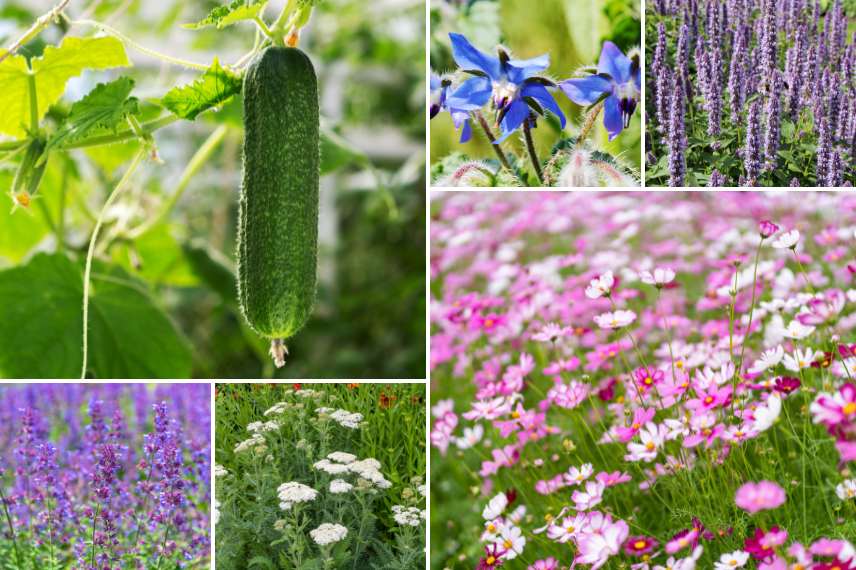
To promote cucumber pollination, plant melliferous flowers in the vegetable garden!
Note also that calendula repels whiteflies and aphids. To act as an attractant for aphids, it is also possible to sow nasturtium near the cucumbers. This plant, furthermore, has the ability to repel whiteflies. Just as marigolds, which also attract hoverflies, predators of aphids.
- Subscribe!
- Contents
Comments