





























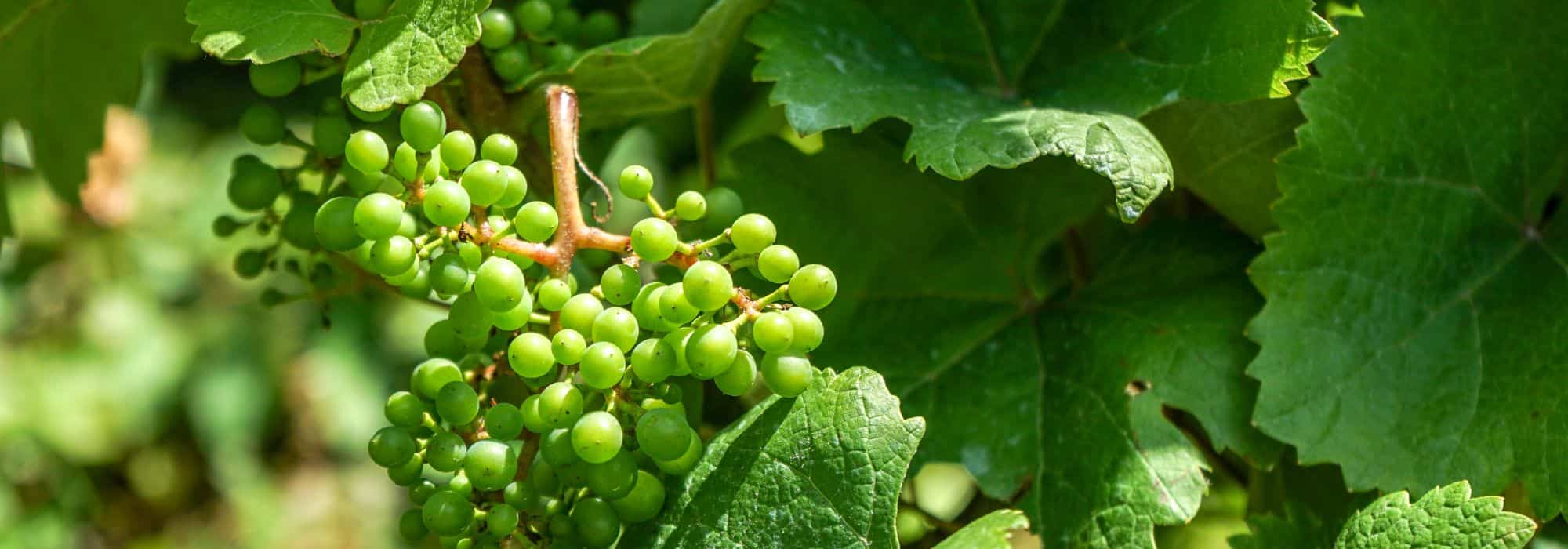
Why aren't there any grapes on my vine?
Our tips to obtain beautiful grape clusters
Contents
Cultivating a grapevine (Vitis vinifera) in your garden or on your terrace is entirely feasible for the average gardener. Obviously, it’s not about producing hectolitres of wine but rather enjoying, after a meal, a few beautiful clusters of grapes that are juicy and sweet. For this purpose, it’s best to choose table grape varieties such as Golden Chasselas or the Muscat. Cultivable throughout France, the grapevine has long, notably voluble shoots, called sarments, with deciduous foliage that flames in autumn and discreet flowering. To accommodate its vigorous growth, the grapevine should be trained on trellises, or better yet on a pergola or an arbour, where it will provide beneficial shade.
We can also choose to plant a vine-plant with pretty contorted shapes for the grapes it bears in autumn. And sometimes, unfortunately, fruiting isn’t on the cards! Let’s look at the various reasons that can prevent a grapevine from producing grapes. And, above all, how to remedy them.

Because planting was not carried out under ideal conditions
Of Mediterranean origin, the grapevine has a visceral need for sun and warmth. However, it is not particularly fragile since it can withstand temperatures down to -20°C. Nevertheless, the grapevine is greatly vulnerable to late-spring frosts which can destroy in a single night all prospects for fruiting. Indeed, flower buds freeze as soon as the thermometer reads -2°C. It is therefore essential to give the grapevine a very sunny site (at least 7 hours of direct sun), ideally facing south or south-east, and above all well sheltered from cold winds and draughts. In regions north of the Loire, it is then essential to grow the table grape on a trellis along a wall or on a south-facing pergola.
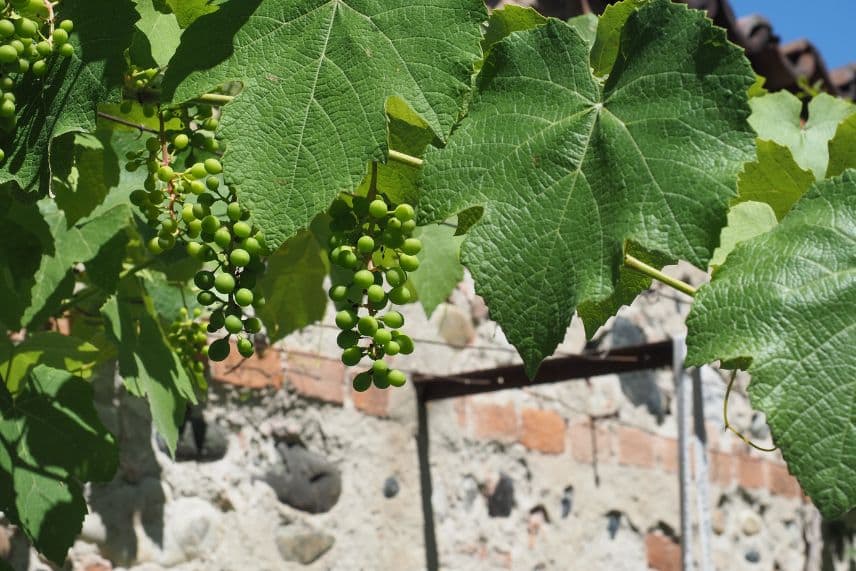
Ideally, the grapevine is planted in a spot facing south or south-west
In terms of soil, table grape is considerably less demanding since it adapts to all soil types provided they are well-drained. The grapevine fears above all heavy, waterlogged and clayey soils. However, a dry or stony soil, neutral to calcareous, suits it perfectly.
Finally, thanks to its vigor, a grapevine absolutely needs to be trained on a sturdy support. The woody climbing stems wrap around the support provided thanks to the tendrils and can reach 6 to 7 m in length.
If you have not met these requirements, your grapevine is less likely to bear fruit.
Because your grapevine is too young (or too old)
If you’ve planted your table grapevine, you’ll need to be a little patient. Indeed, a table grapevine really only yields from the third year. Before then, it can actually offer you one or two clusters, but not more.
By contrast, if you’ve bought a house with a garden, you don’t know the age of the vine that grows there. And even if a vine-plant has exceptional longevity, from around 25 to 30 years old, fruiting will be less substantial and less regular.
Because you haven't chosen the right variety
Depending on the region you live in, and especially the climate that prevails there, the choice of grapevine varieties will be completely different. Thus, if you live and garden south of the Loire, you can treat yourself and grow almost all grapevine varieties, whether they are early (harvest from early August in the south), seasonal (harvest in late August in the south) or late (harvest in October in the south).
However, north of the Loire, it is preferable to choose varieties whose flowering isn’t too early. Indeed, fruiting could be compromised by nocturnal spring frosts. Conversely, the selection can focus on varieties with early fruiting. Similarly, avoid varieties that are too late which do not ripen before October. Indeed, in some regions, by October winter is already there! Thus, to achieve fruiting, Virginie recommends 10 hardy varieties for northern Loire.
To this list of varieties, it is possible to add ‘Perle Csaba’, an old Hungarian-origin variety whose flowering occurs in April–May and the harvest (early) as early as August. It produces clusters bearing small white grapes. The variety ‘Ora’ is also a good choice for its early fruiting, and its beautiful clusters of small golden grapes that are well sweet.
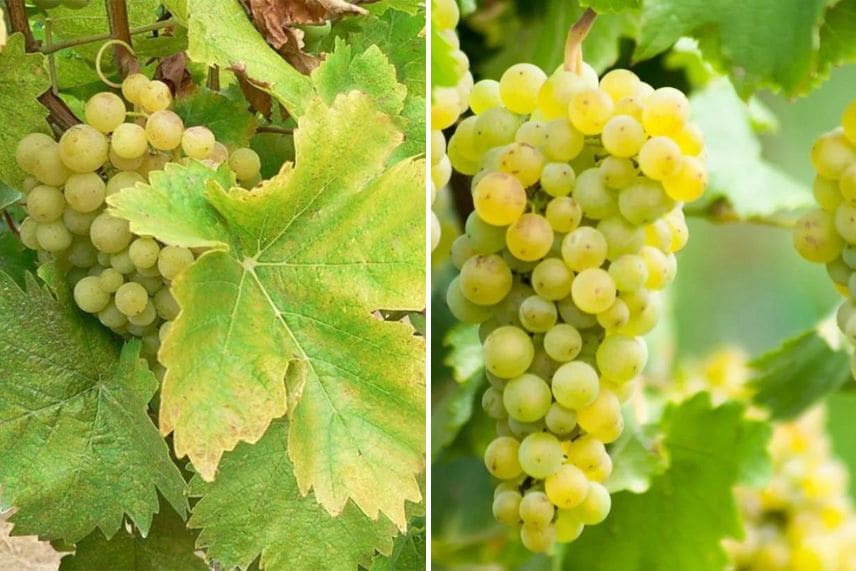 The varieties ‘Perle Csaba and ‘Ora’ benefit from sufficiently early fruiting to be planted north of the Loire
Read also
Vine: planting, pruning and careBecause it's not properly maintained
To produce its finest clusters, a table grapevine needs a minimum of maintenance throughout the year. Maintenance that mainly relies on watering, mulching and trellising. Without these three essential actions, fruiting will be compromised in the long term.
Watering should be regular (roughly once a week in summer) during the first three years after planting. Creating a basin at the base of the vine helps to optimise watering. Thereafter, the vine manages on its own, thanks to a very deep root system. It is even quite drought-tolerant after three years of growth.
mulching is indispensable in summer to conserve a certain level of moisture and prevent adventive growth.
Trellising of the woody climbing stems should be guided for greater effectiveness. So don’t hesitate to train the lianas along their support. Likewise, it is recommended to remove leaves that could hide the clusters and prevent them from ripening.
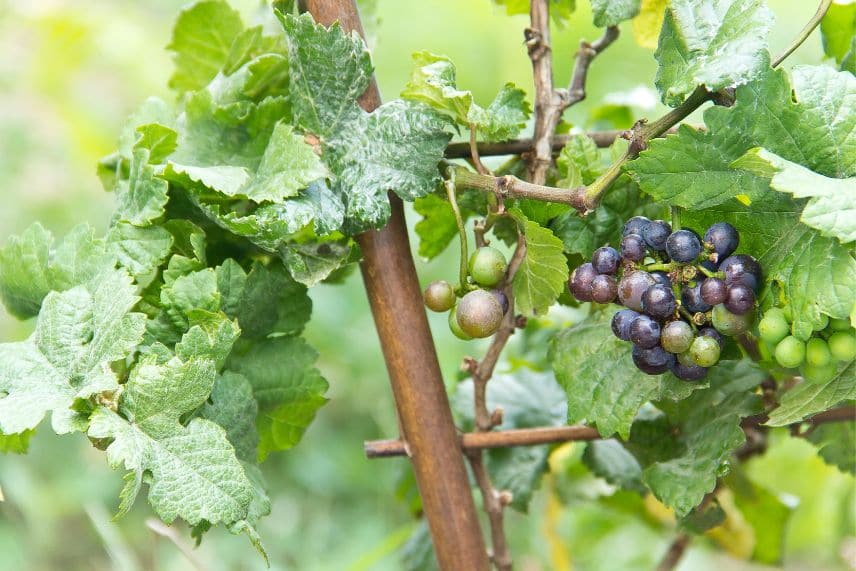
The vine should be trained on a sturdy support
Enfin, a small addition of compost can be made in winter to enrich the soil. But not in excess. De même, one can add a little crushed horn every two to three years to favour fruiting.
Because it isn't properly pruned
If you decide to grow your grapevine on a pergola or an arbour as a climbing plant, pruning of the woody climbing stems becomes less essential. And above all, less strict. It will suffice to channel the overly vigorous shoots by trimming them lightly. Similarly, this pruning will aim to remove dead, dry or diseased branches, or ramous stems that are too tangled. After three years, your grapevine will bear fruit, though smaller, but just as tasty.
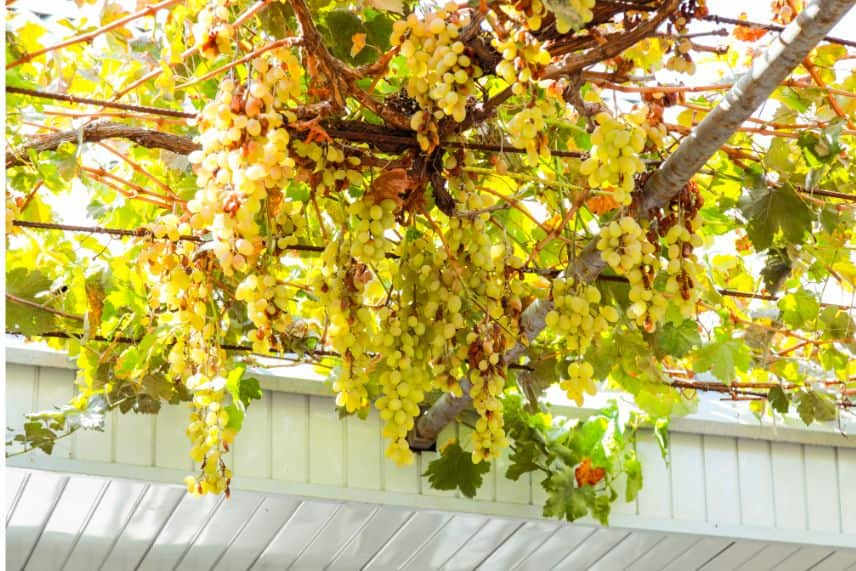
Grown on a pergola or arbour, the vine will be pruned less severely
However, if you wish to espalier it against a wall, pruning will need to be a little more severe. Naturally, you will deprive yourself of a few clusters, but those that reach ripeness will be more beautiful. That said, there is no need to prune your vine as a wine-grower would! It is also important to remember that grape clusters form on the lower part of the year’s shoots.
To learn how to intervene on your vine-plant, I invite you to read the following articles:
Also be sure to carefully remove shoots that grow from the vine-plant near the soil.
Because it is affected by a disease or attacked by a pest
The vine is unfortunately highly susceptible to fungal diseases, starting with powdery mildew and downy mildew very common in regions where rain occurs in spring. To prevent the appearance of these diseases, which do not kill the vine but affect fruiting, it is recommended to apply preventive sprays of Bordeaux mixture, of sulphur or of horsetail manure from flowering. These sprays can be renewed, especially if rain occurs regularly.
Grey rot or botrytis is also relatively frequent, a disease favoured by humidity or by the presence of the grape berry moth. Visibly, the berries are covered with a greyish rot. To remedy this, simply remove some berries from clusters that are too tight, combat the grape berry moth, or treat with sulphur from July to mid-August.
Among pests, the grape moth is the one to fear. It is a moth that lays eggs on the flower buds and the young grapes. The first-generation caterpillars bore into them and feed on them. The second-generation caterpillars attack the berries, causing them to crack and dry up. To treat, you can use Bacillus thuringiensis (BT) or set pheromone traps. In the long term, you should attract insectivorous garden birds such as blue tits or robins, who will happily turn caterpillars into their meals.
Further reading: Vine diseases
- Subscribe!
- Contents

Comments