





























Why isn’t my bignonia flowering?
Understanding why a trumpet vine has no flowers... and how to remedy it
Contents
Trumpet vines, Bignonias, also known as Jericho trumpets, or Campsis in Latin, are exuberant climbers, with flowers usually orange, but also yellow to scarlet red. Very hardy, we love the exotic appeal of their trumpet-shaped flowers which normally bloom all summer. Sometimes, though, one is left wanting, as the vigorous climber does not show as many flowers as one might imagine. Why so? Could we have missed something in its planting, or is it down to the plant itself?
Cultural specifics for trumpet vines: here’s everything you need to know to keep your climber floriferous!
→ Also read: Trumpet vine: planting, pruning, propagating.
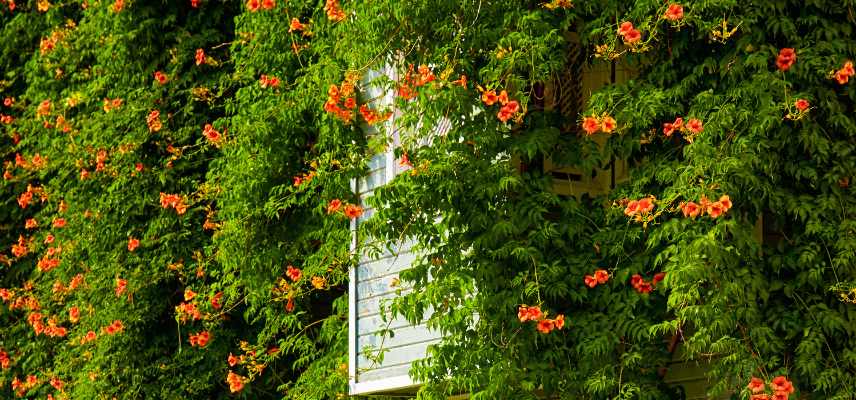
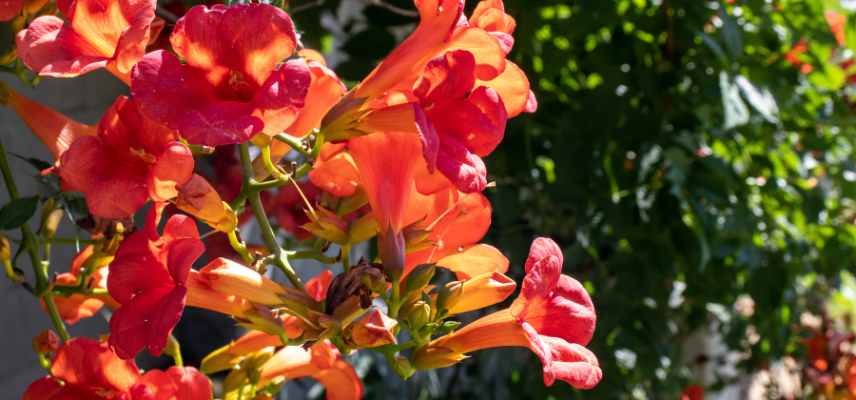
Trumpet vines, spectacular and radiant in full summer sun!

Cultivation requirements for the trumpet vine
Just like wisterias, trumpet vines are vigorous and prolific plants, drought-tolerant once established. We distinguish two main species, the large-flowered trumpet vine or Campsis grandiflora and the American trumpet vine, known as the Virginia trumpet vine or Campsis radicans in Latin. The two varieties look a little similar, flowering in large clusters at the ends of the current year’s shoots, but the Campsis grandiflora, of Chinese origin, produces larger flowers and has a more limited attachment system. Each has given rise to numerous varieties, with orange hues ranging from light to dark, up to red, and sometimes even yellow.
To understand why a plant does not flower, it is crucial to understand its cultural needs and whether these are being met in order to determine the right course of action. Here are the main characteristics to note about trumpet vines:
- Soil: they require well-drained, fertile soil that remains moist. With shallow roots, they benefit from mulching at planting to ensure moisture and protect them from heat in their youth, as well as from winter cold. As they age, they will tolerate drier soils and drought. Note that they dislike compact, heavy soils.
- Exposure: it is a crucial criterion for trumpet vines, which establish best in full sun, and in a sheltered position. Plant a new trumpet vine in a spot sheltered from cold winds.
- Hardiness: these climbers with an exotic look have the advantage of being cultivable here, as they prove relatively hardy, tolerating frosts for a short period, down to -15°C for Campsis radicans and down to -10°C for Campsis grandiflora. The cultivars derived from the hybrid Campsis x tagliabuana are, for their part, fairly hardy, often down to -12°C. Overall, trumpet vines do well in regions with mild winters.
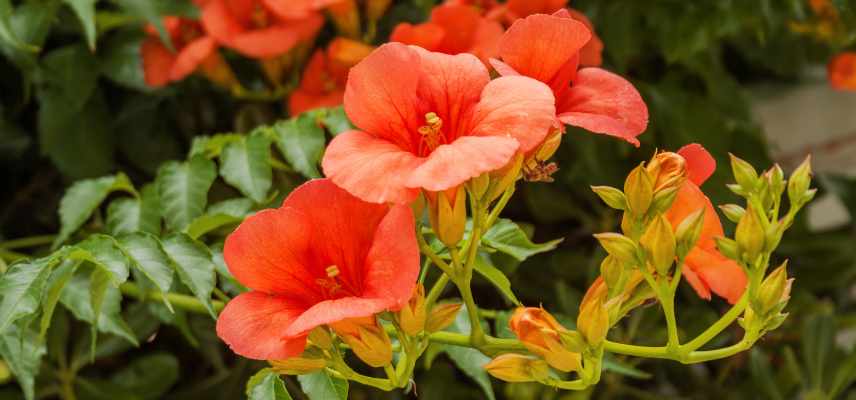
Campsis grandiflora
Read also
Choosing a trumpet vineMain reasons why a trumpet vine does not bloom
It doesn’t get enough sun
In the vast majority of cases, it is a lack of sun that stops trumpet vine from flowering enough. These plants indeed need warmth and plenty of sunshine to perform at their best. Check its position to see if it receives at least 6 hours of sun per day. You may move a young plant, but older specimens will be harder to shift, due to the trumpet vine’s suckering habit. Only southern regions can plant it in partial shade.
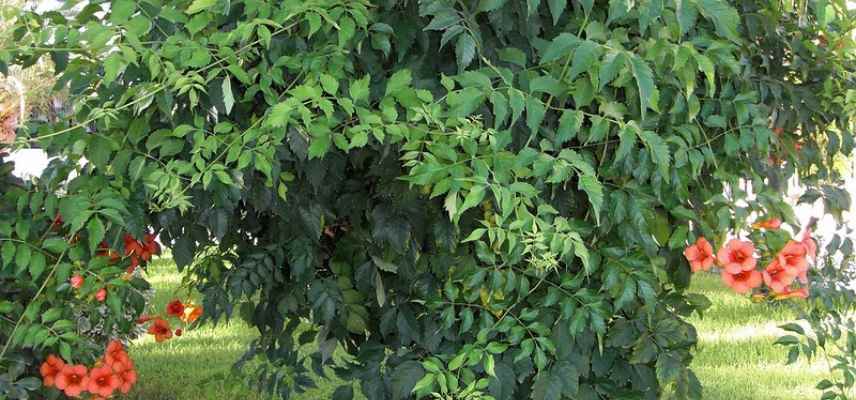
A trumpet vine, here Campsis radicans, with too little sun exposure, flowers far less (© Maja Dumat)
It hasn’t been pruned
C’est comme souvent le second indice qui provoque un manque d’induction florale chez la plante. Left unpruned, trumpet vine will produce only a limited number of flowers, because pruning triggers flowering. If it is pruned at the wrong time, namely in autumn, it will not produce flowers. For spectacular, abundant flowering, prune it at the end of winter or the beginning of spring.
→ En savoir plus dans When and how to prune trumpet vine?
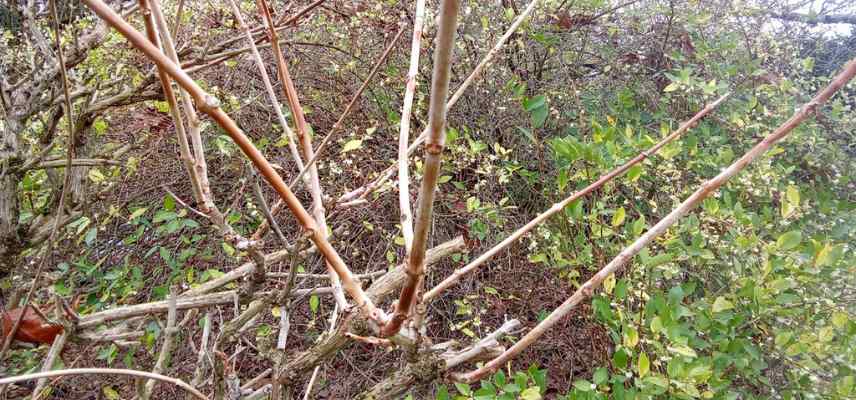
Dry trumpet vine shoots in winter (© Gwenaëlle Authier) : they should be pruned in February to ensure good flowering production
It is from layering or cuttings
Only grafted trumpet vines flower quickly after planting. If yours comes from layering or a cutting, it will take several years before blooming properly.
The soil is too rich in nitrogen
Soil that is too rich in nitrogen or receiving too many nitrogen fertilisers will encourage the climbing plant to produce much more foliage at the expense of flowers.
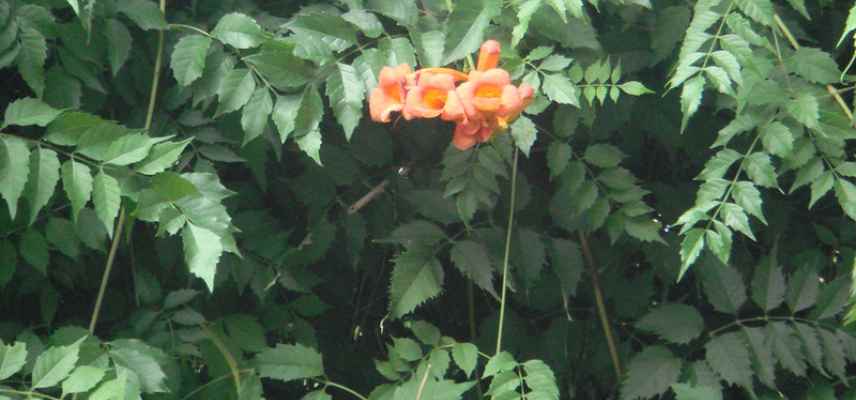
A trumpet vine that mainly produces leaves is often planted in soil that is too nitrogen-rich
It didn’t like very low night temperatures
A trumpet vine subjected to night temperatures that are too low, as well as prolonged drought early in the season, may suffer bud drop. This will further reduce summer flowering… Again, you should choose the location of your trumpet vine carefully (at the foot of a south-facing wall), and avoid planting it in regions that experience repeated frosts.
It grows north of the Loire in France
If you live north of the Loire, trumpet vines generally flower somewhat later there, from August onwards. So don’t worry if the buds have not yet opened in July in these regions. Note that milder climates are the regions where trumpet vines will flower most intensely.
→ Learn more in our article : Which trumpet vine to plant according to your region?
You have a late-flowering bignonia
Il existe deux grandes espèces de bignone, la bignone grandiflora (chinoise), et la bignone radicans (américaine), la bignone à grandes fleurs (la chinoise) étant un peu moins rustique que la bignone américaine. Les deux fleurissent à partir du milieu de l’été, mais une Campsis grandiflora va fleurir beaucoup plus dans les régions de climat doux et aux étés ensoleillés. Quant à Campsis radicans et ses variétés, elle peut être implantée un peu plus au nord, mais sans été suffisamment chaud et ensoleillé, elle fleurira en proportion moindre.
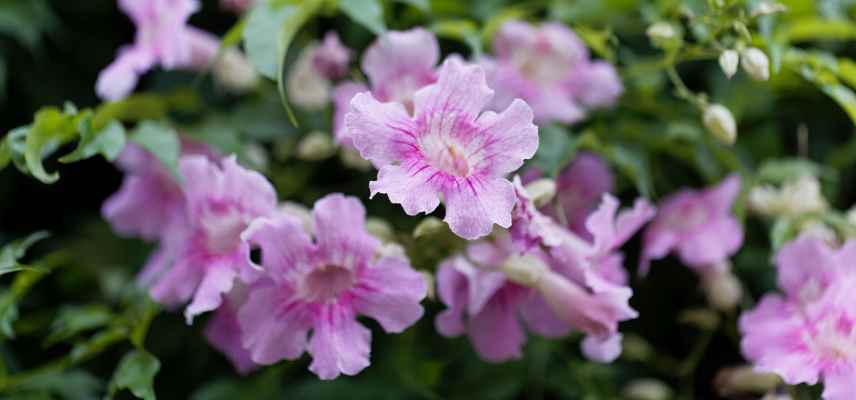
Par contre, il existe une autre très belle bignone, à fleurs roses (ce n’est pas une Campsis) : Podranea ricasoliana : celle-ci est beaucoup plus frileuse, mais surtout, elle fleurit beaucoup plus tard en fin d’été, et s’exprime surtout en automne, jusqu’en novembre en climat doux, où on l’implante principalement. Ne vous étonnez donc pas de ne pas la voir fleurir en plein été comme les autres !
Quant à la Campsis capreolata, aux fleurs rouge orangé et jaunes et parfumée, elle fleurit normalement beaucoup plus tôt, entre avril et mai en climat doux.
It is diseased
Enfin, moins fréquente que les autres raisons évoquées ici, une invasion de pucerons au moment de la formation des bourgeons floraux peut néanmoins grandement affaiblir la floraison d’une bignone.
Some tips to encourage the flowering of a trumpet vine
Here are some pruning tips, an essential step that will guarantee sustained flowering for your trumpet vine:
- Prune back hard the long dry stems, shoots from the previous summer, to about twenty centimetres from their base in February or early March (two or three buds). These branches have helped the plant endure winter, but they must be pruned back to ensure a good production of flower buds.
- Prune the flowering shoots to stimulate new growth: trumpet vine flowers for a long period, so you can allow this, and it’s even the way to renew its blossoms. Moreover, the new shoots will make the trumpet vine even more prolific for the following season. Prune regularly and lightly rather than drastically, which it won’t like. This summer pruning will also help curb its vigour.
- Finally, treat an infestation of red spider mites or aphids as soon as it appears (see our advice in Diseases and pests of trumpet vine)
- Subscribe!
- Contents

Comments