





























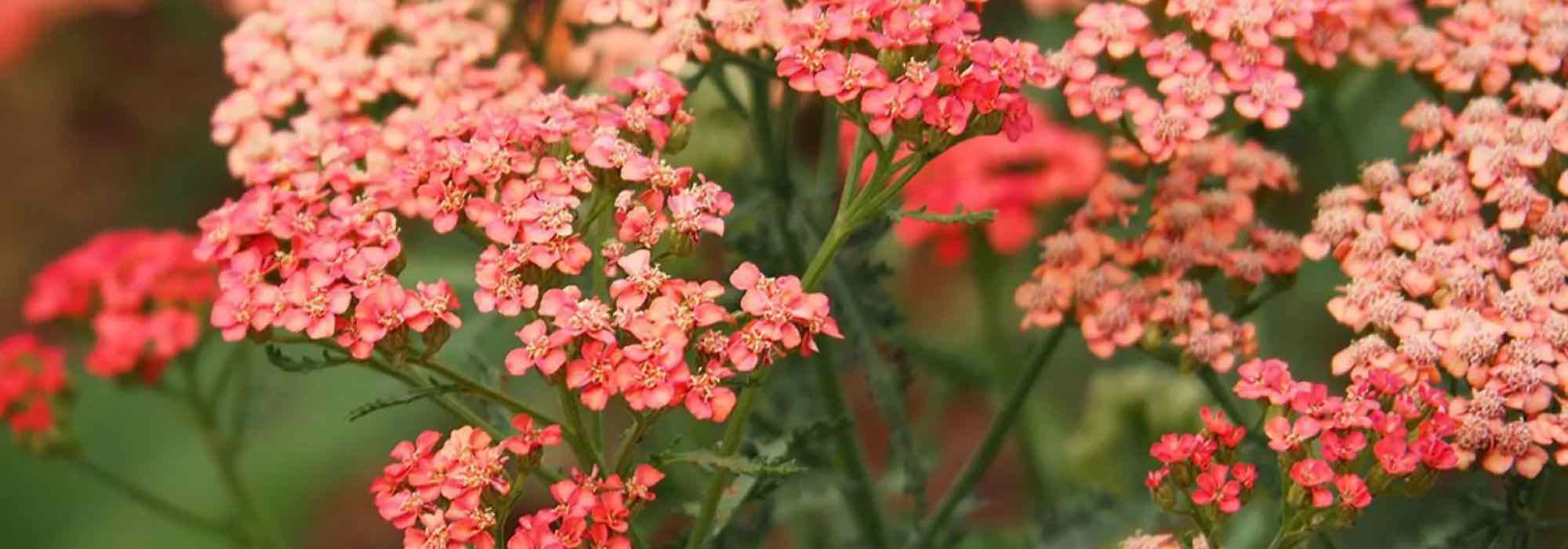
Yarrow: easy and drought-tolerant perennials
Our picks and tips
Contents
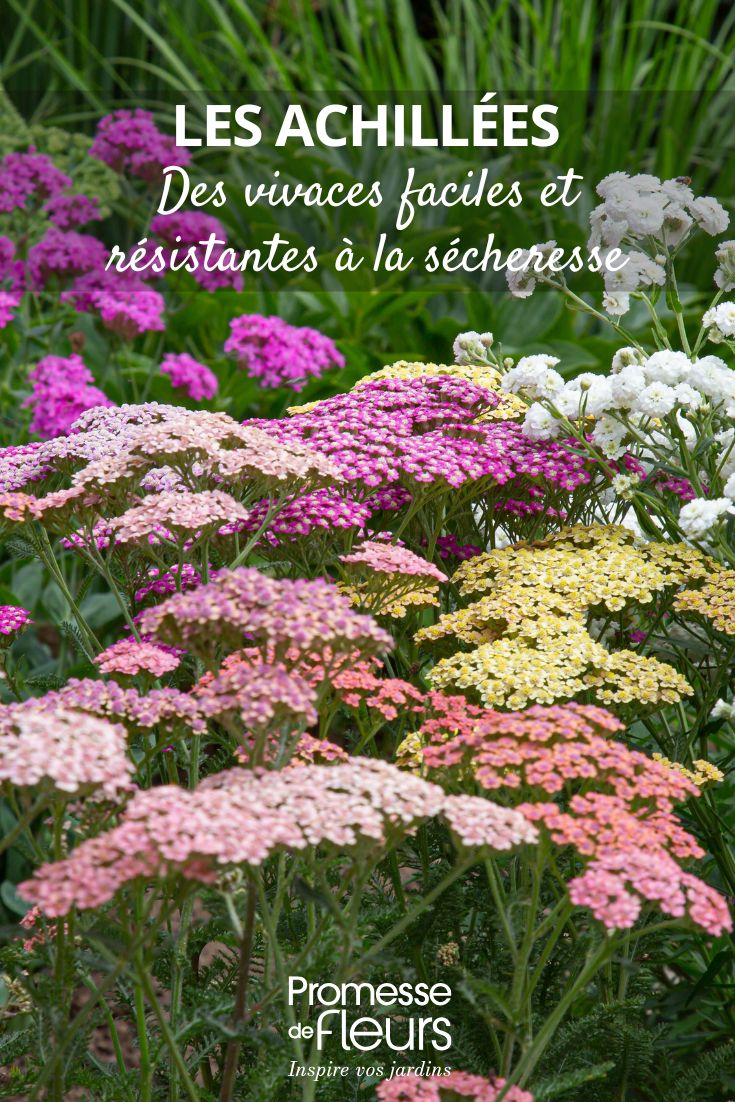
Yarrow is an essential perennial for gardeners seeking robustness and simplicity. Thanks to its exceptional drought tolerance and its ability to adapt to poor soils, it makes an ideal choice for water-wise gardens. In addition to being hardy, yarrows offer generous, long-lasting flowering, with colourful umbels that attract pollinators and add structure to the borders.
Discover our guide to yarrows, from iconic varieties to growing conditions and companion-planting ideas.

The benefits of yarrow for the garden
Yarrow is ideal for dry gardens or areas subjected to challenging conditions. Its finely divided and often deciduous, together with varied and bright flowering umbels, make the plants as ornamental as they are practical. The flowering period, which extends from May to September depending on the variety, lights up gardens throughout the summer.
These plants are particularly suited to dry climates where they tolerate heat and drought. Once well established, they require little watering, even during prolonged drought. Maintenance is minimal: they do not require any specific fertilisation and are rarely affected by diseases, except for powdery mildew in very humid climates. Note that some species tolerate clay soils, provided they are well-drained, and note the exception with Achillea ptarmica which is a plant of banks and damp soil.
Yarrow also plays an important ecological role. Its nectar-rich flowers attract pollinators, such as bees and butterflies, and some varieties produce seeds that feed birds in autumn. Finally, their versatility is remarkable: they are well suited for borders, rock gardens, slopes or edging, and some species are perfect as groundcover, and even as an alternative to lawn.
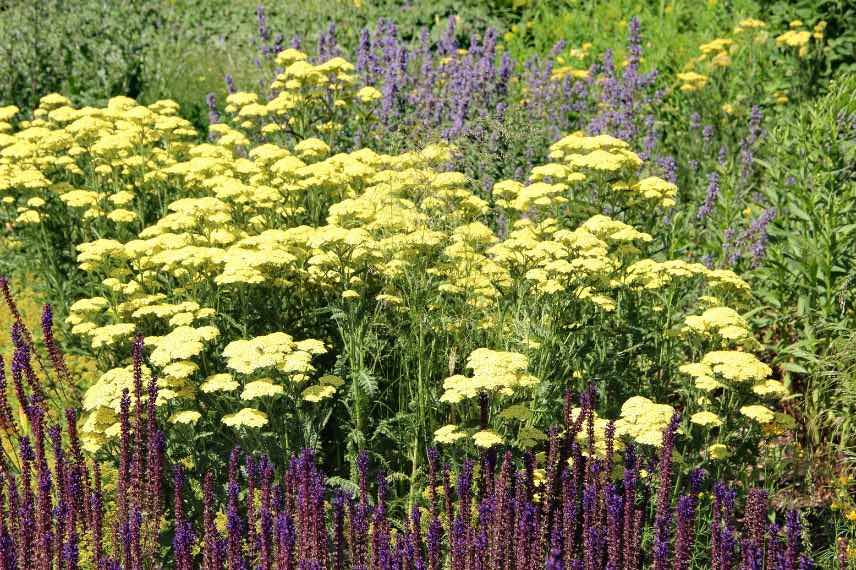
Yarrow is most often a drought-tolerant, sun-loving perennial
Read also
Achillea : planting, growing and careThe best varieties of yarrow
Yarrow offers a varied palette of colours, shapes and sizes. Here is a selection of essential species and varieties.
Achillea millefolium It is the best-known and most versatile species. With its numerous horticultural varieties, it offers a wide range of colours from pure white to deep red, passing through pink, orange and yellow. Achillea millefolium is ideal for sunny borders or flowering meadows. It typically reaches 60–80 cm in height and offers generous, long-lasting flowering from May to September. Among its popular cultivars, there are ‘Paprika’ (bright red with a golden centre), ‘Cerise Queen’ (cherry pink) and ‘White Beauty’ (immaculate white).
Achillea filipendulina This tall, majestic species is perfect for structuring a border. It produces large, flat, dense umbels in golden-yellow colour that reach up to 1.20 m in height. Its feathery grey-green foliage is also highly ornamental and remains attractive year‑round. It is particularly heat-tolerant and stands out for its ability to attract pollinators. Varieties such as ‘Cloth of Gold’ or ‘Golden Plate’ are highly regarded for their spectacular flowering.
Achillea crithmifolia This species is particularly valued for its ability to cover bare soils, even in challenging sites such as drained clay soils or dry banks. Its evergreen, finely cut, light-green foliage forms a dense, uniform carpet. In summer, Achillea crithmifolia produces small white umbels that add a delicate touch. Very hardy, it is ideal for stabilising sloping ground, suppressing weeds, or as an alternative to turf.
Achillea ptarmica Less common and distinctive, this species is distinguished by its double white flowers, which resemble small pom-poms. It thrives in moist, fresh soils, not calcareous. Achillea ptarmica or Silver Button forms a rounded ground-cover of 60 cm in height.
Achillea x ‘Moonshine’ This hybrid is the result of a cross between the Achillea clypeolata and A. taygetea. It develops silvery foliage and umbels of lemon-yellow flowers. With an average height of 50–60 cm, Achillea x ‘Moonshine’ integrates well into borders or edging. Its flowering, which lasts all summer, adds a bright touch to dry and stony soils.
A few more Achillea millefolium cultivars
Achillea ‘Terracotta’ Achillea ‘Terracotta’ is distinguished by its warm and subtle hues of orange-yellow and terracotta, which mellow over time toward softer shades. It reaches about 70 cm in height and sits perfectly in natural or wild borders.
Achillea ‘Summer Pastels’ This cultivar is notable for a pastel colour palette, including shades of pink, peach, cream, yellow and lavender. ‘Summer Pastels’ is an excellent choice for adding a soft, romantic touch to natural borders or flowering prairies.
Achillea ‘Lilac Beauty’ With its pale, bright mauve flowers, this cultivar adds subtle elegance to gardens. Perfect for borders, ‘Lilac Beauty’ reaches about 60 cm in height. Its unusual colour pairs well with plants in silver or white tones.
Achillea ‘Apricot Delight’ This cultivar offers umbels in changing tones of apricot, salmon and pale pink, which evolve through the season. ‘Apricot Delight’ reaches about 60–70 cm in height and is ideal for bringing a warm, delicate touch to natural plantings or cottage-style gardens.
Achillea ‘The Beacon’ A vibrant cultivar that stands out with pink‑fuchsia to deep red flowers, ideal for creating a focal point in a border. Reaching 70–80 cm in height, ‘The Beacon’ is perfect for colourful displays.
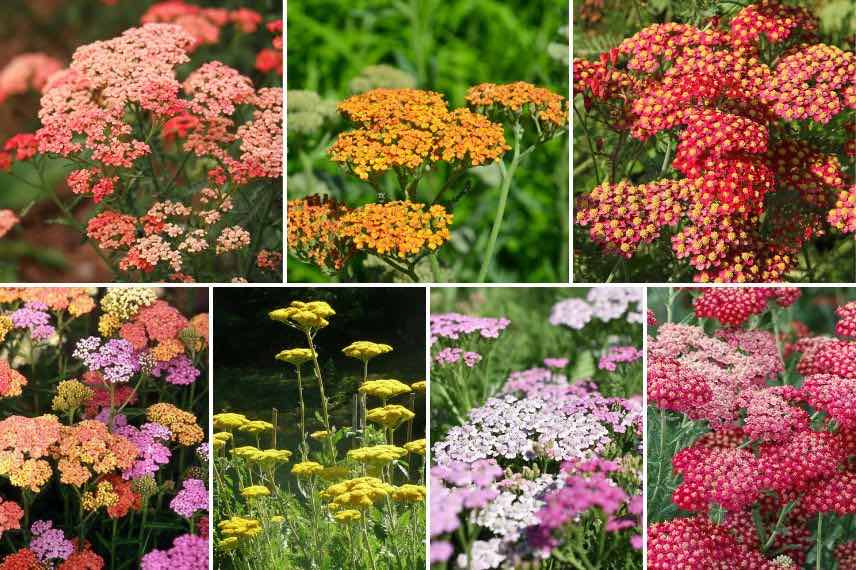
In clockwise order: ‘Apricot Delight’, ‘Terracotta’, ‘Paprika’, ‘The Beacon’, ‘Lilac Beauty’, ‘Cloth of Gold’, ‘Summer Pastels’
Where should I plant my yarrow, and how should I look after it?
Yarrow thrives in full sun, the essential condition for abundant flowering and vigorous foliage. Yarrow prefers well-drained soils, sandy, stony or poor soils. Although some species tolerate clay soils, it is important to avoid excess moisture. If your soil retains too much water, you can amend it with gravel to improve drainage.
Planting is preferably carried out in spring or autumn, when the soil is still warm and conditions are ideal for rooting.
Once established, yarrow requires very little maintenance. Water only during prolonged dry spells or during its first year of planting to promote rooting. After the first flowering, cut back the stems to encourage a new wave of flowers and maintain a neat shape.
At the start of spring, tidy the clumps by removing dry or damaged stems. Yarrow regenerates easily and benefits from division every three to four years to maintain its vigour. This operation is also an excellent opportunity to propagate your plants and redistribute them in the garden.
Thanks to its low maintenance and ability to adapt to challenging environments, yarrow is a valuable ally for a sustainable, beautiful and resource-efficient garden.
Read also
7 pink achilleas to have in your gardenInspiring ideas for incorporating yarrow into the garden
Yarrow is a versatile plant that blends easily into different garden styles. Here are a few ideas to showcase it and make the most of its aesthetic and practical attributes.
Create a structured, colourful border
Yarrow adds both structure and lightness to borders thanks to its upright habit and airy umbels. Pair them with herbaceous perennials such as Gaura, the Echinacea, or the Salvia for a colourful, natural effect. Tall species such as Achillea filipendulina and its cultivars are ideal for creating focal points in a sunny border.
Dress up a rockery or bank
Their tolerance of dry soils and evergreen foliage in some species make yarrow ideal candidates for rockeries and banks. Use species such as Achillea tomentosa or Achillea umbellata to quickly cover ground and stabilise the soil. In rockeries, they pair perfectly with light grasses, lavender or thyme, creating a Mediterranean or Alpine ambience.
Cover bare soil
Some evergreen species, such as Achillea crithmifolia, are ideal as ground cover and even as an alternative to lawn, as they tolerate foot traffic and spread rapidly. Their dense, low-growing foliage quickly covers bare patches and helps to limit weed growth. This choice is particularly wise for difficult soils where few plants manage to thrive.
Create flowering borders or walkways
Compact varieties such as Achillea x lewisii ‘King Edward’ or Achillea kellereri are perfect for delineating spaces or creating flowering borders. Their bright flowering and evergreen foliage ensure elegant year-round decoration with minimal maintenance.
Play with colour and texture contrasts
The silvery or grey-green foliage, characteristic of most yarrows, contrasts nicely with plants with darker or luxuriant foliage, such as agapanthus or daylilies. Also play with flowering contrasts by pairing, for example, yellow-flowered yarrows with perennials in purple or blue hues, such as nepetas.
Using yarrows for fresh or dried bouquets
The flowers of yarrow are perfect for cutting. Fresh, they bring a rustic touch to floral arrangements. When dried, their umbels retain their colour and shape, becoming durable decorative elements for dried bouquets or wreaths. The varieties derived from Achillea filipendulina and Achillea millefolium are particularly valued for this purpose.
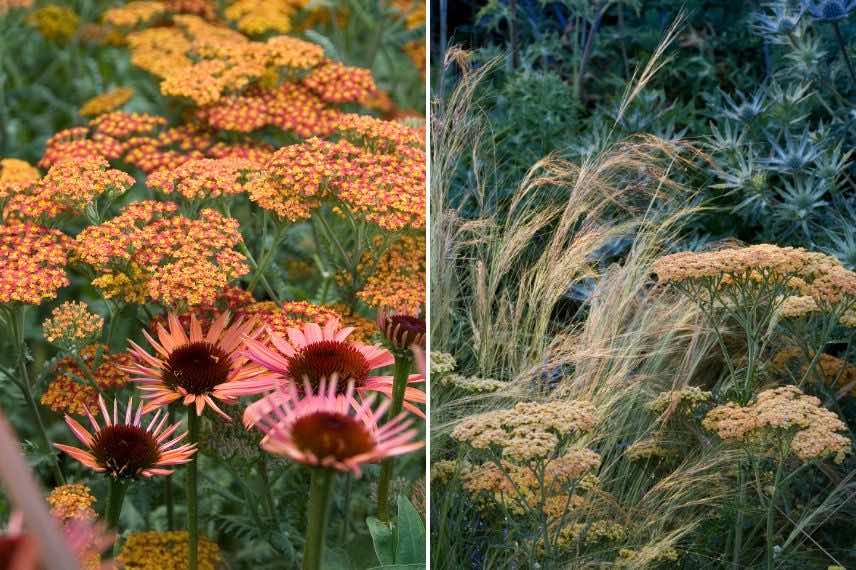
With echinaceas and grasses
- Subscribe!
- Contents
Comments