





























Yellow-flowered crocus: the best varieties
Splendid ways to warm up the garden after winter
Contents
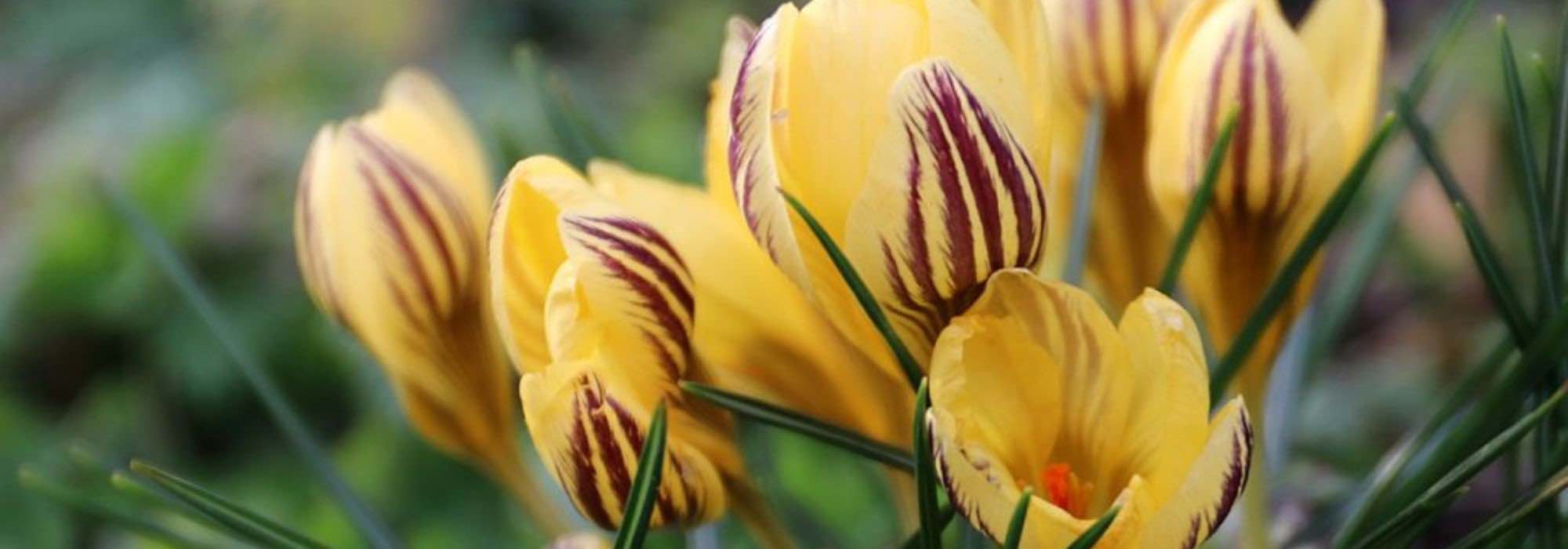
When February arrives, we eagerly await the first yellow-flowered Crocus to emerge from the soil, for they have no equal in warming this still-cold season. These golden touches pair perfectly with the soft rays of a late-winter sun. Often bright yellow or golden-yellow, their flowers open goblet-shaped and quickly unfurl into star-shaped blooms, either solid-coloured or marbled. Yellow-flowered Crocuses are most often botanical species, or varieties derived from very early botanical species, so they are the first to poke their heads above the soil and display delicate foliage. Plant them in well-drained soil, in full sun or partial shade. Discover our beautiful selection of Crocus in sun-coloured hues.

Crocus olivieri ssp olivieri
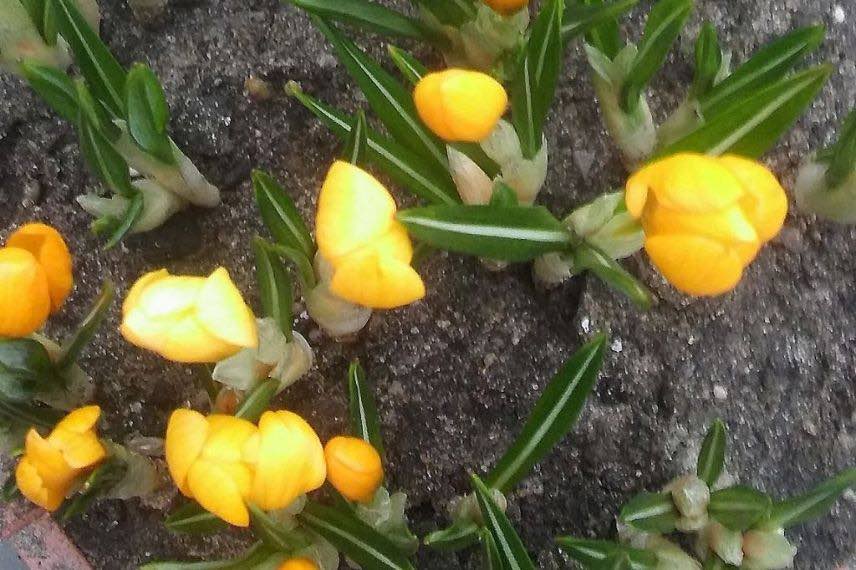
The Crocus olivierii ssp olivieri is a botanical subspecies whose flowers are of a uniform colour, a very bright yellow-orange, inside and out. Its yellow style at the centre of the flower is characterised by a division into six branches. It originates from Turkey and the Balkans where it grows in woods and scrub. Depending on the climate, its flowering can appear as early as February, or in March and April. Its cup-shaped flowers open into star-shaped blooms. Its lanceolate, rather slender foliage is a dark, glossy green, crossed by a central white-silvery band.
Plant it in well-drained soil, even very dry in summer, to see it flower abundantly in late winter and colonise a scree garden, a rock garden or the front of a border or a bed. In full sun, in a perfectly drained rock garden, add the Iris reticulata ‘Alida’, blue and slightly maculate with yellow, the forget-me-nots and the Muscari macrocarpum ‘Golden Fragrance’, with sulphur-yellow and violet flowers, fragrant.
Read also
Crocus: how to plant them?Crocus chrysanthus Fuscotinctus
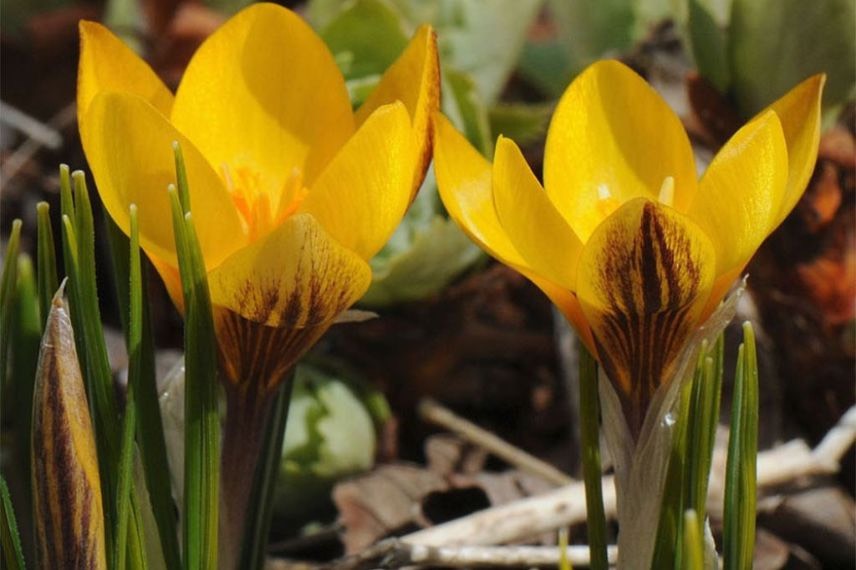
The Crocus chrysanthus var. fuscotinctus kindly offers fragrant flowers, a golden-yellow colour nicely brown-striate. It also originates from the Balkan Peninsula and Turkey. Its flowering takes place from February to March, depending on the climate. Its warm, dazzling colour after winter is adorned on the reverse of the petals with a bronze-to-brown shade that is very flattering. The stamens, grouped into tubes, are a vivid orange-yellow. The whole is enhanced by its fine, medium-green, glossy foliage.
Why not planting it in a pot, at nose height, on a windowsill or on an elevated pot, to fully enjoy its fragrance. When paired with other early-flowering crocuses, mauves or whites, it makes an elegant container planting. Alternatively, stagger the flowering with other spring bulbs such as snowdrops, tulips and daffodils.
Crocus gargaricus
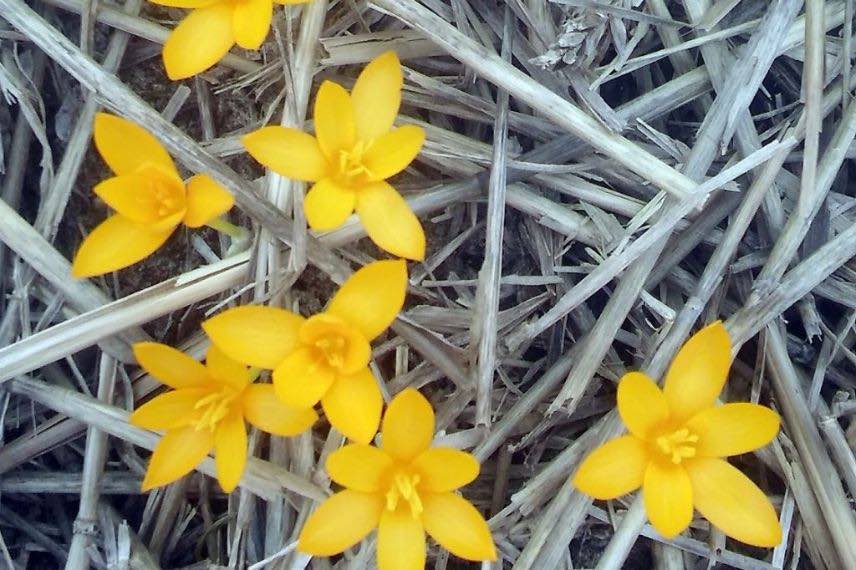
Another plant species, rare in cultivation, the Crocus garganicus is also known as Gargano crocus. It is also rare in the wild, as it is found only on Mount Ida in Turkey. It earns the crown for the most intense colour among crocuses. Its large, elongated, cup-shaped flowers, 4 to 7 cm long, are intensely bright and uniform yellow-orange, dazzling. They appear before the development of the foliage. It flowers from February to April depending on the climate.
This species prefers humus-bearing and cool, acidic soils that do not dry out too much in summer. Its natural habitat consists of humid meadows located between 1,300 and 2,000 m above sea level. In other words, it is habitat-specific as it is not found elsewhere. Therefore, its delicate cultivation is limited to this type of environment: montane meadows that are slightly humid. Rare-bulb enthusiasts may attempt to acclimatise it in the garden, in an alpine rock garden, or naturalise it in a damp lawn until June, as the bulb stores its reserves.
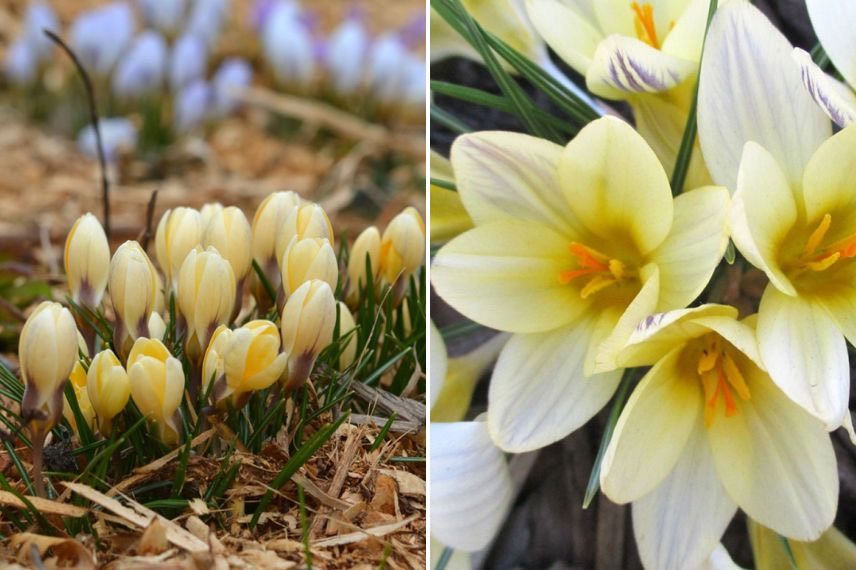
Crocus chrysanthus 'Cream Beauty'
Of a distinctly different colour, the Crocus chrysanthus ‘Cream Beauty’ is among the first crocuses to bloom, from February, alongside the aptly named snowdrops. Its small cup-shaped flower displays a soft beige-creamy shade on the outside, maculated with bronze at the base, possibly touched with purple reflections. The throat is a brighter yellow, punctuated by very bright orange stamens on the inside, in contrast.
Plant it, for example, in an edging border at the edge of a bed, in bright partial shade, with hellebores, purple heucheras and orange-flowered Epimedium, such as Epimedium pubigerum ‘Orangekönigin’, whose foliage is bronzed. Thus you create echoes of colour and bold, yet gentle, contrasts.
Crocus chrysanthus 'Gipsy Girl'
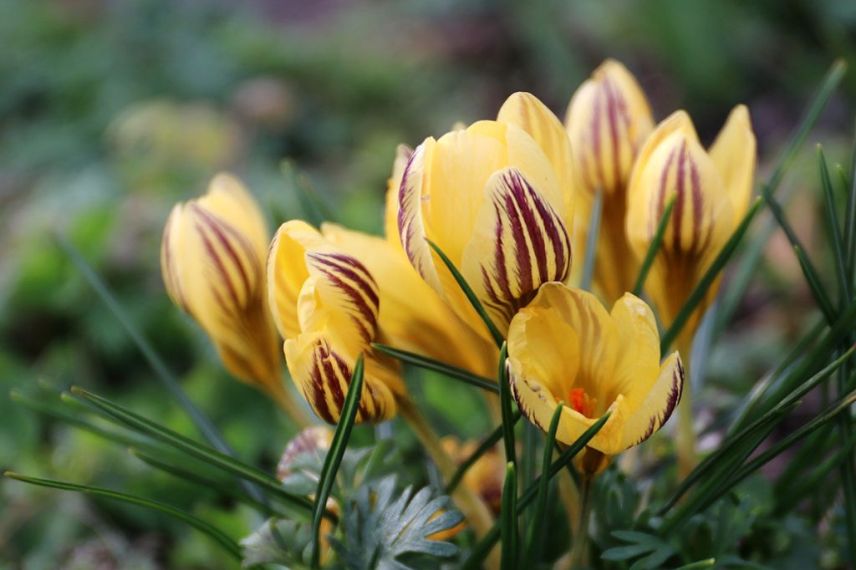
Let’s finish with another Crocus hybrid derived from the species Crocus chrysanthus or Golden Crocus, one of the earliest to bloom, the Crocus chrysanthus ‘Gipsy Girl’. This one, with a handsome sulphur-yellow, is widely streaked with purple-brown on the outside of the corolla. The stamens are a beautiful orange, striking. All told, it forms a miniature yet elegant display. The botanical species from which it is derived is not widely cultivated, but it forms the stock for several horticultural varieties encountered from Greece to Turkey.
As with almost all Crocus, the flowers close at night and in poor weather, opening widely in the sun, even in partial shade. Naturalise it in a lawn, the Crocus’s perfect playground, provided that it is not mown for 5 to 6 weeks after flowering, so that the bulbs, or more precisely the corms, replenish their reserves. In rock gardens where they excel in well-drained soil, they make minimalist and cheerful companions to understated dwarf conifers and creeping plants, such as Junipers or Japanese cedars, which shine by the textures and colours of their foliage.
- Subscribe!
- Contents
Comments