





























There are two types of gardeners: those who fell into it when they were young, often nudged by a passionate grandparent, and those who learned everything by themselves.
To be part of the second category, I tell you: gardening is learned, on the job, accumulating mistakes on one hand (an effective but lengthy process), through contact with experienced individuals on the other... but also in books.
So today, let’s explore the opportunities available to budding gardeners of all ages to learn how to grow flowers and vegetables.
1) Gardening workshops, courses, and stages
Once rare a decade ago, gardening courses and workshops are now proliferating in many regions. Offered as stages, tailored courses, or in cycles of one or two sessions per month, they often focus on vegetable gardening, permaculture, or organic gardening. Organised in renowned landscape schools, experimental centres, or right in the trainers' gardens, they have the advantage of being both theoretical and practical.
Some addresses:
- In the Paris region, in Vincennes, the prestigious École du Breuil also offers courses for adults, either tailored or in an annual cycle. The themes are very varied: practical topics like creating a perennial bed, choosing and planting bushes, or broader subjects like Plant Knowledge or current topics like permaculture or container gardening.
- At the Terre Vivante centre (in Isère, in France) and almost everywhere in France, at a partner training gardener (like, in my region, Jardin des Pépins and Jardins Rocambole), you can also learn about garden design, vegetable gardening, mound gardening, or gentle pruning of fruit trees... as well as basketry or chicken keeping.
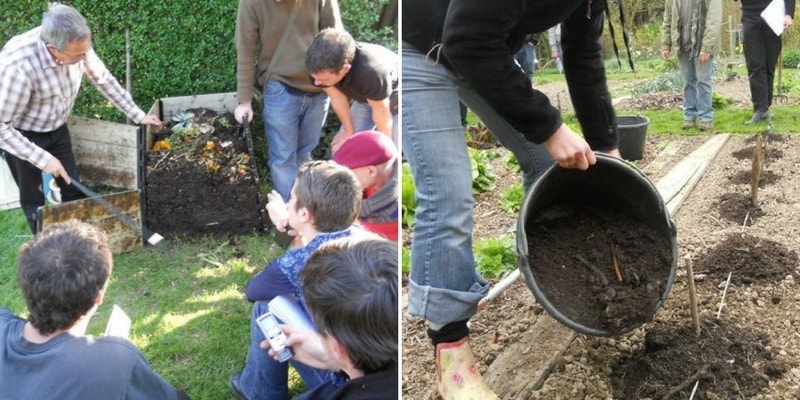
To learn all about composting: a course at Jardin des Pépins, in Brittany
2) Garden coaching
Garden coaching is a support system that allows you to create your own garden. This formula, usually offered by landscape consultants, involves teaching you the basic techniques (planting a tree, perennials, defining a bed, mulching...) while designing your own garden. These private lessons have the advantage of being personalised: they adapt to your availability and specific situation, but they are more expensive.
3) Books
Learning from books sometimes carries a negative connotation. This is unfortunate, as, when selected wisely, they can help you understand the theoretical basics and significantly improve your knowledge of plants. You will quickly notice that there are many books on gardening and gardens in general, of varying quality: rely on the publishing house, as it’s a quick way to filter!
Among my favourite French books for beginners are:
- "I Start My Organic Vegetable Garden" by Jean-Paul Thorez - Éditions Terre vivante
- "The Organic Gardening Guide: Vegetable Garden, Orchard, Ornament" by Jean-Paul Thorez and Brigitte Lapouge-Déjean - Éditions Terre vivante
- "The Flammarion Encyclopedia of Gardening" by Alain Baraton - Editions Flammarion
- "The Shrubs", "Perennial Plants" and "Crazy for Plants" by Didier Willery — Éditions Ulmer
4) Magazines
Subscribing to or regularly purchasing one or more gardening magazines is a good habit. Let’s be honest: if you have no gardening knowledge, you might feel a bit lost at first. Still, take the time to read them; your progress will surprise you quickly!
As with books, the range of gardening press is abundant, and the quality of publications varies. However, four French magazines stand out, in my opinion, for their very good content.
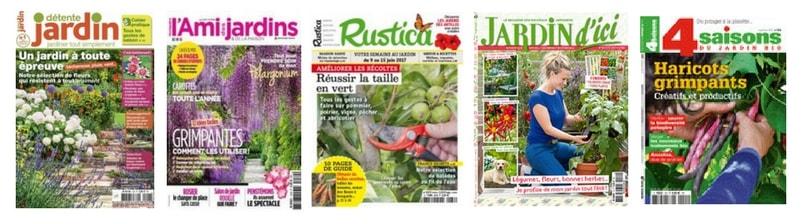
"L’Ami des jardins et de la maison", "Détente jardin" (monthly) and "Rustica" (weekly) are reliable sources filled with ideas and practical advice, both for ornamental gardens and vegetable gardens.
If you are among the "great beginners" for whom cultivating a garden is also an art of living, I also recommend the monthly "Jardin d’ici". Simple and educational, it is also very well illustrated (partly by the talented Florence Dellerie).
Finally, "The 4 Seasons of Organic Gardening" (the bimonthly from Terre Vivante) will satisfy anyone wishing to garden naturally and who is also interested in organic cooking and ecological alternatives regarding housing and health.
5) Shared gardens
Shared gardens are places where exchange is paramount. The principle is simple: several people come together to garden on a common plot (unlike family gardens where each cultivates their own piece) and then share the harvest. Friendly and fostering social connections, these gardens are the ideal place to learn gardening. Once again, the vegetable garden is often the central theme, but you will learn, thanks to the more experienced individuals, the essential actions like sowing, planting a tree, mulching... Don’t worry, you don’t need to know how to garden, and your little mistakes will always be forgiven (from a gardener who, in her early days, annihilated about fifty tomato plants with generous watering one August evening...).
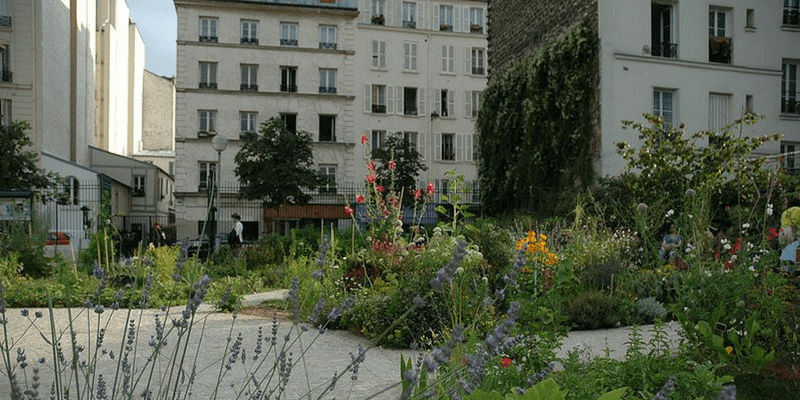
Shared garden of Poireau agile - Paris - Photo: Alice Le Roy
To learn all about shared gardens, in the city or countryside, check out the website of the national network of shared gardens.
6) Resource people
It’s not uncommon to encounter well-managed gardens near you. Nothing happens by chance; there is also a lot of know-how... Don’t hesitate to push open the gate and connect with your most skilled neighbours: they will often gladly advise you, and you may even leave with some plants or cuttings!
7) Internet
Yes, nowadays, when looking for information, the first reflex is to ask Google. The volume of information available online is simply monumental, and even more so than elsewhere, reliability can sometimes be questionable.
Don’t be fooled by enticing promises... Think carefully before subscribing to paid content or downloading miracle recipes in exchange for your email address... And rather than relying on certain forum discussions where tips and tricks (sometimes terribly far-fetched) abound, turn to serious sources.
At Promesse de Fleurs, you will find, for each plant, a growing guide summarising its essential needs (exposure, soil). Our advice section also contains thematic files, accompanied by numerous planting, advice, or association sheets, for both ornamental gardens and vegetable gardens or orchards. Don’t hesitate to refer to them: we have written them for you, with the aim of helping you succeed in your garden!

Comments