





























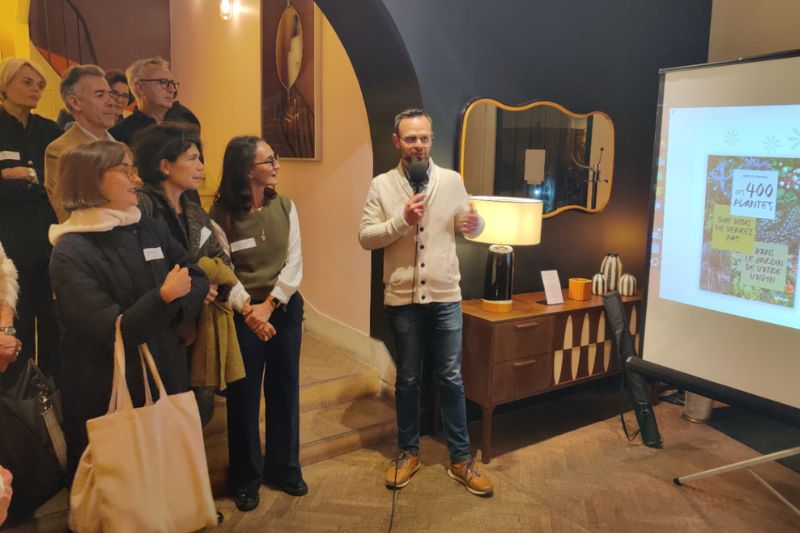
The French jury of the 2025 Saint-Fiacre Prize has made its decision, and its Coup de Cœur goes to 400 Plants You Won't See in Your Neighbour's Garden published by Ulmer. Our friendly colleague Aurélien Davroux presents a work that responds to a growing desire among gardeners: the urge to embrace diversity to transform their garden into a unique, personal, original, and resilient space.
Let’s embrace diversity!
As a reminder, the Saint-Fiacre Prize is a literary award given by horticultural journalists. Since 1971, it has recognised "a work in French addressing themes of gardening, gardens, or the plant world".
Aurélien Davroux's book, "The 400 Plants You Won't See in Your Neighbour's Garden", is a breath of fresh air that invites gardeners to break away from landscape uniformity by exploring less common varieties. Choosing diversity also creates a stronger garden: by varying species, it becomes naturally more resilient to diseases and climate change. Drawing on his experience, this horticultural engineer offers an inspiring and practical guide, encouraging the creation of surprising and ecologically stable gardens.
Although the 400 plants may not be the most common, they are perfectly accessible through specialised nurseries, turning their potential acquisition into a delightful "treasure hunt". The book also stands out for its light and humorous tone — notably illustrated by a hilarious "treatise on neighbourology" — which, combined with the author's botanical expertise, makes this book a true gem.
A few questions to the author
From the genesis of the book to the award
Receiving the "Coup de Cœur" from the Jury at the 2025 Saint-Fiacre Prize is a recognition of the quality of this work in horticultural publishing. Aurélien Davroux shares his reaction and the origin of this bold editorial idea.
Promesse de fleurs: Were you surprised to be nominated for the Saint-Fiacre Prize, and even more so to receive the Jury's "Coup de Cœur"?
Aurélien Davroux: I knew my book had been promoted by Ulmer, but it was still a lovely surprise and an immense pleasure.
Promesse de fleurs: A work that is both useful and surprising. Where did this original idea come from?
Aurélien Davroux: During discussions between Ulmer and Promesse de Fleurs, an idea was proposed by Pascal Griot, who said: "Why not talk about plants that you can't find at your neighbour's?" (editor's note: the very essence of our online nursery). Ulmer then chose me to write it, and from there, we tried to define the plants we wanted to present and how to organise them into three main parts, then into categories. The book discusses amazing plants, but none that are impossible to find or complicated — except for a few here and there: there has to be something for everyone, even the most passionate! It is certainly the opposite of an elitist book. However, it is also good to explain why we don't see them at our neighbour's: due to conformity, convenience, or ignorance. The average gardener cannot know all the botany and horticultural varieties. But we can present them. That is the purpose of my book.
Humour at the service of botany
Promesse de fleurs: The book also stands out for its light tone. Bringing a touch of humour to a gardening book is not common. Was this an initial intention of yours?
Aurélien Davroux: Very quickly, I had the ambition to introduce a quirky tone. Ulmer actually gave me free rein. The challenge was to integrate humour without risking offending anyone or going overboard. So, I sought a guiding thread to avoid monotony. Upon reflection, I remembered the "Memento for Comic Strip Artists" that Gotlib included in his Rubriques-à-brac, which presented the different archetypes of cartoonists. It made me laugh out loud! That’s why, in all modesty, I drew inspiration from it for my Treatise on Neighbourology: a carousel of neighbour archetypes (and we are all someone's neighbour!). Drawing from my own experiences and those of my friends, I wrote this little treatise, which I placed at the beginning of the book, establishing an analogy between the neighbour and the cultivation of a plant. My second source of absurd inspiration comes from Terry Pratchett, the British author of comic fantasy, who enjoyed adding humorous footnotes.
Why is this Guide to Original Plants an Ideal Gift?
Promesse de fleurs: For the end-of-year holidays, this could make a lovely gift. What are the strengths of your book?
Aurélien Davroux: Are you looking for a plant book that stands out from the ordinary, or do you want to convince a reluctant person who doesn't like encyclopaedias? Why not my book?
Promesse de fleurs: Any new works in preparation?
Aurélien Davroux: Not at the moment, but I am thinking about it.
The 2025 Saint-Fiacre Prize
As a reminder, the prestigious *2025 Saint-Fiacre Prize for adults was awarded to the work The Words of the Art of Gardening by Marie-Hélène Benetière and Alain Le Toquin, published by Delachaux & Niestlé. This prize, which annually honours reference works, confirms the horticultural and educational value of this title. Meanwhile, The Wild Square, by Anne-Hélène Dubray and Sarah Loulendo (Éditions L'agrume), won the Saint-Fiacre Youth Prize for its playful and educational approach.
*Awarded by the French Association of Garden and Horticulture Journalists (AJJH) and supported by Valhor (French interprofessional organisation for horticulture, floristry, and landscaping).

Comments