





























Now more than ever in winter, the need for light and colour is felt. To ensure a colourful display in the heart of the dreary season, decoratively-wooded trees and bushes are a top-notch solution to combat winter melancholy. They offer an endless range of interesting colours and textures: coral red, fluorescent orange, milky white are all beneficial colours to incorporate into gardens in the heart of winter. Some species boast smooth or sometimes cracked bark, while others peel in parchment-like strips, creating an irresistible urge to pull at the small piece of bark that reveals lovely bright colours.
If, like me, you are sensitive to the lack of light in winter and are looking for any means to bring colour to your garden during this season, then read this top 5 of the best decoratively-wooded bushes and adopt these essential species that are a must-have in a winter garden.
1 - Betula utilis jacquemontii (Himalayan Birch)
This is the classic of winter gardens to the point that one wonders if decoratively-wooded is synonymous with birch. But do not confuse it with the warty birch (Betula pendula), which is also a common and widely planted species but whose bark is significantly less striking than that of the Himalayan birch.
Long planted in gardens and then neglected, the Himalayan birch has made a comeback in contemporary gardens over the past decade, and rightly so. First of all, its white bark is the only one that illuminates the back of flower beds with such intensity. Next, its light branches provide a gentle shade in gardens, allowing for easy planting of small bushes or perennials at its base. Finally, whether planted alone or in a cluster of three in the back of a flower bed, it offers a very interesting focal point. Landscape architects are not mistaken, and they increasingly use it in contrast with rounded forms (boxwood, trimmed bush honeysuckle) or integrate it into naturalistic flower beds to enhance an atmosphere with unreal and dreamlike accents.
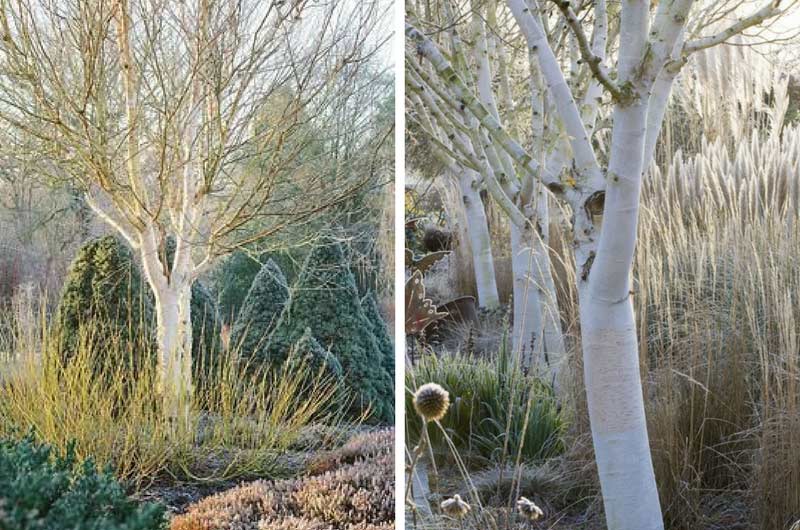 On the right, placed in front of a screen of dark-leaved conifers, the immaculate wood of the Himalayan birch contrasts beautifully. On the left, in a wilder context, the silver spikes of large grasses (Miscanthus and Cortaderia) enhance the striking colour of the bark. (Source Pinterest)
What you should know additionally : Adopt this birch without moderation in your gardens but please, do not top it as some do in winter to drastically reduce its height; it distorts its silhouette and makes it ugly! Instead, opt for coppiced forms at planting, which offer a wider habit but whose branching grows less high than a single specimen that can shoot up.
2- Acer davidii ‘Viper’ (Snake Bark Maple)
The large family of maples includes some species whose ornamental wood is a pure marvel in winter, and this is the case with snake bark maples. Several species are listed under this name, including Acer capillipes, A. pennsylvanicum, A. rufinerve, A. tegmentosum, and numerous hybrids derived from these species.
But of all the snake bark maples, Acer davidii ‘Viper’ remains my favourite! Its bicoloured green-orange wood striped with white is particularly precious in winter. And it is when the foliage has fallen and the light is low that we best appreciate its graphically striped and luminous wood. Lacking bark, this maple is coated with a whitish wax that accumulates on the wood to protect it from the external environment (sunburn, fungi) and becomes intensely luminous when temperatures drop.
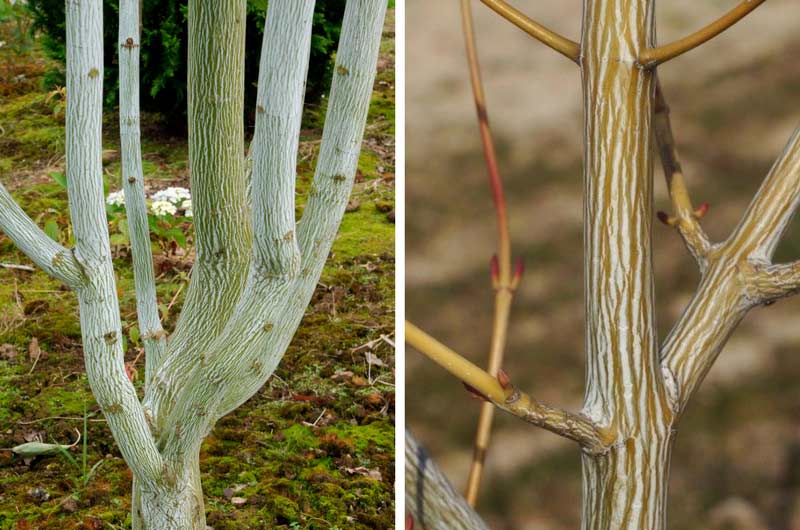 The striped and mottled bark of Acer davidii ‘Viper’ takes on an orange hue with the first frosts. (Source Hortival Diffusion)
What you should know additionally : Beyond its ornamental qualities, it is also for its cultural qualities that it remains my favourite. Unlike hybrids and some other species, Acer davidii is easier to cultivate than other “snake bark”, it does not require an acidic soil and even tolerates a bit of lime. But where it is interesting is that it tolerates heavy and cool soils well and is less susceptible to verticillium wilt than other species, tempting, isn’t it?
3- Cornus sanguinea ‘Winter Beauty’ (Decorative Wood Dogwood)
It is impossible to talk about decorative wood without mentioning dogwoods. I am referring to Cornus alba, sericea, sanguinea, and stolonifera, which form small bushy shrubs and reveal their colour in the heart of winter. These shrubs are obviously essential as they withstand everything! Pruning, cold, heavy, clayey, and humid soils, sun; they only fear the overly draining and dry soils of Mediterranean gardens, but apart from that, we can say they are almost indestructible. They have so many qualities that they have been planted everywhere, becoming a bit too common or even banal.
However, among the dozens of varieties of decorative wood dogwoods, there are a few gems worth discovering. I could mention Cornus ‘Bâton Rouge’ (Pierre's favourite) C. alba ‘Siberian Pearls’ or even C. alba ‘Ivory Halo’, but the one that gives me the most satisfaction is Cornus sanguinea ‘Winter Flame’. First of all, because it is one of the few shrubs to possess bright orange wood, almost fluorescent tinged with red at the tips of the young branches. This colour, quite rare and precious among shrubs with coloured wood, allows for lovely combinations in warm and vibrant shades that one might not dare to make in another season. In light soil, it forms the prettiest duo with Carex testacea Prairie Fire, and in heavy soil, it pairs best with Carex oshimensis 'Evercream'.
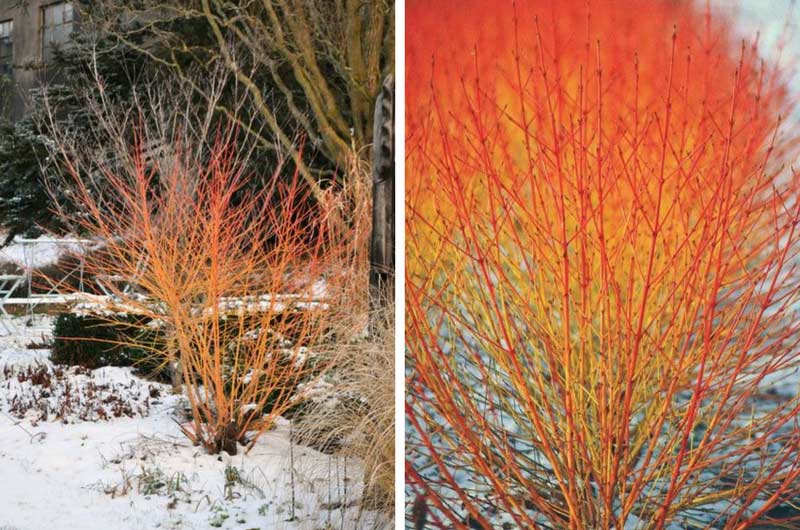 It is in the heart of winter, when the shrub is completely bare, that the spectacle is at its peak. Plant Cornus sanguinea near a bay window to feel the benefits of its warm colour. (Source Pinterest)
What you should know additionally : While all decorative wood dogwoods require spring pruning to maintain beautiful colours in winter, Cornus sanguinea does not need annual pruning. Old wood retains its vibrant colour much longer than its other cousins, C. alba or C. sericea. If it becomes too large, you can still prune it every year, but otherwise, pruning every three years is more than enough to regenerate its wood and maintain beautiful colours. To learn more about pruning decorative wood dogwoods, don’t forget to read Virginie’s article "Dogwood, Decorative Wood Cornus: Planting and Pruning"
4- Prunus serrula (Tibetan Cherry)
Sometimes Prunus serrula (Wood Cherry) is confused with Prunus serrulata (Flowering Cherry), two distinct shrubs that have little in common. Prunus serrulata is the famous Japanese cherry that stands out in spring in gardens and on city sidewalks with its spectacular but fleeting pink flowering.
Prunus serrula is characterised not by its rather discreet flowering but by its shiny and lustrous bark, whose mahogany-red hue with caramel reflections is one of the most beautiful to admire in the garden in winter. It is when it peels that the bark is most interesting, as beneath this dead skin, the new bark is so shiny that it reflects light and seems to shine in the sun.
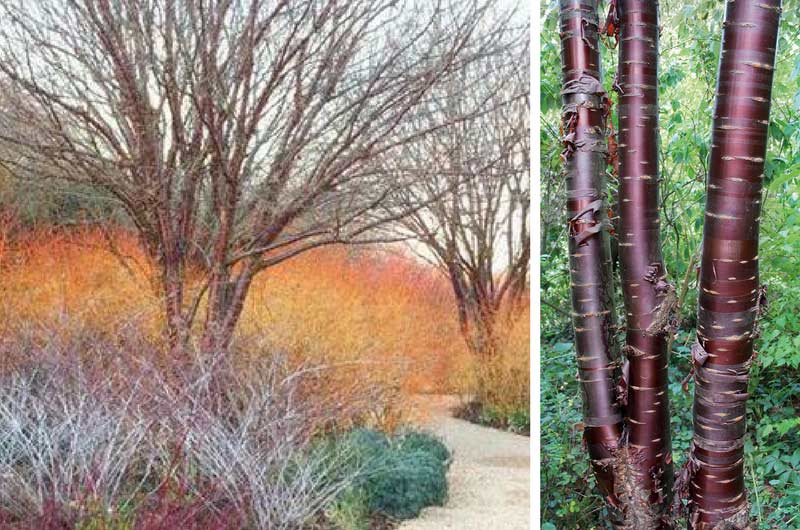 On the left, in this 100% winter scene, the yellow-orange wood of Cornus sanguinea 'Midwinter' highlights the dark silhouette of Prunus serrula. In the foreground, the white wood of Rubus tibetanus contrasts with the mahogany bark of the tree (Source Pinterest). On the right, the cleaned bark of Prunus reveals sublime satin colours.
What you should know additionally : Prunus serrula does not retain such a beautiful and vibrant bark all year round. During summer and early winter, it can become dull and sometimes green, especially when the shrub is planted too much in the shade. While one is often tempted to remove the bark by peeling it off, one risks tearing the sapwood; this deep bark conducts crude sap from the roots to the leaves, and this action can have long-term detrimental effects on the tree. To clean a tree's bark, the solution is simple and involves a stiff-bristled brush, warm soapy water, and elbow grease! Brushing the trunk of the Tibetan cherry once or twice a year with soapy water is the best way to maintain a brilliant bark without damaging the tree, just so you know!
5- Acer palmatum Senkaki (Sango Kaku)
While Japanese maples reward us with stunning graphic and colourful foliage, some, like Senkaki (the Japanese call it Sango Kaku), also boast exceptional wood. It must be said that in summer, its palmate foliage, light green with golden hues, does not suggest such beauty at the end of the season. Already in autumn, its tawny orange foliage is striking, but it is when the shrub begins to shed its leaves that we witness one of the most beautiful leaf-fall displays ever performed by a Japanese maple.
Once its leaves have fallen, the Senkaki maple reveals spectacular wood, tinted a coral red that is almost supernatural. And once again, the cold will enhance the intensity of the hue, making the branches bright red when it freezes. Add to this a lovely upright and very light silhouette, and you have an essential Japanese maple for a winter garden.
Is it more sensitive or more difficult to cultivate than another Japanese maple? The answer is no, it requires acidic, well-draining soil, a bright but not scorching exposure in summer. If you are unsure whether you can provide it with good growing conditions, know that it also does well in pots.
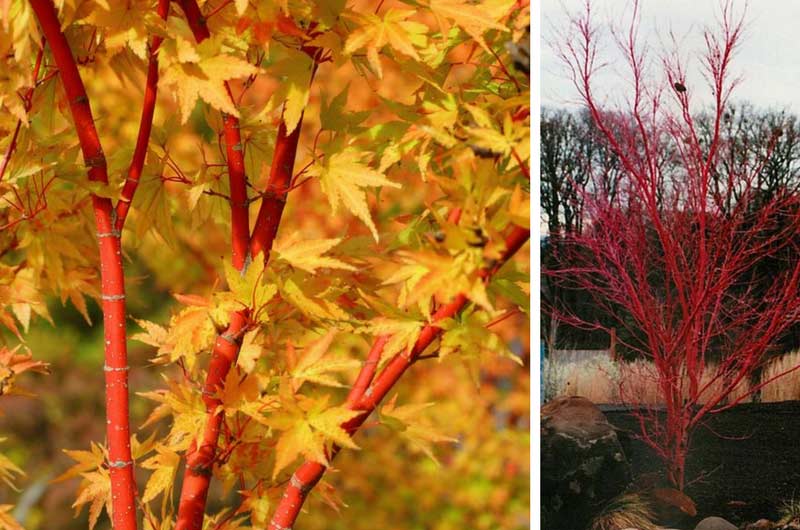 On the left, Acer palmatum Senkaki, with its superb autumn foliage, begins to reveal a coral bark. On the right, in the heart of winter, the bark becomes a much more intense red. (Source Pinterest)
What you should know additionally : Planted alone, this maple retains all its charm. Resist the temptation to associate it with decorative wood dogwoods; they have the same type of bark and also have an upright habit, and you risk creating a dull scene where the maple and dogwood blend together. It is in a zen or mineral garden that the Senkaki maple offers the best potential. This is the shrub that one would typically plant in a minimalist setting, paired with beautiful rocks and a few scattered grasses at the entrance of a house, near the front door, or on a terrace.
Are you interested in creating a winter garden and want to go further? Feel free to revisit Ingrid's article where she introduced one of her favourite books: "Winter Gardens: A Season Reinvented" by Cédric Pollet
And discover Olivier's tips for a beautiful garden even in winter:
Comments