


With the arrival of fine weather, the garden beds awaken, accompanied by their share of weeds, or should I say, adventive plants. It’s high time to prune the edges!
I’ve noticed that beds designed within a lawn often become "dirty" more quickly than those bordered by paving or a terrace, for example. Why? Because once the bed is designed and planted, the edges are often forgotten, and the lawn, which is teeming with adventive plants like couch grass, buttercup, and clover, encroaches into the bed.
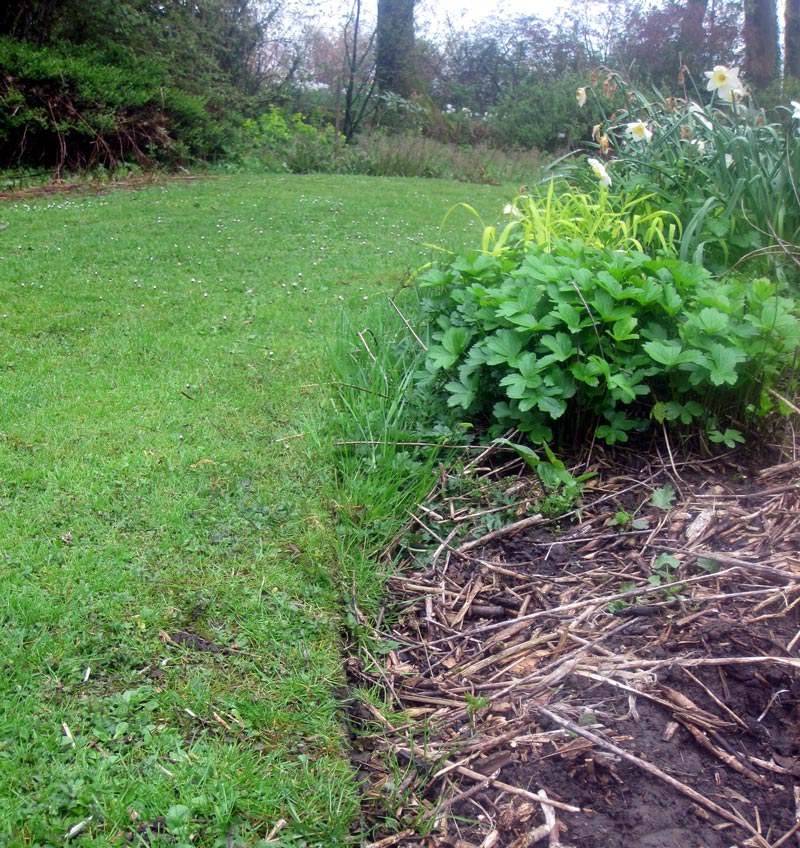 Here, the bed is starting to be overrun by the lawn.
The solution, simple yet demanding, is first to redraw the edge by cutting back the grass encroaching into the flower bed with a spade. Once the grass is cut, you excavate the soil at the edge using a spade held horizontally but angled, and throw it a few metres further into the centre of the bed, creating a slightly raised surface. For it to be effective and aesthetically pleasing, the edge should be at least 5 cm deep, ideally 8-10 cm in height.
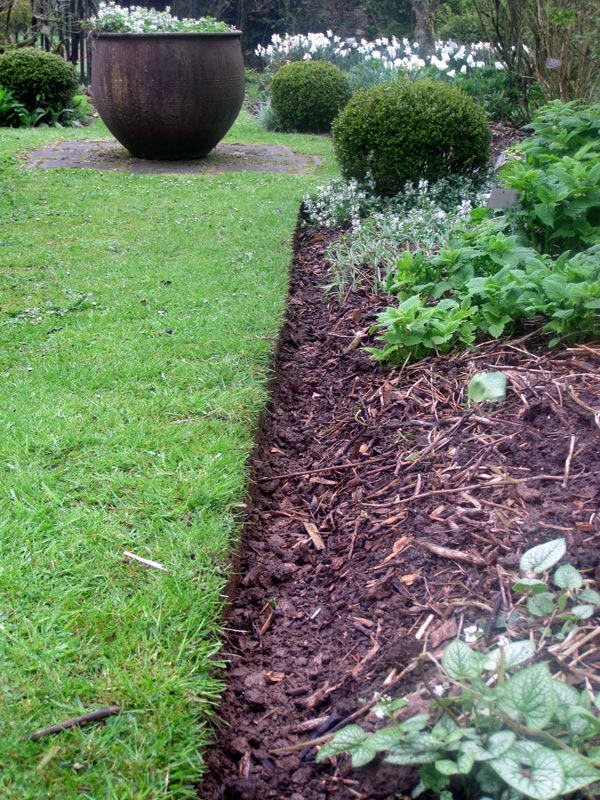
Once the chore is done, all that’s left is to trim back the grass that exceeds, ideally once a month at a minimum, or every 15 days for meticulous gardeners.
Even if you only have a few beds, I highly recommend equipping yourself with a suitable tool: a manual edger. Rectangular, half-moon, or with a cutting wheel, this type of tool will really make your life easier!
For those like me with several dozen linear metres to trim, there has been an effective and inexpensive tool available for a few years now. It’s called a "border edger", a head that fits directly onto the strimmer, replacing the cutting plate. This "border edger" is equipped with a steel blade that cuts through grass and soil, along with a wheel that rests on the lawn; while it’s not easy to cut in a straight line, it’s a breeze for creating and maintaining curved edges.
 "Border Edger"
Besides the fact that the beds become less messy, trimming the edges clearly marks the boundary between the lawn and the bed, creating a distinct transition between the free and colourful vegetation of the bed and the strict and uniform vegetation of the lawn. This contrast creates a strong visual impact between wild nature and controlled nature, making the edge the central axis of visual harmony, which is why it is so important to me in an "English-style" garden.
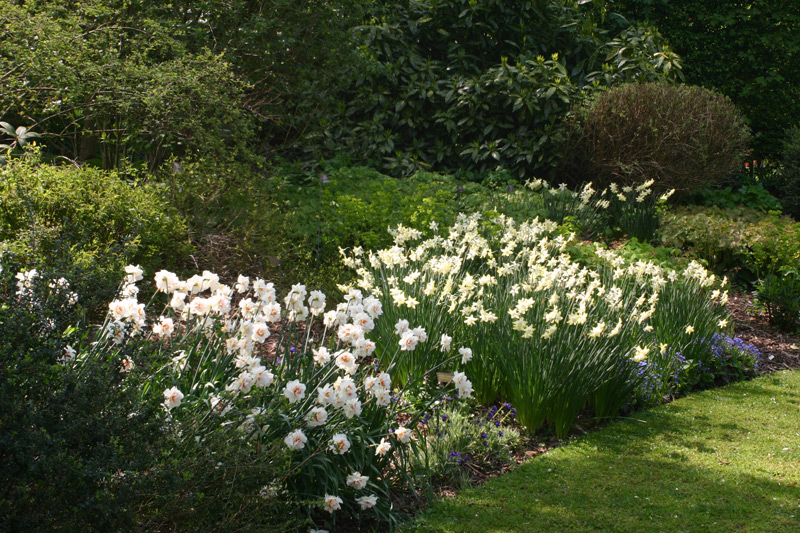 The edge creates a clear transition between the plants in the bed and the green lawn.

Comments