





























November is a rather quiet month in the vegetable garden because, unless you live in a very mild region, it's more about "cleaning up" than sowing. As a proponent of moderate effort (both out of conviction and due to lack of time), this is my favourite time to care for the soil and prepare it for a long restorative sleep.
1) Harvest the last vegetables and tidy up the vegetable garden
Wherever sowing green manure was not possible due to plot occupation, I carry out the last harvests. Rather than uprooting the plants, I cut them at their base, leaving the roots in the ground. They will decompose on their own and provide nitrogen to the soil for legumes or Fabaceae like beans. I reserve these precious green waste for later or add them to the compost, then I do a bit of weeding if necessary.
2) Loosen the soil quickly before winter
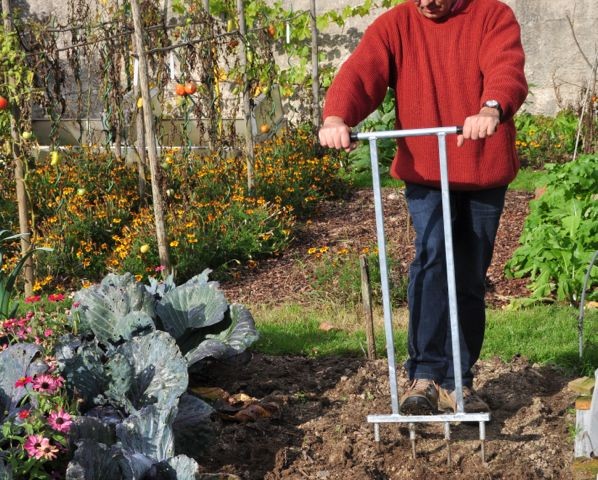
Permanently mulched, the soil in the vegetable garden retains good flexibility. However, the mulches break down like snow in the sun. And I know from experience that my clay-loam soil remains heavy late into spring. That’s why I prefer to loosen it in autumn, even quickly. Firstly because what is done is no longer to be done, but also because I am less likely to disrupt it than if I were to do it hastily and under poor conditions in March or April. For this, I use not a spade, but a "Bio-Spade" or "Grelinette". It’s one of my favourite tools because its long tines loosen deeply without turning the soil, while saving my back.
3) Add organic matter: compost or manure
I try, as much as possible, to respect the crop rotation in the vegetable garden. However, planning the location of each vegetable six months in advance is frankly beyond my capabilities… I reserve the chore of crop rotation for long rainy days when this projection towards spring (as well as my large seed order) comes just in time to lift my spirits!
So I simply determine the plots that should not receive compost (where I will grow broad beans, peas, beans, garlic, and onions next year) and provide a "medium" dose of around 2 - 3 kilos per square metre everywhere else. It will always be possible in spring to add a supplement for greedy crops like squashes. If you lack homemade compost, you can use well-decomposed manure or dehydrated manure, available in pellets.
The compost spread, whether mature or semi-mature, is not buried deeply, but simply spread on the soil and quickly raked in. Indeed, this organic matter is not intended directly for the soil, but to nourish the living beings that inhabit it. And believe me, they know how to find it, and that’s a good thing because if there’s one thing I’ve learned from Denis Pépin’s teachings, it’s that worms work while eating and eat while working. And as long as there’s food on the table, no strikes; they continue to dig their tunnels and bless us with their turicules!
The advantage of this practice, as you will have understood, is to "outsource" the work of the soil while maintaining its fertility, very naturally.
4) Generously mulch the soil
Once the plots are fertilised, mulching can begin. It spreads over several weeks, sometimes until mid-December. The goal is always the same: to protect the soil (from adventive plants, rain compaction, leaching) and, above all, to create a favourable climate for the work of the soil's living beings.
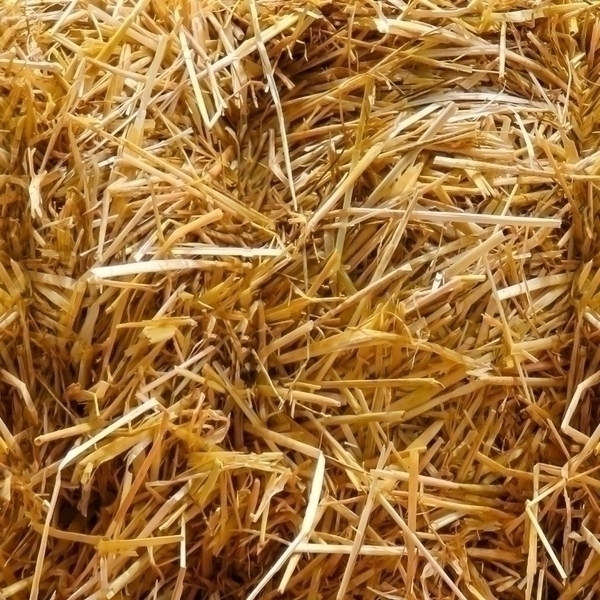
As usual, I use everything that comes to hand: the mowings from my neighbour (I’m a fan of mulching for my lawn), the residues from vegetable crops (free from diseases), straw when I can find it, and especially fallen leaves, a precious material in organic gardening. In case you have none of this, use brown cardboard; it’s not very aesthetic, I admit, but it’s always better than nothing!
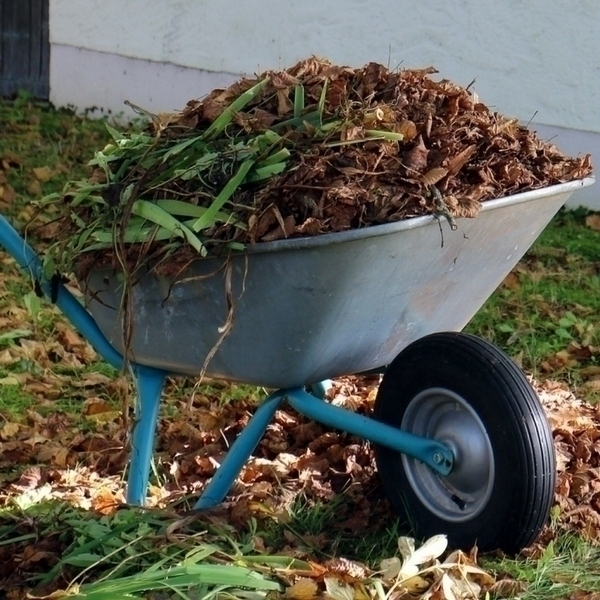
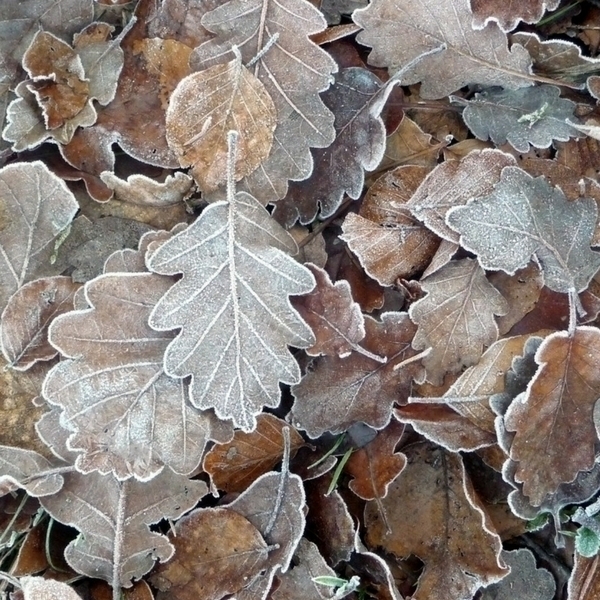
You can simply gather them with a rake or shovel, à la Prévert. It’s a long, tedious technique, but comical in windy weather. For my part, I prefer the mower that sucks them up and chops them (quick and efficient!). However, as our garden is still young, the resource is quickly depleted. So, I’ve taken to calling on the technical services of my village. In autumn, they usually have no idea what to do with them and generally deliver me 3 or 4 cubic metres. I prioritise spreading them in the vegetable garden, but also in the perennial beds and at the foot of hedges.
The mulching is very generous: I accumulate up to 30 cm of leaves on the beds to create a true duvet or anorak. This protection insulates very well from the cold and allows earthworms to continue their work even in freezing temperatures.
In spring, almost everything will have disappeared, and I will only have to plant or move the mulch aside to sow!
And you? How are your autumn tasks in the vegetable garden coming along? Do you have any other techniques to share?
Further reading:
- "Compost and Mulch" by Denis Pépin - Editions Terre vivante
PS: Following various exchanges with Denis Pépin, it seemed useful to clarify: earthworms in the soil do not feed on compost but on decomposing plant debris rich in cellulose (the soft mulches laid on the surface: crop residues, green leaves, soft fallen leaves, fine twigs...). Compost, on the other hand, is intended to provide stable humus and nutrients for the following year's plants. Compost is not necessary before less demanding crops, but only before demanding ones.
Loosening the soil in autumn is essential to aerate compacted soil because the living beings in the soil (especially bacteria) need a lot of oxygen. This is particularly true in autumn when their activity is at its peak. As a result, the soil will be less compacted in spring and easier to work with.

Comments