


Let’s continue our world tour of plants by discovering stunning South African bulbs: crocosmias. Commonly known as Montbretias, these bulbous plants resemble small gladioli and grow wild in the meadows and forest edges along the eastern coast of South Africa for the most part. With their vibrant and warm colours—orange, red, yellow—these exotic summer bulbs instantly add a bright and refreshing touch to any decor. Let’s explore how they have acclimatised over the centuries in our European gardens and why these small, floriferous summer bulbs, once out of fashion, are making a grand comeback today!
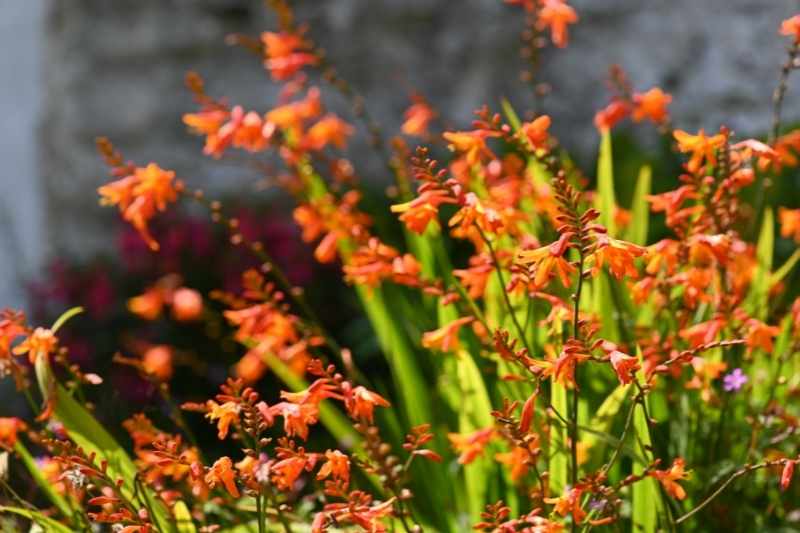
What are Crocosmias?
Part bulb, part corm, crocosmias or Montbretias, also known as “crocosmie” or “montbretie,” are herbaceous perennial plants from the iris family, just like gladioli, with which they share many similarities. These beautiful exotic perennials are moderately hardy and can be grown in the same way outside of our mildest regions (it is safer to lift the corms for winter storage). They form a clump that typically reaches 60 cm in height. The larger varieties, such as ‘Lucifer’, can grow up to 1.20 m. Not demanding, crocosmia bulbs should be planted in full sun, in fertile, moist soil. And when the growing conditions suit them, they multiply over the years, returning faithfully each year, more beautiful and floriferous.
The origin of their name
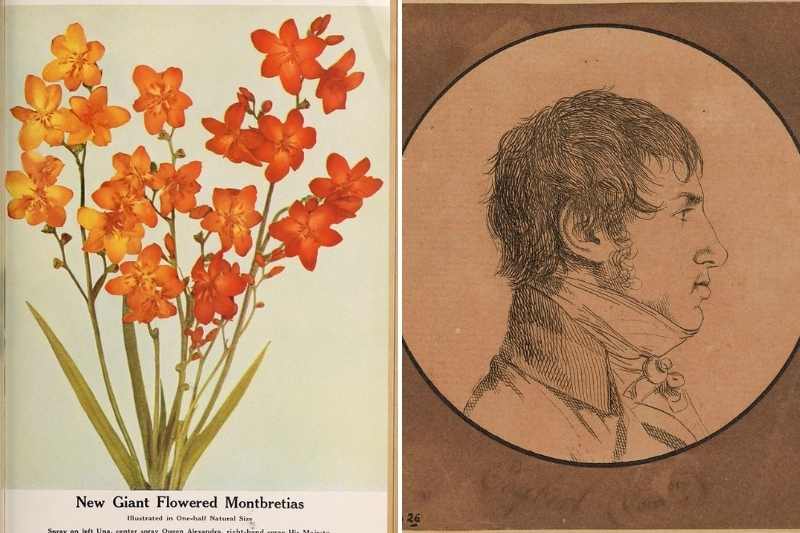
The plant derives its name from the Greek words krokos (saffron) and osme (smell), due to the characteristic saffron scent emitted by its dried flowers when immersed in hot water. Its other name, Montbretia, was given to the crocosmia in honour of the botanist Antoine-François-Ernest Coquebert de Montbret (1780-1801), who was attached to the military and scientific expedition to Egypt led by General Bonaparte and his successors, and was the librarian of the first Institute of Egypt.
Africa, the cradle of Crocosmias
While Crocosmias are now cultivated worldwide, the genus comprises 9 species, all native to South Africa except for one, Crocosmia ambongensis, which is endemic to Madagascar.
The Crocosmia pottsii was introduced to England in 1877 by the English botanist and naturalist Thomas Henry Potts in the mid-19th century. Three years later, in 1880, the famous horticulturist from Nancy, Victor Lemoine, created the first hybrid: the Crocosmia X Crocosmiiflora. This is how crocosmia managed to conquer gardens in the UK, and then ours. In France, it was first observed in the wild in 1889, in the Creuse department. Its cultivation then spread to the Netherlands in the 1990s. Once rarely cultivated and neglected, Crocosmia has found its nobility by making a grand return to our gardens today!
The arrival of Crocosmias on our French coasts
Initially found mainly on the west coast of our country, particularly in Brittany and Loire-Atlantique (they thrive in open ground, especially under the Breton climate), crocosmias have spread. The Crocosmia X Crocosmiiflora has naturalised to the point of becoming invasive and is considered a pest in Great Britain and New Zealand.
Cousins and descendants
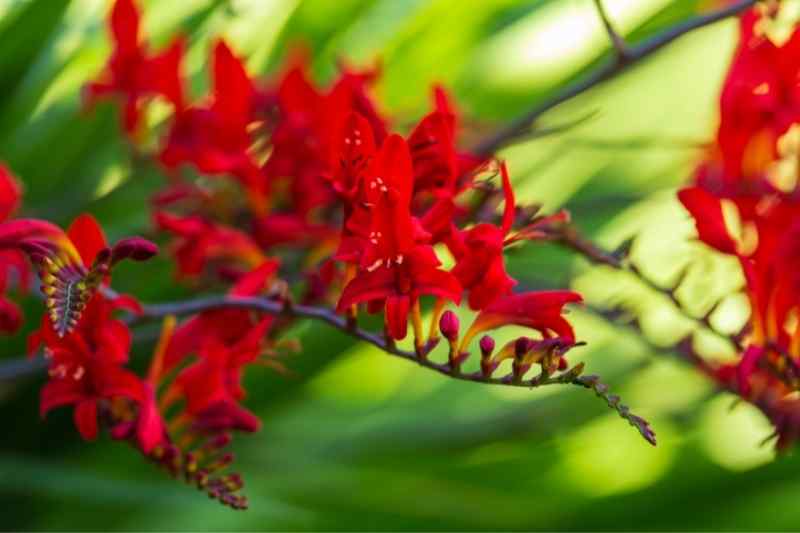
Over 400 hybrids have been created by horticulturists. Most of these varieties are derived from Crocosmia x crocosmiiflora, which results from a cross between two South African species: Crocosmia aurea and Crocosmia pottsii. Crocosmia x crocosmiiflora has produced numerous cultivars that are mostly still marketed under the name "Montbretia." Among the most remarkable fruits of these various hybridisations:
- The Crocosmia 'Emily McKenzie'; striking with its very bright orange flowers highlighted by a dark red centre.
- The Crocosmia ‘Lucifer’; the star of summer borders! It is the most well-known and certainly the tallest! This English horticultural creation was born in 1966 from the marriage of Crocosmia masoniorum and C. paniculata.
- The Crocosmia (x) crocosmiiflora 'Carmine Brillant'; one of the most floriferous Montbretias, each flower stem carries up to 100 flowers throughout the summer.
- The Crocosmia (x) crocosmiiflora 'George Davison'; a very bright variety, covered in summer with an abundant golden yellow flowering.
Crocosmias in the iarden
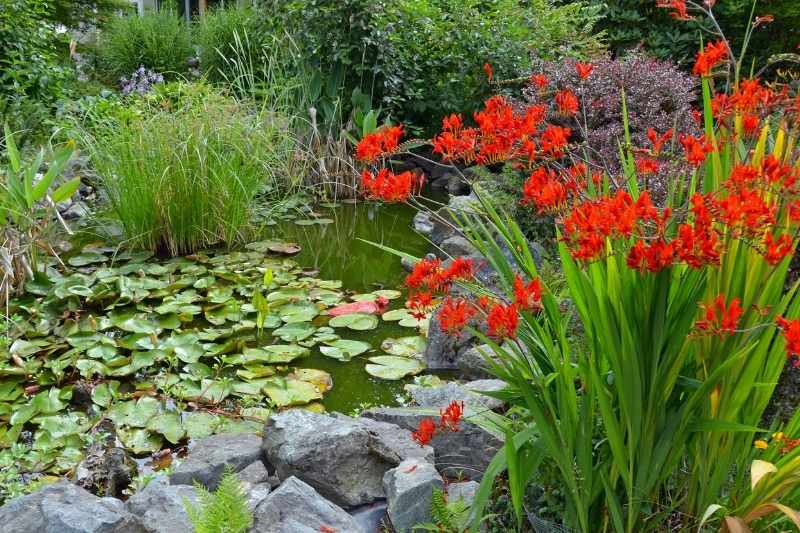
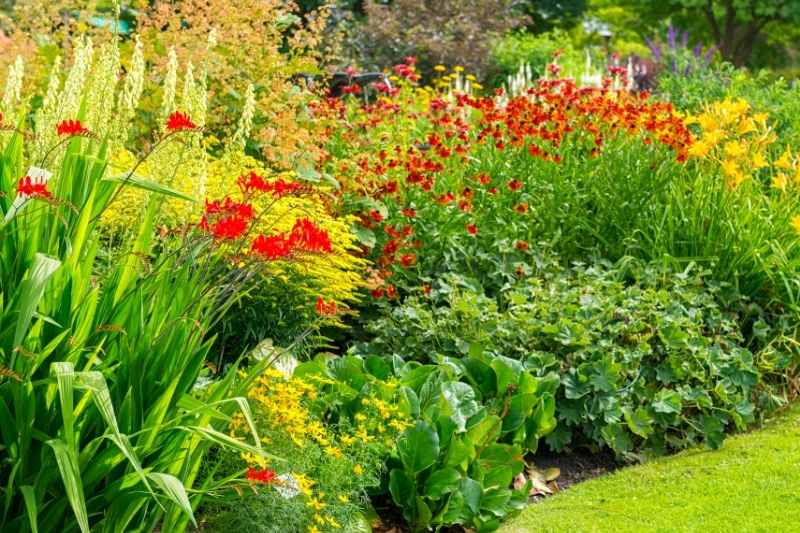
With their flowers reminiscent of small lilies in a wide range of warm colours, Crocosmias bring an exotic and cheerful touch to vibrant perennial borders. Their bright colours—yellow, orange, or red—create vivid and joyful splashes of colour in gardens. They are easy to mix with other flamboyant and colourful blooms such as Cannas, Castor Beans, Coreopsis, Dahlias, or Rudbeckias, along with light perennials like salvias or nepeta and/or with ornamental grasses (Stipa tenuifolia, Pennisetum...).
Discover more ideas in our sheet “Crocosmia or Montbretia: 9 pairing ideas”.
Further Reading
- Our wide range of Crocosmias
- Our dossier "CROCOSMIA OR MONTBRETIA: PLANTING, CULTIVATION AND MAINTENANCE"
- How to Plant Crocosmias
- 8 Summer Bulbs with Orange Flowers You Must Have in Your Garden.

Comments