


To continue our summer saga on plants that have made a long journey before arriving in our gardens, we present to you today the Magnolia, a tree that is familiar to us and appreciated for its large tulip-shaped flowers. A plant that has come from afar, the Magnolia? Not exactly! This tree was present in Europe millions of years ago, but then it retreated to Asia and America, where it found more favourable climatic conditions, before returning to Europe brought by humans. Discover in this article the stages of its fabulous journey to our gardens!
A primitive plant
The Magnolia is among the first flowering trees that ever existed. Fossils of magnolias dating back 36 to 58 million years have been found, and specimens of their family existed over 100 million years ago! Magnolias appeared long before bees: thus, their flowers are not pollinated by them, but by beetles. This explains why their floral parts are so thick and robust: it helps prevent damage from beetles.
Magnolia flowers have primitive characteristics : their structure is close to the very first flowers that ever existed. The flower buds are enclosed in bracts rather than sepals, and the floral parts of the perianth (petals and sepals) are undifferentiated - they are referred to as tepals. They are arranged in concentric circles. The flower produces a large amount of pollen, as beetles feed on it. However, since they are not attracted to nectar (unlike bees and butterflies), the flower does not produce any.
Magnolias were indeed present in Europe over 40 million years ago, but they disappeared during the glacial periods; only the populations in Asia and the eastern part of North America survived, as the climatic conditions there were more favourable.
The journey of the Magnolia to Europe
Magnolias have been known for a long time in Asia, where they were cultivated as early as the 7th century... but it wasn't until the late 17th century, with its share of great explorations and voyages, that they began to arrive in Europe!
The first Magnolia to be introduced to Europe was Magnolia virginiana, native to the United States, which arrived in 1688 in London. John Banister, a missionary sent by Bishop Compton, brought it back from one of his trips to Virginia.
In 1711, Magnolia grandiflora was introduced to Europe from the United States, aboard the large sailing ship Le Saint-Michel, which also brought back many botanical species from the New World. The owner of the ship (and later mayor of Nantes), René Darquistade, decided to plant this species in the orangery of his château de la Maillardière. The tree was cultivated for nearly 20 years but did not flower, so he deemed it uninteresting and decided to discard it. His wife rescued it and had it planted in the open ground in the park. Finding more favourable conditions there, the tree finally began to flower. It attracted many local horticulturists, who succeeded in propagating it through air layering.
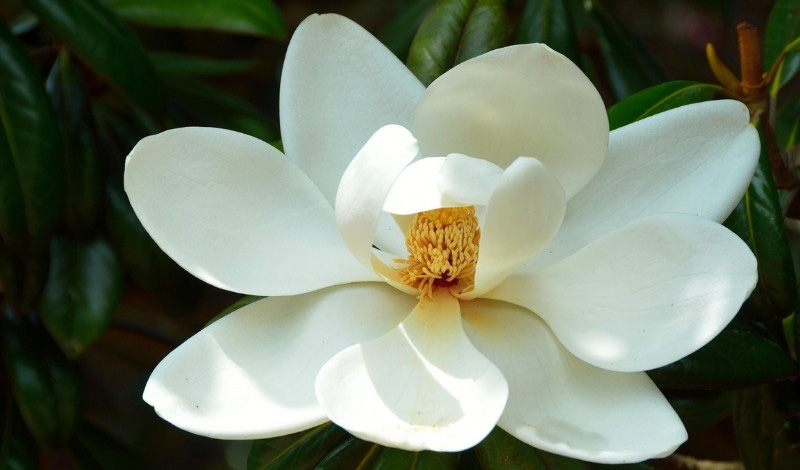
The Magnolia grandiflora was named Tulip Tree, alluding to its thick, glossy leaves that resemble those of the laurel, and its flowers that resemble tulips.
Subsequently, Roland-Michel Barrin de la Galissonnière, governor of New France (corresponding to Louisiana and Quebec), introduced many trees and shrubs, including a new magnolia in his property at La Galissonnière near Nantes. He named the variety Magnolia grandiflora ‘Galissoniensis’.
In 1780, the first Magnolia from Asia was introduced to Europe (nearly a century after the introduction of the first American magnolia). This was Magnolia denudata, imported by Sir Joseph Banks.

However, the most significant introductions of Asian magnolias took place in the early decades of the 20th century. George Forrest, sent to Asia by the Royal Botanic Gardens of Edinburgh, brought back eight species of magnolias during his travels, including three new to cultivation.
Ernest Henry Wilson, a British botanist, brought back about 1,500 new plants from China, including eight new species of magnolia : Magnolia delavayi, M. officinalis, M. sinensis, M. wilsonii, M. sprengeri, M. sargentiana, M. robusta and M. dawsoniana.
With the appearance of all these new species of magnolia in Europe, particularly in the UK and France, horticulturists and nurserymen undertook selection work to obtain new hybrids.
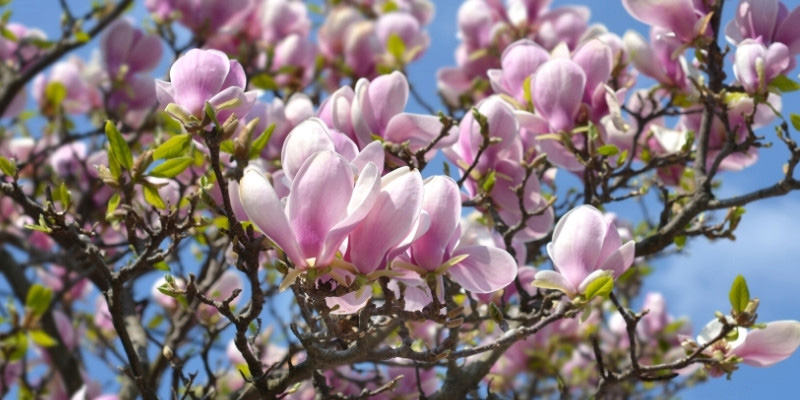
The Magnolia x soulangeana was thus obtained in 1820 by Etienne Soulange-Bodin, a retired officer of Napoleon's army, who crossed a Magnolia denudata and a Magnolia lilliflora. This hybrid was then cultivated in England, as well as in other European countries and North America, giving rise to many varieties!
The origin of its name
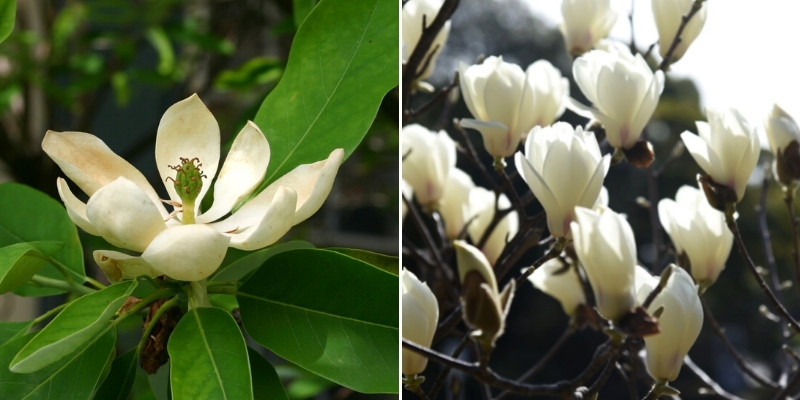
The Magnolia was named in 1703 by Charles Plumier in honour of the French physician and botanist Pierre Magnol (1638-1715), former director of the botanical garden of Montpellier. Plumier named the Begonia in the same way in honour of Begon, the Fuchsia in honour of Fuchs, etc.
Carl von Linné later worked on a tree known in Europe as Tulipifera, and renamed it Magnolia, while also renaming Talauma the tree that Plumier had called Magnolia.
In 1735, Carl von Linné confirmed this name for the Magnolia. In 1753, he reinstated the name Magnolia in the first edition of Species Plantarum.
Uses of the Magnolia
The Magnolia has been used for over a thousand years in traditional Chinese medicine. The first references to its medicinal properties date back to 1083. It is reputed to promote the good circulation of vital energy (Qi) and helps relieve cough, asthma, digestive issues, anxiety, and sleep disorders. The parts used were the bark and flower buds.
Among the active principles of magnolia, recent studies have shown the medicinal interest of Honokiol and Magnolol. These compounds derived from magnolia bark have anticancer, anti-inflammatory, and antidepressant properties; they support intestinal function, help maintain joint flexibility, and soothe menopausal symptoms. They also help maintain brain functions and protect the brain against Alzheimer's disease.
Magnolias in the garden
In the garden, magnolias thrive in deep, cool, humus-bearing soil, neutral to slightly acidic, with sunny or partially shaded exposure. They cope well with pollution and are very suitable for city gardens. They have the advantage of being quite hardy (withstanding temperatures down to -20 °C, sometimes -25 °C).
Evergreen magnolias like Magnolia grandiflora are wonderful in large spaces, for example, as a specimen in the middle of a lawn, or as alignment trees along a path. Deciduous magnolias (Magnolia stellata, M. soulangeana, M. denudata…), which are smaller, will find their place in a shrub border or a flowering hedge, for example, with Japanese quinces, forsythias, flowering currants... They integrate well into Japanese gardens, alongside Japanese maples, azaleas, bamboos, ferns, and ornamental grasses.

Comments