





























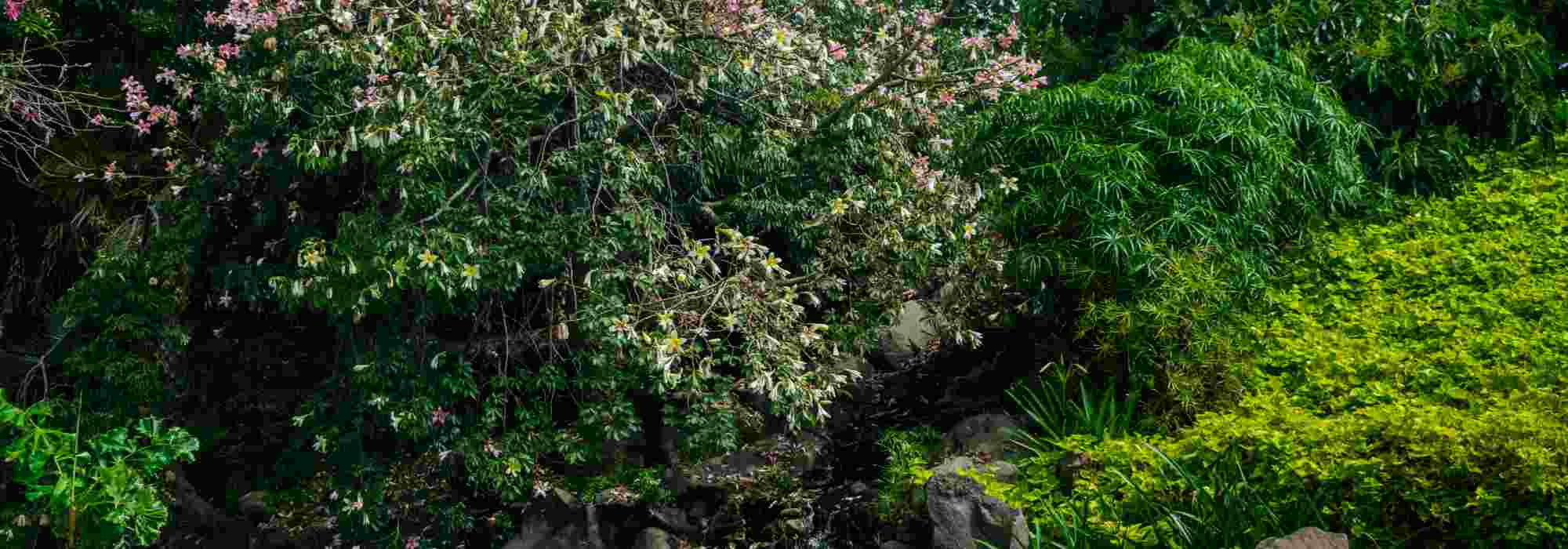
5 exotic bushes with winter flowering
Our selection of bushes from distant origins that flower in the heart of winter
Contents
Originating from distant lands, often from the other side of the world, exotic bushes enchant us with their lush and opulent foliage, often featuring unusual shapes, as well as their vibrant, colourful flowering. These exotic bushes add a touch of originality and a sense of escape to your garden, allowing you to travel at little cost throughout the year.
However, not all of these exotic bushes are equal when it comes to cold. While some display impressive hardiness that allows them to be grown everywhere, others are suited only for regions with milder climates. Even though many of these bushes can also be grown in pots, on verandas, or in conservatories.
To brighten and warm your winter, we have prepared a selection of the best exotic bushes that bloom in winter. With some wonderful discoveries in store!

The juniper-leaved grevillea (Grevillea junipera)
Grevillea junipera is a shrub endemic to the east of New South Wales and the southeast of Queensland in Australia. It proudly displays its exotic side! This shrub from the Proteaceae family rarely exceeds 2 m in all directions but asserts its presence with particularly dense and bushy evergreen foliage, almost tangled as its branches easily intertwine, resembling that of a juniper. Hence its vernacular name, as well as its Latin name, since “junipera” refers to the needle-like leaves of conifers. The grevillea (sometimes spelled grevillia) with juniper-like, slender, and leathery leaves forms a beautiful green shrub throughout the year.
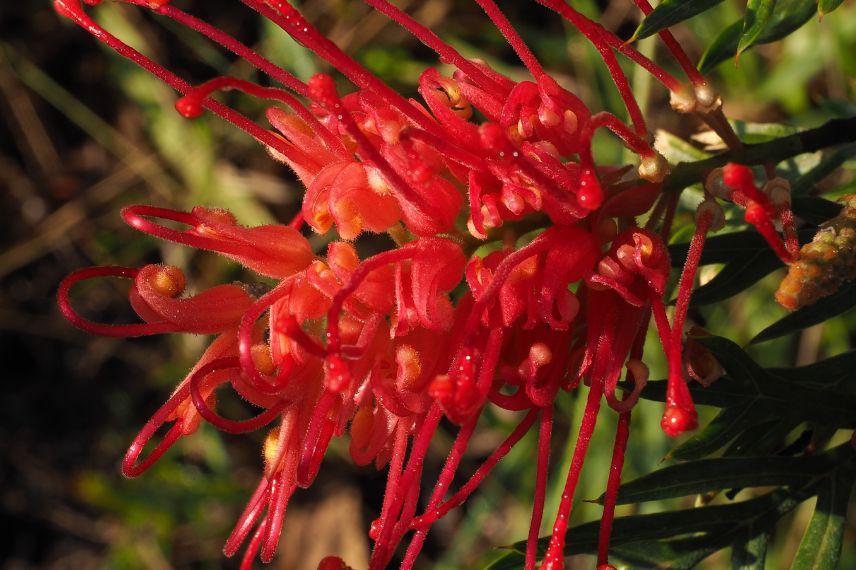
Grevillea junipera
With a hardiness of around -10 to -12 °C (if grown in well-drained soil and sheltered from cold winds), the grevillea can bloom throughout winter and into spring, from December to April, in regions with a mild climate. Elsewhere, in cooler areas, its flowering shifts from February-March to June. And this flowering is worth seeing! Firstly for its bright red colour, enhanced by the dark green foliage, but also for the shape of the inflorescences. The flowers consist of petaloid styles curled upon themselves and long, curved stamens. These flowers resemble spiders. The variety ‘New Blood’ offers very bright pink-red flowers just like ‘Canberra Gem’.
How to grow it?
It requires full sun and well-drained, light, fairly dry, and rather poor soil, with an acidic tendency. This shrub is quite drought-resistant and easily tolerates sea spray. It is ideal for a coastal garden or a Mediterranean garden, to form a privacy or windbreak hedge. However, it can also thrive when planted alone, at the back of a border or on a slope.
It is possible to associate it with shrubs such as camellia, Skimmia japonica, or even Pittosporum tobira.
Eucalyptus
Clearly, not all eucalyptus, mostly native to Australia, flower in winter! However, some do fall into the category of winter-flowering bushes as they produce discreet little white to cream pom-poms, which are very attractive to insects due to their melliferous properties. They also maintain more modest dimensions, allowing them to be classified as shrubs.
Thus, Eucalyptus neglecta, or Omeo gum can, in some years and depending on the climate, flower from November to May, but more reliably in February and March everywhere. Its small white flowers, grouped in clusters, form lovely, highly fragrant pom-poms. This eucalyptus is also interesting for its large, grey-green to bluish foliage, tinged with copper, red, and brown. It is hardy down to -15 °C.
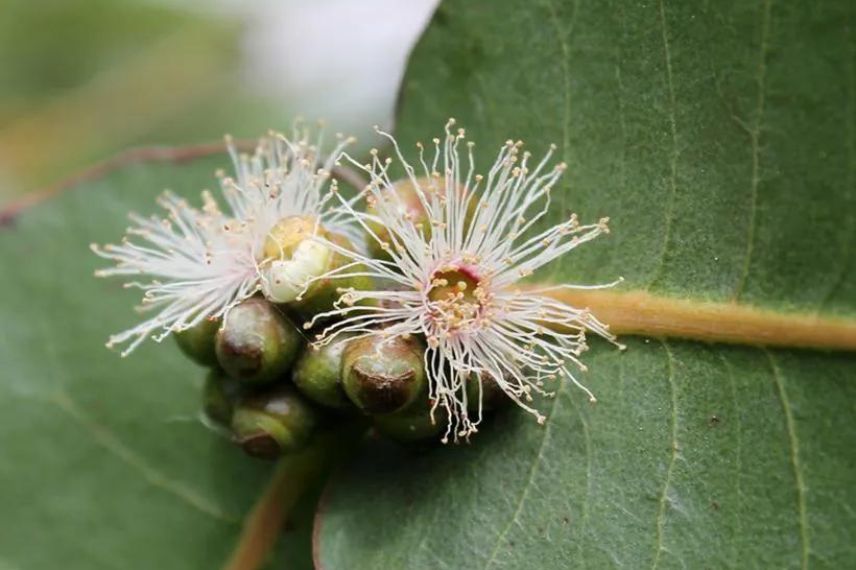
Flowers of Eucalyptus neglecta
Eucalyptus apiculata, or narrow-leaved mallee remains very modest and forms a highly branched, bushy shrub that develops in coppice shoots. It features feathery, narrow foliage and smooth, slightly silvered cream-white bark that peels in terracotta strips. Like Eucalyptus neglecta, its flowering can occur between November and May. The flowers cluster in groups of three at the axil of the leaves.
Eucalyptus archeri, or alpine gum also deserves mention due to its hardiness down to -18 °C, its silver-green foliage, and its grey-green bark mixed with pink and white.
How to grow it?
Eucalyptus prefer well-drained soils, from fresh to dry, and a warm, sunny position, well sheltered from cold winds.
Phymosia umbellata
The Phymosia umbellata hails from Mexico, where it is endemic to forests near Mexico City. A member of the Malvaceae family, this bush reaches a height of 2.50 to 3 metres with a spread of 1.50 metres in our latitudes. However, it is somewhat tender (it is hardy down to -5 to -6 °C) and can only be grown in the ground along the Mediterranean and Atlantic coasts. Elsewhere, it is best grown in pots.
This exotic bush flowers from July, but in a mild climate, it can brighten the winter until December. And this flowering is truly beautiful! Each day, large fluffy buds, grouped in bouquets, form and give rise to five-petalled flowers with a satin-like texture, in carmine red, lightly marked with white. After pollination, these flowers develop into fruits filled with seeds that easily self-sow.
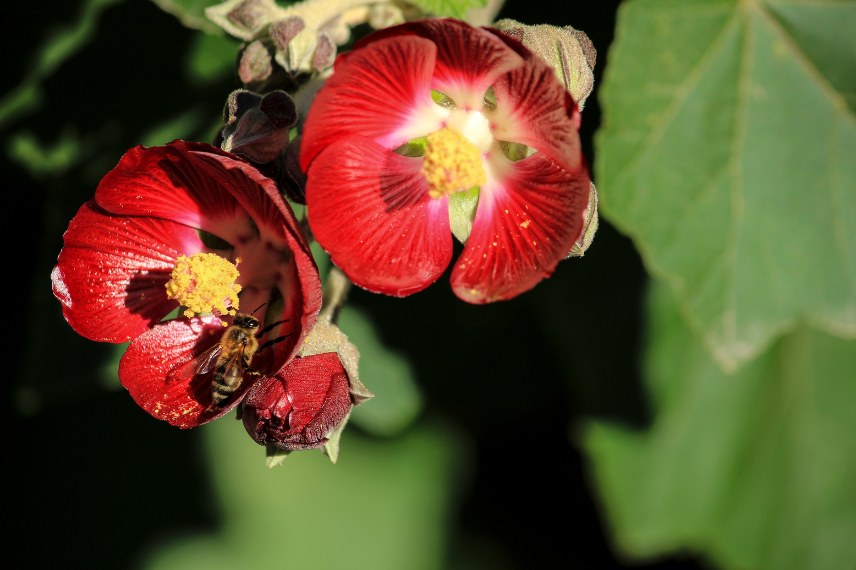
Flowers of Phymosia umbellata
This bush features evergreen, fluffy foliage, palmate and divided into irregular lobes, of a good size.
How to grow it?
The Phymosia umbellata should be planted in full sun and sheltered from cold winds, in ordinary, deep, loose, fertile, and cool soil, and especially well-drained. It thrives when planted alone or at the back of a border, alongside autumn asters.
Bailey's mimosa (Acacia baileyana)
The Bailey’s mimosa (Acacia baileyana) certainly deserves its place in this selection of exotic shrubs with winter flowering. On one hand, because it is native to Tasmania and Australia. On the other hand, because it maintains a reasonable size of around 4 m in all directions. It forms a bush with long, slightly trailing branches and a fern-like foliage, very fine and bluish-grey, divided into small leaflets. Finally, this Bailey’s mimosa offers a beautiful yellow flowering in cylindrical spikes from January to March. These flowers consist of very airy glomerules, themselves made up of bristly stamens. Less fragrant than those of other species of mimosa, the flowers of Bailey’s mimosa are highly melliferous and attract foraging insects.
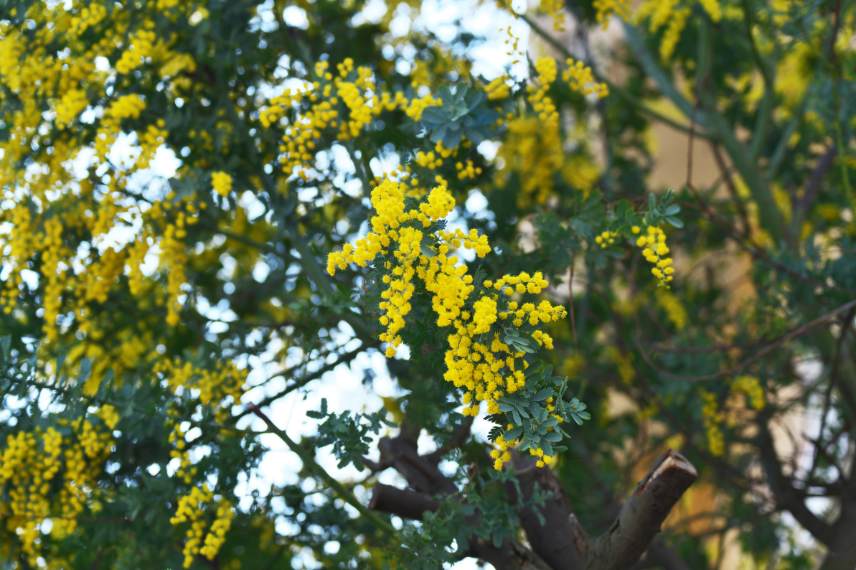
Bailey’s mimosa
Of course, the mimosa is a frost-sensitive shrub that thrives only in mild climates. It should be planted in a location well sheltered from cold winds.
The variety ‘Songlines’ stands out for its young purple shoots that turn bluish-grey and then grey-green with maturity. As for the variety of Acacia baileyana ‘Purpurea’, it offers young silver-blue foliage tinged with purple and lilac.
How to grow it?
Besides full sun and a well-sheltered exposure, this mimosa needs perfectly drained soil. However, the nature of the soil is of little importance to it. It can be grown in a pot. It thrives when planted alone or in a border.
Yellow bush flax (Reinwardtia indica)
Don’t be intimidated by the very low hardiness (-4 °C) of the yellow bush flax (Reinwardtia indica)! In fact, it adapts perfectly to pot cultivation, allowing it to be kept in winter in a greenhouse, an unheated conservatory, or a winter garden. This small bush needs a temperature of around 10 °C to flower in winter. It will spend the beautiful season outdoors. In the Mediterranean region, it can obviously be planted in the ground.
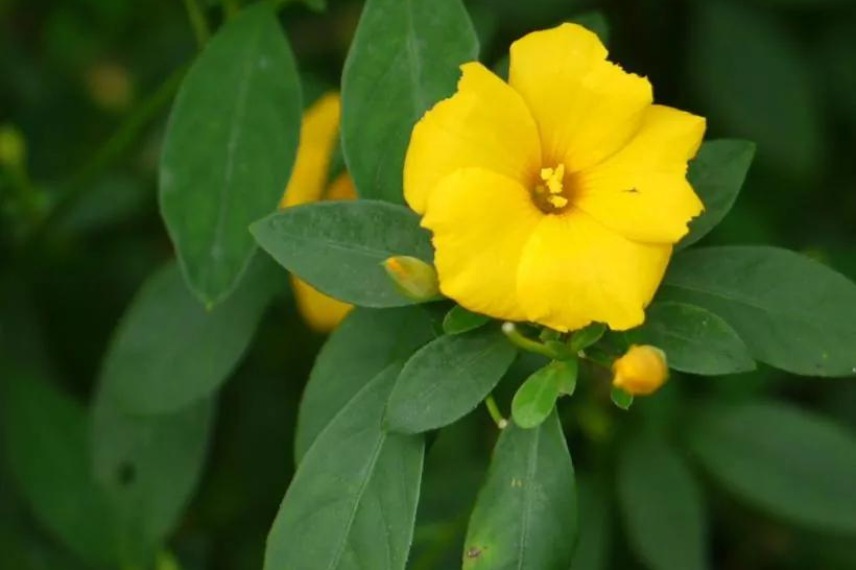
The yellow bush flax
Reaching no more than 1 m in height with a spread of 60 cm, this small bush, native to northern India and southern China, takes on a bushy and ramified form, both upright and trailing. Its foliage, semi-evergreen to evergreen, is oblong and veined, with a rich green colour. However, it is especially its bright yellow flowering that captures attention in the heart of winter, from December to April. The flowers consist of 5 overlapping petals and fill the air with a slightly vanilla scent.
How to grow it?
When grown in a pot, this yellow bush flax thrives in a fertile, well-drained, and cool substrate, made up of garden soil, potting mix, and coarse sand. To ensure it flowers, it needs a bright location with a few hours of sunlight per day in winter, and a partially shaded exposure during the beautiful season. Pruning after flowering is essential to maintain a compact clump.
To find out more
Also discover our article: Exotic bushes with lush foliage: for a garden that transports you!
- Subscribe!
- Contents
Comments