





























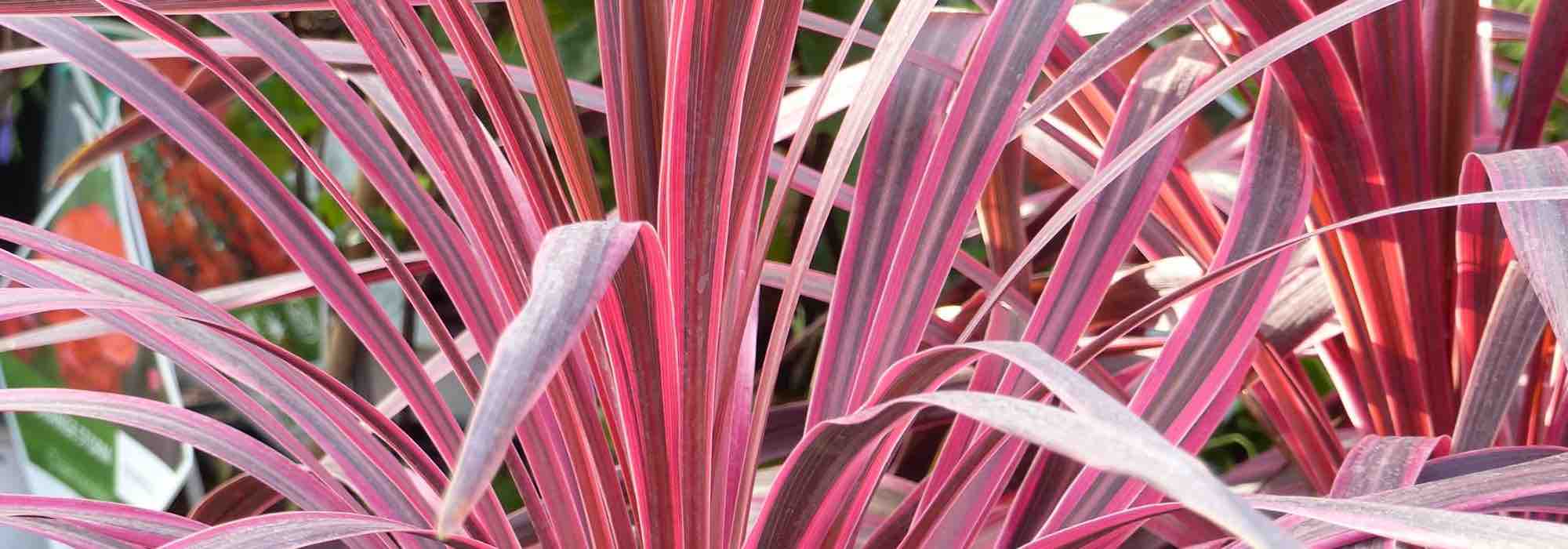
5 Purple-leaved Cordylines
Electric colours all year round
Contents
Plant native to New Zealand and the South-West Pacific, Cordyline, also known as Dracaena, is a perennial with evergreen foliage, decorative all year round, that brings graphic appeal and structure to the garden or in pots. Although its appearance suggests it thrives in dry soil, it appreciates a bit of moisture at its base, while preferring a sunny position. Once well established, it tolerates drought and high temperatures. Not very hardy, depending on the species and varieties, it can withstand light frosts, always below -10° C, often only around -5° C to -8° C, for an established plant in good conditions: no excessively wet winters, well-drained soil, and sheltered from prevailing cold winds. It grows well in pots and can easily be brought indoors in winter, either in a conservatory or even as a houseplant in a bright location.
Varieties with coloured or variegated foliage are more sensitive to frost than those with solid green foliage, and their leaves are also more quickly scorched by harsh sunlight. A position in partial shade is more suitable during the hottest hours and seasons. With a very exotic appearance, Cordylines offer a stunning array of colours. Discover here those with foliage in shades of purple, pink, and violet, whether solid or variegated, in the most vibrant and often electric hues.

Cordyline banksii 'Electric Pink'
The Cordyline banksii ‘Electric Pink’ lives up to its name as its foliage is adorned with a bright, almost fluorescent pink outer margin, beautifully contrasted with the interior of the leaf, which is purplish-brown. It forms a bush that produces several densely packed tufts without a trunk. This is a hybrid of the cabbage tree or Cordyline x banksii. It can be found in nature in various habitats, often along the coast and in the low-altitude mountains of New Zealand. It forms an upright, bushy shrub that never becomes bare, unlike Cordyline australis.
Its tuft of narrow leaves, some upright and others more arching, gives an impression of colour that is both quite dark and very bright, with the bright aspect prevailing, especially when the sun shines on the plant, when the pink margin expresses its full fluorescent and electric potential. Decorative all year round, it flowers when mature. From May to July, its airy cream-white flowers are borne on long spikes above the foliage. It reaches 1.5 m in all directions. Plant it in full sun in a rockery, a border, or a pot. It tolerates temperatures down to -8° C. Plant it in a rounded pot to soften its shape and surround it with a small blue Senecio like the Senecio serpens ‘Blue Chalk’, which perfectly highlights its pink-purple colour.
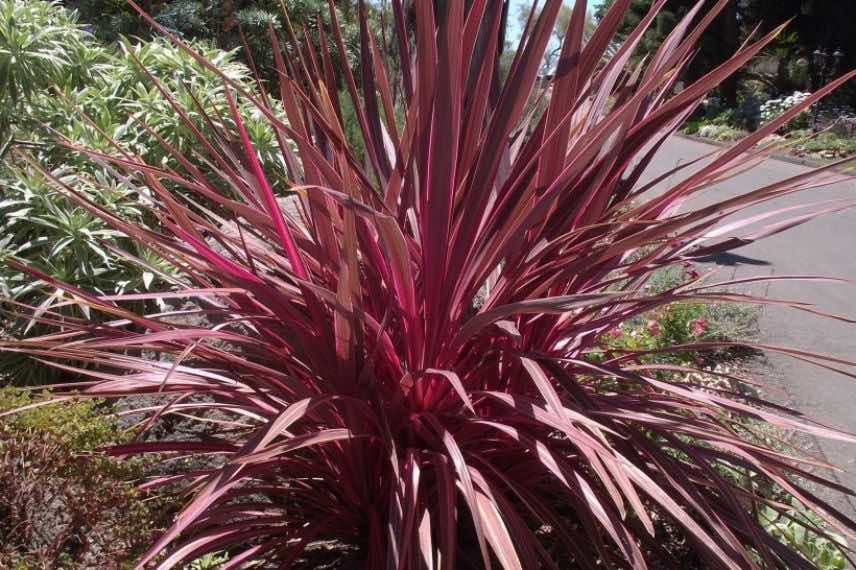
Cordyline banksii ‘Electric Pink’
Read also
Cordyline : to plant, to grow, to careCordyline obtecta 'Superstar'
Superb variety with very dark non-variegated foliage, the Cordyline obtecta ‘Superstar’ develops a tuft of broad, glossy leaves in a stunning dark red-purple, varying from purplish to brownish depending on the light. The shine of its leaves particularly complements the colour of its foliage. Its tall palm-like appearance, with long, upright, and slightly arching leaves that are particularly wide, combined with its dark colour, gives it a lot of style and distinction.
This upright variety, with its slender silhouette, reaches a height of 1.50 m and a width of 80 cm. It withstands frost down to about -8° C for an established plant. Use its beautiful dark colour in contrast with the bright green foliage of small grasses or gramineous plants like Ophiopogon planiscapus, or Carex elata ‘Aurea’, in fresh soil. In drier soil, pair it with a variegated spurge, such as Euphorbia characias ‘Tasmanian Tiger’.
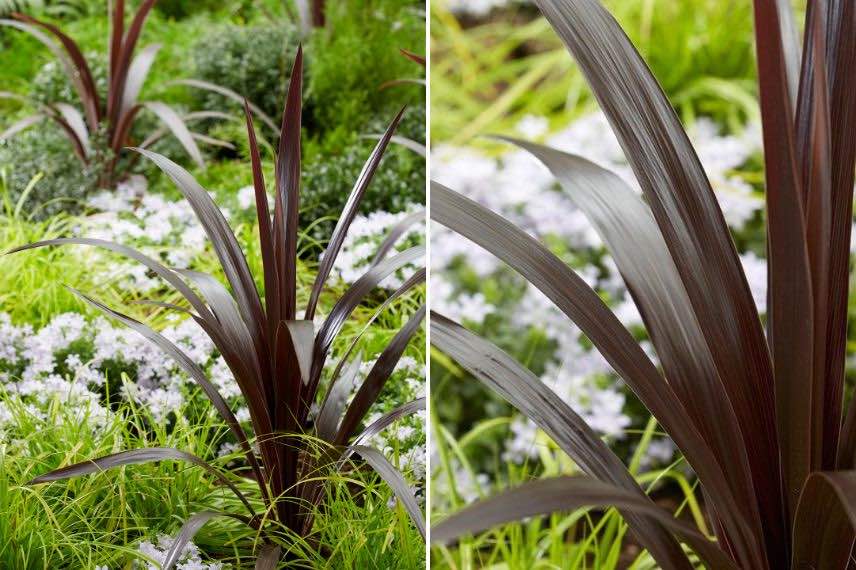
Cordyline obtecta ‘Superstar’
Cordyline australis 'Charlie Boy'
Boasting beautiful ornamental qualities, Cordyline australis ‘Charlie Boy’ is also noteworthy for its resistance to cold, damp conditions. Its purple foliage alternates with bright pink parallel veins that illuminate the clump from its centre. This variety can withstand frost down to approximately -10° C once established. It has a rosette habit during its early years, then develops into a small tree with a single trunk and branches adorned with leafy tufts. This variety typically reaches a height of 1.50 m, with a spread of 80 cm. Its leaves are long and narrow, sword-shaped, pointed, slightly arched, measuring up to 80 cm in length and 3 to 7 cm in width at the base.
In the Atlantic climate, which it particularly enjoys, it can be planted in the ground year-round, in full sun. Plant colourful tulips at its base in similar or contrasting tones and enjoy its beautiful brown-red-pink hues.
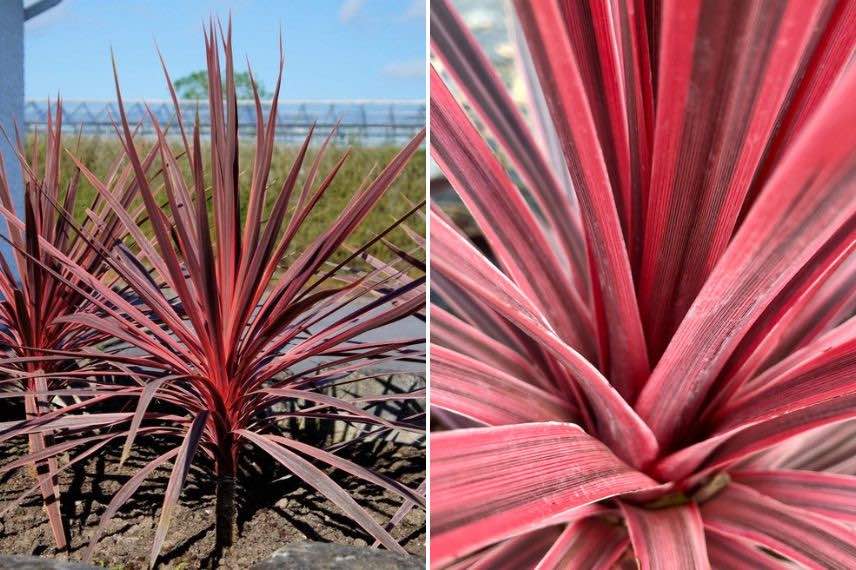
Cordyline australis ‘Charlie Boy’
Read also
Combining CordylineCordyline australis 'Cherry Sensation'
The Cordyline australis ‘Cherry Sensation’ features pink to cherry red foliage, beautifully striated with a colour between olive green and bronze, and a lighter, cream central margin. It has a small palm-like shape with a short stipe and a graphic rosette of stiff, then arching leaves. It reaches 2 m in height and 1.5 m in spread. The small flowers of Cordylines, which are cream-white to pink, are melliferous and delicately scented, borne on large, dense panicles that measure up to 1 m long and remain decorative for a long time. They appear here in May and June.
Not very hardy, it withstands frosts of around -3° C, and occasionally -6° C. Plant it in a rounded pot to bring indoors in winter, with small perennials at its base to protect the soil and keep it cooler. Consider small pinks for example.
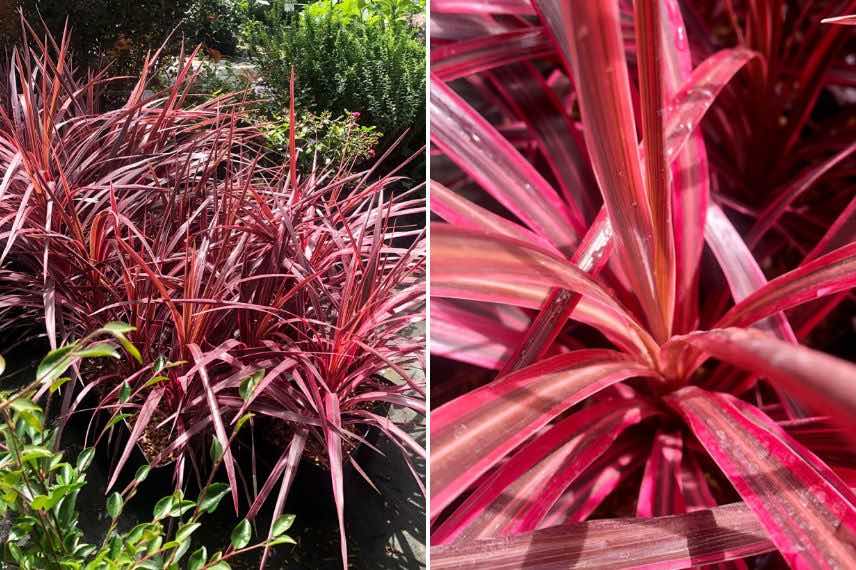
Cordyline australis ‘Cherry Sensation’
Cordyline australis 'Southern Splendour'
Cordyline australis ‘Southern Splendour’, also featuring an electric colour, is distinguished by slightly more muted and softer shades. Its long, very thin leaves have grey tones, with a grey-purple centre and electric pink margins. This variety remains quite narrow, reaching 2 m in height with a spread of 1 m at maturity. After flowering, which occurs here between July and September, the fruit of the Cordylines is a round white berry, highly appreciated by birds.
Plant ‘Southern Splendour’ in the ground where frost does not exceed -7° C in winter. Pair it with a beautiful grass such as Muhlenbergia capillaris, which offers lovely pink flower spikes, harmonising beautifully with the cordyline.
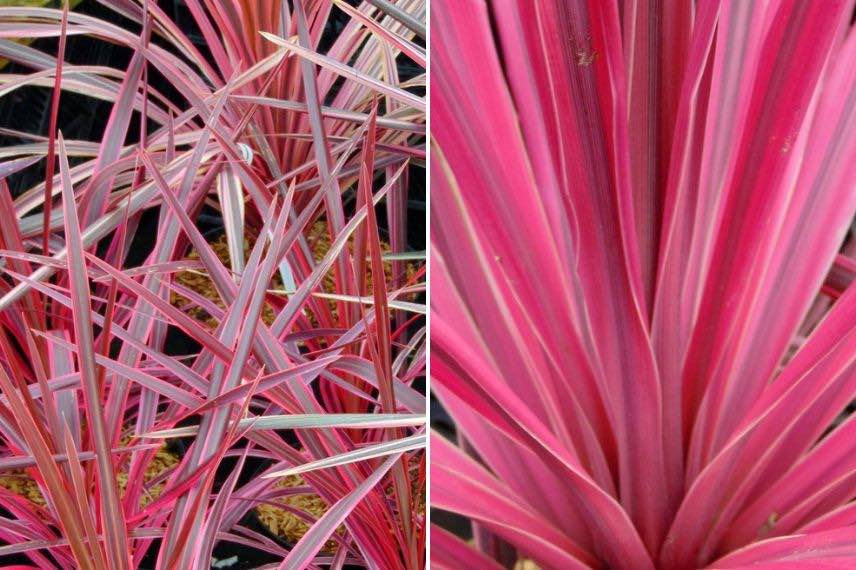
Cordyline australis ‘Southern Splendour’
- Subscribe!
- Contents
Comments