



5 rose bushes with bi-coloured flowers for an elegant and original garden
Selection of bi-colour or multicoloured roses
Contents
Garden must-have flowers, roses enchant us with their flowering in a variety of shapes and colours, their diverse silhouettes and their delightful fragrances. Less well known, two-tone roses have the appeal of changing colours, which lends them a certain originality. Discover a selection of two-tone or multicoloured roses to try in your garden or on your terrace.

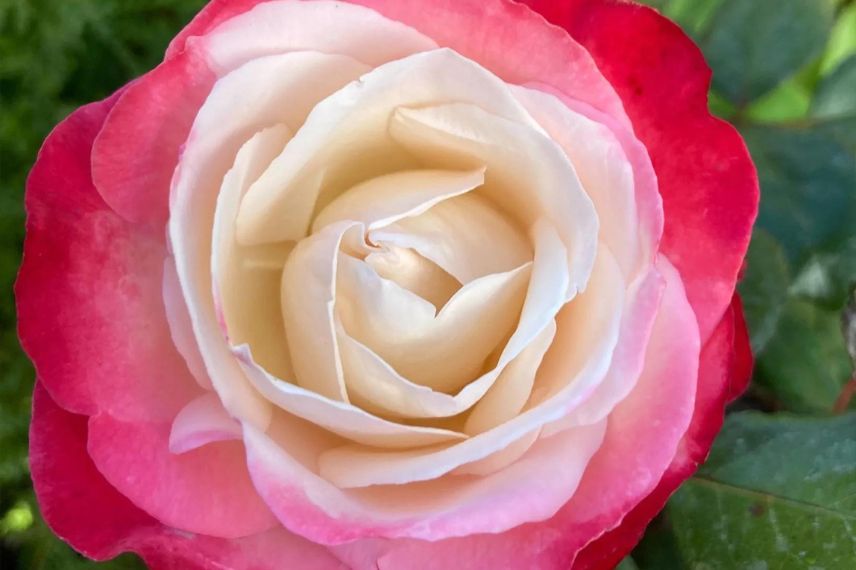
Large-flowered rose 'Nostalgie'
The large-flowered rose ‘Nostalgie’ stands out for the elegance of its turbinated roses, the delicacy of its red and white colours and the appeal of its fragrance. Reaches 80 cm in height at maturity, this repeat-flowering rose is a variety that blooms for long months, from June to October. It bears flowers with a perfect form, with a cream-colour heart enclosed in white petals edged with cherry red. The dark green foliage is healthy and offers very good disease resistance. Fast-growing, its stems and leaves are sturdy and studded with large brown thorns. The stems and leaves emerge bronze-red before turning dark green. The flowers consist of 40 petals and eventually measure 8 cm in diameter. They take the form of cherry-red buds before opening into a cream-coloured heart surrounded by a corolla of petals marginated with red. The flowers may be solitary or grouped in threes.
Hardy to −23°C, this vigorous rose should be planted in full sun or partial shade, in not-too-heavy soil, well-worked and rich. Note that it dislikes calcareous soils. To obtain a good flowering, prune it like all repeat-flowering roses in three stages: a maintenance prune during the season, an autumn pruning and a spring pruning. This rose forms a small flowering shrub with shimmering colours to be placed as a solitary specimen on a lawn or in a pot. It can also be planted in a border alongside white gypsophila or in front of a small boxwood hedge.
Read also
9 highly fragrant red rosesThe botanical rose bush - Rosa chinensis 'Mutabilis'
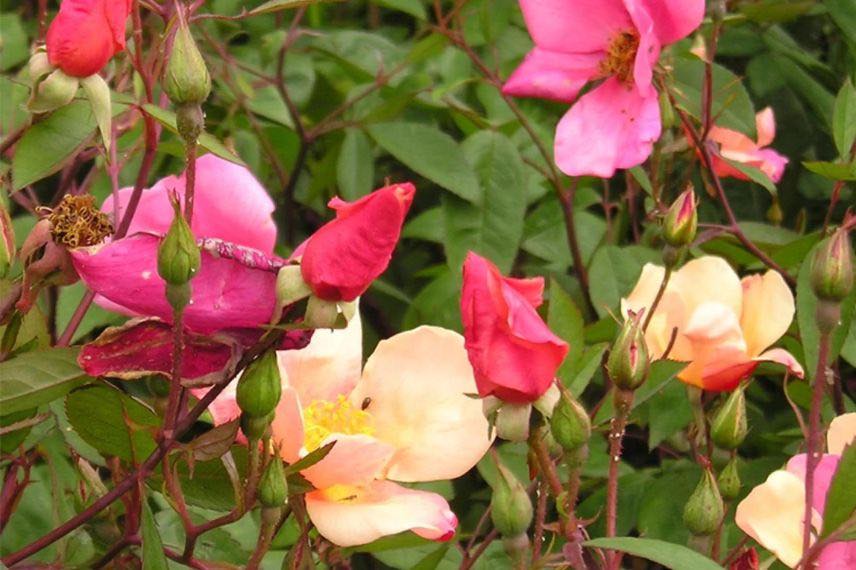
The China rose – Rosa chinensis ‘Mutabilis’ grows to a height of 1.70 metres at maturity, with striking colour-changing hues—from yellow to pink-magenta and salmon. Another irresistible feature is that it flowers from May to October, and its light flowering evokes a multitude of butterflies in soft, shimmering colours. Its 6 cm diameter flowers resemble dog roses. They start yellow, then turn to salmon pink and take on crimson red with coppery purple. This small climbing shrub has light, semi-evergreen, dark-green, glossy foliage. Its airy habit adds grace to a garden. Fast-growing, it has a broad, rounded habit and is only lightly thorny. Young shoots emerge bronze-purple.
This China rose can withstand temperatures down to -15°C in well-drained soil. It appears healthy, sturdy and drought-tolerant. It can be planted in full sun or partial shade, and even in poor soil, provided it is deep and well-drained. It is pruned lightly once a year. Heavy pruning is not advised as it distorts the wild, natural habit of this rose. It can be planted as a specimen plant or incorporated into an informal hedge or a romantic border. Try pairing it with an old-rose Complicata or Rubrifolia bush.
David Austin rose 'The Alexandra Rose'
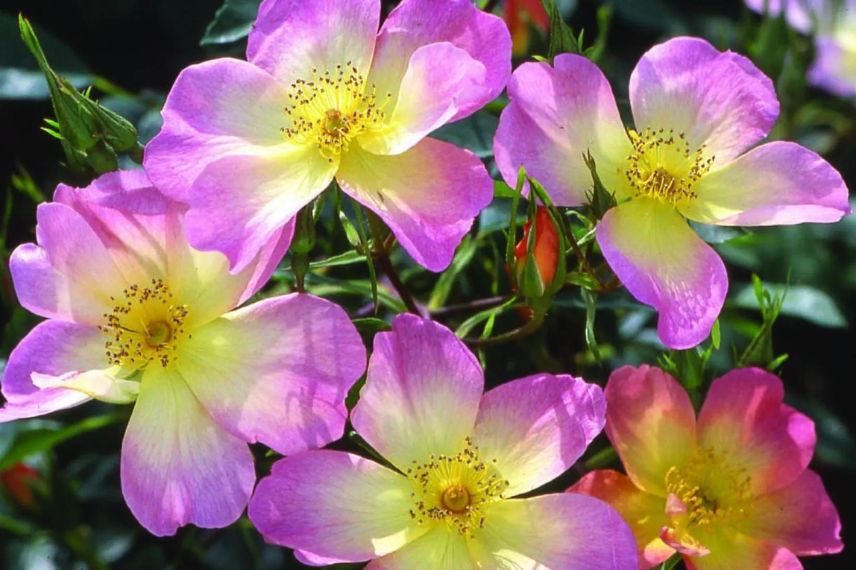
The English rose David Austin ‘The Alexandra Rose’ exudes a wild charm and changing colours. This 1.35 m tall shrub at maturity flowers from June to October. It bears orange-pink buds that open into single dog-rose flowers. Initially coppery pink and golden yellow, they fade to a fresh pink. These colours provide a beautiful range of tones. The shrub produces bouquets of flowers in a soft and warm palette with a lightly musky scent. The foliage is bright green and healthy. It resists diseases well.
This variety is both charming and hardy. It is hardy down to -23°C and will tolerate sun or partial shade. Give it well-prepared, rich and well-drained soil, with no excess lime. Prune at the end of winter and remove faded blooms as they appear to encourage new flowering. This rose fits harmoniously into an informal hedge or in a garden with a naturalistic feel. Pair this rose with other large flowering climbing plants or with other botanical roses such as Rosa chinensis ‘Mutabilis’.
Read also
5 climbing roses with yellow flowersDwarf rose 'Bordure Camaïeu'
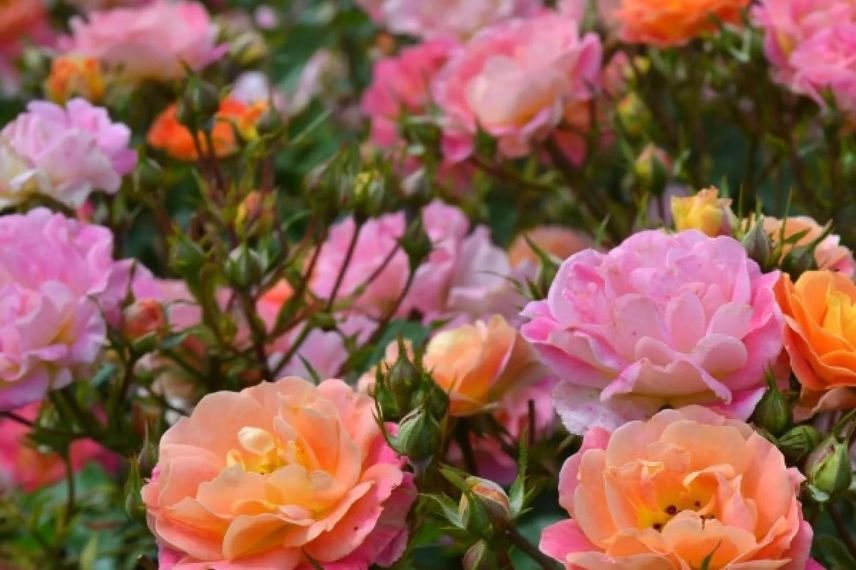
Dwarf rose ‘Bordure Camaïeu’ is a reliable choice that offers a lovely palette of yellow, orange and pink colours. Dense and floriferous, it produces small 4 cm blooms in abundance, from May to October. In a mantle of glossy dark green foliage, clusters of double, multicoloured roses appear, where warm and joyful tones mingle. With a compact, bushy habit, it forms a dome of blooms. The foliage is healthy and borne on thorny stems. This is a Delbard selection. It is hardy to -23°C.
Reaching 50 cm at maturity, it can be planted in a border, at the front of a bed or in a rockery. It can serve as ground cover provided you plant it in groups of three. It prefers deep, loose, fertile and moist soils. It should be planted in full sun. Remember to feed it with fertiliser to encourage flowering and to regularly deadhead spent blooms. It is pruned once a year. You can pair it with hardy geraniums, campanulas or other Bordure dwarf roses.
Climbing rose 'Bohème'
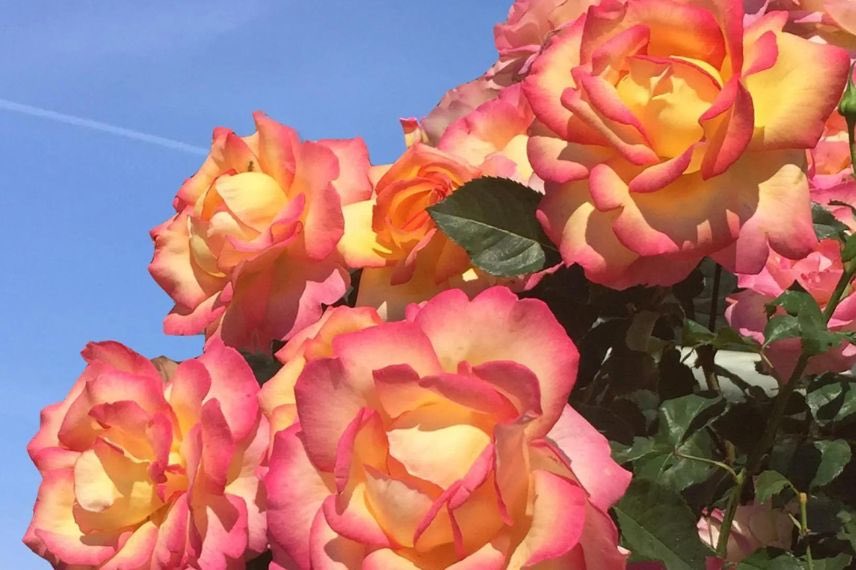
The climbing rose ‘Boheme’ can reach a height of 2.25 metres and bears yellow, red and pink roses from June to October. The flowers are of generous size, with a diameter of 12 cm, opening on abundant dark green, glossy foliage. They open in amber-yellow edged with cherry red, then fade over time. They emit a light fragrance and are grouped into cut flower arrangements, providing a massed effect. The woody climbing stems are flexible and can be trained on a trellis. They are green and armed with sharp, reddish prickles.
Hardy to -20°C, this climbing rose is easy to grow and vigorous. The foliage is highly resistant to diseases. It can be planted in full sun in cool soil to dress a gate, a pergola or a wall. It prefers deep, fertile and cool soils. Avoid exposures that are too hot facing south or west. In drought, flowering stops and restarts in autumn. To prevent powdery mildew, plant it in a not-too-confined spot where air can circulate. It is recommended to prune it once a year. This climbing rose pairs well with buddleias and white lilacs.
For further reading, see our full range of roses as well as our guide on the best rose varieties and how to grow them.
- Subscribe!
- Contents

Comments