


5 Wisterias to grow in pots
Compact varieties for growing, even on a terrace, balcony or in a courtyard
Contents
Wisterias (Wisteria) are among the most popular climbing plants. Floriferous and vigorous, they enchant gardens with their coloured and fragrant clusters. Easy to grow, they allow you to quickly dress up a pergola, a porch, an arbour or a gazebo.
But this climbing plant can also be grown in a pot, to green terraces, balconies or small courtyards with little or no soil. It will require a fairly deep container, as well as a sturdy trellis to support its growth. The largest Wisterias can reach up to 15 metres in height. The varieties chosen for container growing should have more compact growth.
Here is our pick of five Wisterias ideal for pot culture.
For more, read our article on how to grow a Wisteria in a pot.

Japanese wisteria Wisteria venusta: delicate flowers of pure white
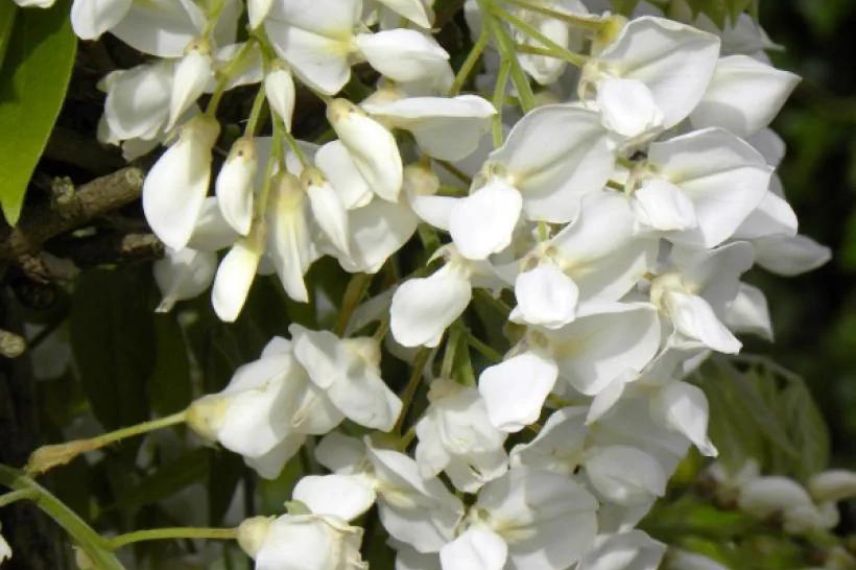
The Japanese wisteria Wisteria venusta (or Wisteria brachybotrys) is a smaller-spreading variety than some of its relatives. It reaches at maturity about 4 metres in height and 3 metres in spread, but pot-grown cultivation will usually reduce its dimensions. It is among the least vigorous wisterias, ideal for growing in small spaces.
If it is also known by the names ‘silky wisteria’ or ‘graceful wisteria’, it is certainly in honour of its delicate flowering. The clusters are fairly short, reaching around ten centimetres in length. They consist of fragrant papilionaceous flowers, whose petals feel as soft as silk. In colour terms, it features a slightly cream-white, very bright and refined hue. As with all wisterias, they are melliferous, attracting a veritable ballet of pollinating insects. These flowers appear in late spring, between May and June. They then give way to large pods.
The foliage divided into leaflets adds a touch of exotica. The leaves are slightly downy on this wisteria.
On a terrace, in a small courtyard or on a balcony: Wisteria venusta will inevitably bring a romantic and poetic touch. In an uncluttered setting, it will be perfectly showcased and will suffice to dress the space.
Hardy to -20°C, it will thrive in sun or partial shade, sheltered from prevailing winds. Provide it with well-drained soil (that does not retain excess water), rich and non-calcareous. This wisteria also has the advantage of developing a trunk with less risk of damaging its support in the long term.
Read also
Wisteria: how to plant, prune and care?Wisteria x venusta 'Grande Diva Cecilia': a cascade of double flowers
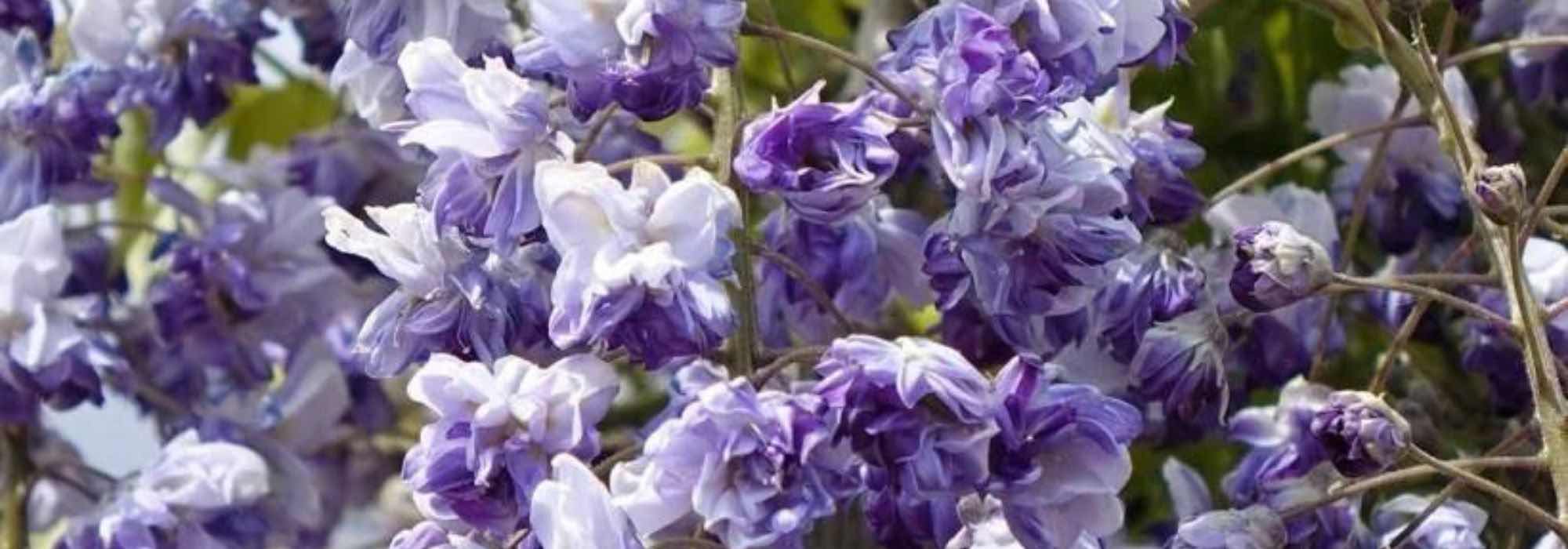
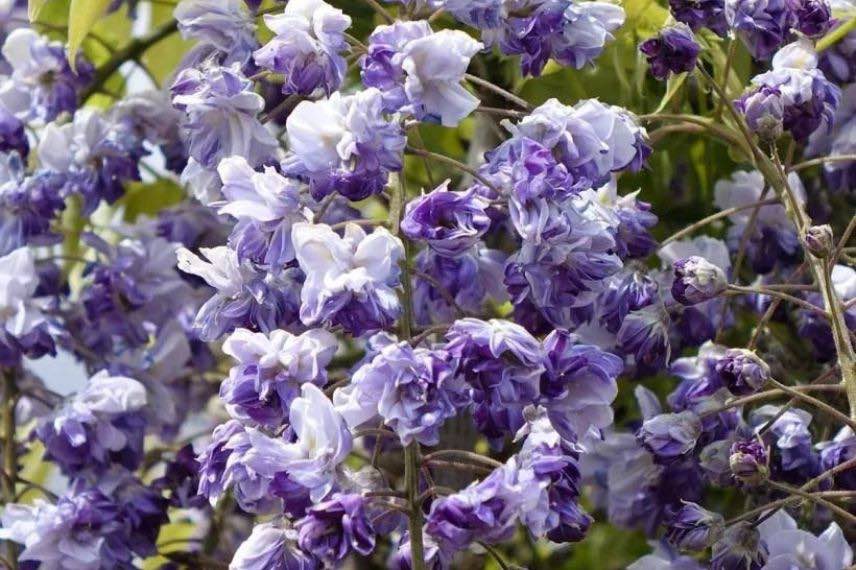
The Wisteria ‘Grande Diva Cecilia’ is a hybrid variety that develops more moderately than other cultivars. Grown in a container and if pruned, it can be limited to 3 metres in height with an equal spread.
In late spring, between May and June, it rewards us with generous clusters of bi-colour flowers, blending blue-violet and white. They add a pretty touch of originality. These flowers are also notably double, consisting of numerous petals forming opulent clusters around twenty centimetres long. The flowering is also fragrant. Another advantage of this variety: flowering begins fairly quickly, from the early years of cultivation.
The foliage, with pale bronze-caramel tones, will then turn green. It provides a handsome contrast with the flowering.
This wisteria will naturally climb up a trellised wall, a railing or a pergola, lending a truly delicate and romantic touch. Less vigorous than other species, it is less likely to damage the supports it uses.
In terms of cultivation, it is an easy-to-grow, hardy plant that tolerates even occasional drought.
American wisteria Wisteria frutescens ‘Amethyst Falls’: a compact variety ideal for small spaces
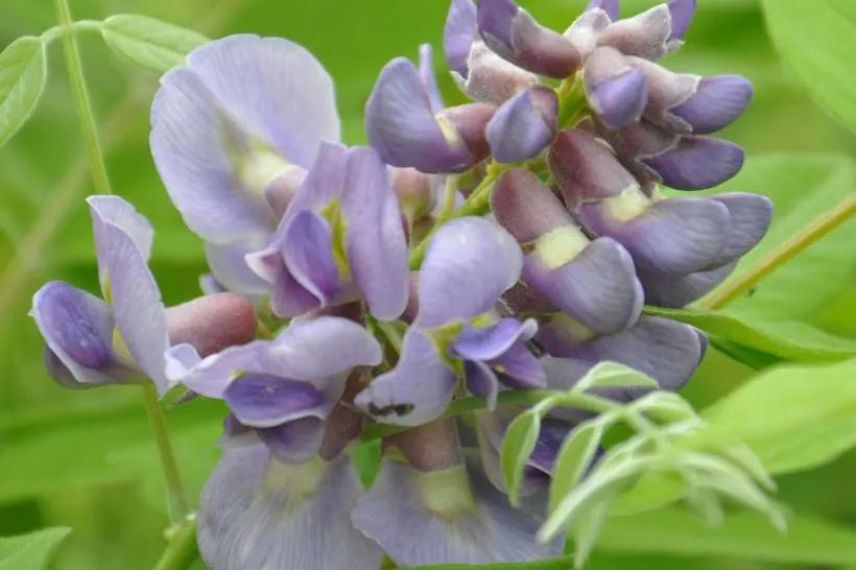
Wisteria frutescens ‘Amethyst Falls’ is an ideal plant for pot culture on a terrace, balcony or any other small outdoor space. It has, in fact, a moderate growth habit and a compact silhouette, reaching up to 5 metres in height with a spread of just 2.5 metres.
This American wisteria flowers from late spring to early summer, between May and July. But it is also repeat-flowering. If pruned, it will flower a second time in late summer, though somewhat more irregular.
It produces generous, dense flower clusters, up to around 20 cm long. They consist of flowers in a very pale mauve colour and delicately scented.
Unlike its Chinese cousins, flowering is fairly quick, but its fragrance is far less intense.
The foliage is initially bronzy before taking on its final light-green colour.
The twining stems of this climbing vine will readily take hold of a porch, an arch, a fence or a post. Easy to grow, it will thrive in well-drained, deep soil, even if poor and occasionally dry.
It boasts good hardiness down to -20°C.
Discover also the variety ‘Longwood Purple’, another American wisteria with more intense purple flowering.
Read also
Choosing your wisteria: buyer's guideJapanese wisteria Wisteria venusta 'Rosea': a very soft pink flowering
The Japanese wisteria ‘Rosea’ is distinguished by a pink flowering with mauve undertones, adding a particularly delicate splash of colour. It is in late spring that it reveals its pretty clusters of flowers about twenty centimetres long, fragrant.
It will be ideal as a potted plant on the terrace, thanks to its modest dimensions (5 metres high and 3 metres spread).
Its only drawback: it takes a little time to establish itself and to flower.
Provide it with rich, deep and well-drained soil, in sun or partial shade.
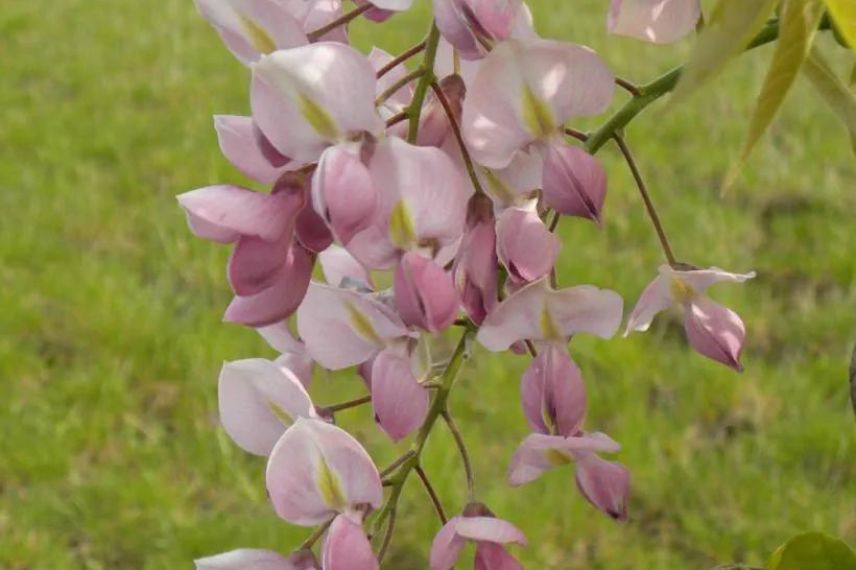
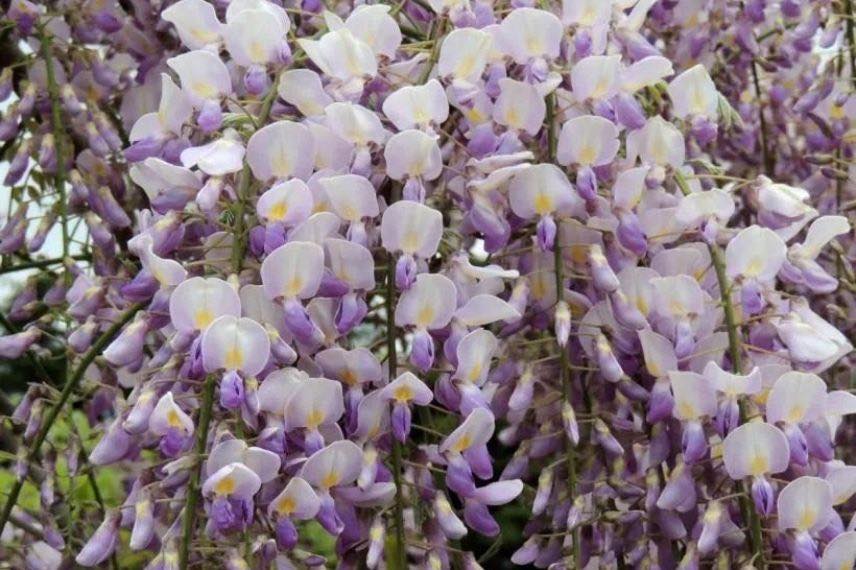
Wisteria (x) venusta 'Grande Diva Maria': bi-coloured, fragrant clusters
‘Grande Diva Maria’ graces us with an original bi-colour flowering, pairing pale mauve-lavender with white. Clusters appear at the end of spring, between May and June. They also benefit from a powerful and indulgent vanilla fragrance. Flowering is rapid and the clusters arranged evenly along the full height of the plant, allowing the creation of a beautiful colour screen. Its foliage is bronzy at first before turning green.
This liana makes a perfect outdoor pot plant, thanks to its moderate size. It can be easily pruned to keep it contained and not exceed 3 metres in any direction. As its sister cultivar ‘Grande Diva Cecilia’ mentioned earlier, it also presents less risk of damaging the supports on which it will be trained to climb.
In the same collection of hybrid Wisterias, also discover ‘Grande Diva Nathalie’ and ‘Grande Diva Barbara’.
- Subscribe!
- Contents
Comments