





























6 shrubs for early winter flowering
For flowers in the garden, on the terrace or balcony even during the cold season
Contents
Winter is rarely the favourite season for gardeners: most plants are dormant, and flowers and colours become scarce. But let’s not forget that during this cold season, some plants stand out by showcasing their most beautiful aesthetic features: colourful wood, decorative fruiting, or even abundant flowering. Some shrubs indeed wait for the start of winter to flower, brightening the shortest days and energising the garden, balcony, or terrace.
Here is our selection of 6 winter-flowering shrubs, which reveal themselves between December and mid-February.

Camellia sasanqua 'Hinode-Gumo': large fragrant flowers
‘Hinode-Gumo’ is a variety of autumn camellia (Camellia sasanqua) native to Japan and China. It blooms from late autumn to early winter, between December and February.
This shrub rewards us with large single flowers measuring 10 cm in diameter. The slightly crinkled petals are adorned with white tinged with pink at the edges. At the heart, a nest of bright golden stamens is revealed. This camellia, with its elegant and natural charm, also offers a pleasant fragrance.
‘Hinode-Gumo’ quickly forms a beautiful bushy shrub with evergreen foliage, which has the advantage of remaining in place all year round, even in winter. Its dark green colour contrasts wonderfully with the lighter flowering, adding a lovely touch of brightness. At maturity, it reaches 2 to 3 metres in height and about 1.5 metres in spread.
Plant it in isolation, near pathways to enjoy its fragrance, or in a bed with ericaceous plants. Container cultivation is possible if you choose a sufficiently large pot (at least 70 cm in diameter). This camellia can thus brighten up terraces and balconies during winter.
Hardy down to -10°C, even -12°C, this shrub can spend winter outdoors in most regions, as long as it is sheltered from cold, prevailing winds. You can also protect its base with a thick mulch. In regions with harsher winters, do not hesitate to bring it indoors to a frost-free room (conservatory, unheated greenhouse…). Provide it with a partially shaded position, in rich, well-drained soil (that does not retain excess water). Ensure that the substrate remains consistently moist, meaning damp but not waterlogged.
For more cultivation tips, discover our dedicated section: “Camellias: planting, pruning, and care.”
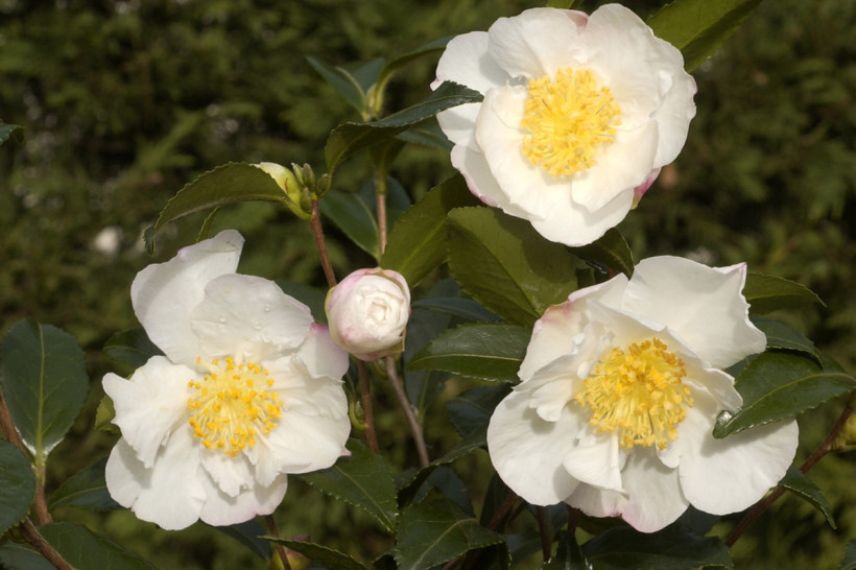
Camellia sasanqua ‘Hinode-Gumo’
Read also
Winter-flowering shrubsHamamelis intermedia ‘Diane’: a flowering that warms winter
Witch hazels, also known as “witch hazel bushes,” are often regarded as shrubs with a mystical charm. Their surprising flowering occurs in winter. The variety ‘Diane’ reveals itself at the beginning of the season, from December to February. Other varieties, such as Hamamelis (x) intermedia ‘Jelena’ or ‘Arnold Promise’, also bloom during the same period.
The astonishing flowers of this shrub consist of sorts of trailing filaments 2 to 3 cm long, gathered in a bouquet on still bare stems. They offer an appearance that is both tousled and delicate. After revealing its flamboyant autumn colours, the foliage indeed falls with the arrival of the cold season, leaving the flowers to put on the show alone. They display a warm garnet red colour that does not go unnoticed and exude a pleasant fragrance.
For its qualities, ‘Diane’ has been awarded an “Award of Garden Merit” by the prestigious British Royal Horticultural Society.
Growing rather slowly, this witch hazel will reach between 3 and 4 metres in height and spread after several years. In its early life, it can easily be grown in a pot on the terrace or balcony.
Easy to grow, this shrub is quite hardy (down to -20°C), low-maintenance and not very susceptible to diseases. Provide it with a sunny, but not scorching, exposure, or partially shaded. In terms of substrate, it will appreciate rather acidic soil (avoid calcareous soils) that remains moist. Plant it in a free hedge or a bed of evergreen ericaceous plants.
To learn more about growing this winter shrub, feel free to read our article “Witch hazel: planting, cultivation, maintenance and association.”
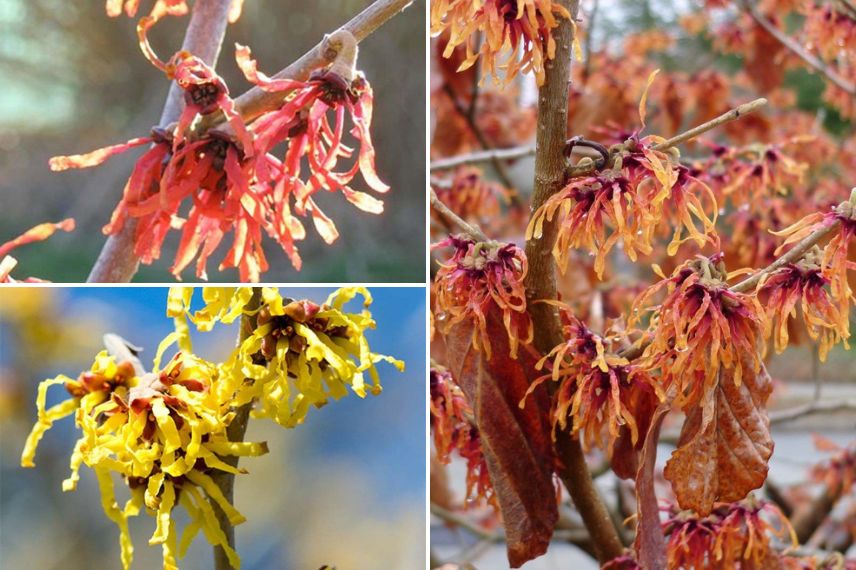
Hamamelis intermedia ‘Diane’, ‘Jelena’ and ‘Arnold Promise’
Discover other Winter-flowering shrubs
View all →
Available in 1 sizes
Available in 2 sizes
Available in 1 sizes
Available in 1 sizes
Available in 2 sizes
Available in 1 sizes
Available in 1 sizes
Available in 1 sizes
Available in 1 sizes
Mahonia (x) media ‘Winter Sun’: yellow flowers bringing light in winter
Mahonia, also known as “false holly,” is a bush with yellow flowers that blooms in winter. ‘Winter Sun’, like the variety ‘Charity’, shows the tips of its petals from the beginning of winter, in December and until February.
This bush is then covered with clusters of flowers nearly 30 cm long, displaying a soft, tender yellow. They are delicately scented, their fragrance reminiscent of lily of the valley. Once this sunny flowering is over, ‘Winter Sun’ reveals one of its other decorative assets: small blue berries that herald the arrival of spring and delight the birds.
Its spiky, finely cut foliage, with an exotic charm, persists all year round. Our mahonia thus remains ornamental in more than one way during winter.
Its silhouette reaches about 3 metres in all directions at maturity, after a rather slow growth. It adds a graphic yet lush touch to the garden. Incorporate it into a border, as a hedge, or showcase it as a specimen. Just avoid high-traffic areas to prevent frequent contact with its spiky foliage.
Grow this mahonia in shaded or semi-shaded conditions. Not demanding, it thrives in all types of fairly deep and not too compact (clay) soils. Quite hardy (down to about -15°C), it can be cultivated outdoors in most regions.
For more details, we recommend our guide “Mahonia: planting, pruning, and maintenance.”
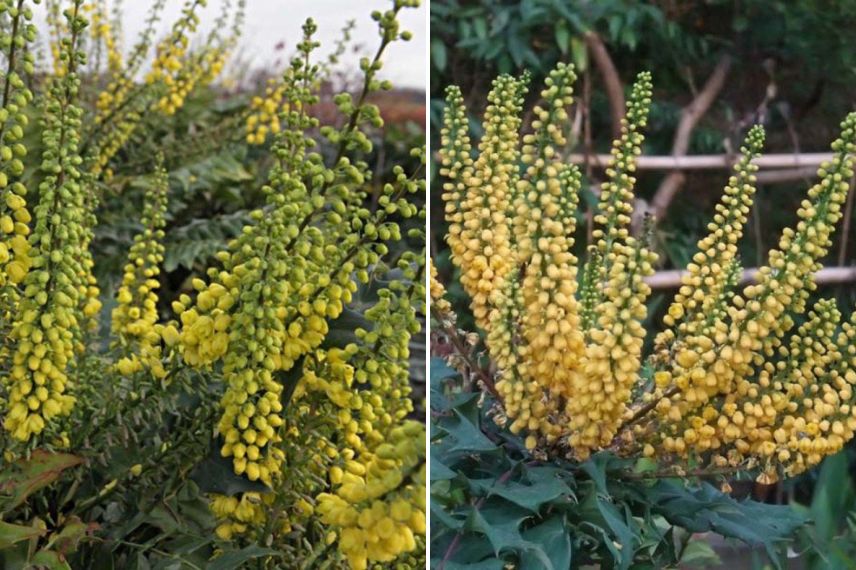
Mahonia (x) media ‘Winter Sun’ and ‘Charity’
Read also
9 autumn-flowering shrubsGarrya elliptica ‘James Roof’: a spectacular and unique winter flowering
‘James Roof’ is one of those winter-flowering bushes that cannot go unnoticed. From January to February, it produces long, pendulous inflorescences in silky aments, nearly 40 cm long, that sway gracefully in the wind. Their colours blend white, silver, and rose-purple. Surprising and unique, this winter flowering is accompanied by dark green evergreen foliage, with a velvety grey underside. This Garrya elliptica thus elegantly enchants the cold season.
Native to the west coast of the United States, it thrives in dry, mild climates. It can withstand frosts down to about -12°C. Easy to care for, it tolerates sea spray, drought, and even a small amount of lime in the soil. It will appreciate sunny or partially shaded positions in warm regions, always protected from prevailing winds.
This species is dioecious, meaning there are male plants, cultivated for their flowering, and female plants.
Our bush will slowly reach its ripeness over several years, attaining about 2.5 metres in all directions. Its bushy silhouette will be showcased as a specimen, in a large container, or in a free-standing hedge.
For more information, check our file “Garrya elliptica: planting, caring for.”
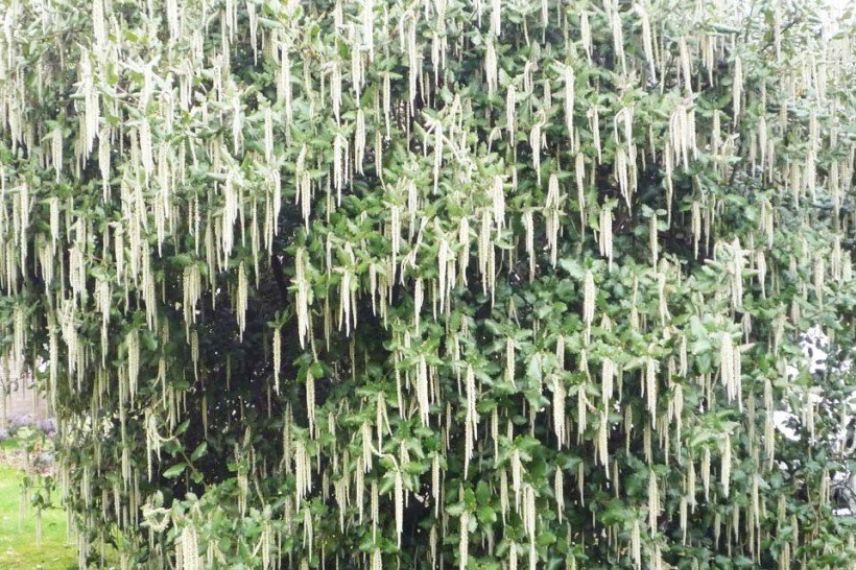
Garrya elliptica ‘James Roof’
Viburnum bodnantense ‘Dawn’: fragrant pink flowers
Here’s another fragrant bush with winter flowering: the Viburnum ‘Dawn’! If Viburnums are so popular, it’s because they have many qualities. Easy to care for, quite hardy, and generous, they decorate the garden in all seasons, whether through their flowering, ornamental berries, or colourful autumn foliage.
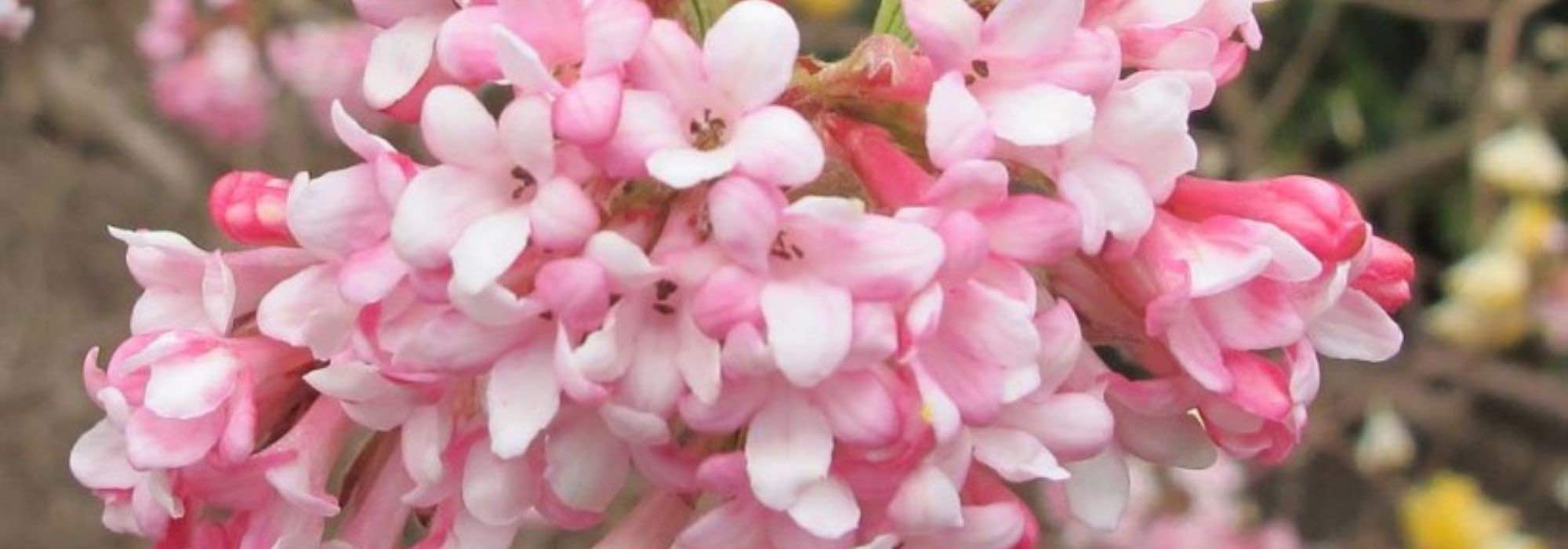
‘Dawn’ is perfect for adding a splash of colour in winter: from December to February, it reveals its inflorescences. The pink buds open into small tubular flowers grouped in a bouquet, in a white hue accented with pink touches. They contrast beautifully with the dark reddish-brown of the bare branches. This flowering emits a vanilla scent reminiscent of heliotrope, flowers that are prized in perfumery.
This Bodnant viburnum will thrive in full sun or partial shade. At maturity, it reaches about 2 metres in all directions. Plant it near pathways to enjoy its fragrant flowering during winter.
Find more growing tips in our section “Viburnum: how to plant, prune, and grow it.”
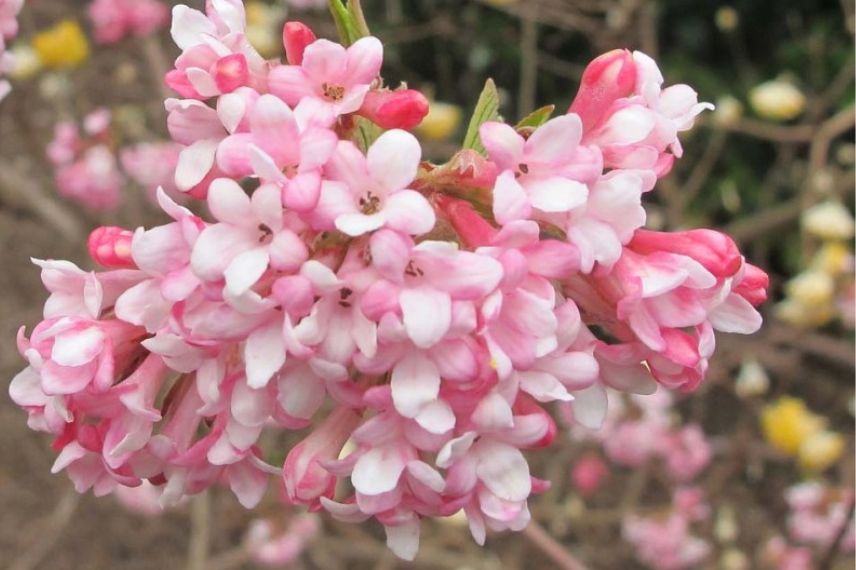
Viburnum bodnantense ‘Dawn’
Christmas heather: adorable pink-purple bells
The Erica canaliculata is notable for being larger than most other heathers: it reaches 1.5 metres in all directions at maturity, after a rather slow growth. It can be grown both in pots, to flower balconies or terraces in winter, and in the garden if it is not exposed to severe frosts. This heather has inherited a rather low hardiness (-6° to -8°C) from its South African origins.
Our winter heather flowers between December and February, providing us with a generous flowering that almost entirely covers its branches. It produces small bell-shaped flowers typical of the genus, in a lovely pink hue leaning towards violet. Sometimes covered in frost or snow in winter, this heather becomes a true Christmas plant that brightens the shortest days. It is a melliferous and fragrant bush, with a sweet scent reminiscent of soap.
Plant it in full sun in well-drained, even poor, rather cool soil. It thrives best along the Atlantic coast.
Discover more tips in the section “Heathers: planting, pruning and maintaining.”
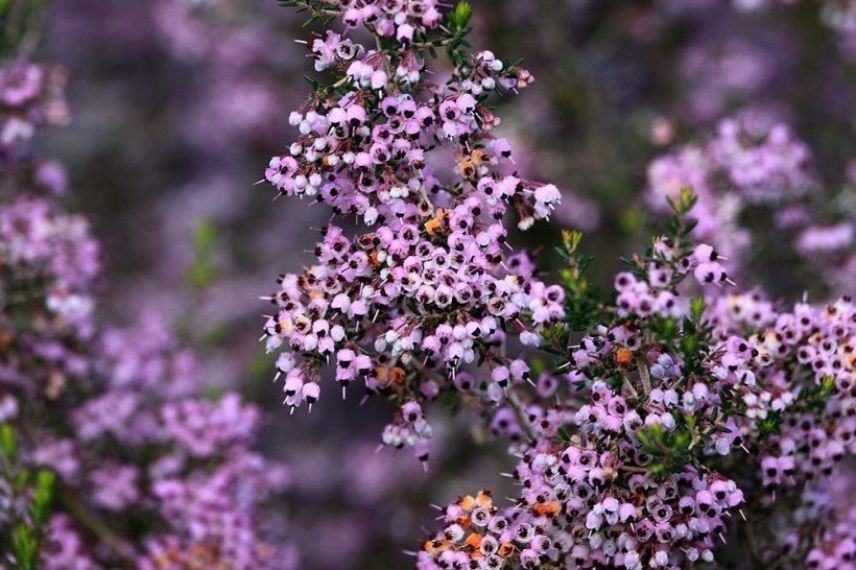
Erica canaliculata
- Subscribe!
- Contents
Comments