


6 fast-growing trees to quickly transform your garden
Our selection of fast-growing trees
Contents
Not all trees grow at the same rate: some, like Paulownia, poplar, or birch, are distinguished by their rapid growth. Choosing a tree that grows quickly allows you to achieve shade in no time or to structure a space. You may also need to plant a tree that grows fast to create privacy in the garden. A fast-growing tree offers an ideal solution for transforming a garden without waiting several decades. Some of them feature remarkable flowering, others have decorative foliage, an elegant silhouette, or unique bark. Want to know which tree grows the fastest? Here is a selection of 6 fast-growing species.

Paulownia: the fastest growing tree
Also known as the Empress Tree, the Paulownia tomentosa is a beautiful deciduous tree native to northern China and Korea. It features large heart-shaped leaves and offers a lovely purple flowering. The flowers appear in May-June, usually before the leaves. It then produces numerous bell-shaped, fragrant purple flowers, clustered together. It subsequently unfolds large cordate leaves, measuring between 15 and 25 cm in diameter, providing dense shade. The Paulownia forms a majestic tree with an elegant silhouette. It is certainly the fastest-growing tree. It can reach 5 to 7 m in height in just three years, and mature at a height of 10 – 12 m.
The Paulownia enjoys full sun but also grows well in partial shade, thriving in cool, rich, and deep soil. If possible, place it sheltered from the wind. Quite hardy, it withstands winter temperatures of around -15 to -20 °C. It is sensitive to wind, which can break its branches.
For more information, feel free to check our complete guide: “Paulownia, Empress Tree: planting, cultivation and care”
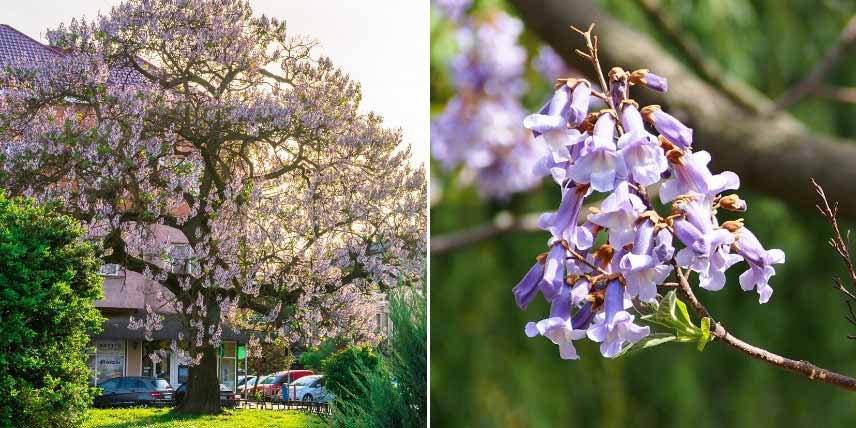
A Paulownia tomentosa in bloom, with a close-up of the flowering (photo: Agnieszka Kwiecień)
Read also
5 fast-growing evergreen treesThe Poplar: a fast-growing tree for large spaces
The poplar is a very large tree that grows quickly, suitable for parks and large gardens. They take on a pyramidal or columnar shape and bear deciduous leaves with a silver underside. As they grow rapidly, they have been extensively planted along roads and canals, or as windbreaks. The black poplar, Populus nigra, forms a tree with a dark, broad, and irregular silhouette, reaching up to 30 m in height. It has small triangular to diamond-shaped, dark green, glossy leaves, turning golden yellow in autumn. The variety Populus nigra var. italica, with a columnar habit, has been widely planted in France. It is immediately recognisable by its slender and very tall silhouette. During the first few years, it grows 60 cm to 1 m per year, reaching between 3 and 4 m in height after 5 years, and about 10 m at the age of 15.
Poplars thrive in full sun, in rich, cool to moist soil. The trembling poplar, Populus tremula, also adapts to sandy and poor soils. Due to their spreading and very running roots, it is advisable to plant them away from buildings.
Discover our complete sheet: “Poplar, Populus: planting, growing and caring”
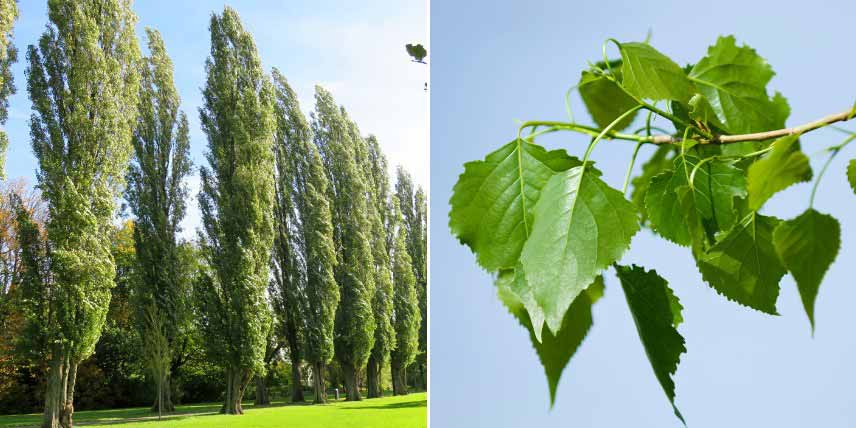
The Italian poplar, Populus nigra var. italica
Discover other Large specimen trees
View all →
Available in 3 sizes
Available in 4 sizes
Available in 5 sizes

Available in 6 sizes
Available in 6 sizes
Available in 3 sizes
Available in 4 sizes
Available in 3 sizes
Available in 5 sizes
Available in 4 sizes
White Willow: a fast-growing tree suited to wet soils
White Willow, also known as Silver Willow or Common Willow (Salix alba), is a large deciduous tree that forms a broad, rounded crown and bears long, flexible branches with lanceolate, fine and glossy leaves, with a silver underside. Its light foliage is appreciated for bringing brightness to the garden. The white willow is often pollarded, forming a swollen and relatively short trunk from which numerous young branches emerge. During the first 15 years, the white willow typically grows between 60 cm and 80 cm per year. At maturity, it can reach heights of 20 to 25 m, with a spread of about 10 m.
It is a fast-growing tree suited to moist soils. The white willow requires fresh to wet soil and is perfect for the edge of a water feature. It is best to plant it away from foundations and ducts, as its root system could damage them.
Our complete sheet: “Willow, Salix: plant, prune and maintain”
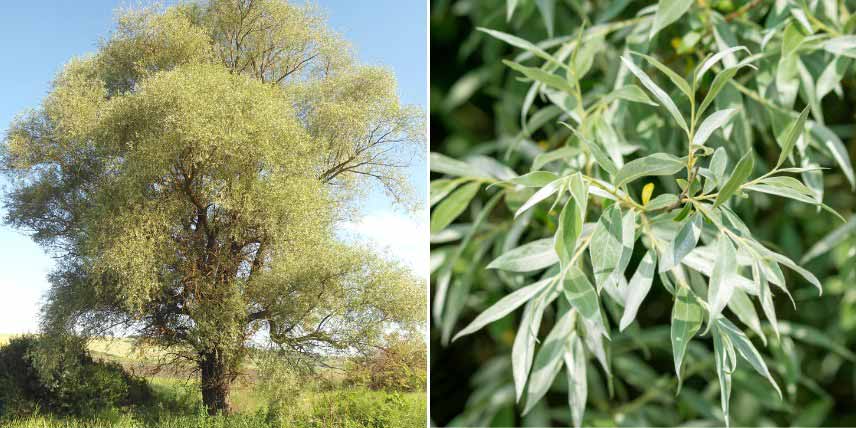
White Willow, Salix alba
Read also
10 shade treesBirch: a fast-growing tree with a light silhouette
Birches are large trees notable for their generally white bark, their light, flexible, and graceful silhouette, and their foliage that takes on lovely yellow or golden hues in autumn. The black birch, Betula nigra, is a fast-growing tree. It is one of the fastest-growing species: it typically grows 60 cm to 1 m per year. After 15 years, it can reach 10 m in height, ultimately reaching a height of 15 to 20 m, with a spread of about 10 m. It has beautiful bark that is initially yellow-brown in young specimens, turning brown with red hues, and exfoliating to reveal a smooth orange-grey trunk. It also bears lovely glossy green, dentate leaves that turn yellow in autumn before falling.
The birch is an easy tree to cultivate, thriving in fresh, fertile soils that are not too calcareous, and it enjoys full sun or partial shade. The black birch tolerates wet and waterlogged soils.
Discover our complete guide: “Birches: planting, pruning, and maintenance”
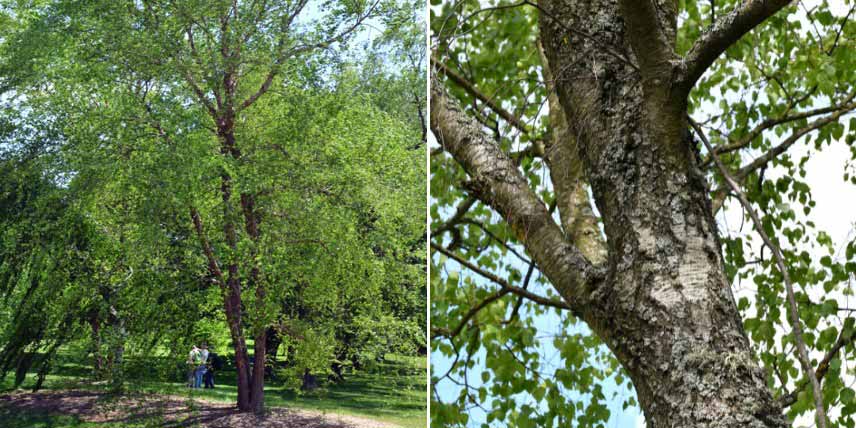
The black birch, Betula nigra (photos: Plant Image Library / Viacheslav Galievskyi)
Catalpa: a fast-growing tree for creating shade
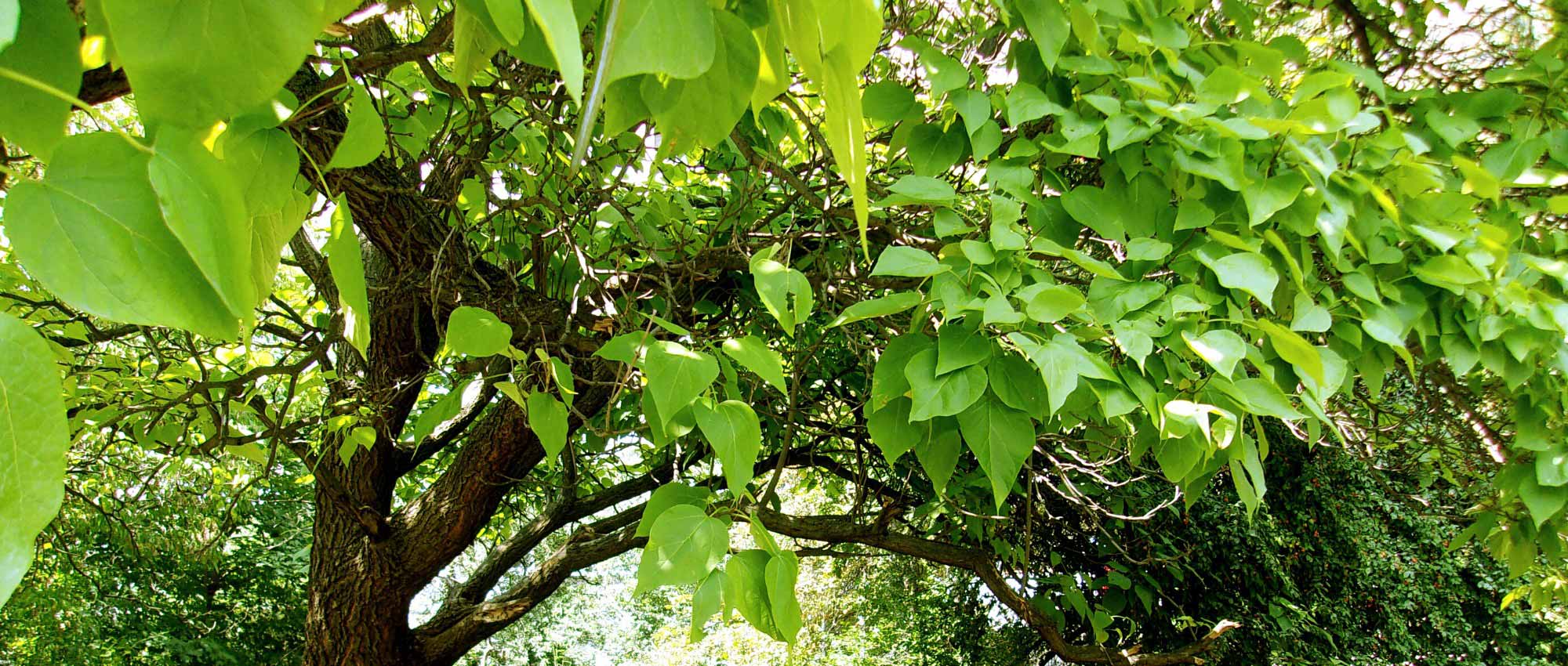
The Catalpa bignonioides is an excellent fast-growing tree that provides shade thanks to its spreading and rounded habit. It is often confused with the Paulownia mentioned earlier, as it also bears large, broad cordate leaves and has a very decorative flowering. The leaves of the Catalpa appear late in spring. They are heart-shaped, medium green, and turn yellow in autumn before falling. In summer, between June and August, the Catalpa produces beautiful clusters of white flowers. These are highly appreciated by pollinating insects. They are followed by long pods, first green then brown, measuring 20 to 50 cm in length. Growing very quickly, the Catalpa will reach a height of between 8 and 12 m after 10 years.
The Catalpa thrives in full sun, sheltered from strong winds. It prefers deep, cool, and fertile soils. Perfectly hardy, it withstands temperatures down to -30 °C.
To learn more about its cultivation, discover our complete guide: “Catalpa: planting, pruning, maintenance”
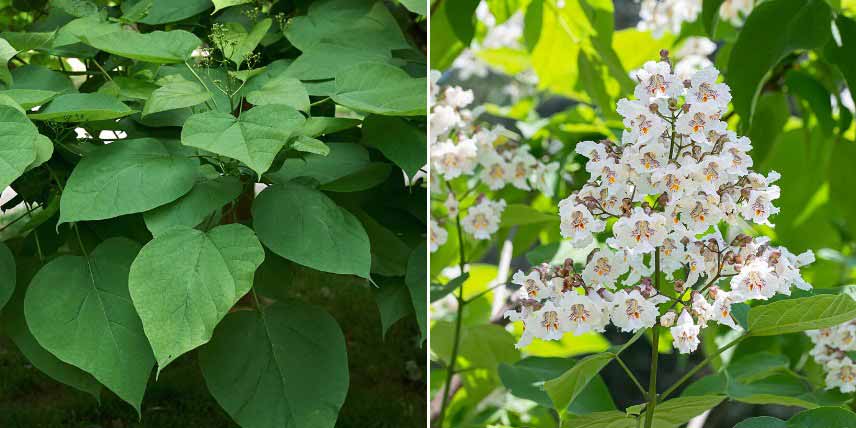
The leaves and flowers of a Catalpa bignonioides
Mimosa: a fast-growing tree for mild climates
Mimosa is a small evergreen tree emblematic of the Côte d’Azur and highly valued for its typically winter flowering, which takes the form of yellow, fragrant pom-poms. This fast-growing tree, suited to mild climates, also features lovely finely cut leaves that resemble fern foliage. Depending on the species, mimosas can reach heights of between 3 and 8 m. The Acacia dealbata, commonly known as Winter Mimosa, is the most well-known. It blooms from January to March, depending on the climate, producing small yellow pom-poms, which are clusters of stamens grouped on axillary clusters. They release a pleasant fragrance reminiscent of honey and vanilla. The Acacia dealbata typically grows between 60 cm and 80 cm per year, depending on the climate and growing conditions.
Mimosa thrives in full sun, sheltered from the wind. It prefers well-drained, sandy or stony soils, ideally acidic or neutral. Hardy down to –6 / -8 °C, its cultivation in open ground is best reserved for regions with mild climates, such as the Mediterranean or Atlantic coast, where the risk of frost is low. However, it can also be grown in a large pot to be brought indoors for the winter.
Our complete guide: “Mimosa: planting, pruning and care”
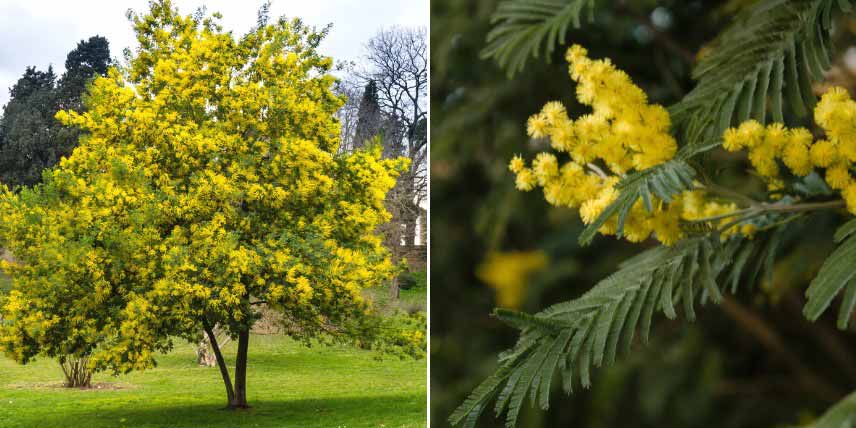
Mimosa, Acacia dealbata
Which tree grows the fastest?
| Tree | Estimated annual growth rate | Height at 10–15 years |
|---|---|---|
| Paulownia tomentosa | 1.5 to 2.5 m/year | 5 to 7 m (10–12 m at ripeness) |
| Poplar (Populus nigra var. italica) | 0.6 to 1 m/year | 10 m at 15 years |
| White willow (Salix alba) | 0.6 to 0.8 m/year | 8 to 12 m at 15 years |
| Black birch (Betula nigra) | 0.6 to 1 m/year | 10 m at 15 years |
| Catalpa bignonioides | 0.8 to 1.2 m/year | 8 to 12 m at 10 years |
| Mimosa (Acacia dealbata) | 0.6 to 0.8 m/year | 5 to 8 m depending on climate |
- Subscribe!
- Contents
![[catalpa_bignonioides]](https://en.promessedefleurs.eu/blogwp/wp-content/uploads/2023/02/6-arbres-a-croissance-rapide.png "6 fast-growing trees")
Comments