


7 beautiful Lacecap Hydrangea varieties
Hydrangeas with airy, elegant flowering
Contents
Within the broad family of hydrangeas, lacecap hydrangeas stand out for their elegance and timeless charm, essential to refined gardens. These bushes, with their delicate and airy inflorescences, bring a touch of lightness and colour throughout the growing season. Depending on the species, they adapt to various soil types and exposures. Discover our selection of seven magnificent varieties of lacecap hydrangeas to enhance your gardens and terraces.
They are not in this selection, but also take a look at the climbing lacecap hydrangea species, namely Hydrangea anomala, the Hydrangea petiolaris, H. semiola, or the large-growing shrub Hydrangea heteromalla.

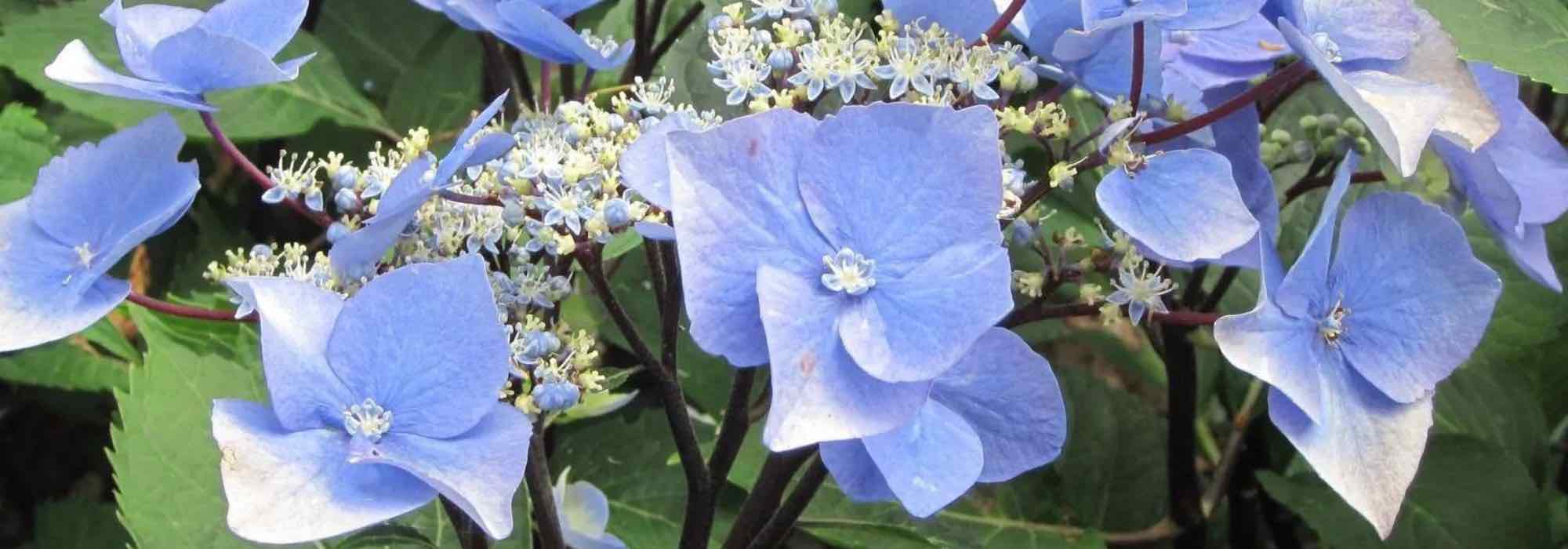
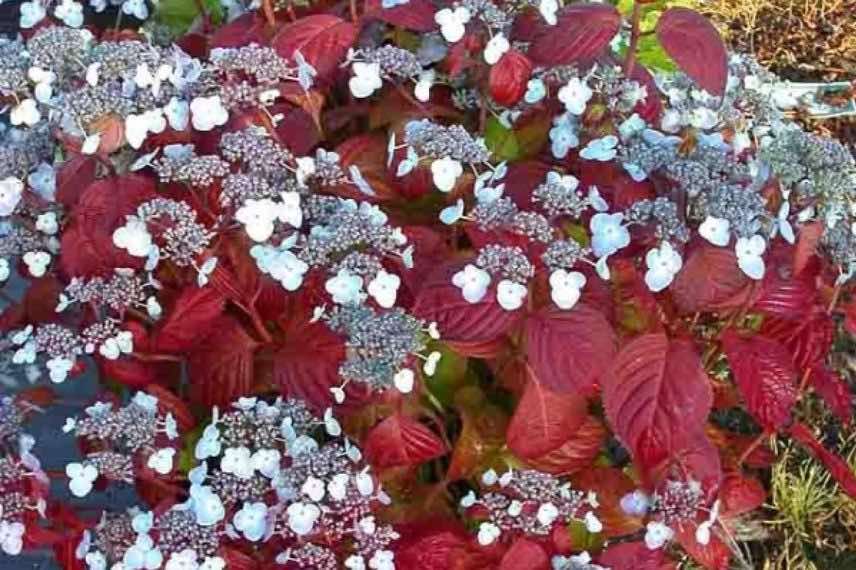
Hydrangea - Hydrangea serrata 'Shojo'
Hydrangea serrata ‘Shojo’ is a very beautiful variety of hydrangea, with a striking contrast between the flowers and the foliage that colours in late summer. Its large, flat panicles, light as lace, are composed of sterile florets ranging in colour from pink to pale blue, surrounding pale blue fertile florets. The dark green foliage develops a magnificent reddish-brown colour after the summer.
‘Shojo’ is a cultivar of the species Hydrangea serrata, hardy, native to Japan and Korea. It forms a bushy, rounded shrub about 1 m across in all directions. It is distinguished by its dark green leaves, coloured in late summer, smaller and more ovate than those of Hydrangea macrophylla. Its flat, airy panicles open from early June, and fade in pretty colours. The sterile florets are pale blue to pink and surround the fertile, button-shaped florets, pale blue in colour.
Hydrangea serrata ‘Shojo’ enjoys a sunny exposure, but not scorching, or partial shade. Choose a spot where it will receive morning sun or late afternoon sun, sheltered from the noonday sun. Its compact growth adapts well to cultivation in large containers or in borders, whether shaded or sunny, in non-calcareous soil. On the woodland edge, plant it, for example, with foxgloves, Geranium nodosum, ferns and thalictrums.
Read also
How to grow hydrangeas?Hydrangea - Hydrangea 'Runaway Bride'
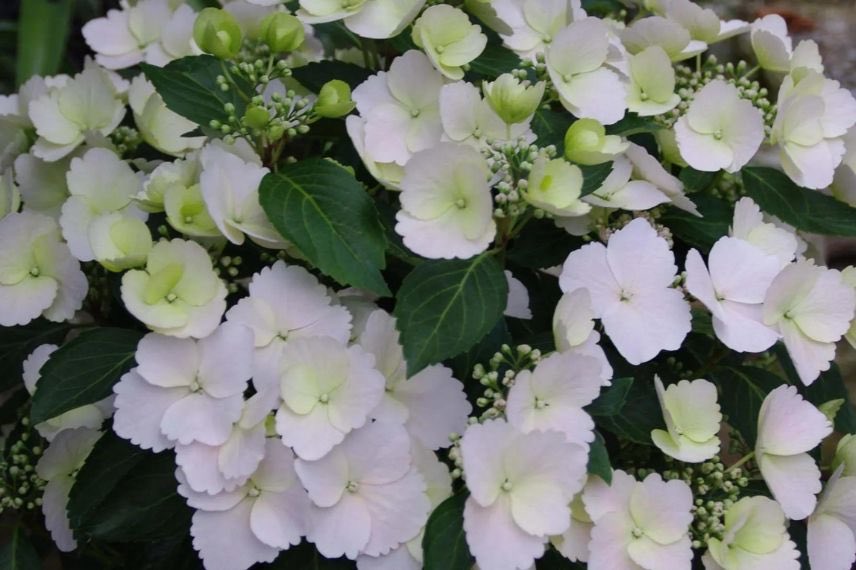
Hydrangea ‘Runaway Bride’ was voted Plant of the Year 2018 at the Chelsea Flower Show in England. Uniquely, its flowers open not only at the tip of its shoots but also along the stems, in the leaf axils. They are white, often pink-tinged in neutral soil, and arranged in small, flat, delicate inflorescences.
This Japanese variety has a rounded, bushy habit, about 1 m in spread. Its flowering lasts from July through October. The dark-green, small leaves, oval to elliptical, are dentate and turn yellow in autumn.
This ‘Runaway Bride’ variety is a wonderful terrace and balcony plant that also thrives in borders. Pair it with Fuchsia magellanica, or plant spring-flowering bulbs in front of its round silhouette. Plant it preferably in a partly shaded position, for example against a wall facing east or even north.
Hydrangea - Hydrangea macrophylla Zorro®
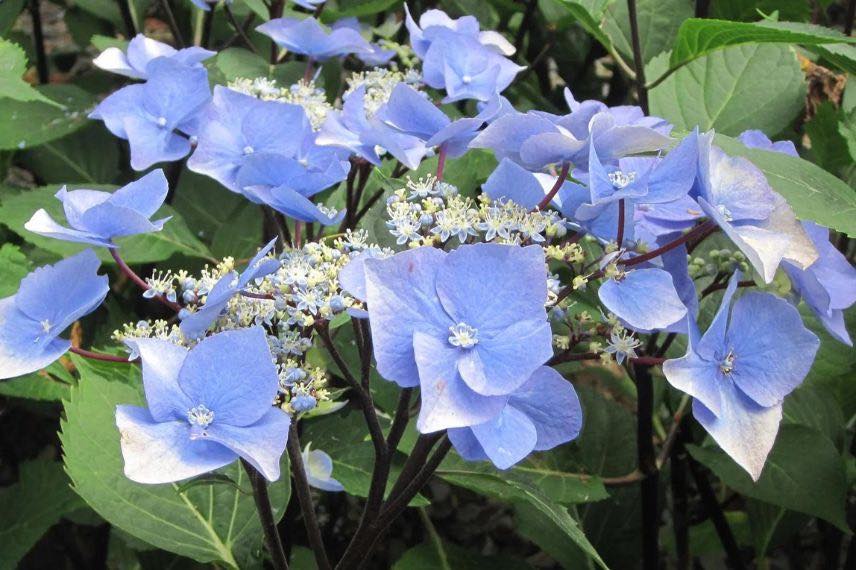
Hydrangea macrophylla Zorro® is a vigorous and distinctive hydrangea. Its flat-topped blue-violet flowers are borne on striking black stems. The umbels consist of fertile flowers in the pale blue centre and blue-violet sterile flowers at the periphery. It forms a large shrub with a spreading habit, reaching a height of 1.8 m. Its large deciduous leaves, ovate, are dark green and measure up to 20 cm long.
Zorro® requires slightly acidic soil rich in aluminium sulphate to keep its blue-violet colour. Mix heather soil into your garden soil and apply aluminium sulphate (slate contains it) as soon as the colour turns pink. This hydrangea should be planted in shade or partial shade, sheltered from cold winds. Pair it with ferns, the dead-nettles or conifers for an attractive contrast.
This variety has received the Royal Horticultural Society’s Award of Garden Merit.
Read also
Choosing a Hydrangea paniculataHydrangea - Hydrangea macrophylla 'White Wave'
The Hydrangea macrophylla ‘White Wave’ is a bi-colour flowering variety, with relatively flat inflorescences composed of white sterile flowers at the margin and pink-tinged sterile flowers in the centre, pink on neutral soil or blue-tinged on acidic soil..
Among Hydrangea macrophylla, there are varieties with rounded heads and those with flat heads. ‘White Wave’ produces beautiful white inflorescences that can reach up to 20 cm in diameter. They bloom throughout the summer and into early autumn, from July to September–October. The foliage is mid- to dark-green, finely dentate, ovate, fairly elongated. It forms a shrub about 1.5 m in height and spread.
The Hydrangea ‘White Wave’ makes a striking feature in the garden, whether grown as a specimen or planted alongside other flowering shrubs on non-calcareous soils. This handsome, easy-to-grow shrub needs cool roots and a shaded aspect. Plant it at the woodland edge or in a border alongside other flowering shrubs, such as Ceanothus ‘Glory of Versailles’, with airy blooms in a pale blue, sharing the same romantic charm.
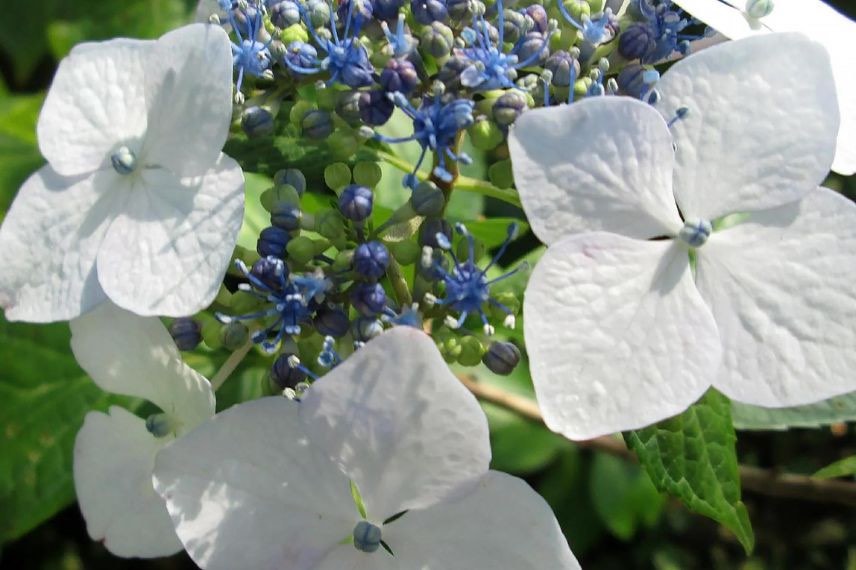
Hydrangea - Hydrangea aspera 'Kawakami'
Hydrangea aspera ‘Kawakami’ is a magnificent bushy, large-growing hydrangea with broad, domed inflorescences arranged in a parasol, particularly dense, with a diameter of 35 cm. Fragrant, the fertile flowers, resembling small, button-like clusters, wine-red, open into tiny violet flowers, framed by white florets. This particular arrangement is known as Granny’s bonnet. They bloom from late August to September.
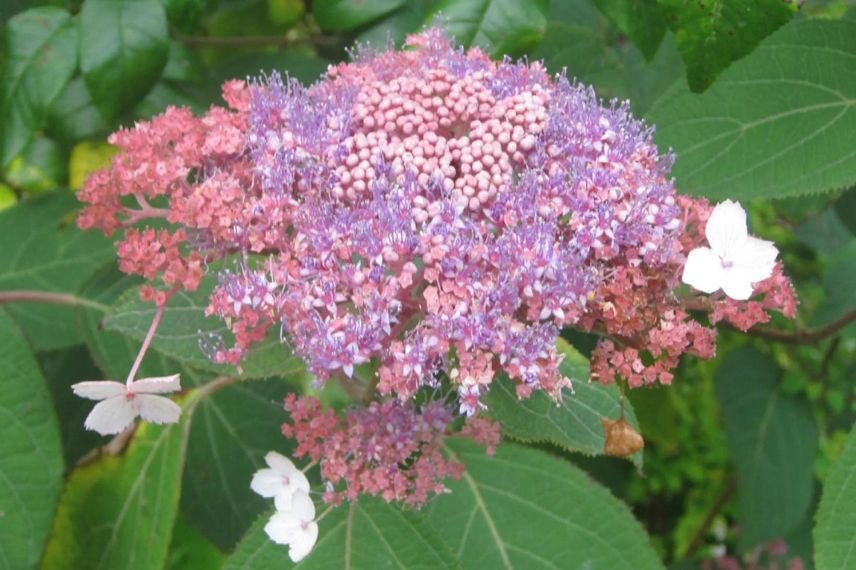
Hydrangea - Hydrangea serrata 'Grayswood'
Hydrangea serrata ‘Grayswood’ forms a bushy shrub 1.50 m tall by 1.20 m wide, with dark green, dentate leaves. The sterile flowers, initially white, then pale pink, contrast with the dark pink fertile buds at the centre of the flat inflorescence, 15 cm in diameter. By the end of summer, the entire bloom turns crimson. The colour of the flowers varies with soil type and the presence or absence of aluminium sulphate.
Originating from the montane regions of the Kuril Islands to Taiwan, and from southern China to eastern Japan, Hydrangea serrata thrives in montane climates. Hardy to -15°C, Hydrangea ‘Grayswood’ prefers drained, acidic or neutral soil, neither heavy nor waterlogged. It thrives in partial shade or sun, but should be protected from the hottest midday sun to avoid scorching the flowers. Use Hydrangea serrata ‘Grayswood’ in a border, as a specimen plant or in a pot. Be aware that the presence of a Paulownia is highly beneficial for hydrangeas, as its turgescent roots feed the roots of shrubs planted in the understorey.
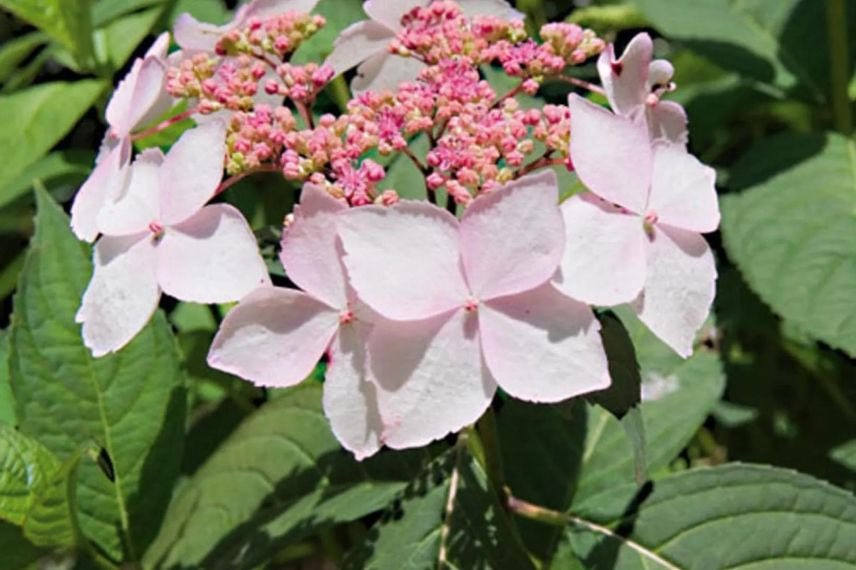
Hydrangea - Hydrangea aspera 'Bellevue'
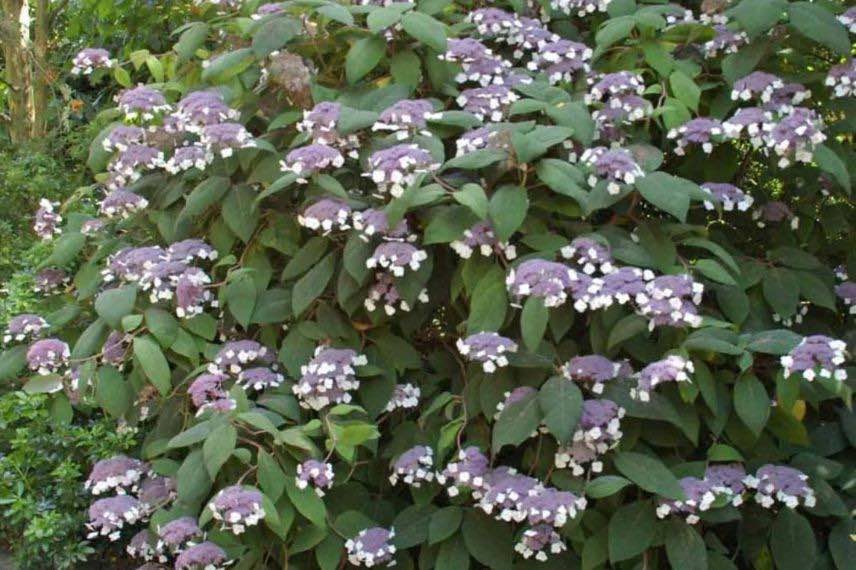
Hydrangea aspera ‘Bellevue’, rarely seen on the market, forms a spectacular bush, particularly large, with gigantic leaves. On its broad velvety leaves sit large, flat inflorescences, sometimes slightly domed, whose colour is little influenced by soil pH. Very dense, they measure 30 cm in diameter, and are coloured a soft blue-lilac and fringed with a few white florets.
Not fussy about soil, provided it stays moist, it is a variety suited to large spaces, reaching 3 m in all directions. It is derived from H. aspera macrophylla and H. aspera sargentiana, a form of very vigorous growth. Its deciduous foliage resembles that of its second parent, darker in colour, and its leaves measure up to 50 cm long, with veins rather deeply marked.
Hydrangea aspera ‘Bellevue’ can be used to form a free-standing hedge with fragrant viburnums, large deciduous spindle trees, or at the edge of a clump or woodland, where it stands out for its elegance.
- Subscribe!
- Contents

Comments