





























7 climbing plants that will enhance your garden all year round
All-year-round appeal
Contents
Some climbing plants stand out for their beautiful appearance that lasts all year round. They weather the seasons without losing their beauty or vigour. Classical or original, by their evergreen foliage, prolonged flowering and their voluble nature, they will help extend the aesthetic appeal of your garden through the months. These pretty lianas, able to quickly cover a support, will show their full potential on a large trellis, on old walls, a wire-mesh fence, an arbour, a pergola or even in large containers deep enough. Discover our selection of climbing plants that stay beautiful all year round!

Common ivy 'Marginata Elegantissima'
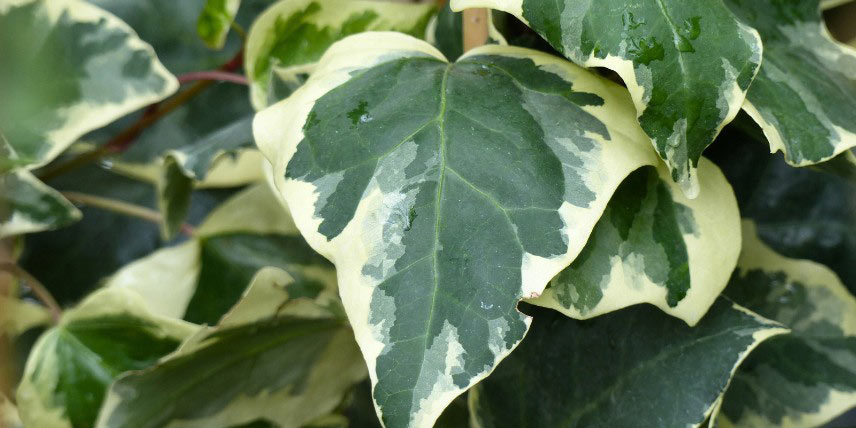
Hedera helix ‘Marginata Elegantissima’ is a variety of common ivy that stands out for its variegated and evergreen foliage. It consists of dark green leaves broadly splashed with cream on the margins, and edged with pink, offering a colourful and lush screen of greenery all year round. In late autumn, small yellowish flowers may appear, attracting pollinators. They then develop into blue-black berries that are decorative and delight birds in winter.
It climbs fairly quickly to a height of up to 3 metres, clinging to any support thanks to its climbing roots. Very hardy (down to -29°C), it thrives virtually anywhere and grows in any ordinary soil. It brightens shaded corners of the garden, provided they are sheltered from the scorching sun which its variegated foliage dislikes.
It is ideal for covering walls, fences, trellises or pergolas, and can also be grown as a groundcover, forming a dense carpet in the shade of trees. Once established, Hedera helix ‘Marginata Elegantissima’ requires little maintenance. However, monitor its growth and prune as needed to prevent it from becoming invasive.
Kadsura japonica 'Fukurin'
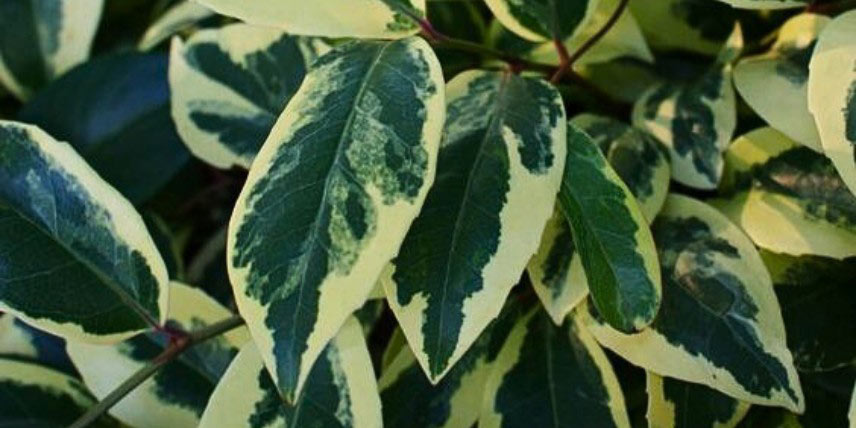
Relatively uncommon in our gardens, the Kadsura japonica ‘Fukurin’ is nevertheless a beautiful climbing plant with many qualities. This Japanese climbing plant is prized for its variegated foliage, its scented summer flowering and its decorative fruits in autumn. Particulièrement vigoureux, it can climb up to 3 m in height, quickly taking hold of a trellis, a pergola, an arbour or a wire-mesh fence. The evergreen foliage of Kadsura japonica ‘Fukurin’ is characterised by ovate leaves, dark glossy green, with cream-yellow marbling along the margins that redden in cold weather. In summer, from June to August, it bears small cream-white flowers, reminiscent of miniature magnolias with a light fragrance. A pretty fruiting then appears in the form of small red berries, highly attractive to birds that feed on their seeds. This handsome climbing plant will brighten shaded areas of the garden and be well sheltered from the cold winter winds, though it boasts excellent hardiness (to -15°C). It prefers light shade and cool, light soils, and survives cold winters by resprouting from the stump in spring. This evergreen climbing plant adds an interesting splash of colour year-round and can be paired with other climbers, such as a woody Fuchsia, which will flower at the same time.
Clematis 'Apple Blossom'
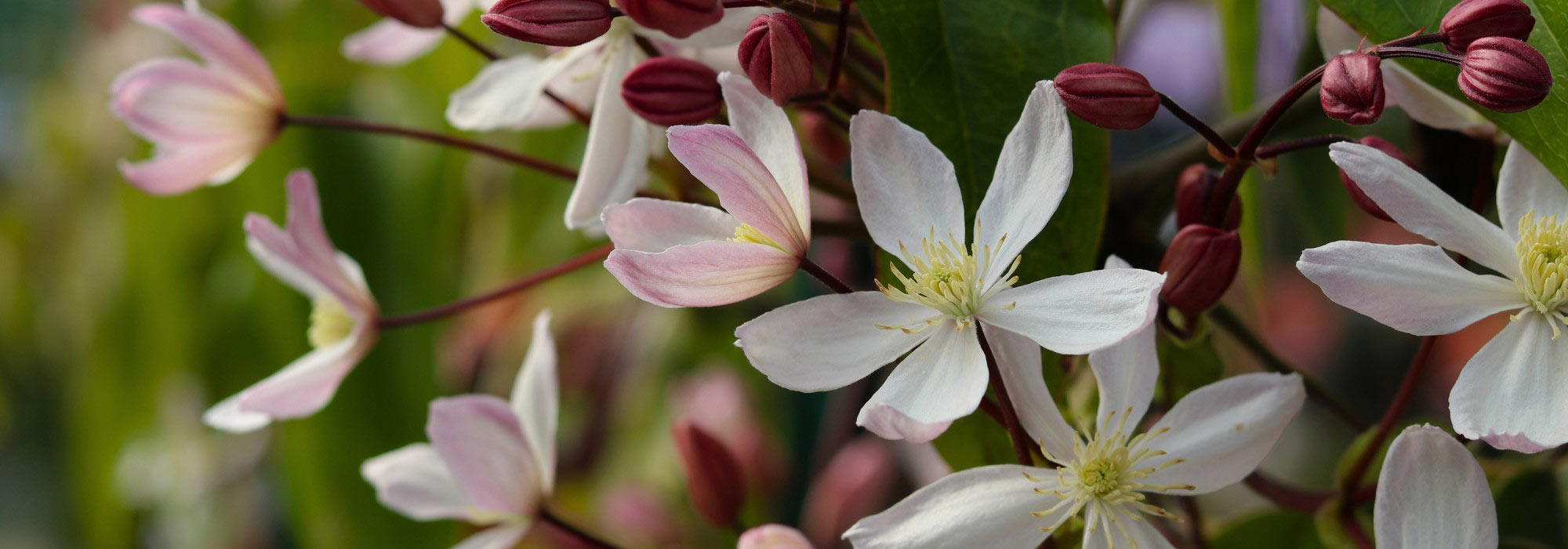
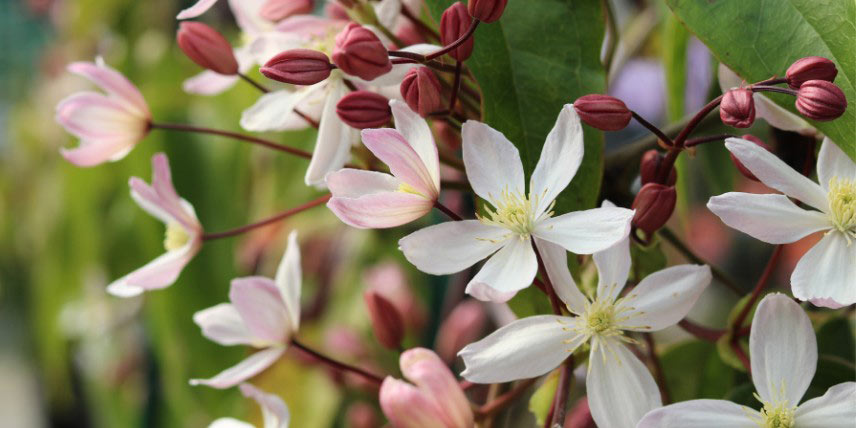
Clematis armandii ‘Apple Blossom’ is a fragrant climbing plant capable of quickly covering a support, reaching 3–5 m high or wide. It features evergreen foliage of dark green, glossy leaves, divided into 3 lanceolate leaflets, and a early spring flowering that is quite remarkable. From March, it is covered with large star-shaped flowers in a soft pink, subtly shaded by a deeper pink on the reverse of the petals. They emit a delicious fragrance reminiscent of orange blossom and almond. It is a clematis of Chinese origin, a little tender (-10°C), which requires a sheltered position away from cold winds, but it tolerates summer drought once well established. In regions with cold winters, it requires extra protection, such as a thick mulch or wind protection. You may also prefer to grow it in a pot. It thrives in full sun, in cool, well-drained soil. It climbs on old walls, trellises, wire mesh, but also among trees that provide it with natural support, giving it a touch of the exotic.
Read also
10 climbing plants ideal for fencesHenry's honeysuckle 'Copper Beauty'
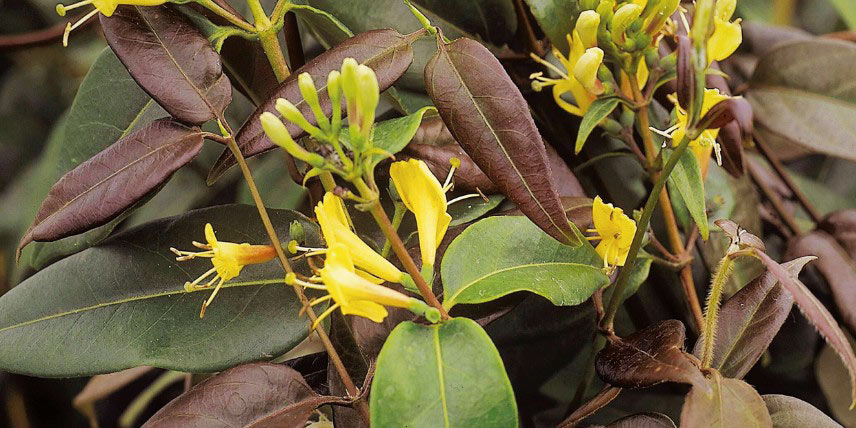
The Lonicera henryi ‘Copper Beauty’ is a honeysuckle that stands out for its modest growth, not exceeding 2 m in height and 1.5 m in width, and for a sun-loving flowering set against sumptuous evergreen foliage. Its twining stems wind around any support provided. Its leaves are oval, a bluish-green glossy hue, highlighted by coppery tones that become more pronounced in winter. This coppery colouring brightens the darker months of the year. From spring to summer, it displays tubular flowers in a bright yellow-orange highlighted by this mantle of bronze- and blue-toned leaves. They emit a light, sweet and heady fragrance that attracts butterflies and bees. Over time, the flowers reveal calyces turning almost red. These colourful flowers then transform into fleshy black-violet berries. A fine addition to the late-season garden!
Fully hardy to -15°C, it thrives in any good, deep garden soil, with the head in the sun and the feet in cool shade. It will quickly clothe a wall, a fence or an arbour with clematis, for example. Its moderate pruning also allows growing in pots.
© Pépinières Minier
Honeysuckle 'Mint Crisp'
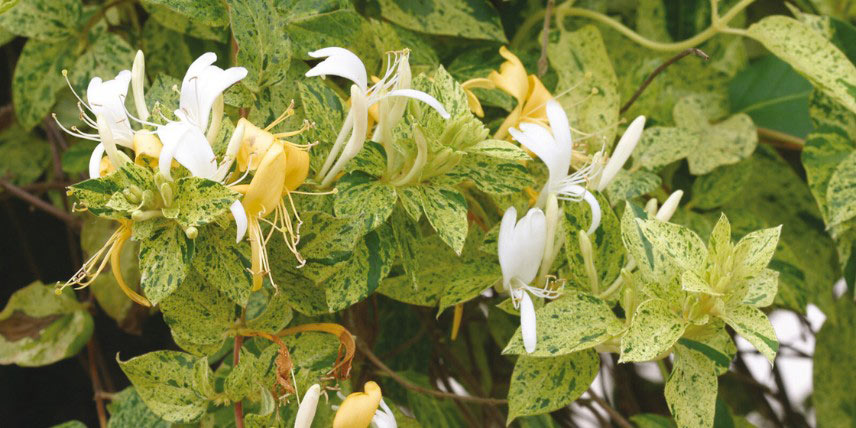
Here is another, less common honeysuckle, but just as decorative throughout the seasons. Lonicera japonica ‘Mint Crisp’ has many attributes that make it attractive year-round. First, its variegated foliage! Semi-evergreen, it features a delicate variegation. Its bright green leaves are marked by irregular yellow marbling that adds a touch of freshness and vitality to the foliage. Its vigorous growth reaches about 3 m tall at maturity, and it can be trained to climb walls, trellises and pergolas, or planted in a pot to decorate the balcony or terrace, even in winter. In summer, from June to September, this Japanese honeysuckle produces small yellow flowers grouped into terminal clusters. They emit a strong, sweet fragrance that intensifies in the morning and in the evening, which is why it deserves a place not far from the house or a path to enjoy it. Hardy to -18°C, it thrives in full sun or partial shade in well-drained garden soil. For an almost year-round decorative effect, you can, for example, plant beside it the Japan honeysuckle ‘Sweet Isabel’ in bloom from summer to autumn and the Clematis cirrhosa ‘Wisley Cream’ which will take over with its fragrant winter flowers, white-cream.
Tendril-bearing trumpet vine
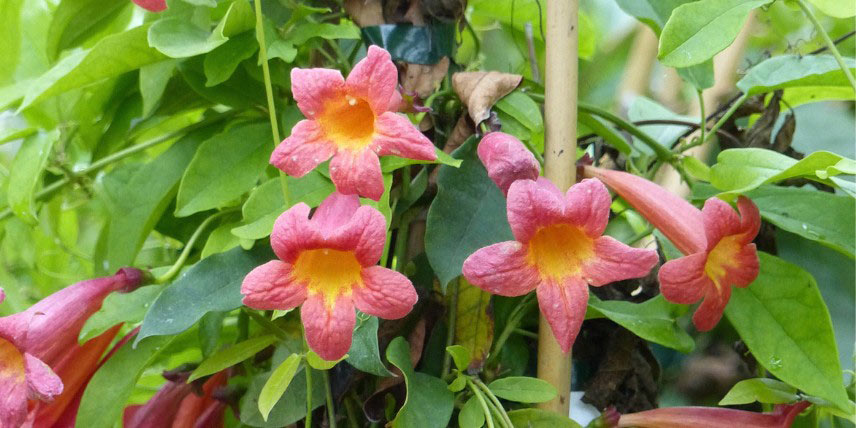
Campsis or Bignonia capreolata is a beautiful climbing liana, prized for its vibrant flowers and vigorous growth. This tendril-bearing trumpet vine variety bears tubular flowers in warm colours from May to September, starting in April in mild climates. They open into long 5 cm trumpets, with colours ranging from red-orange to coppery, yellow-orange at their heart. They emit a distinctive fragrance, somewhere between chocolate and coffee, reminiscent of toffee. This profusion of bouquets of tubular flowers blooms on a hardy evergreen foliage (in climates not too cool), dark green, turning to purplish reflections in winter. With rapid growth, it can reach 8 to 10 m in height in a few years and will cover anything you wish to hide! It will happily flower on a wall sheltered from cold winds, an unattractive building, a south-facing façade, a fence or a trellis. It will dress any support within reach with an exotic note. With fairly good frost resistance once established, it will tolerate short frosts down to -12°C; this trumpet vine prefers sunny, wind-sheltered exposures. Perfectly drought-tolerant, not particularly water-hungry, it will establish in any soil, in partial shade in hot climates. For a very colourful exotic display, consider pairing it with other unusual climbers such as unusual climbers such as l’Akebia quinata.
Star Jasmine 'Variegatum'
The Trachelospermum jasminoides ‘Variegatum’ is an adorable variegated form of false jasmine or star jasmine. It is, in fact, a woody and twining Chinese vinca that is used as a climber. It is an evergreen climber that can reach up to 5 m in all directions, allowing walls or trellises to be covered year-round. It can also be left to colonise the ground, in a somewhat wild corner of the garden, as an alternative to ivy. This vigorous liana is interesting for its distinctive and bright variegated foliage with cream-white markings on a pale green background. Its summer flowering, in small, intensely fragrant white flowers, adds further to its charm, perfuming the garden with their heady fragrance for several metres around. Moderately hardy (-10°C to -12°C), it can be grown in a large tub in the north of the Loire, in a sunny position, even though it tolerates partial shade, or even shade (where it will flower less, however) in the south of France and in very well-drained soil. It will form a beautiful association with clematis.
- Subscribe!
- Contents
Comments