


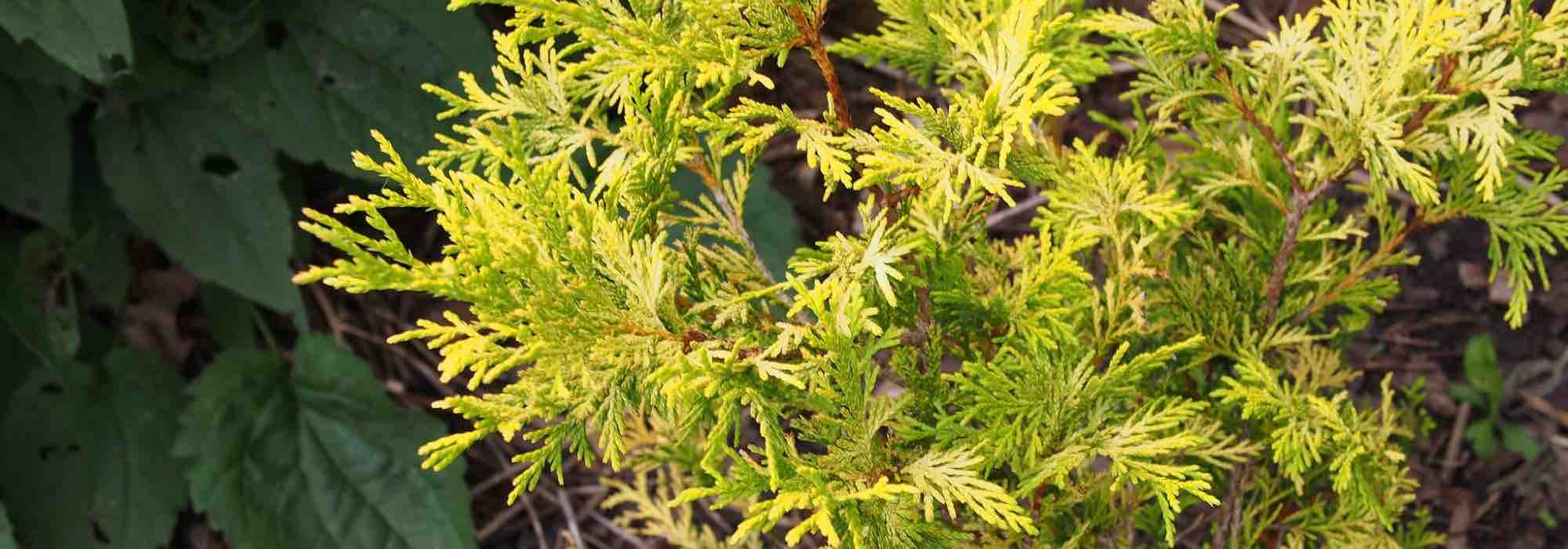
7 conifers with golden yellow foliage
Selection of conifers for a bright garden
Contents
The golden-foliage conifers are perfect for bringing light and warm colours to a garden. With their evergreen foliage, they also brighten up the garden in winter, a time when vegetation lies dormant. Depending on their size, they can structure a flowerbed, illuminate a rockery, or enhance a container on the terrace or balcony. Discover our selection of sunlit conifers to brighten and awaken your displays!

Chamaecyparis lawsoniana 'Alumigold' – Lawson Cypress, a flame-shaped silhouette
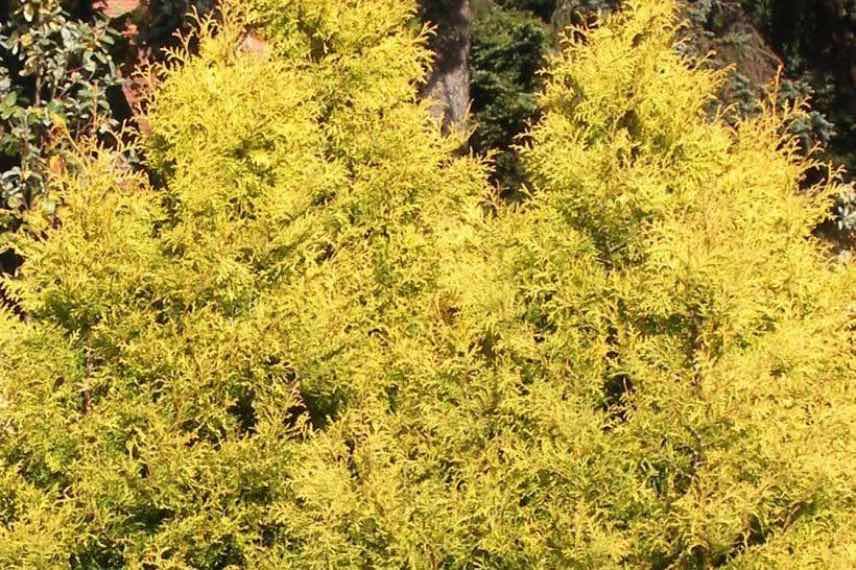
The Chamaecyparis lawsoniana ‘Alumigold’ – Lawson Cypress is a conifer with golden foliage and a flame-like silhouette. This reliable choice reaches 4 to 6 metres in height at ripeness and features evergreen foliage, intensely golden in spring, which then turns yellow-green. It produces numerous thin, flattened branches that grow upright and are covered with scale-like leaves. When they first emerge, at the tips of the branches, the leaves are a vibrant yellow, but over time, they turn acid green. The Lawson Cypress remains decorative all year round and is most often used in hedges, in borders, or as a standalone specimen. It thrives in sunny locations, in cool, even calcareous, and fertile soil. It is hardy down to – 23°C.
In a garden, the Chamaecyparis lawsoniana ‘Alumigold’ can be used to structure a border and serve as a backdrop. To temper its golden yellow hue, it can be paired with other blue plants, the complementary colour to yellow. Try combining it with a conifer, such as the Juniper ‘Blue Star’, or flowers, like the blue aubrietas.
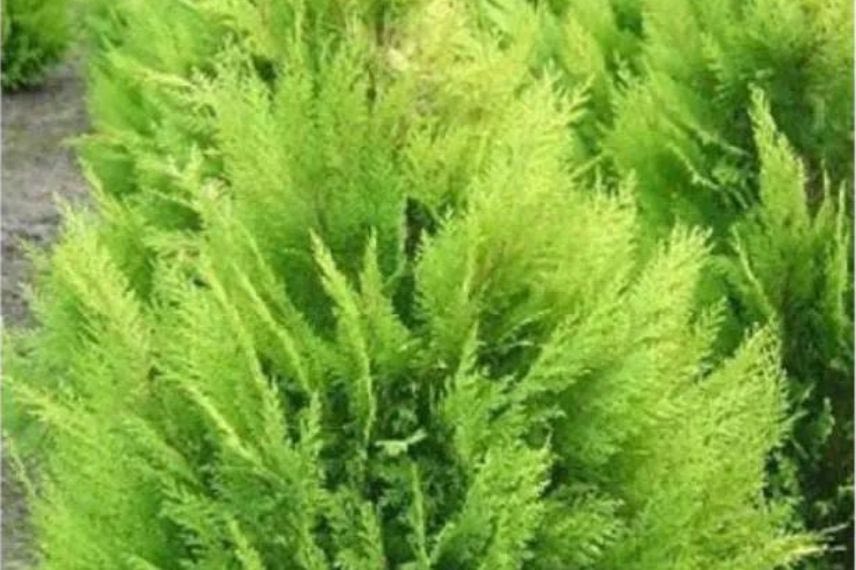
Cryptomeria japonica 'Vilmorin Gold', a bright dwarf cedar
The Cryptomeria japonica ‘Vilmorin Gold’ has a rounded and compact, slightly irregular habit. This dwarf form of Japanese Cedar brightens the garden with its very dense foliage. Coloured a vibrant green, the evergreen foliage lightens with the emergence of young golden shoots, which turn cream in summer. The leaves take on a rosy bronze to reddish hue in cold weather during autumn and winter. The branches are short, as are its needles, which are also curved. Slow-growing, it reaches 60 cm in height and 60 cm in width at the age of 10 years. It prefers to be planted in full sun, in ordinary, cool, well-drained soil that is not too dry. Easy to maintain, it is also hardy down to –20°C.
It can be used to create surprising combinations in a rockery or alpine garden. Pair Cryptomeria japonica ‘Vilmorin Gold’ with other dwarf conifers of different shapes, such as the creeping blue foliage Juniper Juniperus horizontalis ‘Blue Chip’ or the Chamaecyparis pisifera ‘Blue Moon’ – Sawara Cypress, which naturally forms a blue ball.
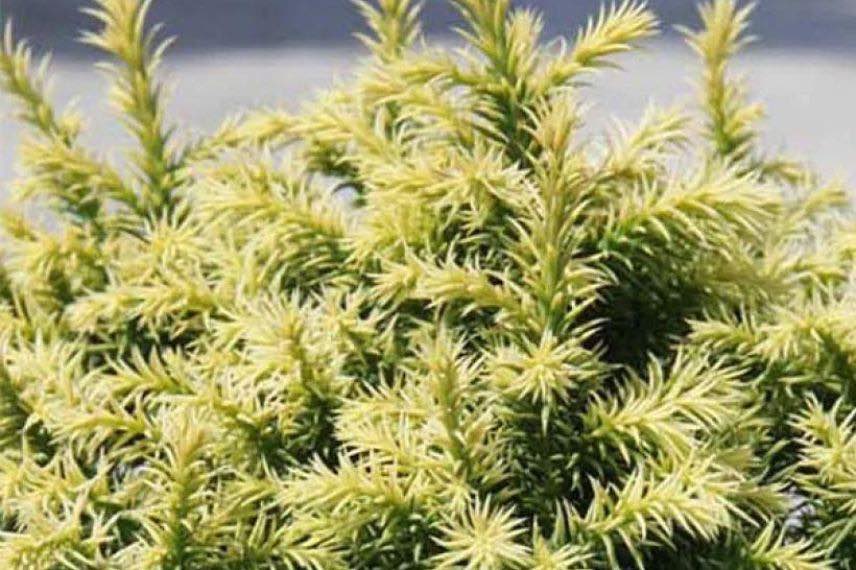
The Sawara Cypress - Chamaecyparis pisifera 'Golden Mop', a sun-loving shrub
The Sawara Cypress – Chamaecyparis pisifera ‘Golden Mop’ forms a curious rounded bush, covered in soft and very dense, thread-like golden yellow foliage. Its silhouette, somewhat tousled and nonchalant, adds to its charm, as does the bright colour of its evergreen foliage. The young shoots are a light green, while the older ones are darker, scaly, and pointed. Its bark is dark red and thread-like. Its rot-resistant wood is lemon yellow and is used for making furniture and buildings in its native country, Japan. The Sawara Cypress grows slowly, reaching 80 cm in height after 10 years. It is ideal for rockeries, small spaces, or pot cultivation, to which it adapts very well. It enjoys a sunny or partially shaded position, and light, well-drained, fresh, humus-bearing soil. It withstands frost down to -15°C.
With its rounded silhouette and sunny colour, the Sawara Cypress can be planted alone on a lawn or in a container. It can also be placed in a contemporary rockery alongside other small conifers, allowing for playful combinations of shapes and colours.
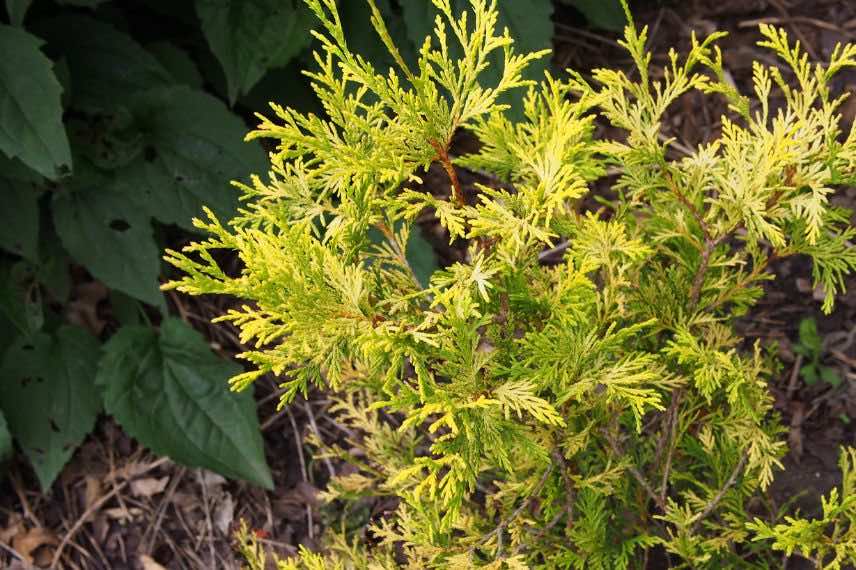
Photo F.D. Richards
Read also
Blue conifers: remarkable varietiesThuja occidentalis 'Rheingold', or Canadian Arborvitae, a conifer with resplendent colours
The Thuja occidentalis ‘Rheingold’ or Canadian Arborvitae boasts numerous advantages. With its conical and broad habit and the variety of colours in its evergreen foliage, it draws all eyes in a garden. Throughout the seasons, the foliage transforms into a palette of coppery, golden, bronze, or yellow hues. Flat and finely structured, it produces young shoots of coppery pink in spring, followed by flat branchlets of golden yellow in summer. As autumn arrives, its colours shift to coppery orange, turning to bronzed gold in winter. The foliage is aromatic when crushed between the hands. The reddish-brown bark becomes fibrous and peels off in long grey-brown strips. Slow-growing, this small Canadian Arborvitae reaches 2 metres in height and 1.5 metres in width at maturity. Hardy down to -34°C, it thrives in well-drained soil that is not too dry and in full sun.
Its small size allows it to be inserted into various settings: in a rockery with other conifers, in a bed of shrubs and flowers to add a touch of bright colour, or in a large pot on a terrace. Consider pairing it with a Microbiota decussata – Creeping Cypress, which also offers beautiful autumnal and winter colours.
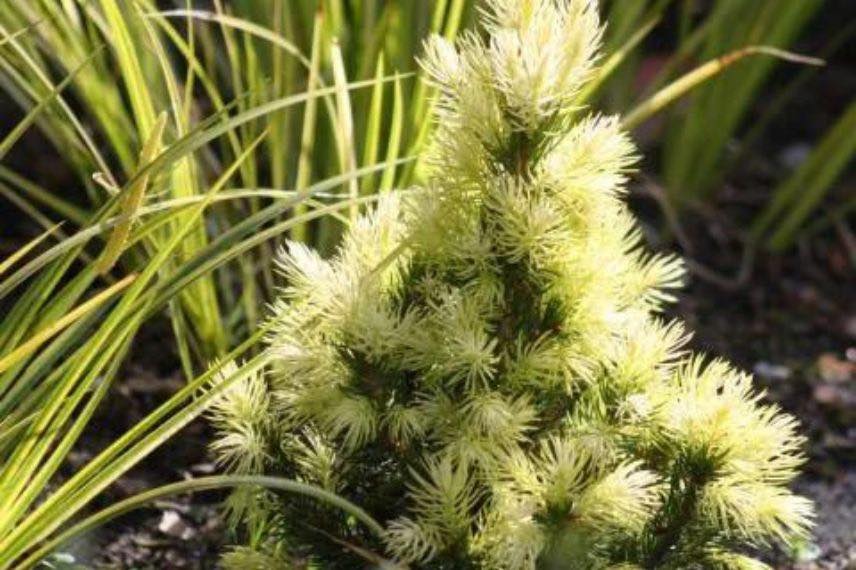
White Spruce - Picea glauca 'Daisy's White', a conifer that catches the eye
The White Spruce – Picea glauca ‘Daisy’s White’ forms a regular pyramid or broad-based cone. Its dark green evergreen foliage is tinged in spring with young shoots that are white to pale yellow. Its stunning bright colour draws all eyes in the garden. The soft-looking foliage is very dense, composed of short, tightly packed, tiered branches covered with short, very sharp needles. Arranged like a brush, the needles emit an aromatic scent. The young shoots, soft and bright, provide a striking contrast. This decorative conifer is a miniature white spruce with slow growth, reaching 1.5 metres in height and 90 cm in width at maturity. Easy to grow, it is hardy down to -40°C and thrives in many situations and various climates, provided it is planted in well-drained, not overly calcareous soil. With a shallow root system, it does not appreciate being transplanted once mature and is sensitive to wind.
The White Spruce enlivens rockeries, borders, and containers placed on a terrace. To create beautiful colour or contrast effects, it can be paired with shrubs and plants with red or purple foliage, such as Photinia fraseri ‘Little Red Robin’ or Pittosporum tenuifolium Purpureum.
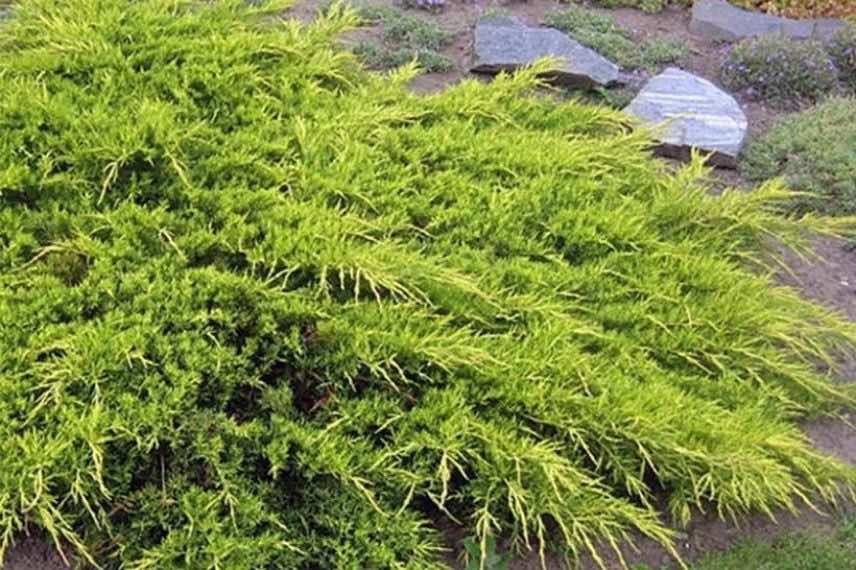
The Juniperus (x) media 'Pfitzeriana Aurea', a creeping and golden juniper
The Juniperus (x) media ‘Pfitzeriana Aurea’ offers a charming creeping, tiered, and tabular habit. Its foliage is dense, and its flexible branches are trailing. In spring, its leaves are golden, turning green in summer. Slow-growing, it reaches an average height of 1 metre and a spread of 2 metres by the age of 10 years. Easy to grow, this creeping juniper adapts to all types of soil and climate. Hardy down to –40°C, it thrives in full sun or partial shade, in well-drained soil that can be poor, calcareous, and occasionally dry.
The Juniperus (x) media ‘Pfitzeriana Aurea’ is a colourful and decorative conifer, making a stunning impact in a rockery, amidst rocks. You can pair it with other conifers of different habits: columnar, pyramidal, or rounded. It also beautifully complements heathers, lavenders, boxwood, and rosemary.
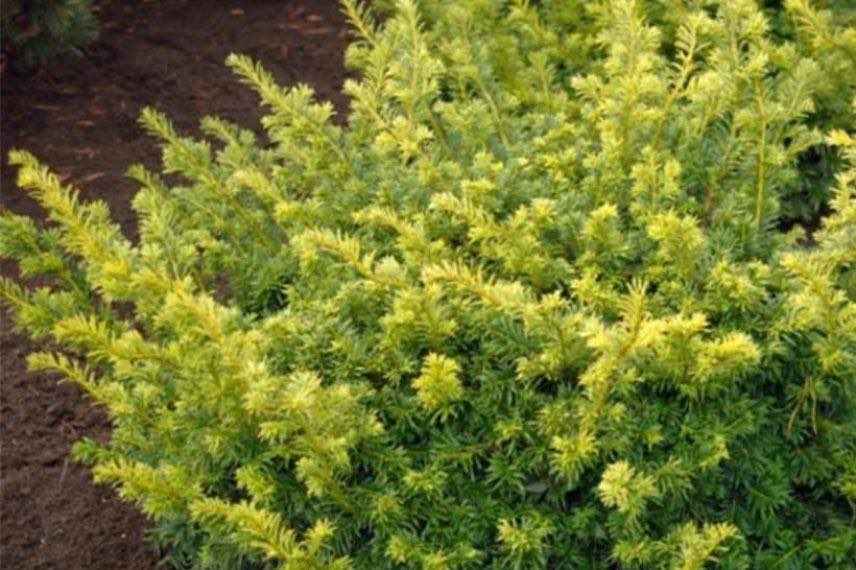
Taxus baccata 'Summergold', a golden and resilient yew
With its golden foliage in summer and its bushy, almost cloud-like habit, Taxus baccata ‘Summergold’ showcases beautiful decorative qualities. Its branchlets bear flattened, shiny needles, pointed at the tips but very soft to the touch. They turn a light yellow-green when young, then shift to bright golden yellow, eventually transitioning to bronze and very dark green. Red berries appear after a discreet flowering, solely on female plants and in the presence of male plants. At maturity, it reaches a height of 80 cm and a width of 2.50 metres. Easy to grow, it adapts to many growing conditions and requires little maintenance. It withstands temperatures down to –23°C.
Displaying its beautiful palette of colours and being very resilient, Taxus baccata ‘Summergold’ looks lovely planted alone or alongside creeping shrubs like low Cotoneaster or Germander Small Oak.
- Subscribe!
- Contents

Comments