





























7 evergreen grasses to have in your garden
Our selection of grasses for an extraordinary garden throughout the seasons
Contents
Hardy and diverse, evergreen grasses are essential ornamental plants for creating beautiful colourful scenes all year round. Enjoy the rich diversity they offer while making gardening easier: with their appearance changing throughout the seasons, these “herbs” are always decorative and require little maintenance.
Discover our selection of 7 perennial grasses, reliable, easy, and generous, perfect for an attractive garden from January to December!

Golden Sedge - Carex elata 'Area'
Related to grasses, but botanically distinct, the genus Carex comprises over 1500 species of perennial plants known for their ornamental qualities. They belong to the family Cyperaceae, otherwise known as the family of Papyrus. Evergreen and easy to cultivate, Carex deserves a place in our gardens.
The banks of a water body deserve this striking trio composed of the long, luminous leaves of Carex elata ‘Aurea’, which forms a gracefully arching clump, made up of long, fine leaves, of a golden yellow edged with light green, becoming even more golden as the plant receives sunlight. Its spring flowering consists of fine brown spikes. The stump, quite hardy, can withstand being submerged under 10 cm of water. Pair it with the Hosta fortunei ‘Gold Standard’ and its large green leaves edged in yellow, complemented by lavender-coloured flowers. The zesty yellow of this duo brightens a dark corner of the garden and highlights the mauve and pink blooms of the Astilbe chinensis ‘Vision in Pink’ and the hardy geranium ‘Starman’.
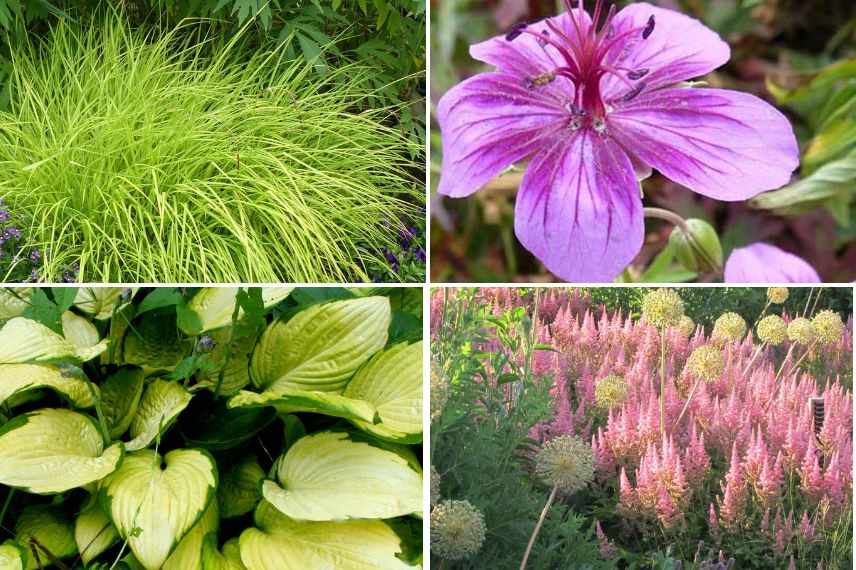
The elegant Carex elata ‘Aurea’ highlights the blood-red corollas of Geranium ‘Starman’. It establishes itself as a bright focal point amidst the variegated leaves of Hosta fortunei ‘Gold Standard’. In the background, the large, feathery blooms of astilbes create a soft and luminous backdrop.
Read also
Planting grassesWhite Luzula - Luzula nivea
Naturally present up to the Alps, Luzula nivea is native to central and southern Europe. It is a hardy grass with narrow, green, evergreen foliage edged with small white hairs, forming a loose tuft. It has a slow rhizomatous growth. In spring, the white luzula reveals very fine inflorescences that are off-white to almost white. In full bloom, they can reach up to 60 cm in height.
Hardy and resistant to both cold and drought, luzula thrives in a variety of soils, whether moist or slightly dry. It is well-suited for the edges of borders in sunny or partially shaded locations. Luzula nivea retains its green foliage all year round.
Pair the softness of luzula foliage with that of another equally romantic groundcover. The Epimedium rubrum, also known as the fairy flower, is adorned with small bicoloured flowers in flesh pink mixed with white. Its beautiful tender green evergreen foliage is marbled with red in spring, turning almost mahogany red during winter. It creates a timeless and ever-changing atmosphere in any rustic border.
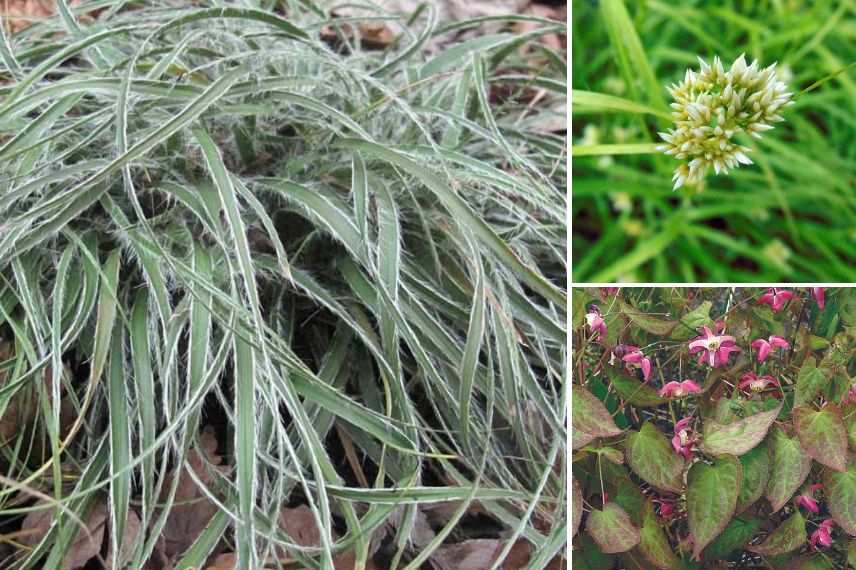
The fluffy appearance of Luzula nivea contrasts with Epimedium rubrum throughout the seasons
Discover other Ornamental grasses
View all →
Available in 0 sizes
Available in 0 sizes
Available in 0 sizes
Available in 0 sizes
Available in 1 sizes
Available in 1 sizes
Available in 2 sizes
Available in 1 sizes
Available in 1 sizes
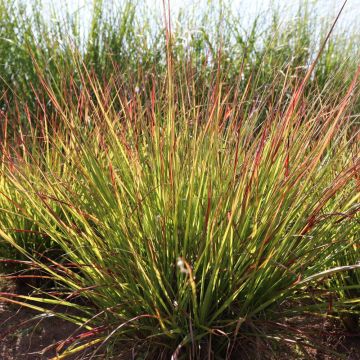
Available in 1 sizes
Black Ophiopogon - Ophiopogon planiscapus 'Nigrescens'
Surprising is the almost black gramineous foliage of the Ophiopogon planiscapus ‘Nigrescens’! This small perennial, resembling a grass, is adorned in summer with pale pink inflorescences that beautifully contrast with its foliage. The same ornamental strategy applies to Rubus tricolor or Rubus ‘Betty Ashburner’, which features glossy, bright green foliage, with white flowers in spring followed by orange fruits that stand out against its evergreen leaves. The Ophiopogon is also enhanced by the very dark purple foliage of the Heuchera ‘Binoche’, whose light white flowering complements the large pure white flowering of Digitalis purpurea ‘Snow Thimble’ which self-seeds to naturalise for a most natural effect.
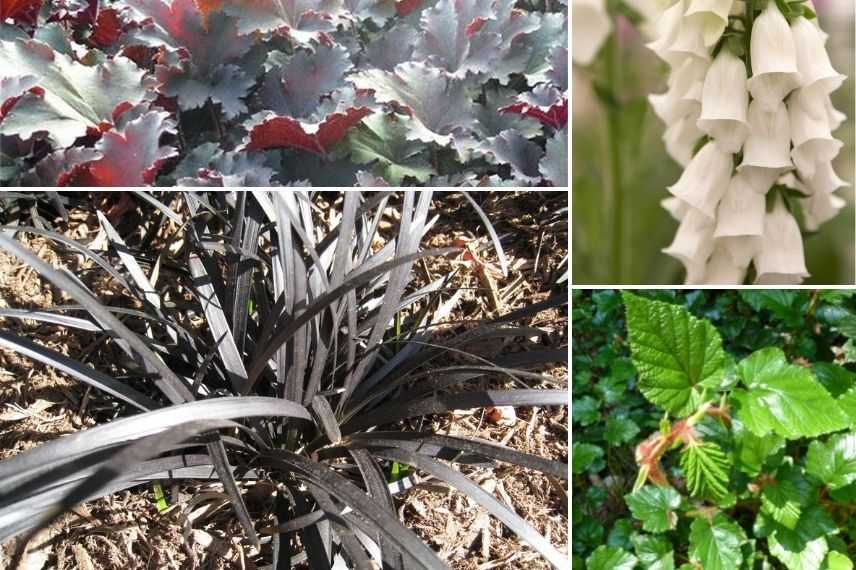
The almost black graphic foliage of the Ophiopogon is placed alongside Heuchera ‘Binoche’ and the ornamental bramble Rubus ‘Betty Ashburner’. Above, the white flowers of the foxgloves serve as vertical lines in this arrangement.
Read also
Grasses: which variety to choose?Giant Feather Grass - Stipa gigantea
The Stipa gigantea belongs to the large family of Poaceae. This perennial grass, perfectly suited to summer drought, is hardy down to -12/-15 °C. It forms a bristly tuft of leaves 55-60 cm high and 50 cm wide. Evergreen in mild climates, this foliage is composed of long, very narrow, and leathery leaves. Flowering begins in late spring, usually in May, and continues until July. Numerous, very sturdy stems, reaching heights of 1.80 m to 2 m, emerge from the foliage, bearing at their tips trailing spikes 20 cm long, airy, and silvery, which sway with the slightest breeze.
They will take on a golden hue in winter and persist on the plant until December. Its tall presence in any border makes it an ideal companion for compact or pruned plants like Lavandula angustifolia ‘Munstead’, a lovely small lavender with a regular round shape, vigorous and aromatic, which is covered in summer with spikes of very bright blue-violet flowers, emerging from evergreen grey-green foliage. This perfect duo, full of contrast, is enriched by the presence of another decorative binomial with its deep and warm hues: the Pennisetum x advena ‘Rubrum’ accompanies the generous star-shaped inflorescences of the Aster turbinellus from late summer. This wild aster, with a bushy habit, is adorned with small lavender to light violet flower heads. It will bring its subtle and light charm in association with the two beautiful grasses in this scene.
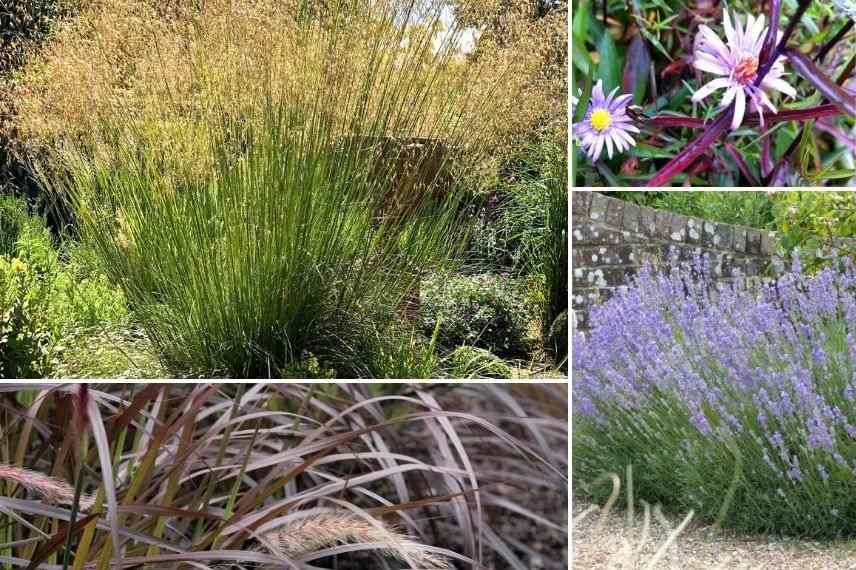
A play of colour and graphics between the apparent rigidity of Stipa gigantea and that of the Munstead lavenders against the softness of the forms of Pennisetum x advena ‘Rubrum’ and Aster turbinellus
Red Uncinia - Uncinia rubra
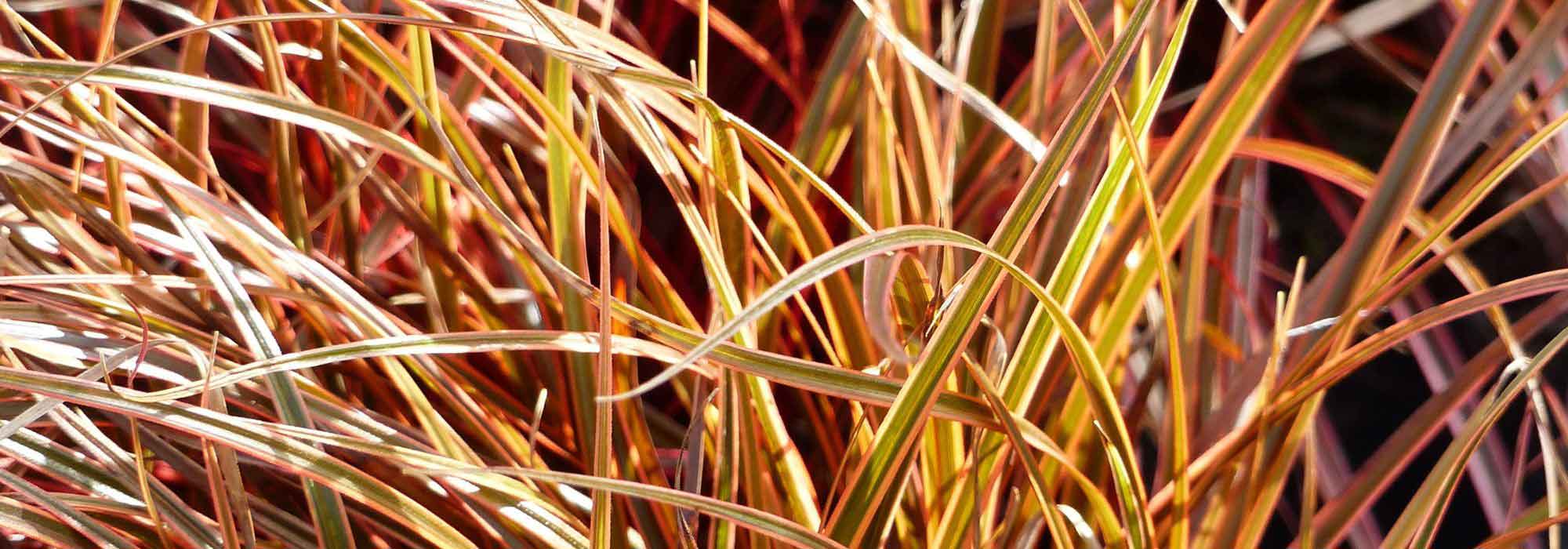
Uncinia rubra stands out for its very ornamental foliage, with ribbon-like leaves ranging from reddish-orange to purple bronze. This plant, related to sedges, native to New Zealand prefers mild climates and rich, cool to moist soils. Its persistent bronze-red foliage and trailing habit form a dome. It thrives in sunny locations and well-drained soil.
It will be highlighted by contrast with the grey-white, beautifully cut foliage of Artemisia stelleriana ‘Boughton Silver’ or the downy foliage of Senecio Silver Dust. This richly coloured groundcover welcomes the warmth of the orange flowers of Diascia barberae ‘Blackthorn Apricot’ until the first frosts, along with Geum ‘Totally Tangerine’ on soft green foliage that is often persistent.
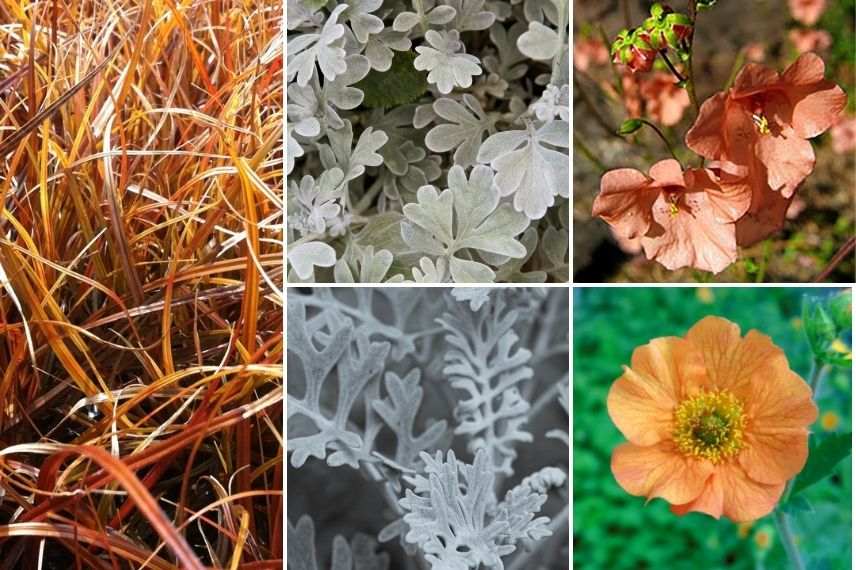
The flamboyant Uncinia rubra is softened by the winter-flowering white of the Senecio and the wormwood, while touches of orange from the flowers of the avens below Geum ‘Totally Tangerine’ and Diascia Apricot above right
Blue Fescue - Festuca glauca
The Blue FescueFestuca glauca is a small drought-tolerant grass, highly valued for its evergreen, grey-blue foliage that is compact, graphic, and colourful, forming lovely blue mounds topped with silver spikelets, gracefully trailing and very decorative.
This small grass will make a lovely impact when paired with the Karvinsky Fleabane –Erigeron karvinskianus- for its pretty, wild-looking, voluble daisies amidst the fine, blue-green foliage of Euphorbia cyparissias which takes on a beautiful orange-yellow hue in autumn, and is adorned in spring with abundant, airy flower spikes of a bright yellow-green. The Oenothera speciosa ‘Siskiyou’, or pink evening primrose, provides this bed with its abundant summer flowering, in the form of large, cup-shaped flowers that are white washed and veined with pale pink, fragrant and nectariferous.
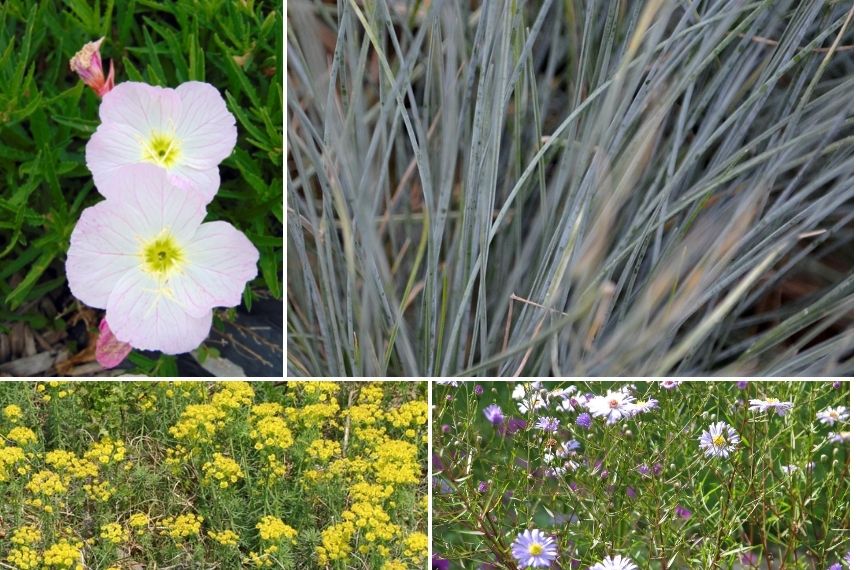
The moiré reflections of the blue fescue in the sun are echoed in the starry corollas of the Karvinsky Fleabane and the feathery foliage of the small cypress spurge, which can be found at the end of the season in the foliage of the evening primrose.
Variegated Sedge - Carex brunnea 'Jenneke'
The Carex brunnea ‘Jenneke’ is a lovely evergreen grass reaching 40 cm, with fine yellow-green foliage edged in dark green, bright and refined. It should be planted in partial shade in cool to moist soil, preferably humus-bearing, forming a fairly flexible, dense clump that is upright and trailing, about 30-35 cm in all directions, remaining decorative even in winter if it doesn’t freeze too hard. In July and August, short cream spikes measuring 2 to 4 cm appear among the foliage, borne on slender stems 40 cm tall. At maturity, they take on a brown hue.
This grass will bring a lot of lightness when paired with the hardy Bergenia cordifolia ‘Rotblum’ with its glossy evergreen foliage and crimson flowering. In contrast, the beautifully cut foliage of the Potentilla ‘Arc en ciel’ adds a touch of softness and roundness, just like its flowers, which are also a deep red reminiscent of poppies. In the background of this border, the shrubby veronica Hebe ‘Santa Monica’ blends its flowers and foliage into this colour palette for a total harmony in cool shade, whether in the garden or in pots, in well-drained soil, in sun or partial shade.
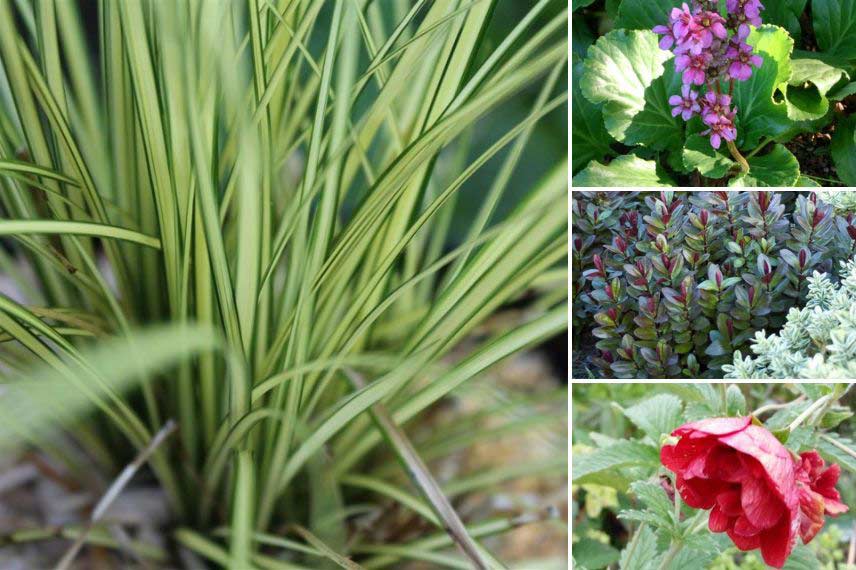
Elegant little grass, the Carex brunnea ‘Jenneke’ along with Liriope muscari ‘Lilac wonder’ pairs beautifully with the lavender of Bergenia Rotblum’s flowers. Add a warm touch with Hebe ‘Santa Monica’ and the stunning flowering of Potentilla ‘Arc en ciel’
- Subscribe!
- Contents
Comments