


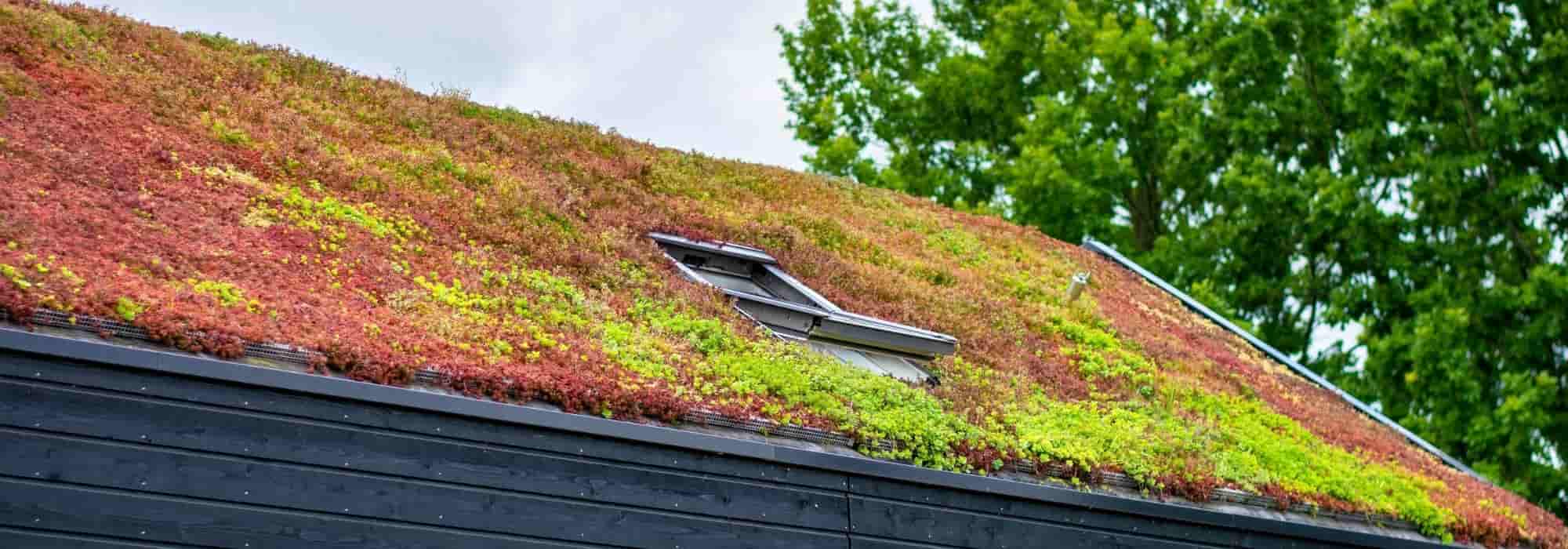
7 plants for green roofs
to colour and flower your roof
Contents
Bringing ecological insulation and promoting biodiversity, green roofs are increasingly appealing to nature and gardening enthusiasts. To create a roof covered with greenery and flowers, the choice of plants is crucial, as the growing conditions are specific, with little substrate and limited water available for cultivation. For a green roof, it is advisable to choose plants that can thrive in extreme conditions, requiring virtually no maintenance, such as succulents, rock garden plants, or alpine species. From sedums to Dianthus, including Delosperma and Phlox, discover our selection of beautiful plants to create a stunning green roof.
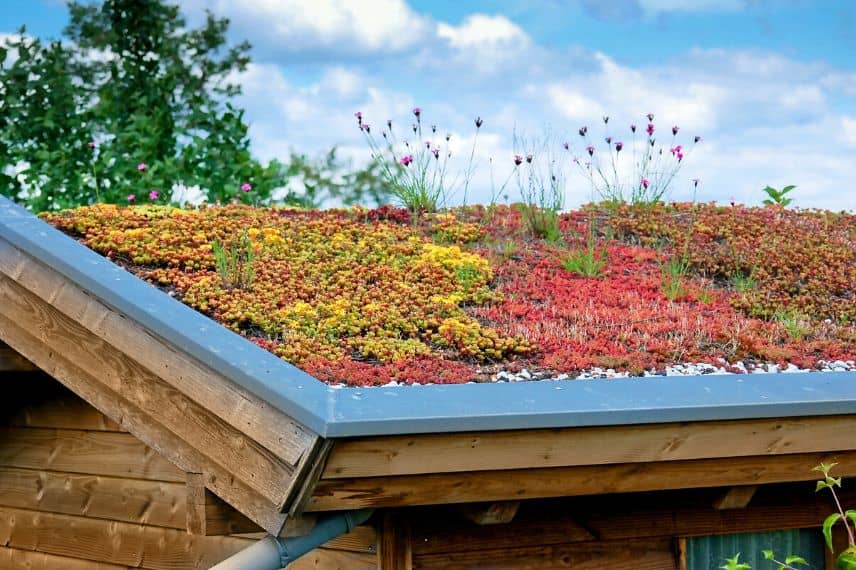
A garden shed with a green roof

Sedum, the ideal plant for a green roof
The sedum or stonecrop is a very drought-resistant plant that is described as self-sufficient, as it requires almost no maintenance or watering. With its shallow roots, it is the ideal plant for a green roof, which, in most cases, can only accommodate a few centimetres of substrate. With over 400 species and numerous varieties, sedum offers a wide choice for gardeners. For cultivation on a green roof, look towards the spreading species and varieties, which will not exceed 15 cm in height, to ensure the weight and stability of your roof.
Flowering from summer to October, sedums provide blooms in a variety of colours. Yellow, red, purple, green, pink, white… the flowers of sedums take the shape of small stars. They create very attractive decorative carpets, adorned with small fleshy leaves, most often evergreen, even in winter. They thrive in well-drained substrates and sunny exposures.
Among the sedums most suited to sunny green roofs, you can choose Sedum acre ‘Yellow Queen’, which offers bright yellow blooms in June and July. The Sedum album ‘Murale’ is also delightful with its small rounded leaves that change colour with the seasons, turning dark reddish-purple in winter. It produces small white flowers in June and July. If you prefer pink blooms, the small Sedum spurium ‘Fuldaglut’ is covered in raspberry-coloured flowers from July to September. Its small bronze-green leaves edged in purple add to its charm.
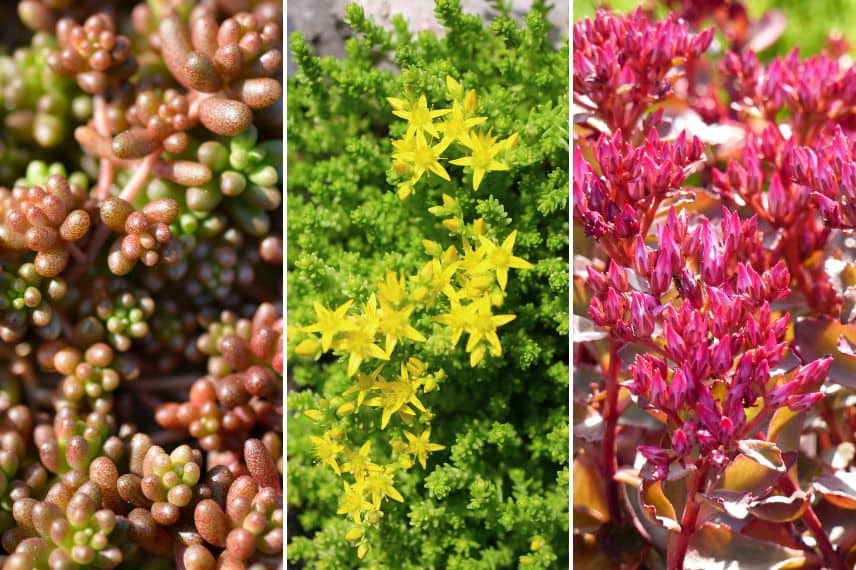
Sedum album ‘Murale’, Sedum acre ‘Yellow Queen’ and Sedum spurium ‘Fuldaglut’
Read also
How to create a green roof?Sempervivum, a highly graphic and colourful plant
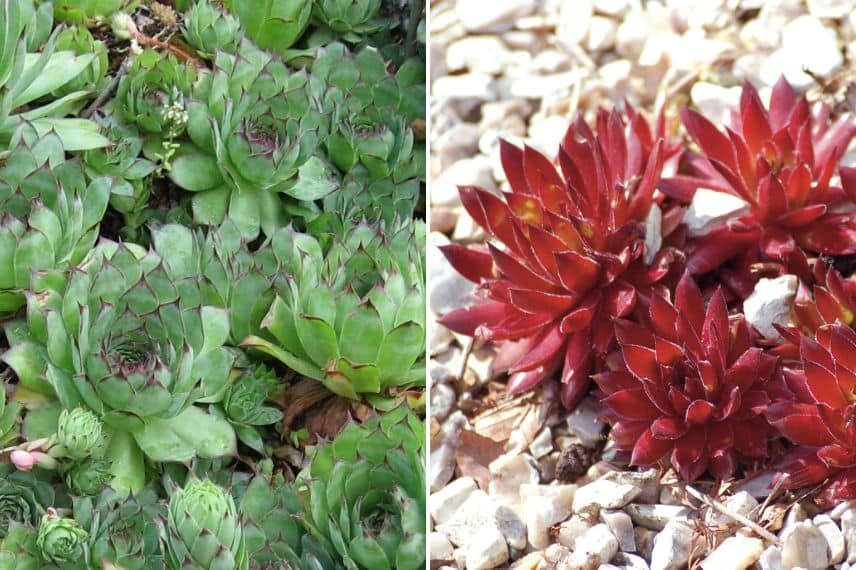
With its small, graphic rosettes and creeping flowering, Sempervivum or houseleek forms lovely carpets of low, fleshy plants, perfect for a green roof. Very easy to maintain, this small montane succulent plant requires little water and soil. They are adorned with green, golden, or purple-red leaves and also offer very colourful flowers in shades of pink, red, yellow, or white. They thrive in warm, sunny locations.
For a sun-exposed green roof, Sempervivum tectorum or roof houseleek is the perfect plant. Well-known, it forms carpets of small rosettes resembling tiny green or red-tinted artichokes. Its fleshy rosettes are evergreen. It produces small star-shaped pink flowers in June and July. If you enjoy colour changes throughout the seasons, try Sempervivum ‘Othello’ – Purple hybrid houseleek. Its fleshy rosettes transition from purple-red to orange and from green to bronze.
For lovers of vibrant colours, Sempervivum ‘Chick Charms Gold Nugget’ showcases fantastic hues: bright green in summer, golden with bright orange tips in autumn, and a reddish-orange colour that intensifies in winter. Adding to this colour festival is the purple-pink of its flowers, from June to August.
Delosperma: vibrant colours under the sun
The Delosperma or hardy ice plant is an ideal plant for a dry, sunny garden. It blooms for a long period, from June until the first frosts. On fleshy green foliage, this succulent plant produces brightly coloured flowers in Indian pink, yellow, orange, and white. It enjoys well-drained soil, warmth, and sunlight. Semi-hardy, it withstands temperatures down to –8°C. This rock garden plant thrives alongside campanulas, sedums, Dianthus, and Stachys.
On a green roof exposed to the sun and in a rather dry region, you can install Delosperma cooperi, which produces large mauve flowers with a white centre from June to September. It will form a lovely persistent green carpet, coloured with bright violet during the fine days. Another variety, Delosperma ‘Wheels of Wonder Orange’, delights us with pretty star-shaped bright orange flowers with a golden yellow centre, also from June to September.
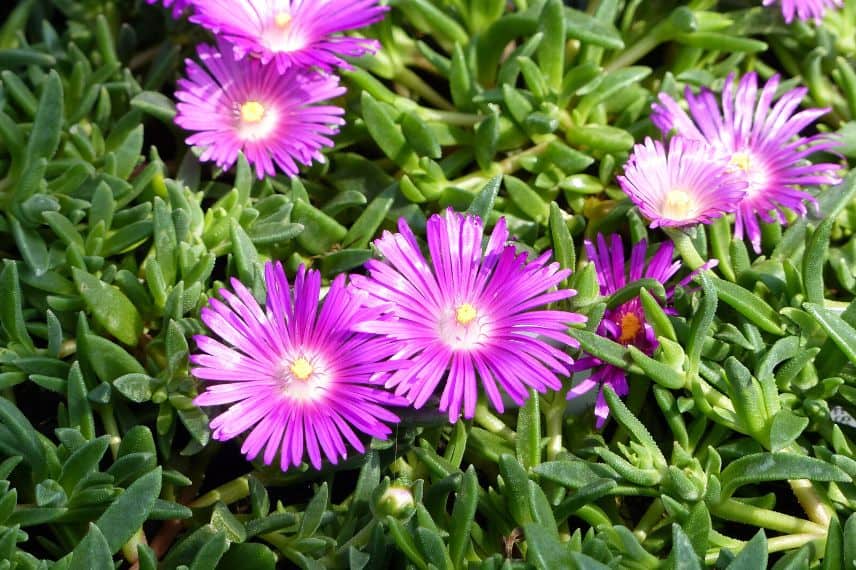
Delosperma cooperi
Read also
5 perennials for dry groundSmall Carex for a semi-shaded position
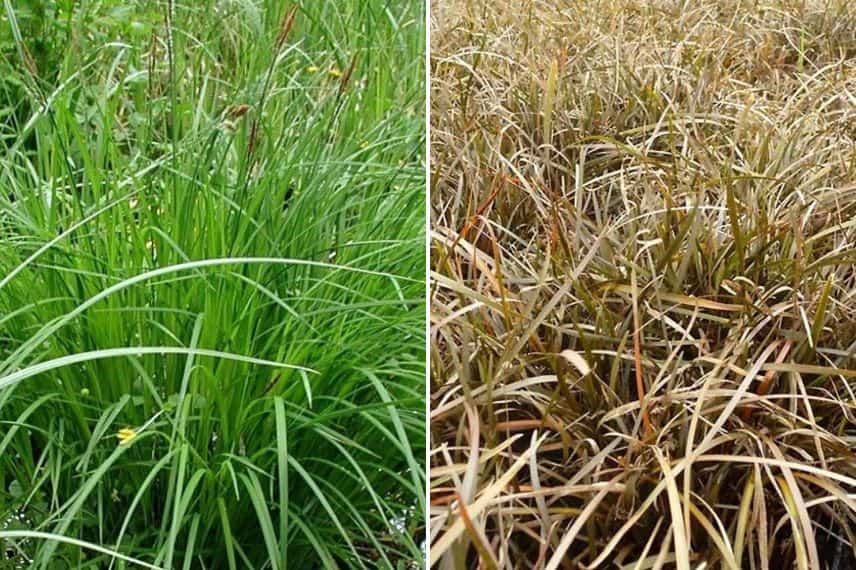
Carex are grasses with evergreen leaves that can be interesting as groundcover. They bring structure and lightness and offer a wide variety of colours. They require little maintenance and adapt well to shaded situations. This is practical if you have a green roof in partial shade, with a substrate that remains cool.
The Carex berggrenii – Berggren’s Sedge is a miniature carex that reaches a height of 5 cm. Its foliage, bronze to copper-brown in colour with metallic highlights, is evergreen, providing a decorative cover all year round. Short brown spikes appear from April to July. This plant enjoys sunny or partially shaded locations, with a cool substrate, making it an interesting choice for a green roof in shaded areas. Another modest-sized Carex, the Carex montana or Mountain Sedge is a perennial with short rootstock, reaching a height of 20 cm at ripeness. It forms a compact tuft of fine, persistent pale green leaves that turn yellow. It produces brown spikes from April to June and can be planted in both sunny and partially shaded areas.
Moss phlox for lovely flowering cushions
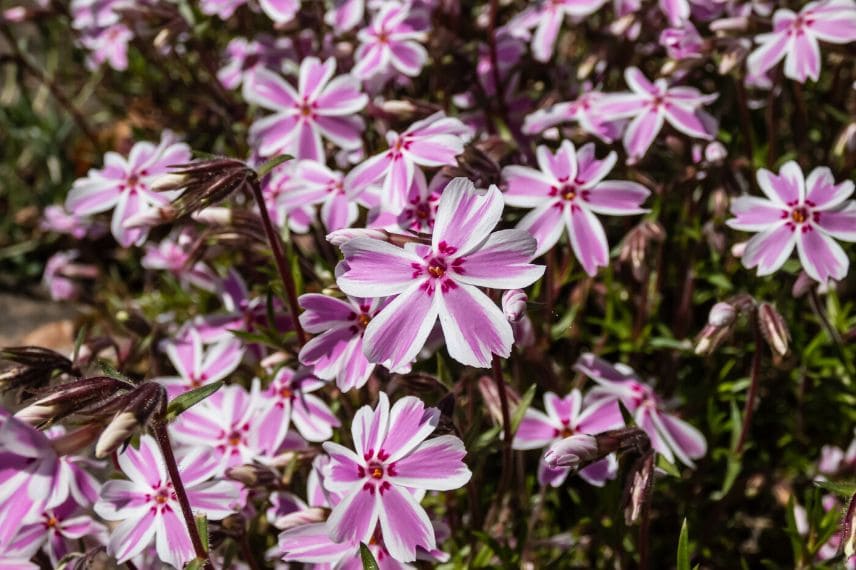
Moss phlox are creeping plants that form carpets of flowers in soft colours. They bloom from April to June and are easy to maintain. Preferring sun and partial shade, they thrive in fresh, rich soil. For a green roof in partial shade, try moss phlox.
At a height of 10 cm, the Moss phlox ‘Moerheimii’ is a perennial that forms a cushion of star-shaped flowers in candy pink from April to June. It also enjoys dry soil. For a touch of originality, add Moss phlox ‘Candy Stripes’ – Phlox subulata with pink flowers edged in white to your green roof. And for fans of lavender blue, you can install Phlox subulata ‘Emerald Cushion Blue’ – light blue moss phlox, which also blooms from April to June while maintaining a modest height of 10 cm.
Dwarf saxifrages for an alpine atmosphere
Saxifrages are also low-maintenance rock garden plants, making them good candidates for a green roof. They thrive in full sun and partial shade. For a roof, prefer dwarf varieties, such as Saxifraga arendsii ‘Purpurteppich’ – Moss saxifrage, which only grows to 5 cm tall. In spring, from April to May, it forms lovely small cushions of purplish-pink flowers. The only consideration to keep in mind is that it prefers a rich, humus-bearing substrate. You can pair it with Saxifraga arendsii ‘Ware’s Crimson’ – Moss saxifrage, which provides a delicate blend of pink and white.
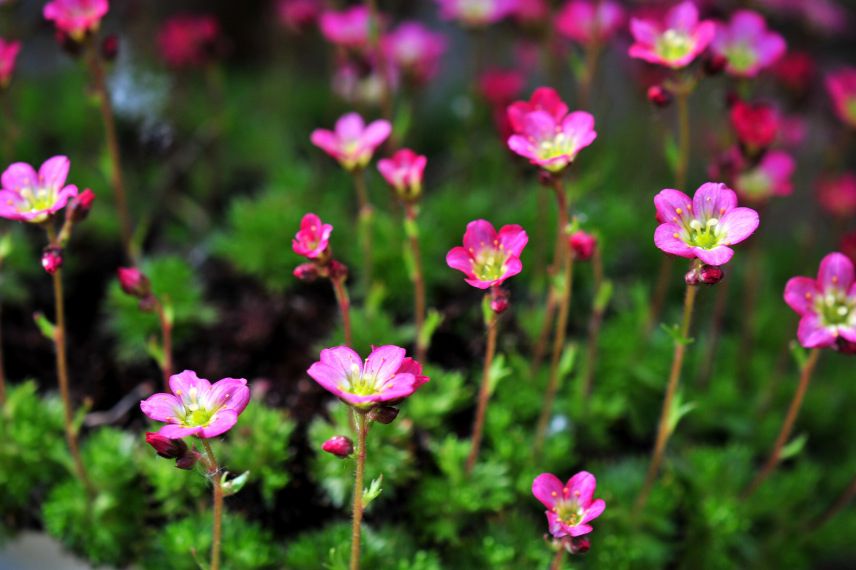
Moss saxifrage
Dianthus to Bring Poetry
To add a bit more verticality to your green roof, you can install dianthus or small carnations. Requiring little maintenance and easy to grow, dianthus brings a lot of charm and poetry. They offer a wide range of colours, from red to white, including pink and yellow, and a variety of shapes, from small pom-poms to fringed pom-poms. The dianthus thrives in full sun in well-drained soil.
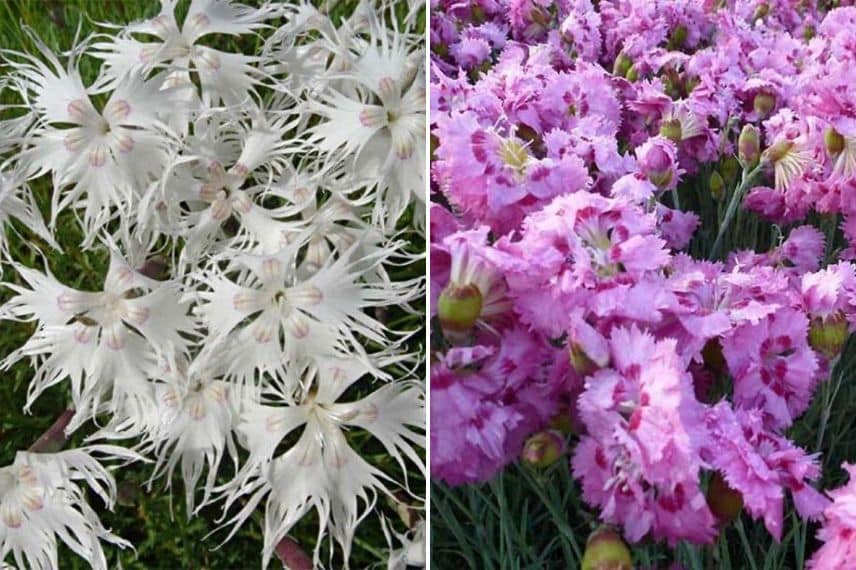
For a sunlit green roof, you can plant Dianthus arenarius – Sand Carnation, which produces cushions of fringed white flowers on very fine green foliage from July to September. It reaches 25 cm at maturity and withstands temperatures down to -17°C. Its foliage is very fine, green, and evergreen.
The Dianthus deltoides ‘Brillant’ – Heath Carnation grows to 15 cm and blooms from May to July. It bears bright red flowers with fringed petals and also forms dense little cushions. For pink flowers from June to August, you can choose Dianthus plumarius ‘Maggie’ – Sweet William, which will reach a height of 25 cm. It offers bicoloured double flowers in pink with a carmine red centre. The advantage of carnations is also their fragrance, which may reach you if your green roof isn’t too high.
Many other plants can be installed on a green roof, such as dwarf irises, small lavenders, small spurges, small campanulas, or even small Erigerons.
For further reading
You can consult:
- the Guide to Green Roof Plants by Edmund C. Snodgrass and Lucie L. Snodgrass, published by Editions du Rouergue in 2008 (in French).
- our detailed tutorial on creating a green roof.
- Subscribe!
- Contents

Comments