





























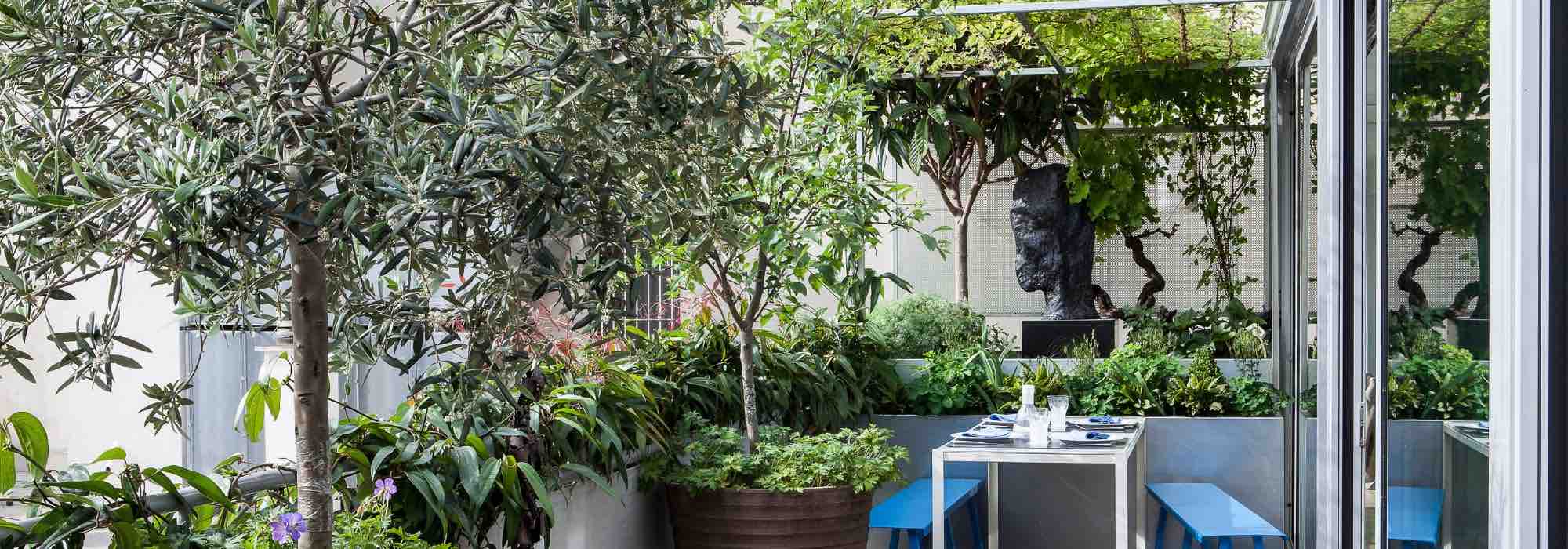
7 trees to grow in pots on a terrace or balcony
To create a green haven
Contents
It is possible to consider planting a tree as a terrace plant or for a large balcony. Some species or varieties form small dwarf trees and allow you to create, even without a garden, a haven of greenery, accompanied by various smaller plants. Properly oriented, they can also provide welcome shade to set up a small table or protect some outdoor potted plants from the sun’s rays. However, they will require ongoing care: watering, fertilising, repotting or regular top-dressing and it may not be possible to keep them in pots as long as they would be in the ground, but you can easily plant them there for many years.
Here is a selection of small-growing trees that thrive in pots and a few factors to consider for their installation. So, if you’re wondering what to put in large pots on a terrace, look no further — you’re in the right place.

The olive tree
Olive trees are very well suited to growing in pots, you can regularly see venerable specimens in large tubs. Choose a compact-growing species such as the Olea europeae ‘Negrette’, a variety that reaches 4 m in all directions at maturity (and probably less in a pot). The olive tree, over time, forms a broad, gnarled trunk, with attractive grey bark, and its habit is that of a small tree. Its handsome, fine, silvery, airy foliage contrasts with the trunk’s robustness. It is grown mainly for its ornamental appeal and its pot culture is well suited, as the preparation of its fruit—the olives—is tedious.
The olive tree appreciates a sunny position, sheltered from cold winds. It will tolerate frosts to around -10°C, but only -5°C when still young. A tree of dry and poor soil, it is not overly fussy about watering, though it relies more on your care when in a pot.
→ Read Ingrid’s article to learn more about its cultivation and wintering: growing an olive tree in a pot.
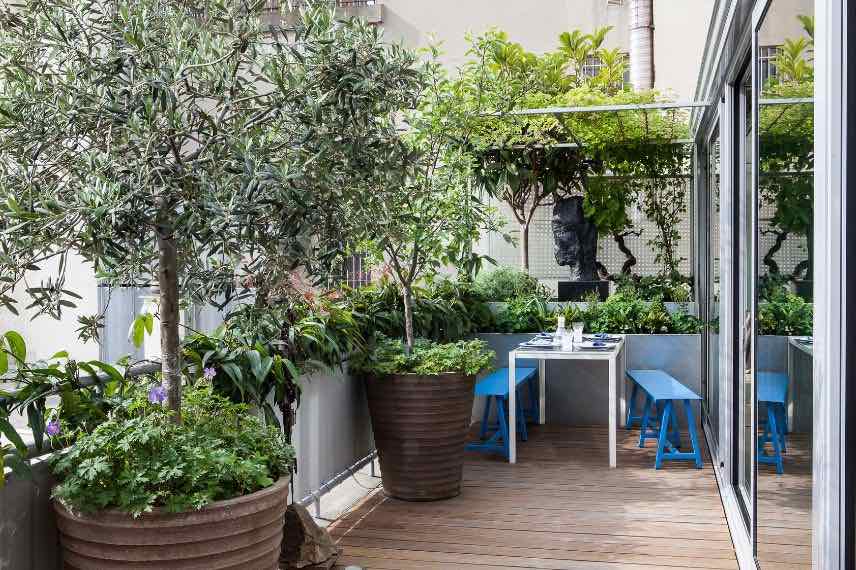
An olive tree in a pot in the foreground on this terrace
Read also
10 dwarf fruit trees to grow in potsAcer japonicum 'Aconitifolium'
Acer japonicum Acer japonicum ‘Aconitifolium’ is a Japanese maple with foliage reminiscent of monkshood leaves, finely cut, fairly large. Its stems and leaves form a slightly umbrella-shaped canopy, well rounded, spreading in width, on a single small trunk, giving it the appearance of a small tree. Its apple-green leaves turn red in autumn, ranging from reddish-brown to ruby red. It reaches 3 m in height and 3.5 m in width. While it tolerates a little more sun than other varieties, it does not cope well with high temperatures. In a pot, on a terrace or balcony, place it in partial shade, where shade is ensured during the hottest hours of the day, in spring and summer. Shield it from cold winds. To space out watering, to which it will be quite dependent, especially during the first two years, mulch the top of the pot generously.
If Japanese maples are regularly grown in pots, particularly because of their compact growth, not all have the appearance of a small tree. Acer japonicum ‘Aconitifolium’ certainly belongs to those with this miniature-tree habit. In addition, its deciduous, opposite leaves, deeply cut, with 7 or 11 dentate lobes, are very distinctive among the Japanese maples.
→ Read the plant guide on Japanese maples: planting, pruning and care.
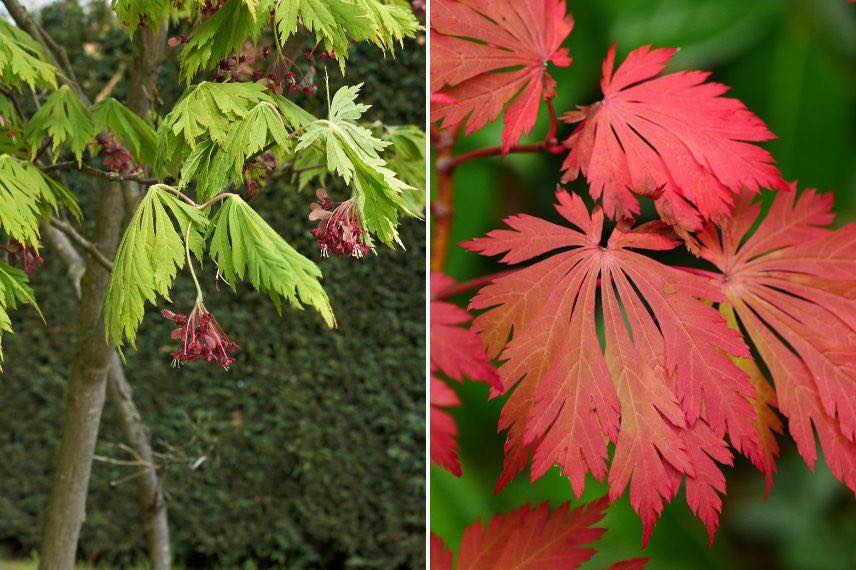
Spring foliage and flowering, autumn foliage
Callistemon viminalis
Callistemon viminalis forms a small, weeping-habit tree, with evergreen, fine and elegant foliage, forming a dense, dome-shaped crown of trailing branches. This plant, also known as Bottlebrush, offers spring flowering in the form of very bright red flower spikes, glossy, taking on a magenta hue as days pass, slightly trailing. They are followed by the production of small cupule-shaped fruits. Originating in south-eastern Australia, it is a plant of mild climate, frost-hardy to about -5 to -6°C. It rarely exceeds 7 m in height with a 2 to 3 m spread under our climates, and will be shorter when grown in a large container. Its growth is fairly rapid. Its grey-brown, fissured bark is decorative. Its foliage, linear and narrow, is a beautiful grey-green colour. Spring shoots are tinged red. It is melliferous and nectariferous.
The flowering can recur several times during the season and into late summer, if you provide regular watering throughout the summer, simply allowing the substrate to dry slightly between waterings.
→ Read the family sheet for more information: Callistemon, Bottlebrush: plant, prune, care.
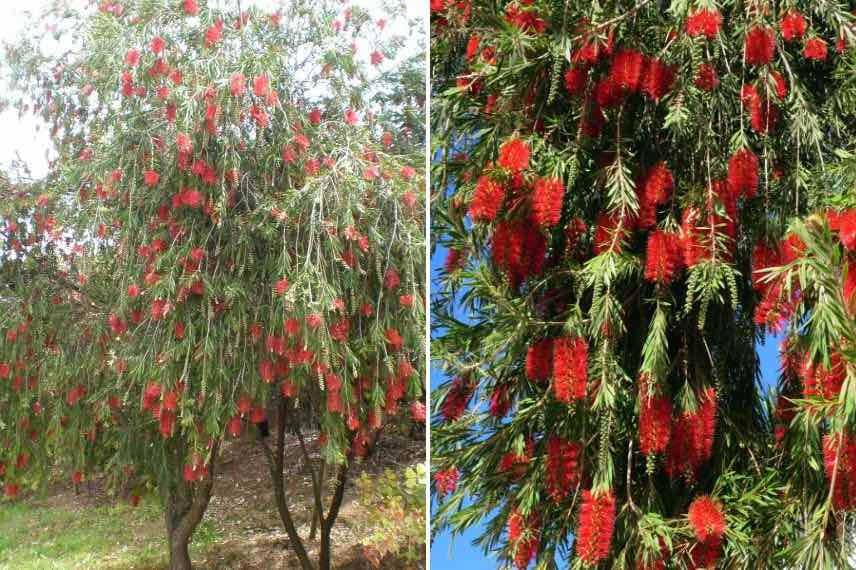 Callistemon viminalis is an appealing and hardy tree[/caption>
Read also
5 dwarf trees to grow on a windy balconyTecoma stans
Another small tree suited to temperate climates, the Tecoma stans offers a beautiful, bright yellow flowering in clusters of trumpet-shaped flowers. It has a long flowering period from April to September, attracting bees and butterflies. The fruits that follow are elongated pods up to 20 cm long, initially bright green, then turning dark brown at maturity. The leaves, a vivid green, lanceolate and relatively narrow, are delicately dentate. They give the plant a light, ramified appearance. The Tecoma stans reaches 2–3 m in all directions.
Of tropical origin, it is a small tree for the Côte d’Azur, as its aerial parts freeze at -2°C. The rootstock, more resilient, tolerates down to -8°C or -10°C. It can be grown in a pot elsewhere provided you can overwinter it in a bright, frost-free space.
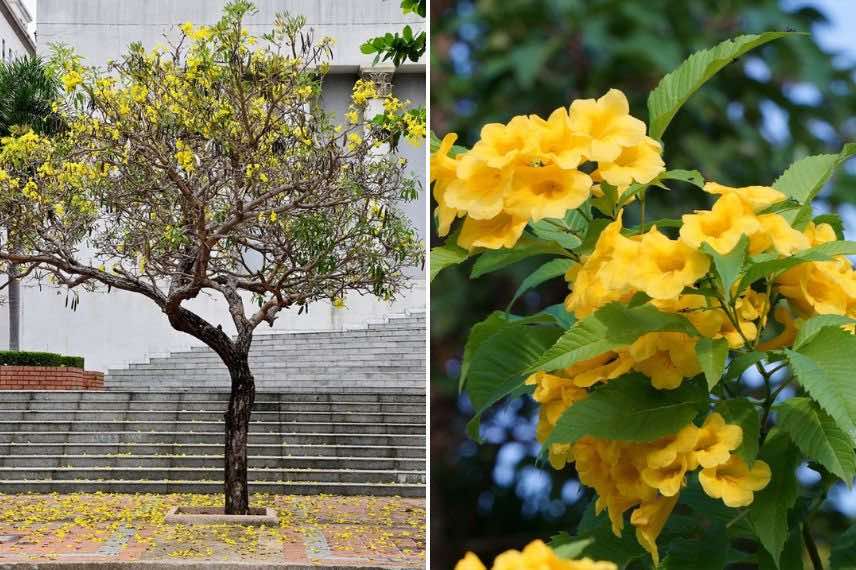
Tecoma stans offers generous, long-lasting flowering
Eucalyptus
Don’t hesitate to plant the most compact Eucalyptus species and varieties in pots on a balcony or terrace, to enjoy this beautiful exotic tree in your own way. The aromatic, blue-tinged foliage and the bark of Eucalyptus are very decorative. Choose Eucalyptus ‘Baby Blue’ or the Eucalyptus gunnii ‘France Bleu Rengun’ or ‘Blau Liebe’. You can also plant a coppiced Eucalyptus with multiple trunks, such as Eucalyptus apiculata or Eucalyptus approximans. These varieties and species will stay smaller in a pot than in the ground. Eucalyptus grow rapidly. Most are hardy down to around -12°C, though in pots they may suffer frost down to around -9 to -10°C. Eucalyptus ‘Blau Liebe’ is slightly hardier, down to around -15°C, i.e. around -12°C in a pot.
Plant your Eucalyptus in a sunny position, sheltered from the wind. If necessary, bring it indoors for the winter into a frost-free, unheated and well-lit room. It requires moderate watering, preferably with rainwater to avoid limescale.
→ For more information, read the article: Growing an Eucalyptus in a pot.
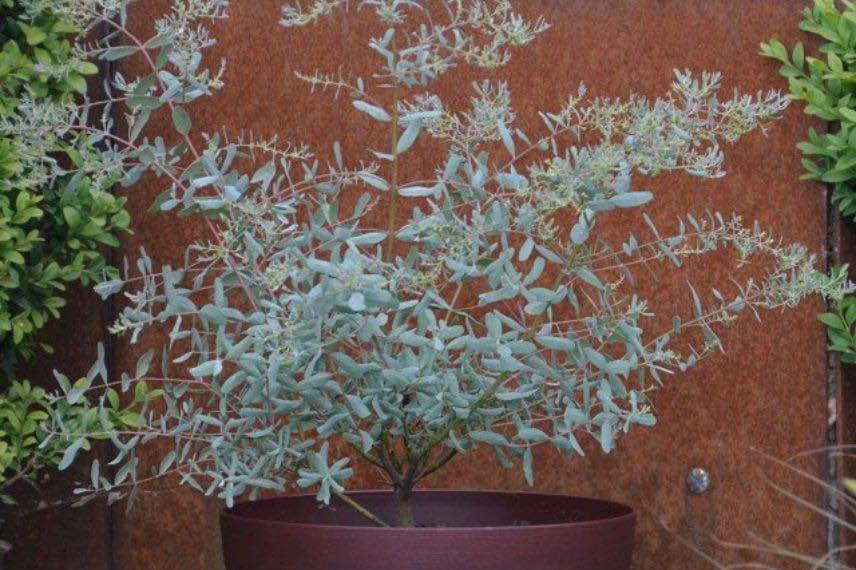
The Eucalyptus ‘France Bleu Rengun’ in a pot
Sophora japonica 'Pendula'
The Sophora japonica ‘Pendula’ is a pagoda tree with a trailing habit, weeping, tiered and irregular. We recognise its light foliage, characteristic of the Fabaceae family, formed of small leaflets in dark glossy green. Its long, flexible branches eventually touch the ground. It reaches 3 m tall by 3 m wide, with fairly rapid growth. With age, its trunk becomes twisted. It tolerates pruning well, resists pollution and tolerates drought once established. It enjoys warmth and sun, best sheltered from winds that could uproot it, as it has a shallow root system. It is hardy down to about -15°C. In a pot, it will still require regular watering, especially during the first two years.
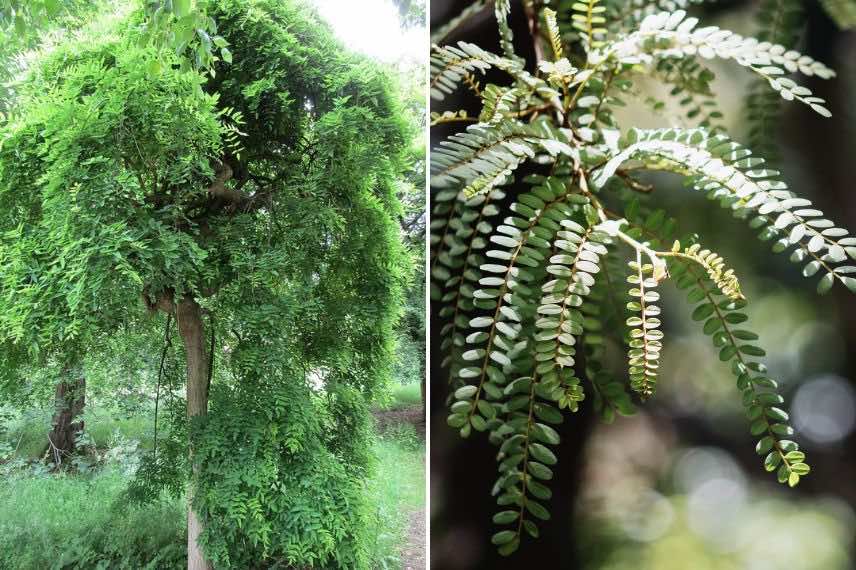
The graceful habit and elegant foliage of Sophora japonica ‘Pendula’
Albizia
The Albizia, or silk tree, is a very popular tree that can be grown in a pot on a large terrace. Its umbrella-shaped habit gives it some breadth and Albizias often reach 4–5 m tall by 4–5 m wide. Some varieties stay smaller, such as the Albizia julibrissin ‘Shidare’ or ‘Evey’s Pride’. The first has a weeping habit and the second a chocolate-coloured foliage. They reach about 3.5–4 m in height by 2.5–3.5 m in spread, with relatively slow growth. The Albizia features a beautiful, light foliage from the Fabaceae family, which cascades from the pendulous branches. It flowers in silky pink pom-poms, usually in mid‑summer. This small tree with an exotic appearance, also prized for its shade, thrives in full sun, sheltered from cold winds, in well-drained soil. It is hardy to −15°C in the ground. It may therefore be necessary to protect it from frost in some regions.
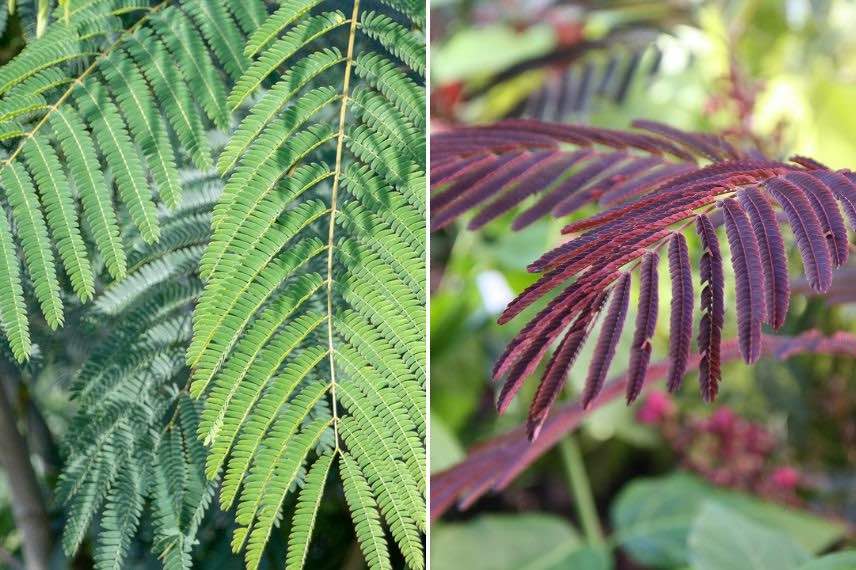
Albizia julibrissin ‘Shidare’ and ‘Evey’s Pride’
Further reading
→ Also consider dwarf fruit trees, their modern cultivars are often very productive, such as the Fruit Me series, available as apricot, plum, cherry, peach, nectarine and apple trees.
- Subscribe!
- Contents
Comments