Tecoma stans
Tecoma stans
Tecoma stans
Tecoma stans
Tecoma stans
Tecoma stans
Tecoma stans
Tecoma stans
Tecoma stans
Tecoma stans
Tecoma stans
Shrubby Trumpet Flower, Golden Trumpet
Back-to-school special offer!
Get €10 off for every €50 you spend! And get up to €40 off on a single order.
How does it work?
1. Shop your favourites
Add your favourite plants to your basket. For every €50 you spend (excluding delivery charges, store credit and the plastic-free option), you’ll receive a €10 voucher.
€50 spent = €10 voucher
€100 spent = €20 voucher
€150 spent = €30 voucher
€200 spent = €40 voucher
2. Place your order
Once your basket reaches one of the spending thresholds, place your order. You can even choose your delivery date!
3. Receive your voucher
As soon as your order has been shipped, you’ll receive an email containing your personal voucher code and its value.
4. Use it on your next order
Your voucher is valid for 90 days from the date you receive it. It can be used once only, on a new order worth at least the value of the voucher, excluding delivery charges.
Please note: Vouchers can be combined with other offers, but cannot be split or refunded.
Why not try an alternative variety in stock?
View all →
Available in 1 sizes
This plant carries a 24 months recovery warranty
More information
We guarantee the quality of our plants for a full growing cycle, and will replace at our expense any plant that fails to recover under normal climatic and planting conditions.
Would this plant suit my garden?
Set up your Plantfit profile →
Description
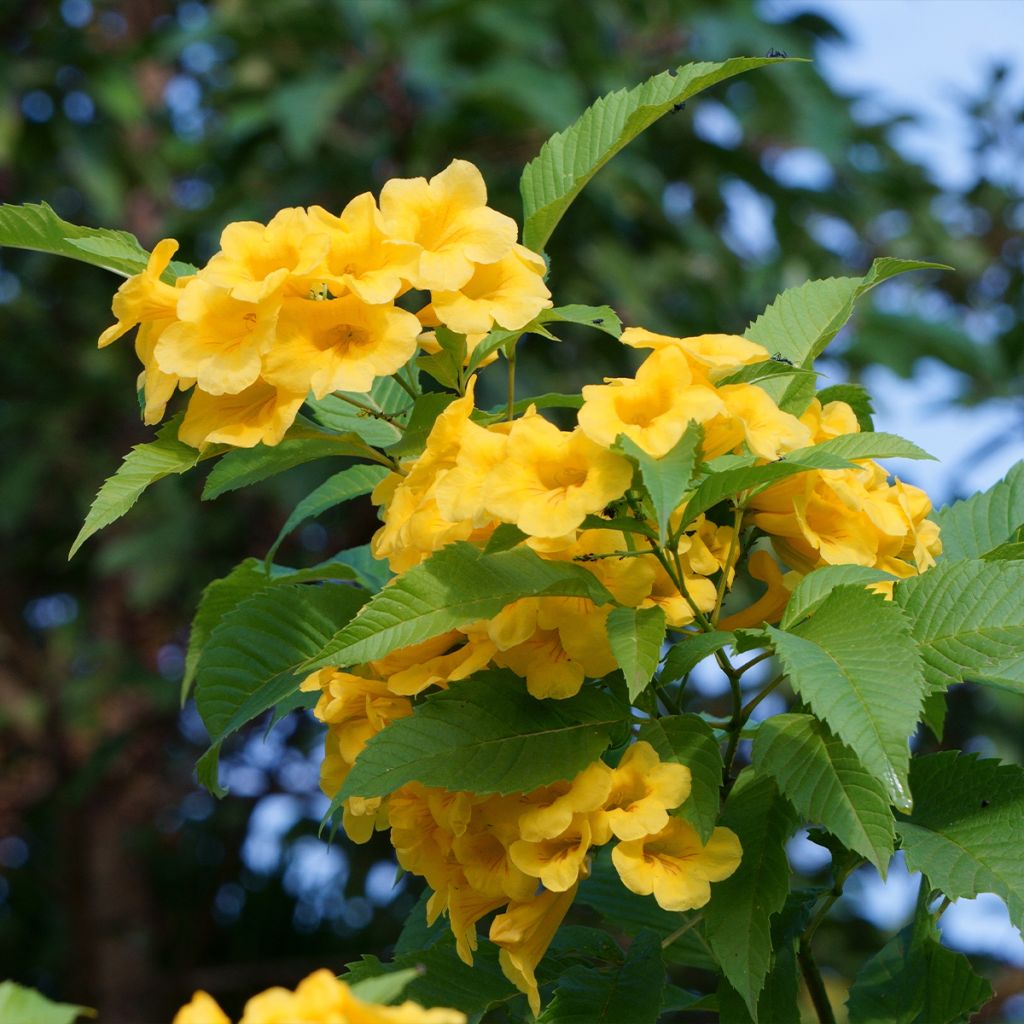
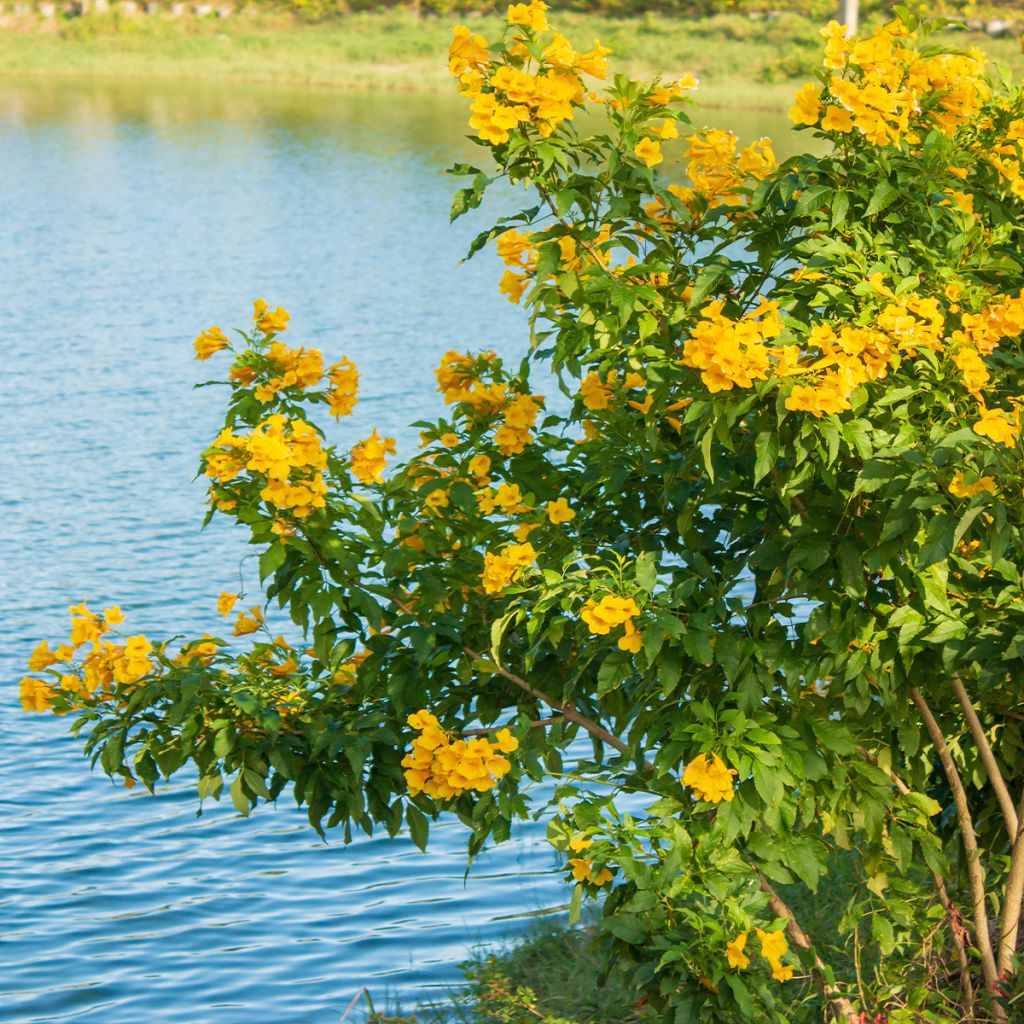
The Tecoma stans or Golden Trumpet is a tropical shrub that can also grow in a warm temperate climate. Its flowering is particularly attractive, consisting of numerous clusters of trumpet-shaped flowers in a bright yellow color. It stretches throughout the growing season, from spring to the beginning of autumn, making it an extremely desirable flowering plant. As it is frost-sensitive, it can only be planted in a few frost free areas. However, Tecoma stans can be cultivated in containers elsewhere, allowing it to be enjoyed on a terrace during the warm season, and then overwintered in a bright frost-free room.
The genus Tecoma belongs to the Bignoniaceae family, which includes trees (such as Catalpa), shrubs, and numerous climbers and lianas (Campsis, Podranea, etc.). There are 14 species of Tecoma, 2 from Africa and the others from South America, mainly evergreen shrubs and small trees.
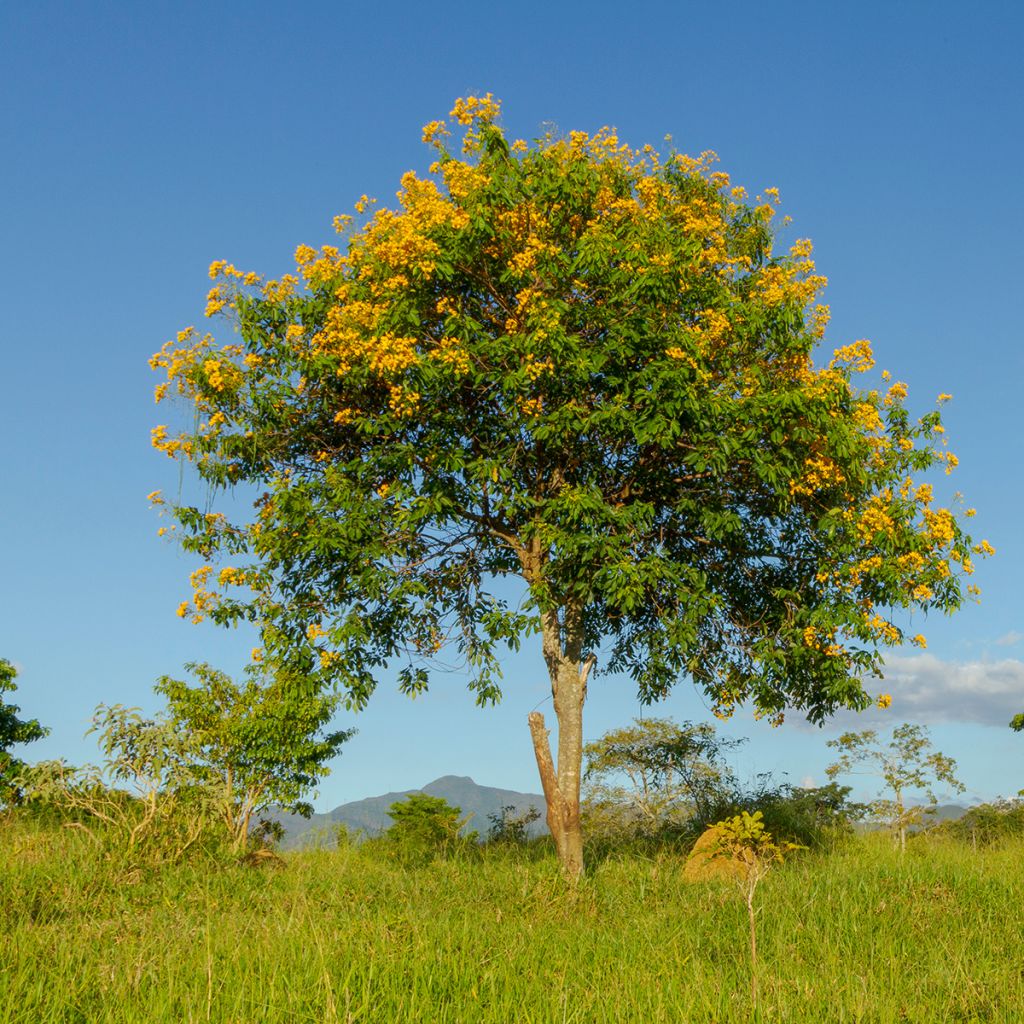
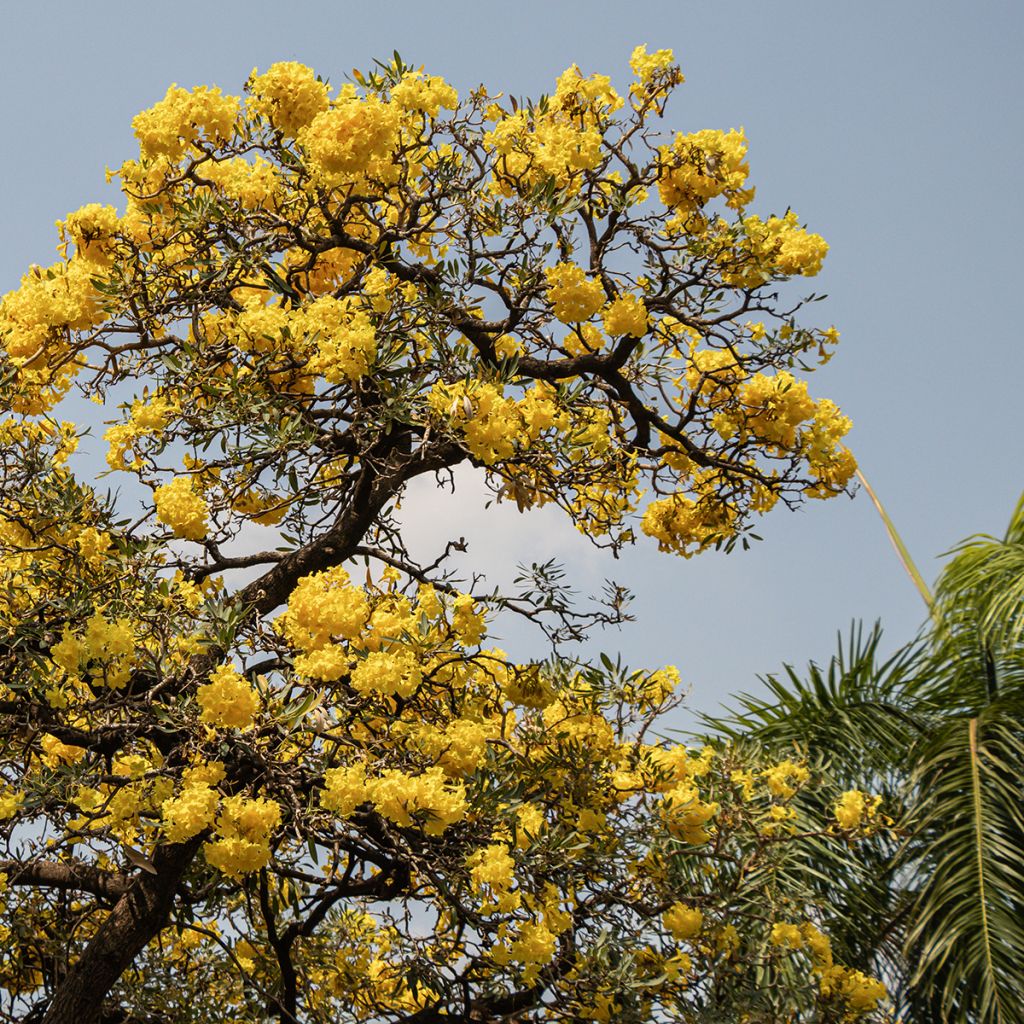
This is the case with Tecoma stans, which is mainly native to tropical areas of South America and also Central America, where it grows from sea level up to 1300m (4265ft) altitude, in deciduous or semi-evergreen forests. It forms a shrub or a small tree, ranging from 4.50m (15ft) to 6-8m (20-26ft) in height, with a grayish and rough bark. Highly branched, it generally has a rounded habit. It is a semi-deciduous species, meaning it loses its leaves when new ones appear.
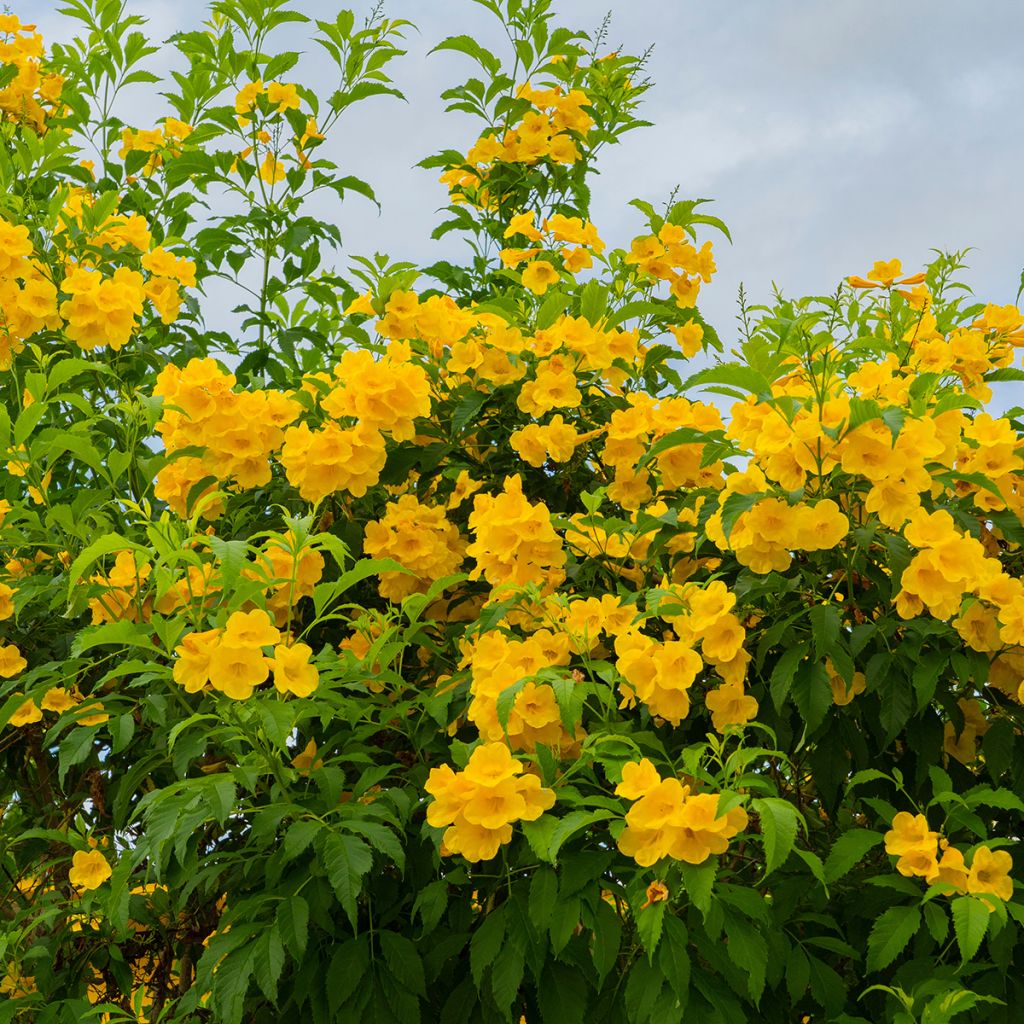
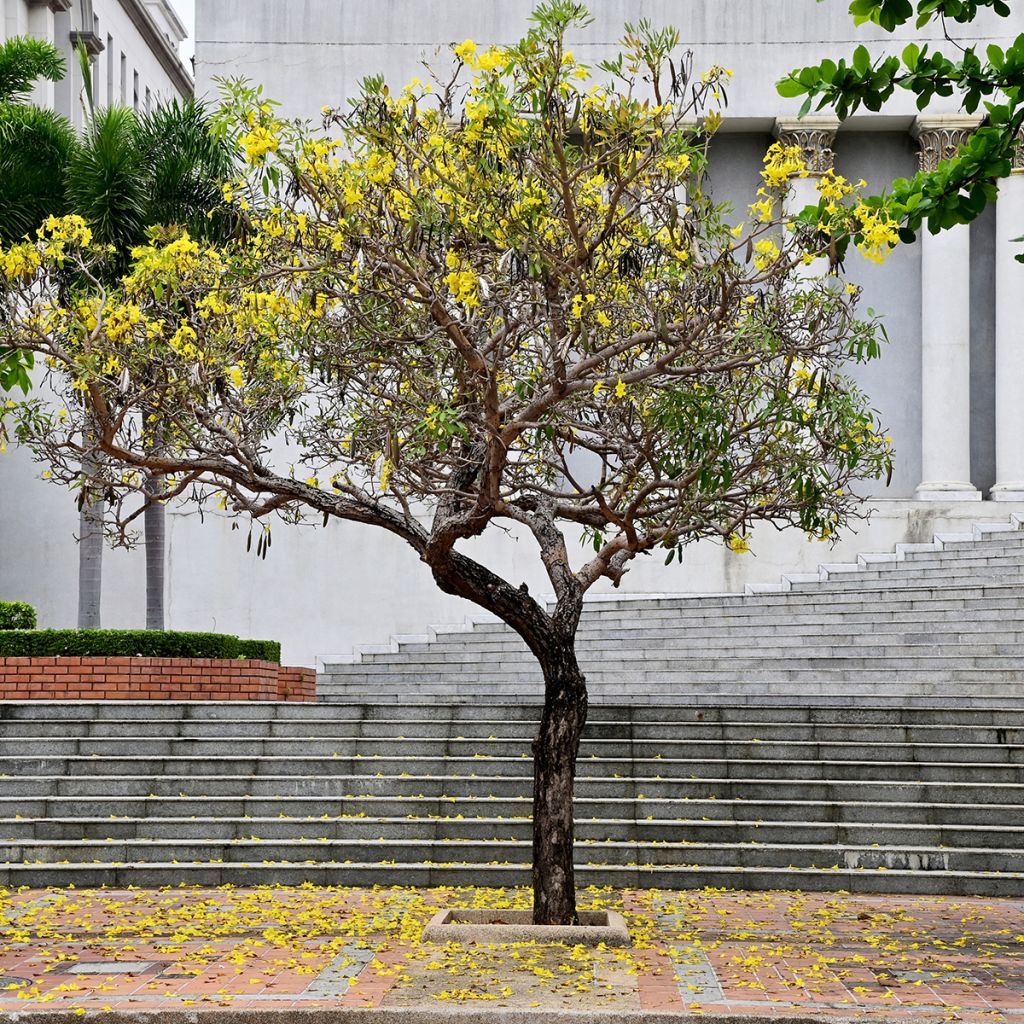
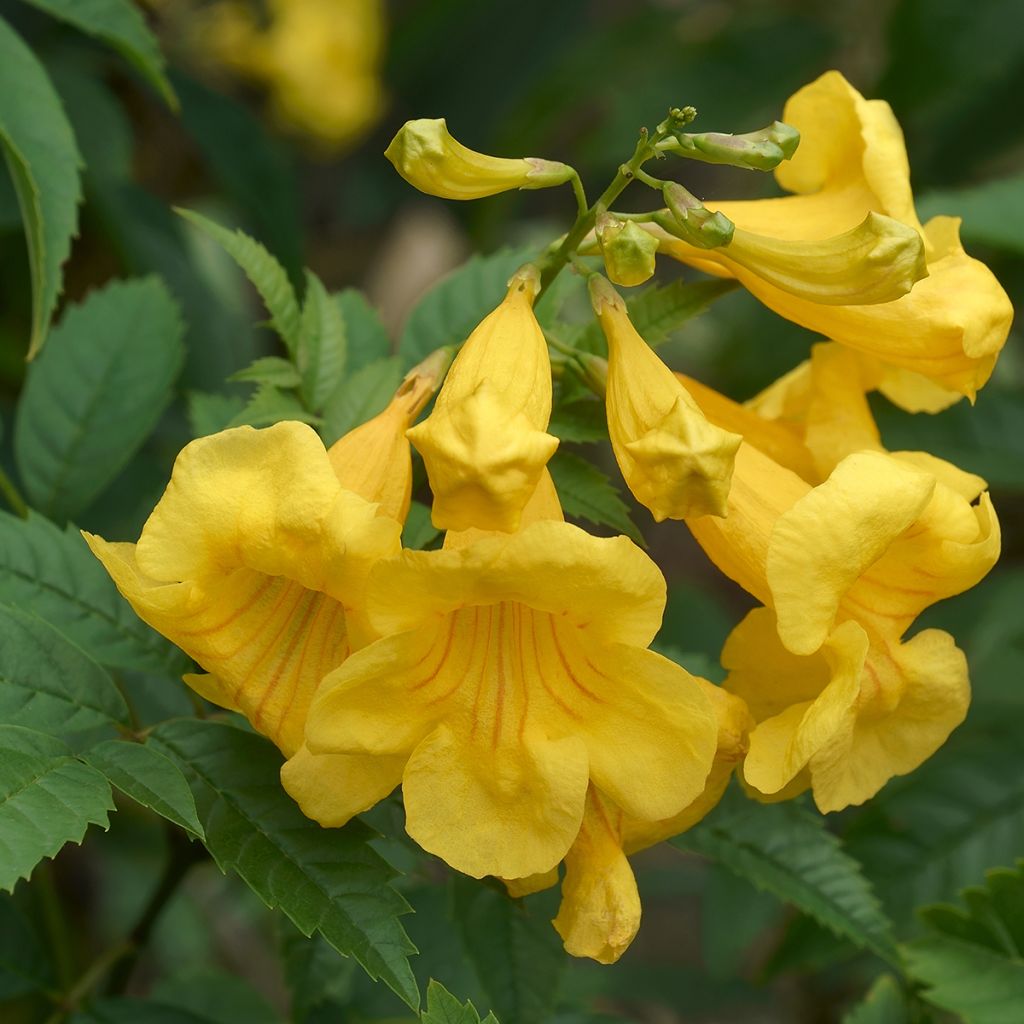
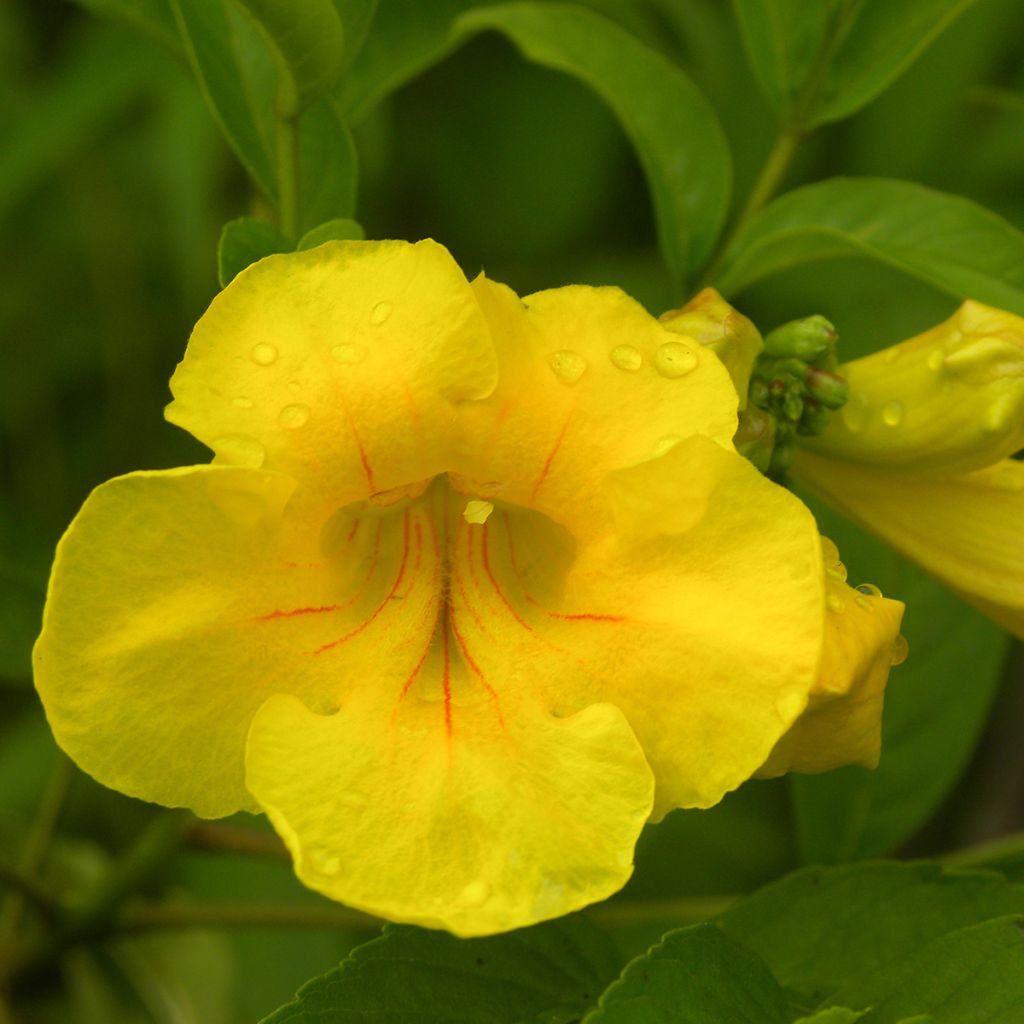
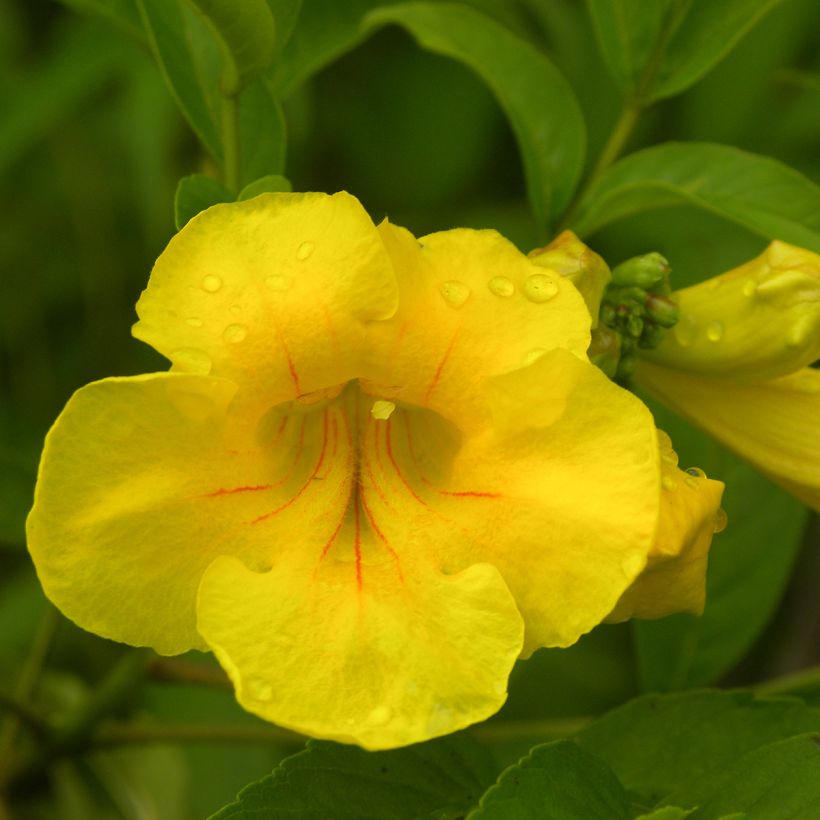
Cultivated in a warm temperate climate, it behaves as a deciduous plant, losing its leaves due to winter cold. Only the mildest areas can accommodate it in the ground (there is one specimen in the botanical garden of Bormes les Mimosas, well protected in the heart of the old village). Under this type of climate, it usually forms a bush 2-3m (7-10ft) in height, decorative with its beautiful cut leaves and especially its magnificent flowering. From April to September, clusters of bright yellow flowers are constantly renewed, attracting attention from all around. Shaped like trumpets measuring 4 to 5cm (2in) in width, slightly fragrant, they are grouped at the ends of branches. Nectar-bearing, they attract bees and butterflies. Their bright yellow color is tinged with subtle red streaks in the corolla tube. The fruits that follow are elongated pods, measuring up to 20cm (8in) in length, initially green and then turning dark brown when ripe. Dehiscent, they open by themselves to release numerous winged seeds, dispersed by the wind.
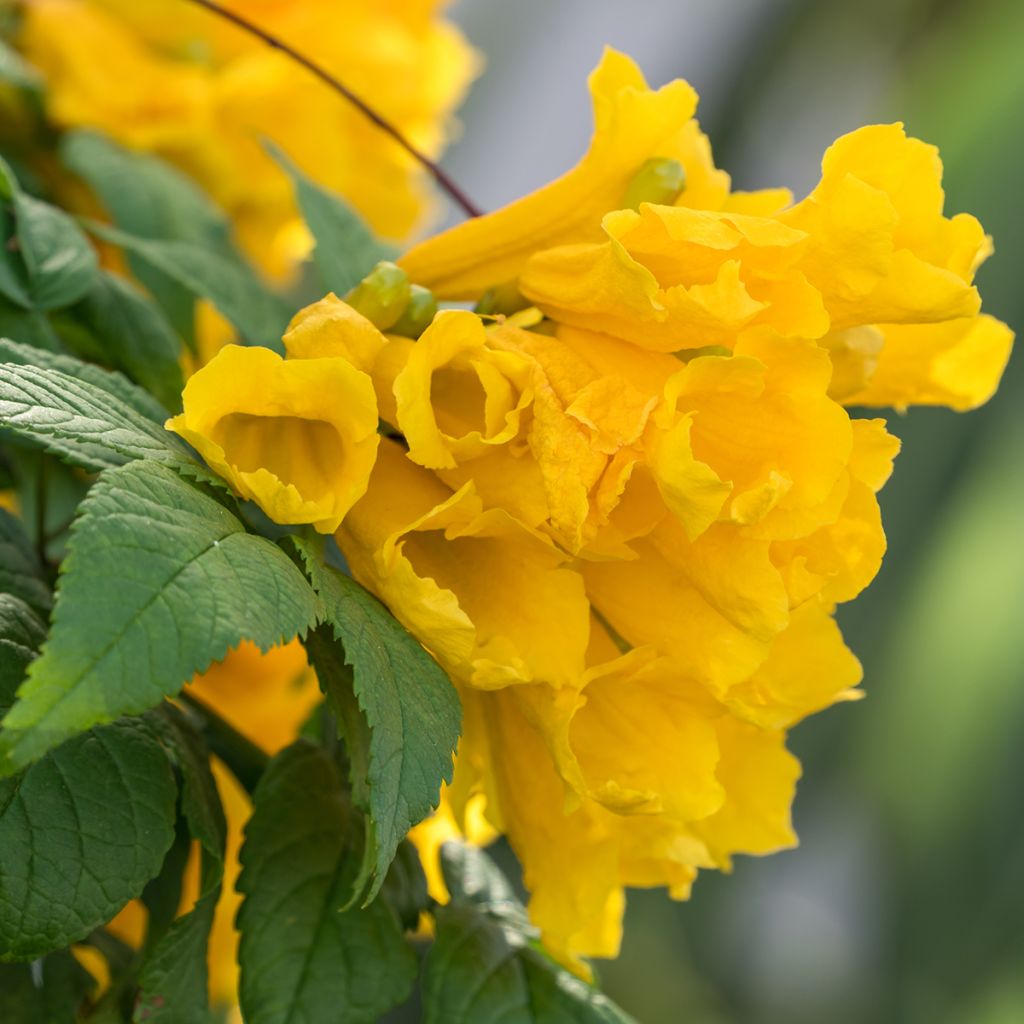
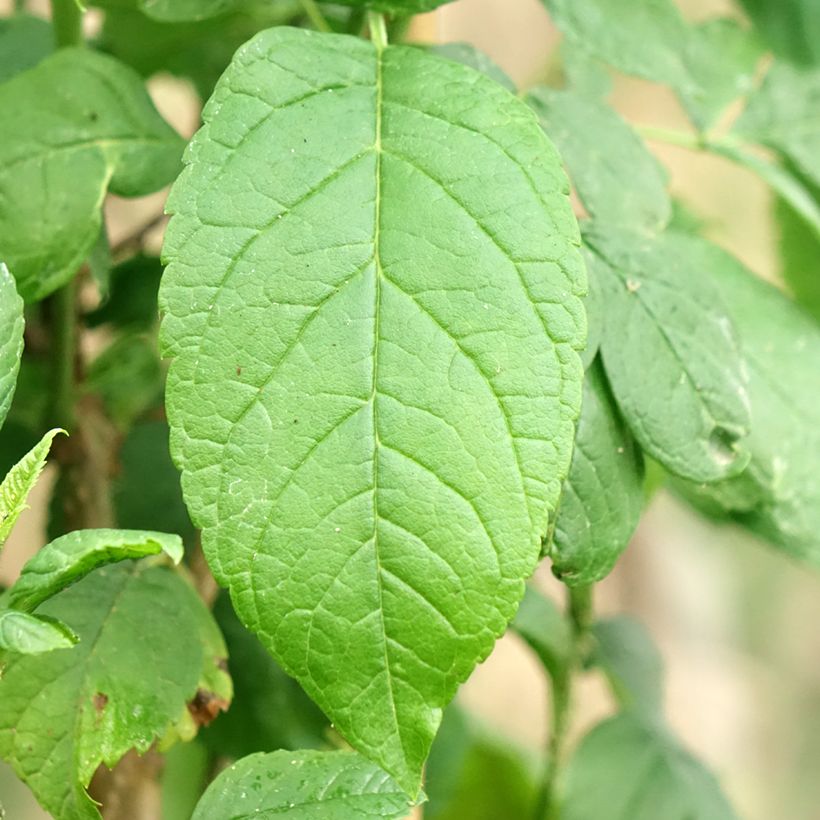
The abundant foliage is a beautiful bright green, with a light and very decorative appearance. It is composed of opposite leaves on the stems, measuring up to 25cm (10in) in length and consisting of 5 to 13 leaflets. Lanceolate and relatively narrow, they are delicately toothed. A frost-sensitive plant, its above-ground parts can be destroyed from -2°C (28.4°F). The root, on the other hand, is more resistant, being able to withstand temperatures down to -8°C (17.6°F) or -10°C (14°F) and then regrow in the following spring.
With its deliciously exotic appearance, Tecoma stans is captivating due to its enchanting and long-lasting flowering. Accompany it with other tender plants to create a tropical-inspired scene on your terrace. The Plumbago capensis will play the color contrast card with its long-lasting blue flowers. If you have enough space to overwinter a container with a trellis, go for the Hardenbergia violacea, a fabulous climber producing numerous violet-colored flowers resembling peas. And to add a tangy touch to your decor, why not choose a Citrus limon, which will offer you enchanting white flowers and lemons that you can use in the kitchen.
Report an error about the product description
Tecoma stans in pictures
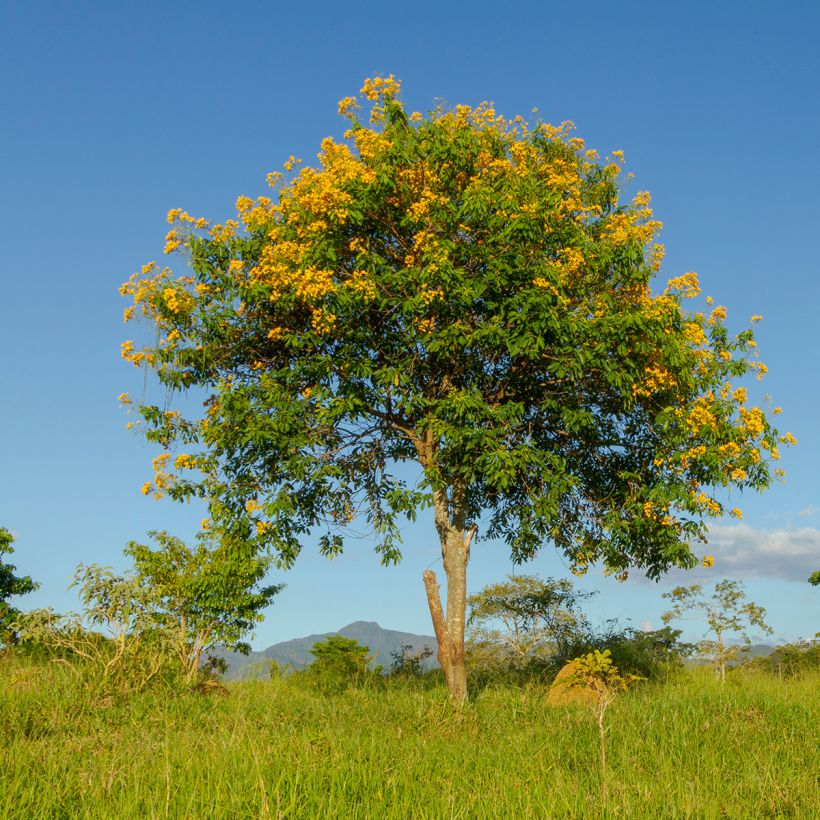
Plant habit
Flowering
Foliage
Botanical data
Tecoma
stans
Bignoniaceae
Shrubby Trumpet Flower, Golden Trumpet
South America
Planting and care
The Tecoma stans is a non-hardy plant whose above-ground part freezes from around -2°C (28.4°F), but its stump can restart after more intense frosts (up to -8/-10°C (17.6/14°F)). Therefore, planting it in open ground is reserved for frost-free micro-climates. Everywhere else, it will have to be grown in a container in order to be overwintered in a frost-free veranda or a very bright room.
In the garden, it will thrive in a rich, moist, but well-drained soil, and especially in a very sunny exposure. It will also be necessary to choose a location sheltered from the wind, a south-facing stone wall will be ideal. Once well rooted, it can withstand dry periods, but occasional watering will always be preferable.
In a container, use a light, well-drained potting soil that remains moist. We recommend the following mixture: 60% good horticultural soil, 20% coarse river sand, 20% clay soil for its water retention capacity. The pH should be between 6.5 and 7.5. Water regularly during the summer.
Watch out for red spiders (mites) that can attack this species. Prune at the end of the season before wintering to limit its volume and reduce both the frequency and quantity of watering.
Planting period
Intended location
Care
Planting & care advice
-
-
-
-
-
-
-
-
This item has not been reviewed yet - be the first to leave a review about it.
Recently viewed products
Haven't found what you were looking for?
Hardiness is the lowest winter temperature a plant can endure without suffering serious damage or even dying. However, hardiness is affected by location (a sheltered area, such as a patio), protection (winter cover) and soil type (hardiness is improved by well-drained soil).

The flowering period indicated on our website applies to countries and regions located in USDA zone 8 (France, the United Kingdom, Ireland, the Netherlands, etc.)
It will vary according to where you live:- In zones 9 to 10 (Italy, Spain, Greece, etc.), flowering will occur about 2 to 4 weeks earlier.
- In zones 6 to 7 (Germany, Poland, Slovenia, and lower mountainous regions), flowering will be delayed by 2 to 3 weeks.
- In zone 5 (Central Europe, Scandinavia), blooming will be delayed by 3 to 5 weeks.
In temperate climates, pruning of spring-flowering shrubs (forsythia, spireas, etc.) should be done just after flowering.
Pruning of summer-flowering shrubs (Indian Lilac, Perovskia, etc.) can be done in winter or spring.
In cold regions as well as with frost-sensitive plants, avoid pruning too early when severe frosts may still occur.
The planting period indicated on our website applies to countries and regions located in USDA zone 8 (France, United Kingdom, Ireland, Netherlands).
It will vary according to where you live:
- In Mediterranean zones (Marseille, Madrid, Milan, etc.), autumn and winter are the best planting periods.
- In continental zones (Strasbourg, Munich, Vienna, etc.), delay planting by 2 to 3 weeks in spring and bring it forward by 2 to 4 weeks in autumn.
- In mountainous regions (the Alps, Pyrenees, Carpathians, etc.), it is best to plant in late spring (May-June) or late summer (August-September).
The harvesting period indicated on our website applies to countries and regions in USDA zone 8 (France, England, Ireland, the Netherlands).
In colder areas (Scandinavia, Poland, Austria...) fruit and vegetable harvests are likely to be delayed by 3-4 weeks.
In warmer areas (Italy, Spain, Greece, etc.), harvesting will probably take place earlier, depending on weather conditions.
The sowing periods indicated on our website apply to countries and regions within USDA Zone 8 (France, UK, Ireland, Netherlands).
In colder areas (Scandinavia, Poland, Austria...), delay any outdoor sowing by 3-4 weeks, or sow under glass.
In warmer climes (Italy, Spain, Greece, etc.), bring outdoor sowing forward by a few weeks.
Shipping country and language
Your country of residence may be:
Your country of residence is:
For a better user experience on our website, you can select:
Your shipping country:
-
 Austria
-
 Belgium
-
 Bosnia & Herzegovina
-
 Bulgaria
-
 Croatia
-
 Cyprus
-
 Czechia
-
 Denmark
-
 Estonia
-
 Finland
-
 France
-
 Germany
-
 Greece
-
 Hungary
-
 Iceland
-
 Ireland
-
 Italy
Italy
-
 Latvia
-
 Liechtenstein
-
 Lithuania
-
 Luxembourg
-
 Malta
Malta
-
 Netherlands
-
 Poland
-
 Portugal
-
 Romania
-
 Serbia
-
 Slovakia
-
 Slovenia
-
 Spain
Spain
-
 Sweden
-
 Switzerland
Language:
-
French
-
 English
-
Spanish
-
Italian
-
German
-
Portuguese
-
Dutch
-
Finnish
My Account
Hello
My wish lists
My cart
Log in / Register
Existing customer?
This form is protected by reCAPTCHA - the Google Privacy Policy and Terms of Service apply.
New customer?
Create an account to track your orders, access our customer service and, if you wish, make the most of our upcoming offers.