





























8 shrubs for a defensive hedge
Our selection of thorny hedge shrubs
Contents
When considering creating a defensive garden hedge to deter intruders, the choice of suitable thorny shrubs is essential. These shrubs are renowned for their ability to form a deterrent barrier thanks to their thorns, prickly leaves, density and interwoven shoots. Here is a selection of shrubs capable of creating an impenetrable barrier: they are often evergreen, robust, suitable for pruning, and grow naturally to a range of heights. They can also boast attractive ornamental qualities: vibrant flowering, abundant fruiting, sometimes edible, in bright colours, colourful foliage.

Berberis, essential and colourful
One naturally thinks of Berberis for forming a defensive hedge. It makes an ornamental choice, with deciduous varieties displaying foliage that can be very colourful, in purple, orange, red and lemon-yellow. Evergreen varieties, on the other hand, offer generous flowering followed by decorative berries. Berberis has more than one trick up its sleeve and proves generous in its qualities. It bears formidable thorns at the axils of the leaves, a perfect subject for an impenetrable hedge. Another advantage: it will grow in any well-drained soil, in any aspect. It is a shrub that responds well to pruning and requires little maintenance.
Its bushy, dense habit with interlaced branches is either upright or very spreading. Depending on the required hedge height, some cultivars top out at 90 cm, while others reach 3 m. For a colourful defensive hedge, pair it with Japanese quince (deciduous), with Rugosa roses, and gorse.
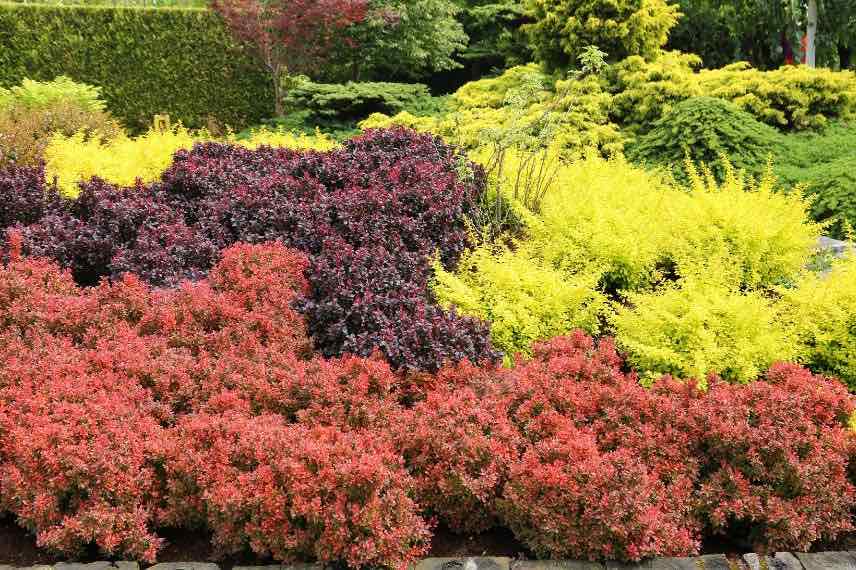
The beautiful colours of Berberis
Read also
How to create a defensive hedge?The holm oak, very appealing and very useful
The Holm Oak, or Quercus ilex, is not as thorny: some of its leaves are slightly prickly. But when mixed in a hedge composed of more prickly species, it is quite interesting. If it naturally forms a large tree, it can also, when pruned, join the formation of a hedge provided one accepts that it grows slowly. Evergreen and robust, it offers a picturesque beauty, in contrast of textures, shapes and colours, with a habit that is slightly twisted and a foliage green and silvery-grey. It flowers abundantly in spring. An iconic tree of the south of France and the garrigue, Holm Oak has another asset. It is regarded by specialists as a climate-change-ready species: if its establishment has so far been mainly in the Mediterranean zone, it is gradually moving north and constitutes an interesting choice for the decades to come across France.
Install it as a supplementary, more understated feature in a defensive hedge, alongside several Berberis with varied foliage, of Mahonia with bright yellow flowers, of Sea Buckthorn and of Holly with colourful berries.
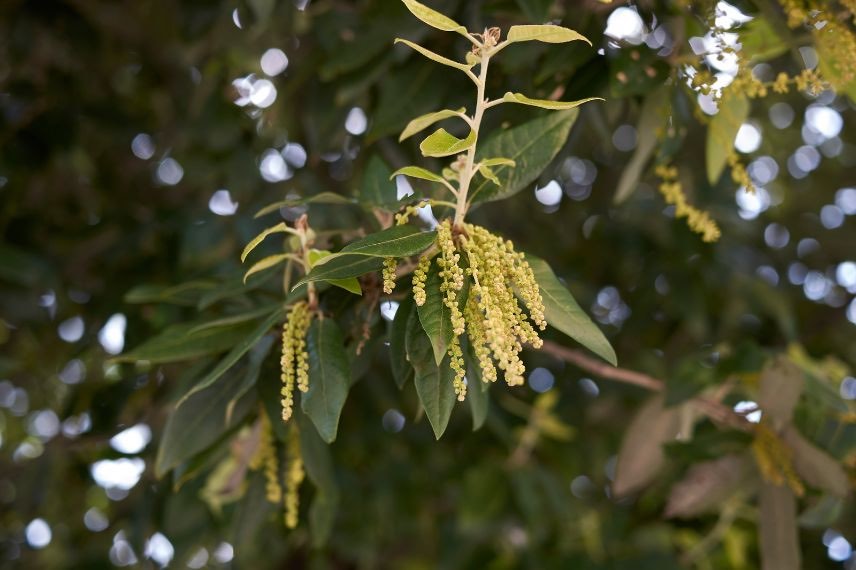
Foliage and flowering of the Holm Oak
Holly and its beautiful foliage
Another hardy evergreen shrub with tough, spiny leaves. The holly, or Ilex is a genus comprising many species, not all of which are spiny. Those that are have leaves of various shapes, often very ornamental, in colours ranging from green to bluish as seen in the American Holly or Ilex meserveae. The Common Holly or Ilex aquifolium, which we know well in Europe, features winter fruiting in red, yellow or black drupes, attractive on the female plants. American holly hybrids are less prickly, even though their foliage is spiny; they bear fruit particularly abundantly. All form dense shrubs of varying height, but which, apart from some dwarf varieties, reach at least 3.50 m in height.
Plant holly with hawthorns, sea buckthorns and Pyracantha for an eco-friendly hedge full of colourful berries in autumn and winter, which will delight the birds.
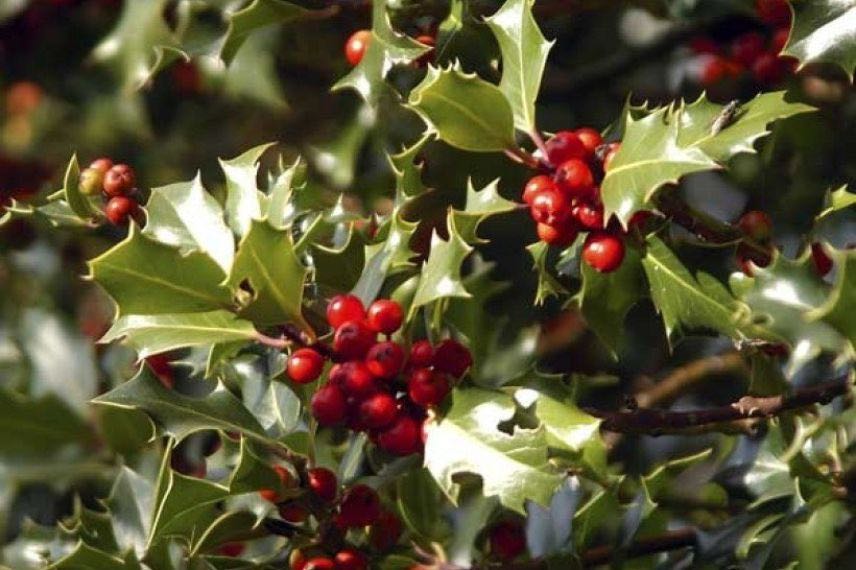
Foliage and flowering of Holly
Read also
5 Perfect Berberis for hedgesMahonia with a strong character
Mahonia is a very handsome evergreen bush with thick, spiny foliage, complemented by an exceptional and magnificent flowering in yellow or orange from autumn to early spring, followed by fruiting in dark berries loved by birds. Its glossy green leaves take on purple hues in winter. It has a very graphic habit and an exotic look. Depending on species and variety, it reaches 80 cm to 3 m in height. Some Mahonias are not prickly, and instead have delicate foliage (‘Sweet Winter’ and ‘Soft Caress’). Mahonia requires little maintenance and can be pruned. It is susceptible to powdery mildew and rust. It does not like heavy, compact soils and prefers shade or partial shade.
You can decide to form a monospecific defensive hedge with Mahonia, planting in groups of at least five plants. This highlights its very graphic habit and gives even more impact to its flowering. For this, choose either the Mahonia x media or the Mahonia oiwakensis subsp. lomariifolia.
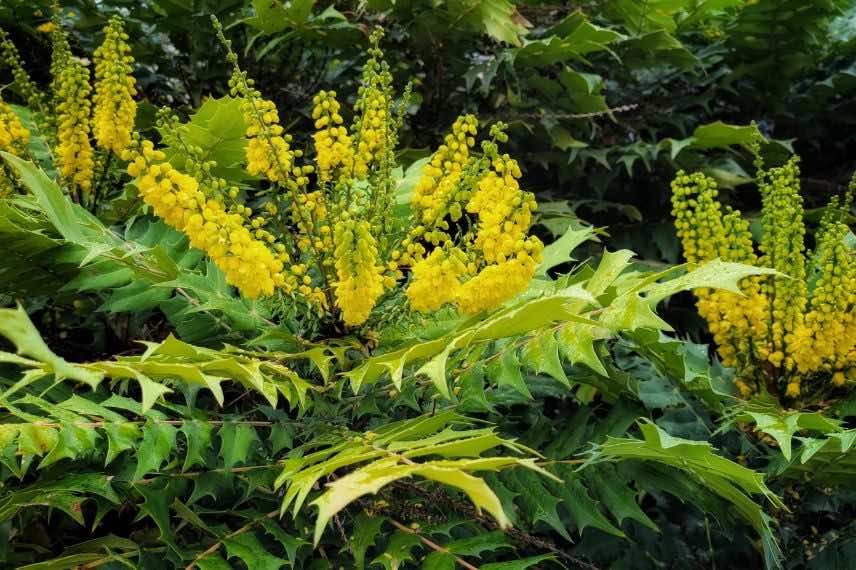
The Mahonia’s graphic habit
Pyracantha, well known for its abundant fruiting in vibrant colours
Pyracantha lives up to its name as a firethorn shrub: its long shoots are armed with very sharp thorns. Its evergreen foliage is complemented by an interesting, highly melliferous flowering from May to July, followed by fruiting of yellow, orange or red berries in autumn, very decorative and abundant. Pyracantha will adapt to any soil type, provided it is fairly well-drained. It is advisable to prune it annually so that its habit remains dense and full. In a hedge, it can be pruned up to three times a year. Pruning is less necessary once mature, except to maintain its height. It reaches 1.5–4 m in height at maturity. Some varieties are susceptible to bacterial fire blight and coral spot disease.
It is often said that Pyracantha are too prone to disease, but newer varieties, such as ‘Saphyr Orange’ are very resistant.
By choosing these modern, robust cultivars, you can plant the Pyracantha among themselves, varying the colours of fruiting, as with ‘Saphyr Red’.
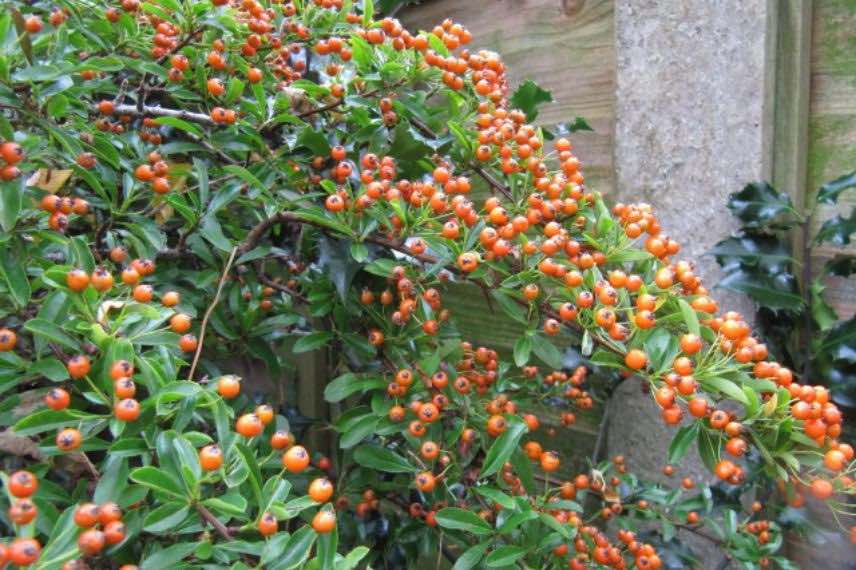
Modern Pyracantha cultivars, resistant to diseases
Zanthoxylum with spicy, peppery berries
Various species of Zanthoxylum, or pepper bush, form very interesting shrubs.
If they are not strictly speaking peppers, such as the “true” pepper, Piper nigrum, they offer small, spicy and edible berries, reminiscent of pepper and used as aromatic peppers, as with Zanthoxylum piperitum or Sichuan pepper bush, which has been appreciated here for many years.
Zanthoxylum is armed with thorns on the branches, and the leaves, which are also aromatic and decorative. For example, the Zanthoxylum piperitum ‘Black Magic’ has very handsome purple foliage. Zanthoxylum prefers fertile, well-drained soil and good light as well as a sheltered position. In these conditions, it grows quickly. It requires little maintenance and tolerates pruning well. The different species produce berries with different aromas, as with Zanthoxylum americanum and of the Zanthoxylum coreanum.
Don’t forget that this shrub is also ideal for a defensive hedge. It has a bushy habit and reaches 3–4 m in height at maturity. Pair it with thorny shrub species that aren’t usually so, such as Prunus spinosa or Osmanthus heterophyllus. Add the beautiful flowering of hawthorns.
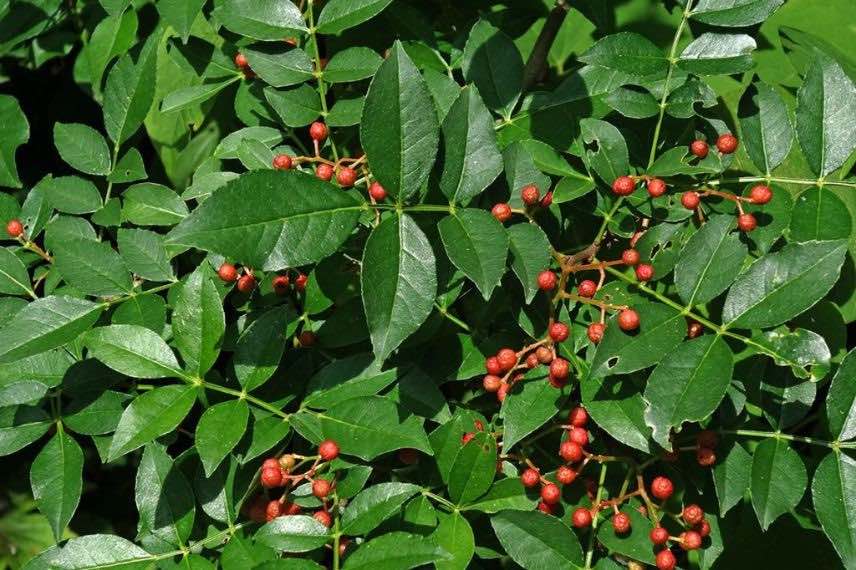
The Zanthoxylum coreanum, whose berry husk is edible
Japanese flowering quince, with lovely late winter flowers on bare branches
The Japanese quince, or Chaenomeles is a deciduous shrub that has its place in a defensive hedge. Its interwoven, very spiny shoots, bare since autumn, are crowned with some of the earliest flowering, appearing in late winter and early spring. Many varieties are of interest: with simple or double flowers, in fiery red, apricot, white, or pink. They have a squat, compact, bushy habit and reach 1 to 3 m in all directions. Chaenomeles tolerate only very heavy soils, resist drought and require little maintenance, except for pruning to keep their growth in check, which tends to be unruly.
Plant them with other equally decorative, evergreen and deciduous shrubs: Sea buckthorn with orange autumn berries, Berberis, Rugosa roses or Pimpinellifolia rose, Holly.
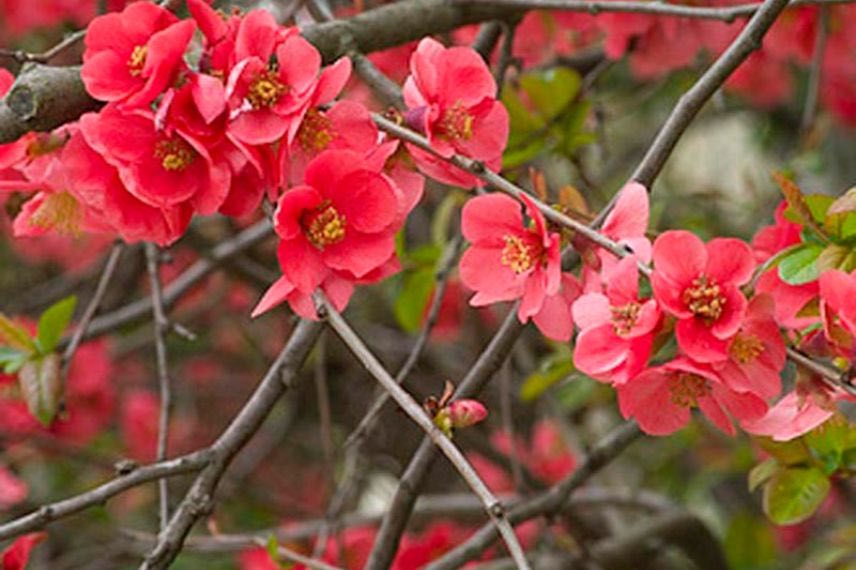
Chaenomeles offer one of the earliest flowering displays in late winter
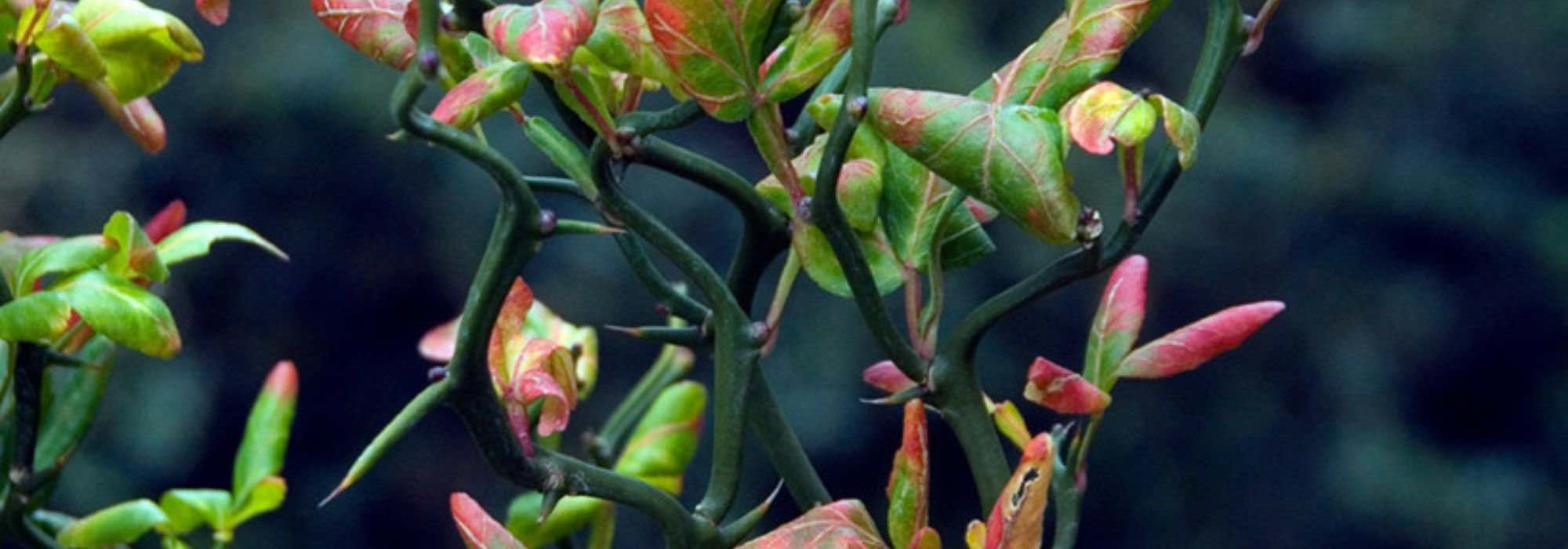
Poncirus trifoliata, a thorny and ornamental citrus
Last shrub in this selection, Poncirus trifoliata is a citrus tree. It is the hardiest of the lot, withstanding temperatures down to -18 to -20°C. It is grown for its ornamental qualities, of which there are many, more than for its small yellow fruit, which resembles a lemon. The latter is not edible raw and is mainly used in powder form as a condiment or for tea. With handsome, long thorns, it has a place in a defensive hedge. Its deciduous foliage is preceded by a white spring flowering, a characteristic of citrus trees. It reaches 4 m in height at maturity. Smaller and less vigorous, the cultivar ‘Flying Dragon’ offers beautiful twisted branches, very decorative after the leaves fall in winter. Hardy, the Poncirus trifoliata can be grown in many regions, provided it has a warm, sheltered position.
Plant it alongside hawthorn, which flowers in spring like it, and sea buckthorn with orange berries in autumn and winter.
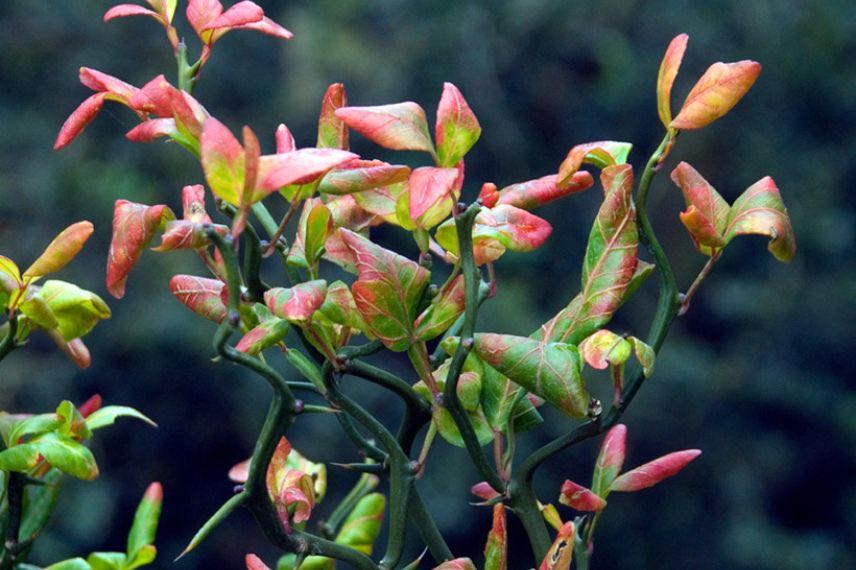
Poncirus trifoliata ‘Flying Dragon’, with pretty twisted branches
- Subscribe!
- Contents
Comments