






























8 great pairing ideas with oleander
Sunlit atmospheres in the garden or on a terrace
Contents
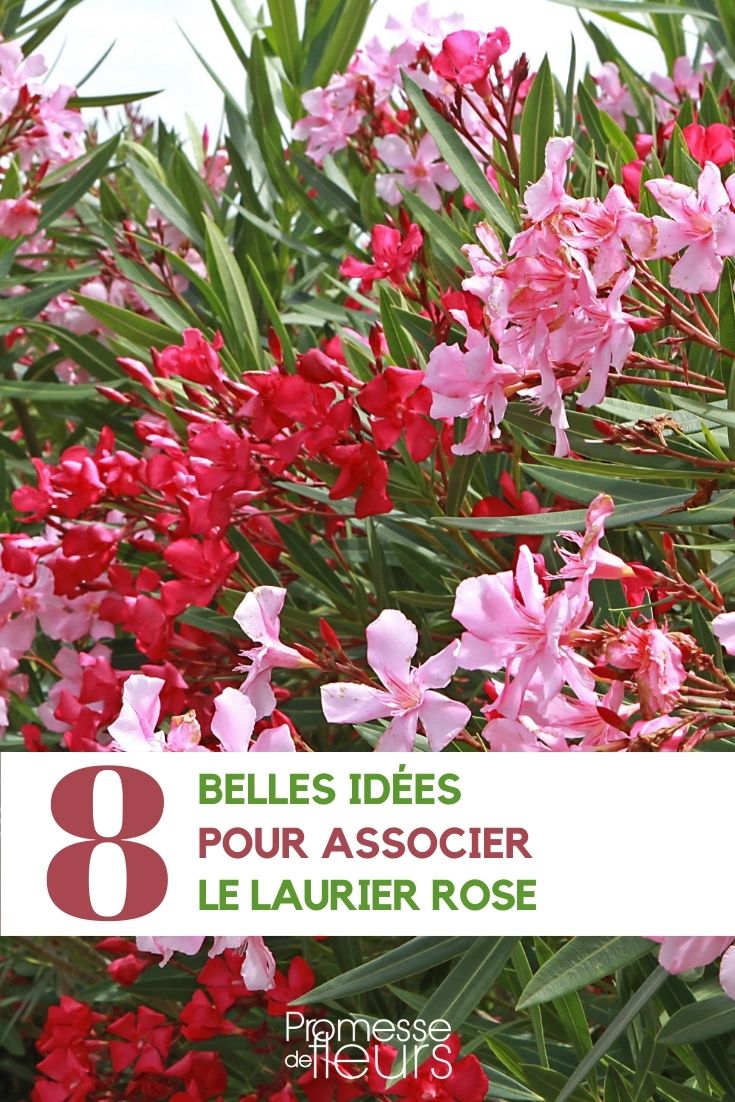
Pairing oleander in the garden is fairly easy, as this lovely Mediterranean bush comes in many varieties with white, yellow, apricot, pink or red flowers. We therefore have an interesting colour palette to explore, and prolific flowering for at least four months, allowing you to pair with numerous perennials and flowering bushes.
In open ground in mild-climate gardens, around a pool, in an exotic border, or on a terrace, discover eight ideas to pair your oleander harmoniously.
→ Learn more about oleander with our comprehensive guide Oleander: planting, pruning and care.

In a Mediterranean garden
Symbolising the world of southern gardens in its own right, oleander is a marvel planted in Mediterranean-inspired gardens and in all southern gardens.
To create an ambiance worthy of the French Riviera gardens, opt for plants that thrive there and won’t suffer during drought periods. There are many evergreen foliage plants and shrubs with grey-green leaves: lavenders for the blue mass they provide and their rounded shape when pruned, rosemary, a handsome olive tree (Olea europaea) as a totem tree, a palm for the sense of escape it affords, with a Phoenix canariensis, becoming truly opulent after a few years of growth, and a grove of cypress, inseparable from the Mediterranean garden. Surround these handsome subjects with a few dusty-grey foliage plants such as Santolina or the Helichrysum italicum.
You can almost hear the cicadas…
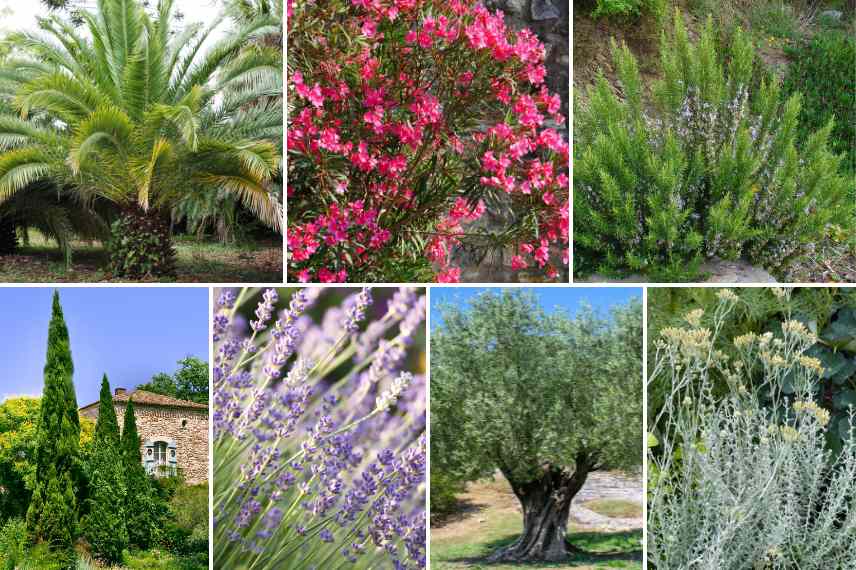
Phoenix canariensis, oleander, rosemary, cypress, Lavandula angustifolia ‘Munstead’, olive tree and curry plant
Read also
How to grow oleander in a pot?Around a swimming pool
Potted to keep it out of reach of children (all parts are toxic) or placed slightly higher, you can also pair one or more oleanders with architectural, easy-care plants around a pool. They will bloom for a long time, brightening the pool’s blue with a touch of vivid or pale colour, and their longevity will be appreciated as they help reduce maintenance.
For example, around an oleander ‘Emilie’ or ‘Caro’ (the smaller variety), a few agapanthus, Phormium or Cordyline, and a few handsome tall grasses such as a Muhlenbergia capillaris, which will add a sense of lightness to the whole with its airy inflorescences.
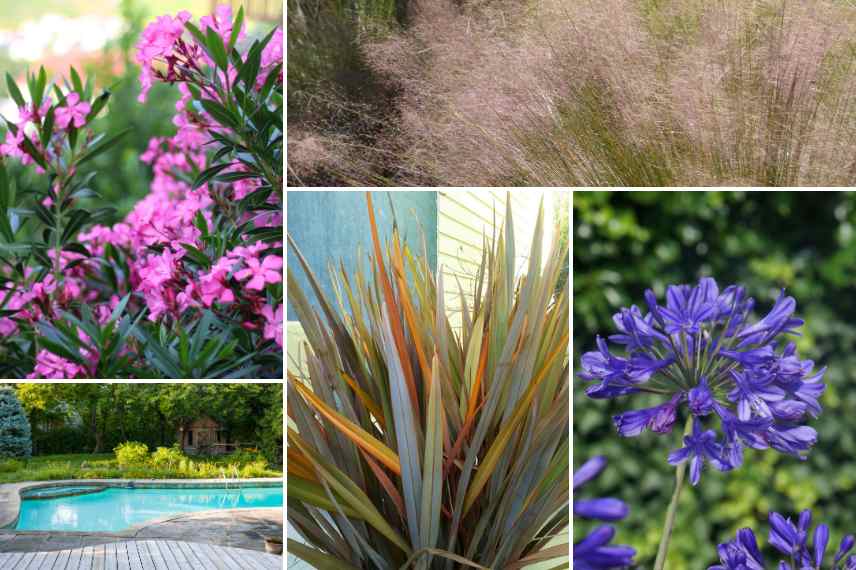
Oleander (here the type species), Mulhenbergia capilaris (© Forest and Kim Starr), Phormium and Agapanthus ‘Brilliant Blue’
If you prefer a more neutral ambiance in the tones, opt for white flowering varieties, very chic for any style of house with a pool area, especially contemporary properties, as below.
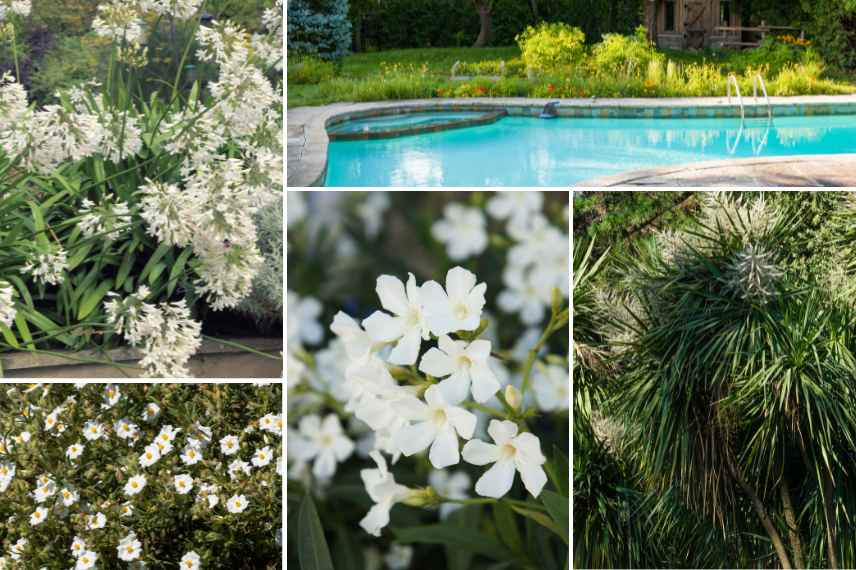
At the centre, white oleander with single flowers surrounded by white agapanthus, a Cistus monspeliensis and a Cordyline australis
In a hedge
Oleanders make very attractive evergreen hedges in regions with a mild climate. They can be planted for this purpose in the gardens of southern France, or along the Atlantic coast, well protected from winds.
If a hedge can be envisaged as a single-species hedge—that is, planted with only the same shrub species, with two or three varieties of oleander, white, pink and red for example—you can also pair them with a climbing plant such as Bougainvillea, which lends it a Mediterranean air.
It’s a classic duo, but of radiant beauty, as the hedge flowers for many months in these regions with a favourable climate.
We can also try a more varied flowering hedge, interspersing different shrubs that grow up to 2 m in height, or even taller if they thrive: Grevillea and Abutilon, or for the more favoured regions the Lantana camara which becomes shrub-like in the Midi and will remain evergreen. It will harmonise well with the oleander’s bi-coloured flowers. Further north of the Loire, a Pittosporum or an Elaeagnus ebbingei will replace Lantana and provide very ornamental evergreen foliage.
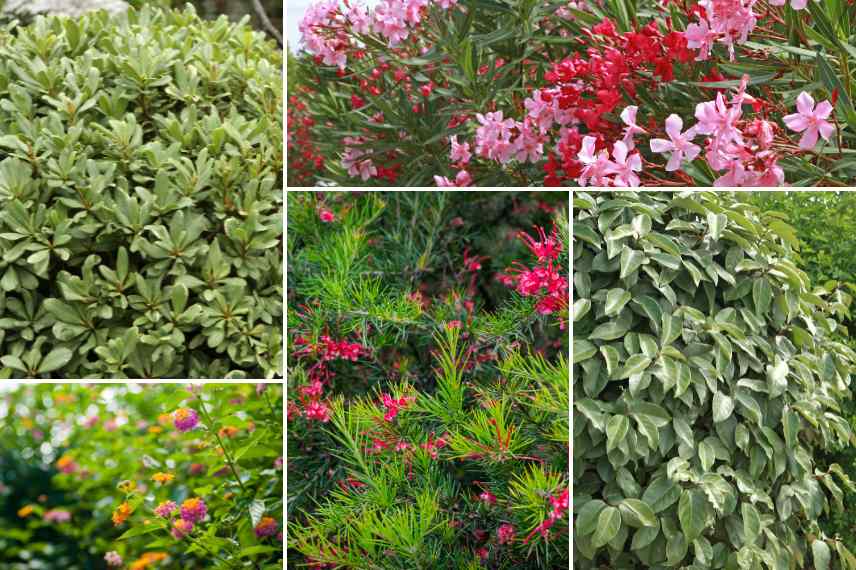
Pittosporum tobira ‘Variegatum’, oleanders pink and red, Lantana camara, Grevillea juniperina and Elaeagnus ebbingei
Read also
How to create a hedge of oleanders?In an exotic garden
While its origins may recall the Mediterranean basin, oleander can certainly be considered for an exotic garden, or an exotic space in the garden, and act as the link to a very sunny area.
For this ambience, prefer varieties with red flowers or Indian pink flowers that will harmonise with the warm palette of the exotic garden. Pair with some extravagant foliage, such as that of a banana tree (banana tree), (‘Basjoo’ hardy, or the superb Abyssinian banana or Ensete ventricosum ‘Maurelii’ where it will not freeze), from a Taiwan Fatsia with very deeply lobed leaves, or the slimmer one of the Pittosporum illicioides var. angustifolia. On flowering, pair the strong red of an oleander with scarlet flowers such as those of the Hibiscus moscheutos (common Rose mallow), those of Canna indica edulis, or Crocosmias ‘Lucifer’, and why not a Calistemon with its quirky brush-like blooms?
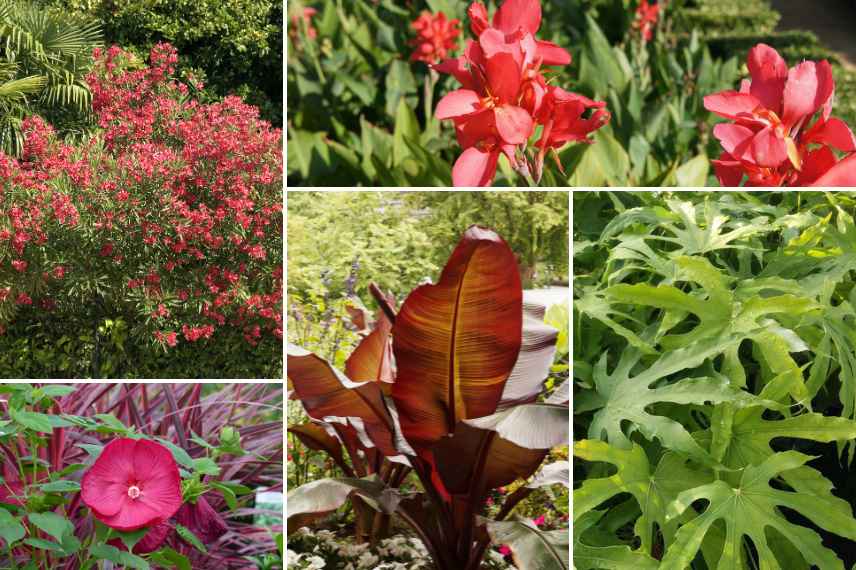 Salmon oleander, Canna indica, Hibiscus moscheutos, Ensete ventricosum ‘Maurelii’, and Fatsia polycarpa ‘Green Fingers'</
In a large pot on the terrace
In many regions, oleander cannot be grown in the ground. But we can invite this radiant bush onto terraces in (almost) all regions, provided you can winter it correctly for the cold season.
Planted in a container large enough (at least 50 cm wide and 70 cm deep), oleander will be majestic in an orange-tree tub or an XXL terracotta pot and will thrive with proper care.
In our example, we choose a delightful salmon-coloured variety as salmon-coloured variety such as ‘Angiolo Pucci’, which is compact, making it ideal for pot culture, or ‘Souvenir de Michel’, and surround it with salmon-to-orange flowering displays, with stronger orange tones, which also enjoy pots: bulbine or Belamcanda chinensis, in a salmon colour that is very soft like the shrub sage ‘Papajan’ or ‘Ribambelle’, or a Bird of Paradise (Strelitzia) in regions not frost-prone. A few pots will also accommodate perennials and annuals with flowers in a velvety violet shade, with the Agapanthus ‘Royal Velvet’, and heliotropes scenting the air in the evening, as with oleander. Add a touch of greenery with a succulent plant such as Crassula or an Aeonium, which we will bring indoors to the living room or conservatory at the first frosts, or a handsome foliage with that of a dwarf Pittosporum.
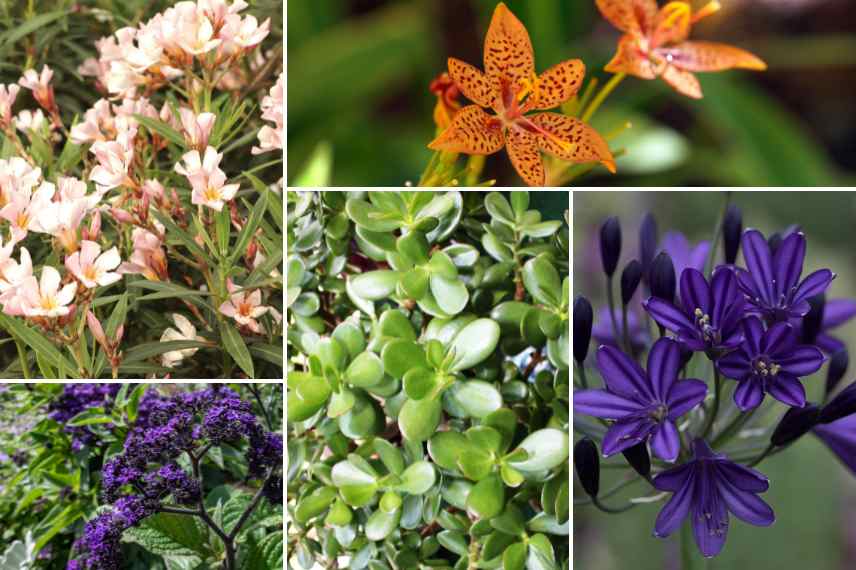
Oleander ‘Angiolo Pucci’, Belamcanda chinensis, Heliotrope, Crassula ovata and Agapanthus ‘Royal Velvet’
For a coastal garden
On the Atlantic coast, oleanders thrive in very sunny exposures, which they need in order to flower well, and they tolerate salt spray when planted at a sensible distance from the shoreline. They can live for many years when planted in a sheltered garden. They are easy-care bushes with little real maintenance for holiday homes and seaside gardens between the Cotentin and the Basque Country. In these frost-sparing coastal regions, there is a choice among many varieties, which we will pair with other remarkable plants for their growth habit and flowering.
Here we opt for a yellow-and-blue display, with an oleander bearing yellow, double flowers, the Nerium ‘Luteum Plenum’. It pairs perfectly with the late-flowering Eucryphia, a fine Tasmanian shrub with white and yellow flowers, which will need acidic soil, a palm chosen for its remarkable bluish foliage, the Brahea armata, a pretty climber such as Solanum jasminoides or the Solanum crispum ‘Glasnevin’ blue with a yellow heart, and at the start of the season, Madeira viper’s-bugloss, with blue-violet spikes and velvety green-grey foliage.
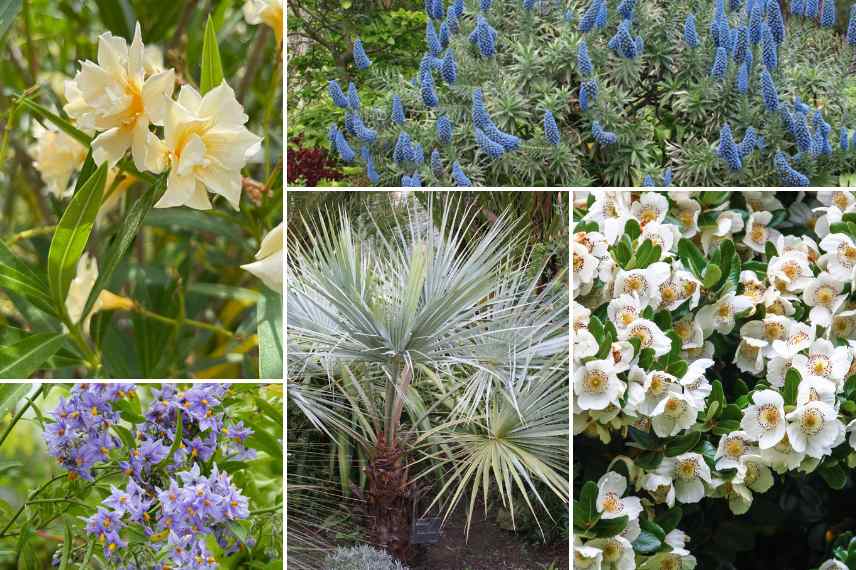
Nerium oleander ‘Luteum Plenum’ (photo Wikimedia Commons), Echium fastuosum, Solanum crispum blue with a yellow heart, Brahea armata, and Eucryphia
In a pink monochrome garden.
Oleander finally makes its entrance with all its gentle charm into pink gardens, where we aim to highlight this colour without it becoming cloying. The character of a large bush such as oleander allows us to pair it with other charming plants, all in a sunny aspect to see it in full bloom.
We will select hardy plants to surround it, whose flowering will extend from spring to autumn: Persian rose ‘Alissar’ and bi-colour Penstemons with ‘Strawberry and Cream’, and another one, entirely white with a hint of purple on its stems to balance the ambient pink. Joining later in summer are a pink Vitex (Vitex agnus-castus ‘Galactic Pink’) and a pink bignone, the Podranea ricasoliana, in mild-climate regions (elsewhere replace with a pink clematis, such as the Clematis ‘Super Cute’). Hibiscus syriacus can complete the display for long summer flowering, while white-flowering shrubs in spring will also join in: Staphylea or Prunus pissardii, which will turn purple in summer.
NB: opt for a variety known for its cold hardiness, such as ‘Atlas’ or ‘Villa Romaine’, if your region sits at the edge of hardiness for this plant. Otherwise, there is a wide selection with the many varieties currently available on the market.
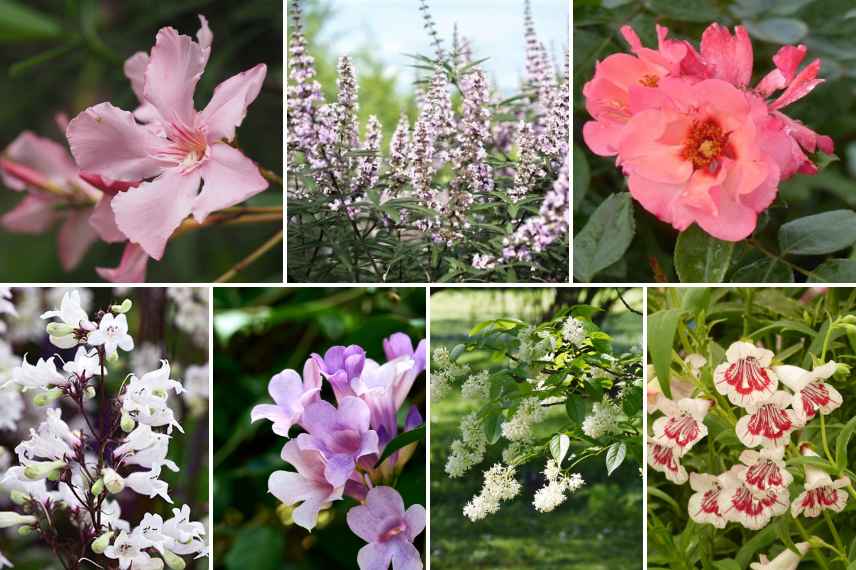 Oleander, Vitex ‘Galactic Pink’ in a soft pink shade, Persian rose ‘Allisar’, Penstemon ‘Husker Red’, pink trumpet vine (Pandorea), Staphylea in spring bloom, and Penstemon Strawberry and Cream</caption]
- Subscribe!
- Contents
Comments