





























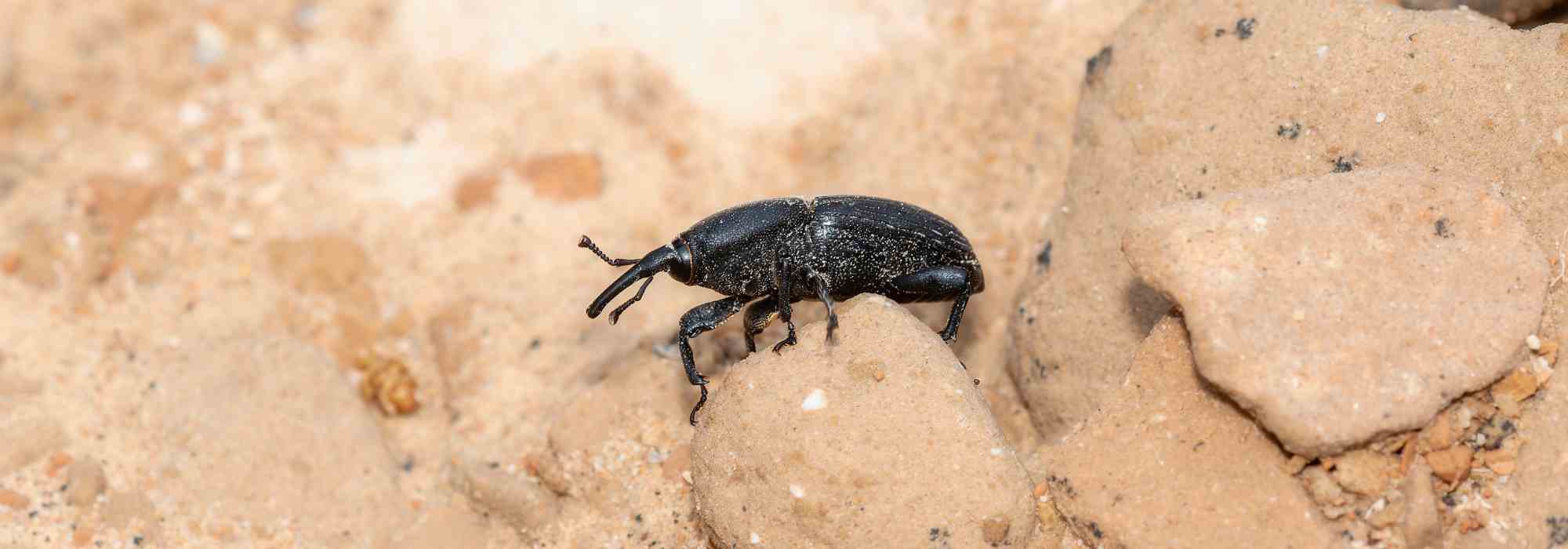
Agave Weevil: Effective identification, treatment and prevention
Everything you need to know about this pest
Contents
Over recent decades, the growth of international trade, including exotic plants, has facilitated pest insects entering the territory. If climate conditions are suitable for them, these feared insects—such as the box tree moth, the horse chestnut leaf miner, or the red palm weevil—settle quickly and develop just as fast. Since 2007, a highly prolific beetle has established itself in France around the Mediterranean rim, from Hérault to the Pyrénées-Orientales and Corsica: the black agave weevil. As its name suggests, this weevil targets agaves, but also other plants in the Agavaceae family and Bromeliaceae…
Discover how to identify the black agave weevil, as well as how to treat it and prevent its invasion.

How to identify the black agave weevil?
Originating from Central America, and in particular Mexico, the agave weevil (Scyphophorus acupunctatus) is a pest beetle of the family Curculionidae, a close relative of the red palm weevil (Rhynchophorus ferrugineus) which has a preference for palms.
Arrived by chance, via international trade, in the Netherlands and then Italy, it has quietly crossed the border to establish itself around the Mediterranean, undoubtedly attracted by the easy living.
In 2007 it was detected for the first time near Hyères in France. Since then, it has made its way as far as the Pyrénées-Orientales and Corsica where the damage has become considerable. So how to identify this new creature that has managed to find, in the south of France, hot and dry climate conditions that remind it of its homeland?
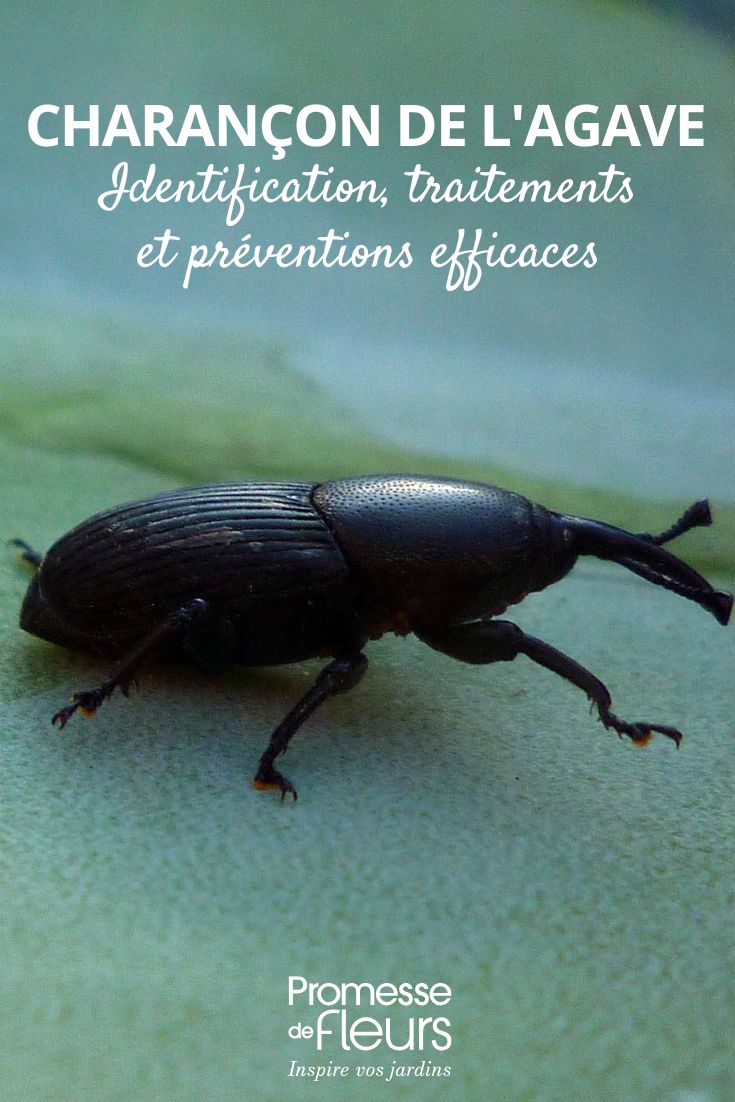
The agave weevil is a beetle up to 19 mm long, entirely black (even the eyes!). A distinctive colour that makes it easy to recognise.
And if you look closer, you can notice a curved rostrum (the rostrum is a kind of snout bearing the mouthparts at its tip) and striate elytra. Its wings are fused, preventing flight; black weevils therefore move by walking.
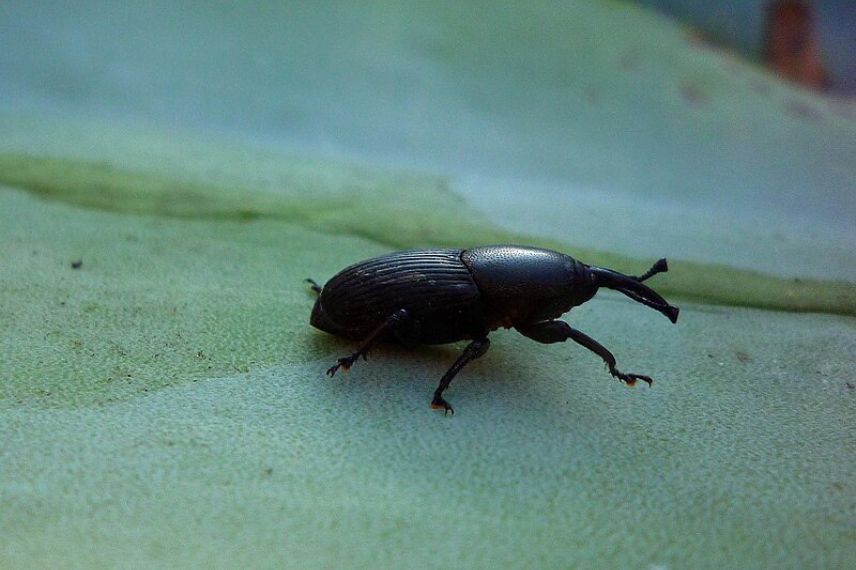
Agave weevil ©Nanosanchez (Wikimedia Commons)
As for the larvae, they are cream-coloured, with a head lightly tinged orange.
What is the life cycle of this beetle?
Quite logically, it all begins with mating between a male and a female. Knowing that this mating does not occur at a specific time, the adults are active all year round, as soon as the climate is warm and dry. In their homeland, 4 to 5 generations of agave weevils can succeed one another over the course of a single year, given that the larvae have a development cycle of 60 to 90 days. Under our latitudes, the generation is longer, around 120 to 150 days, or more.
After mating, the females use their rostrum to bore into the leaves and sometimes the stem, in order to feed and, most of all, to lay eggs. Then the larvae develop calmly and feed (voraciously) inside the leaves, moving toward the inner part of the leaves and the vegetative apex of the plant. They bore galleries and go through four instars of development. When mature, the larvae measuring about 25 mm are ten times longer than at birth.
Once it reaches ripeness, the larva stops feeding and builds its cocoon from fibres of the host plant. Pupation occurs in this nymphal chamber, and a new generation of adults emerges. Thanks to their rostrum, the adults bore through the leaf cuticle to access sap or plant exudates. Well fed, they can again mate. And the cycle begins again…
Which plants does the agave weevil attack?
As its name readily suggests, the black agave weevil has a penchant for agaves, particularly those with relatively fleshy growth. Seedlings are of less interest to these beetles. But it can attack other nearby plants:
-
- The agaves, and in particular those with substantial growth such as American agave (Agave americana) or the Agave tequilana. But potentially, all agaves can be affected
- The Berchorneria or Mexican lily, exotic herbaceous perennials with a yucca-like appearance that can reach up to 3 m in height
- Furcraea, succulent plants closely related to yuccas. Furcraea bedinghausii is particularly susceptible
- The Yuccas, and especially the Yucca aloifolia, the Yucca recurvifolia, the Yucca filifera, the Yucca linearifolia, and the Yucca elephantipes
- Cordylines can be affected, but much less frequently
- The Nolina longifolia, and in particular Nolina longifolia
- Dasylirion longissimum
- Beaucarnea recurvata, or elephant’s-foot
- Puya
- Dyckia.
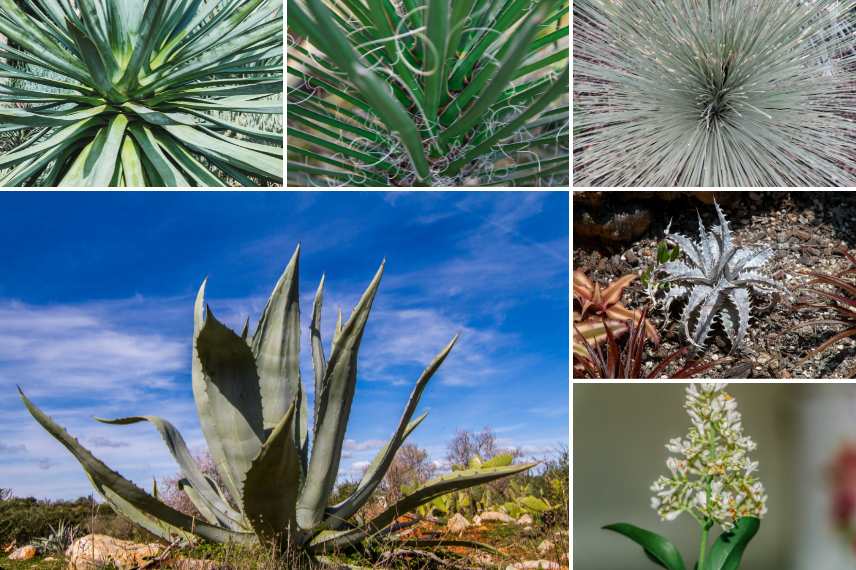
Agaves are the main targets of the black agave weevil, but it can also attack other species of Agavaceae, Dracaenaceae and Bromeliaceae
The black agave weevil may also invade tuberiferous perennials such as Polianthes tuberosa, native to Mexico and a member of the Agavaceae family.
What damage is caused by Scyphopholus acupunctatus?
When the first signs of infestation appear, it’s often too late, the plant is already considerably weakened. If the adults can be spotted, the agave weevil larvae act insidiously, inside the host plant tissues.
Specifically, a plant whose leaves are browning at the base sends out warning signs. Little by little, circular necroses appear and the base of the foliage rots. The plant leans, withers irretrievably, and eventually collapses in a lamentable fashion due to galleries that run through the plant tissues.
Some witnesses report having seen their agave or yucca collapse suddenly before their eyes.
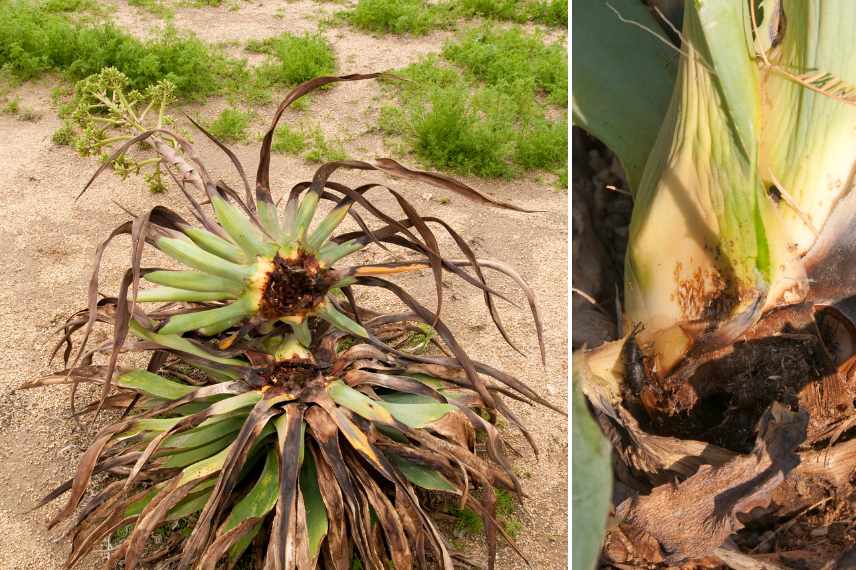
Agave attacked by adults and larvae of the agave weevil (Scyphophorus acupunctatus)
The wounds to the foliage caused by rostral punctures are also entry points for fungal diseases or bacterioses that accelerate heart rot. Among the most common bacterial diseases, one can cite the so-called soft rot caused by bacteria of the genus Erwinia. The larvae feed on the decaying tissues of the attacked plant.
How to control black vine weevil?
Eradicating non-native pest insects, whose larvae hatch and develop inside a plant, is difficult, even with synthetic insecticides. Moreover, these pests have no natural predators. That is why direct control is very challenging. A host plant showing clear signs of attack is difficult to save. But acting quickly, it can still be saved. Just cut off at the base the affected parts, then crush them and take them to the household waste recycling centre, reporting the attack. Do not throw fragments of infected plant into the compost bin.
A plant that is too severely affected should be pulled up and taken to the recycling centre.
In any case, in case of suspicion or suspected observation of agave black weevils, it is recommended to report it to the FREDON organisation in your region which maps their spread and progression.
Biological control trials using nematodes have been conducted and appear conclusive. They mainly involve the parasitoid nematodes of the type Steinernema carpocapsea, used to combat the red palm weevil. These nematodes are applied by spraying onto foliage, either preventively or curatively.
To strengthen protection, prevent infestation as early as possible. To this end, several measures can be implemented:
- Regular monitoring of foliage on target plants which can help detect adults and capture them for elimination
- The use of pheromone traps which help detect the presence of adults and capture them to limit mating. Again, the red palm weevil trapping systems appear to be effective. However, they are not 100% effective and must be complemented by nematode applications.
Otherwise, if you live in an area where the presence of agave black weevils is confirmed and you wish to plant specimens from the families Agavaceae, Dracaenaceae or Bromeliaceae, favour small specimens, not exported, and try to diversify species by introducing other succulents such as cacti or aloes.
- Subscribe!
- Contents
Comments