


Artichoke diseases and parasitic pests: identification and treatments
Our natural solutions
Contents
Artichoke (Cynara scolymus) is a vegetable-flower that combines indulgence and aesthetics. Indeed, artichokes form a beautiful tuft of downy leaves in a bluish-grey, from which edible flower buds emerge. If these immature inflorescences are not harvested for cooking, artichokes will offer you beautiful blue flowers, very attractive to pollinating insects. Artichokes will thus find a place in the vegetable garden as well as in borders or beds as an ornamental plant.
This perennial plant, which can stay in the same place for several years, is relatively easy to grow, provided you give it winter protection in regions with cold winters. Nevertheless, artichokes are subject to certain diseases or parasitic attacks. Discover how to identify them, treat them naturally and prevent their return.
Further reading : Artichoke: planting, sowing, growing and care.

Diseases affecting artichokes
If diseases affecting artichokes are mostly observed in large-scale crops, artichokes grown in the kitchen garden can indeed be affected. Admittedly on a smaller scale, vigilance is still essential, especially in years when weather conditions are unfavourable. Thus, wet and warm years are quite conducive to the development of certain diseases. Likewise, poor cultural conditions can impact the growth of artichokes. Or an excess of adventives.
Like many other vegetable plants, downy mildew and powdery mildew can affect artichoke plants. Let us show you how to identify, treat and prevent these diseases through our two dedicated articles: Powdery mildew or white disease and Tomato: downy mildew, other diseases and pests.
But other pathologies can appear on artichoke foliage.
Ramularia leaf spot
Very specific to artichoke, ramularia leaf spot appears as brown to greyish, necrotic spots on the foliage just before harvesting the artichokes. The growth of the spores lightens the centres of the spots and gives them height. The foliage tends to wither and dry. This cryptogamic disease is caused by the fungus Ramularia cynarea, which overwinters in crop debris and soil for at least two years. This disease is favoured during cool, moist summers.
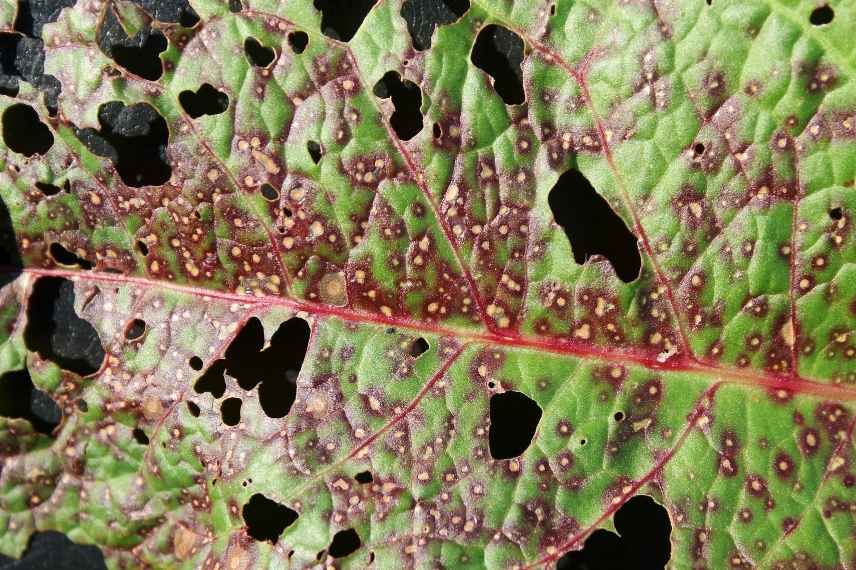
Symptoms of ramularia leaf spot
What to do in the short and long term?
As a curative measure, the horsetail decoction can be effective against this fungal disease. It is also necessary to remove and destroy the diseased foliage.
Otherwise, as a preventive measure, one should:
- Apply Bordeaux mixture
- Remove crop residues from preceding crops
- Work, aerate and loosen the soil before planting
- Apply a crop rotation of 3 to 4 years
- Remove adventives.
Sclerotinia collar rot
This disease, caused by the fungus Sclerotinia sclerotiorum, is noticeable by wilting and yellowing of the outer leaves which eventually sag and dry up. Then the inner leaves follow. The base rots and a white mycelium covers the affected parts. The fungus survives in the soil for many years and thrives under moist, warm conditions.
What to do in the short and long term?
There is no treatment. As a preventative, one should:
- Plan long crop rotations of at least 3 to 4 years
- Plant in well-drained soil
- Avoid nitrogen-rich amendments
- Remove and destroy plant debris from affected crops.
Botrytis or grey mould
The fungus Botrytis cinerea appears in damp conditions, at temperatures between 20 and 25 °C, often on artichokes damaged by a wound. The inflorescences become covered with brown spots, then brown, necrotic and rotting.
What to do in the short and long term?
Control is difficult, even impossible. Everything relies on prophylactic measures:
- Spray horsetail decoction or nettle manure
- Water sparingly, preferably in the evening, without wetting the foliage
- Avoid planting too close together
- Be careful not to damage the artichoke heads
- Avoid excess nitrogen
Ascochyta leaf spot
Due to the fungus Ascochyta hortorum, this relatively rare disease causes irregular brown-black necroses on the bracts. Speckling then appears. It develops in early winter when temperatures fall. The pathogens remain in the soil or crop debris. They thrive with high humidity and temperatures above 15 °C.
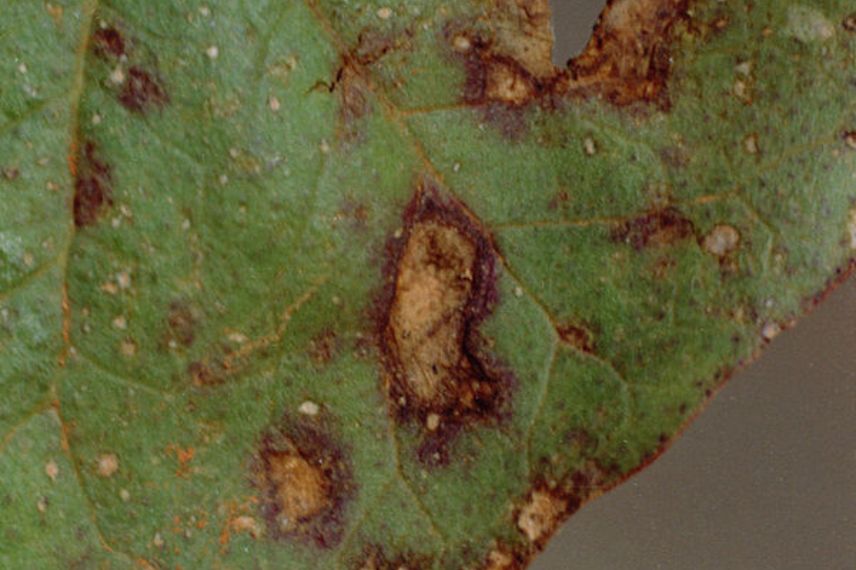
Symptoms of Ascochyta leaf spot (© Clemson University Wikipedia Commons)
This disease can be prevented by various preventive measures:
- Destroy crop debris
- Water at the base of the plants without wetting the foliage
- Spray Bordeaux mixture
Grease
This bacterial disease caused by Xanthomonas cynarea frequently sets in with high humidity, after spring frosts or thunderstorms. The bacterium enters the artichoke through a wound. Specifically, the bracts become covered with dark, oil-like spots and a yellow mucus.
To fight, avoid amendments too rich in nitrogen and do not plant in frost-prone areas in spring. Since the disease tends to develop on artichokes with large heads, simply choose varieties such as the Provencal violet artichoke.
Pests that attack artichokes
A number of pests attack artichokes, and in particular aphids, which have a marked predilection for the heads, foliage and roots. This invasion does not hinder the growth of the bracts. If they bother you or if they are protected and tended by ants, it is quite possible to eliminate them with a solution based on black soap. Virginie D. explains everything in her article: Aphids: identification and treatment.
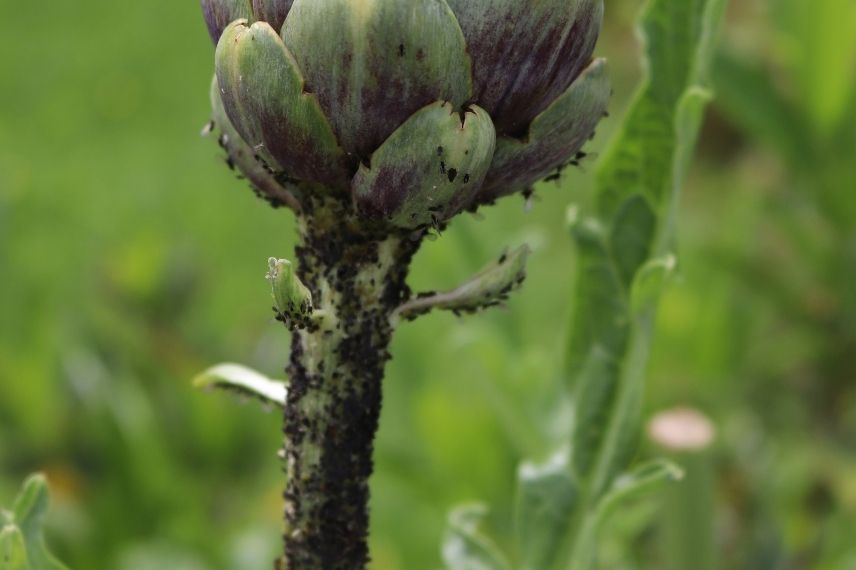
The main pests of the artichoke are aphids
Nevertheless, other pests can also take up residence on artichokes.
The artichoke defoliating noctuids
Several species of caterpillars can attack the artichoke foliage, but the most common is Gortyna xanthenes, a yellowish-grey butterfly mainly found in the south of France. Eggs are laid at the base of the artichokes between October and November, then the larvae hatch in winter. They climb up the stem and gnaw the leaves before entering the stem to move up into the heads where they hollow out galleries. The damage is therefore considerable, as the heads are lost and the plant weakened.
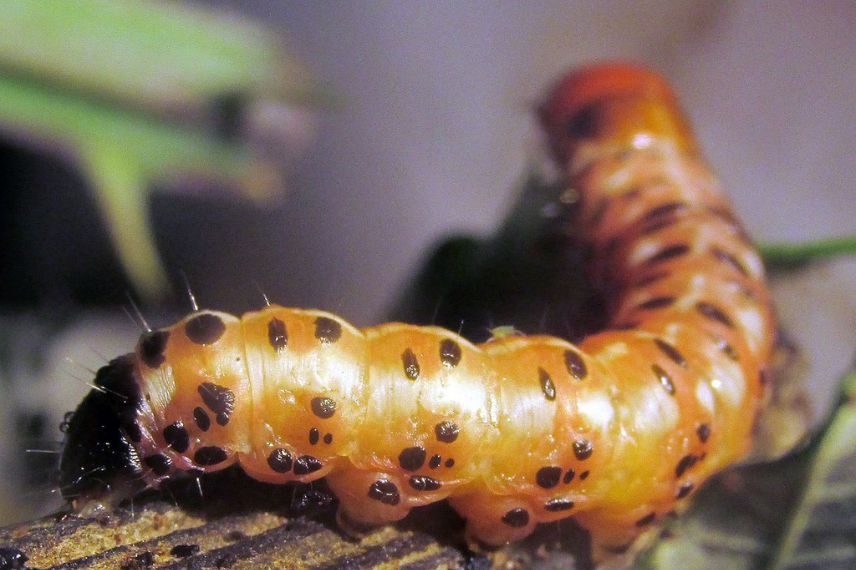
Larvae of Gortyna xanthenes (©Assianir Wikimedia Commons)
The young caterpillars are treated with Bacillus thuringiensis as soon as they are first observed. The installation of sex pheromone traps will help to capture the males. The use of insect nets can be effective. It is also necessary to destroy the plantings immediately after harvest.
The artichoke butterfly
It is a large black and orange butterfly, often called “painted lady”, common in Brittany, which gives rise to greyish-yellow to black caterpillars bristly with spines. Adults fly from April to October, but the population remains substantial until July and August. The larvae gnaw the foliage, leaving the veins.
To combat, one can implement the same solutions as those adopted for the artichoke defoliating noctuids.
The artichoke tortrix
The artichoke tortrix (Cnephasia) is very common in the south of France. Adults lay eggs in boundary hedges, the eggs hatch in January. The caterpillars live first as leaf miners, then invade the heads. Totally invisible and invulnerable, they cause the rotting of the heads.
We can treat in the same way as the two previous caterpillars.
Two beetles, the cassid and the apion
Two phytophagous beetles also attack artichokes. On the one hand, the cassid (Cassidia), a beetle with a green upper body and black underneath, which produces black larvae bristly with spines. The adults and the larvae eat the foliage. On the other hand, the apion (Apion carduorum). This beetle lays eggs in the stems, the veins and the peduncles. The larvae cause reduced growth and withering of the foliage.
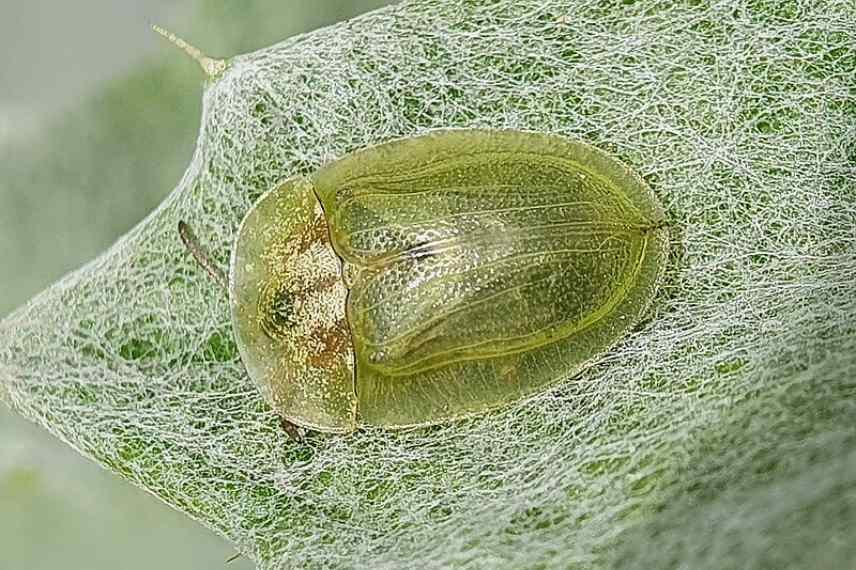
The artichoke cassid (©Mehdi Chetibi Wukupedia Commons)
To prevent these invasions, favour the presence of birds that feed on larvae, such as blue tits. You can also make sprays of fern manure and garlic manure which are natural insecticides.
- Subscribe!
- Contents
Comments