





























Pairing ideas with Exochorda
5 companion planting ideas for your Bead Tree
Contents
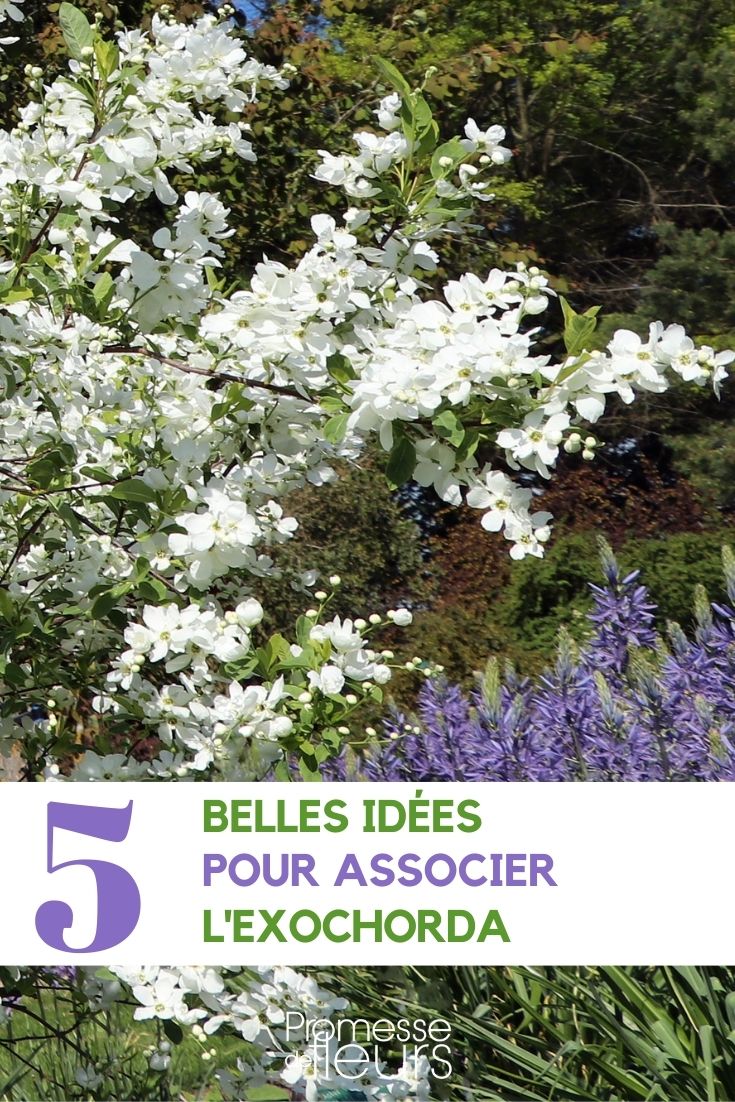
The Exochorda is one of the most beautiful spring-flowering bushes. It stands out as soon as its flower buds appear, resembling small pearls of a lustrous white, which is why it is also known as the ‘Pearl Tree’ or ‘Bush of Pearls’. When these corollas bloom, around April and May, the bush becomes a cloud of flowers that are equally immaculate and delicately beautiful. Deciduous, its green foliage is rather discreet for the rest of the year but can take on warmer hues in autumn. Easy to care for, disease-resistant, and hardy, it boasts many qualities, especially since its modest size allows it to fit into any garden, even in a pot on a terrace. This bush enjoys bright but not scorching exposures or partial shade, and prefers cool, well-drained soils with low lime content. While Exochorda macrantha ‘The Bride’ is undoubtedly the most well-known, other species and varieties equally deserve a place in a garden or on a balcony. This is a great opportunity to pair it with companion plants, whether it is used in a flowering hedge, a colourful or monochrome bed, in a low-maintenance shrubbery, or to enhance a balcony. Discover some of the plants you can use in these 5 pairing ideas.

A burst of spring colours!
When it comes to pairing plants together, Exochorda offers two major advantages. Firstly, it blooms around April-May, a time when many other plants do as well, which provides a wide selection. Secondly, the white of its flowers is neutral and complements all other colours. However, be careful not to mix too many shades; instead, play with tonal variations. Exochorda racemosa ‘Niagara’ (1.5 m x 1.5 m) has a most romantic weeping habit. You can enhance this effect by pairing it with companions such as Lilac, Burkwood Viburnum, Mexican Orange Blossom, or Chinese Azalea, all of which are highly fragrant. For perennials, Foxgloves, Garden Valerian, Bleeding Hearts, Comfrey, or Spurge create a cloud of flowers in the middle of the bed, just like Baptisia, a less demanding cousin of Lupins. The foreground is occupied by low perennials and groundcovers that contribute to this springtime display. Again, the choice is vast among Alyssum, Aubrieta, Iberis, and other hardy geraniums. Add some clumps of evergreen grasses (such as Carex, Stipa, or Deschampsia, for example) or deciduous (Miscanthus, Panicum, Pennisetum), which provide soothing undulations, a permanent backdrop, and rich hues depending on the species. Of course, it’s impossible to envision a vibrant spring bed without bulbs, such as late tulips, daffodils, alliums for ornamental use, Anemones, Fritillaries, or Iris. With such a selection, you’re guaranteed nearly 2 months of flowers!
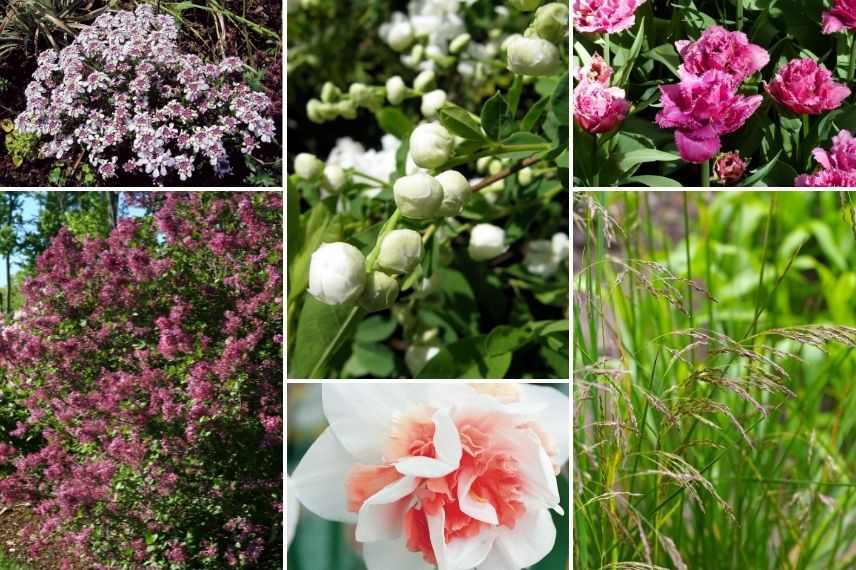
Iberis sempervirens ‘Pink Ice’ (photo Leonara Enking), Exochorda racemosa ‘Niagara’ (photo Nadiatalent), Tulip ‘Match Point’, Syringa ‘Bloomerang Dark Purple’ (© Proven Winners ColorChoice), Daffodil ‘Rosy Cloud’, Deschampsia cespitosa
A white garden
What could be more luminous than white? Or rather, should we say, ‘the whites’, as it is a shade that comes in many nuances. Explore this palette starting with Exochorda ‘Snow White’ (3 m), then set your sights on bushes such as Common Hawthorn (sometimes considered a small tree), Flowering Dogwood ‘Ascona’, a fragrant Lilac like Syringa‘Dentelle d’Anjou’, or a Magnolia stellata, all of which bloom at the same time. Don’t forget to add flowers for the other seasons, thanks in part to certain Hydrangeas and of course to white-flowered roses. Foliage is also important, and you can create beautiful gradients between the dark green of a Skimmia ‘Fragrant Cloud’ and the light, almost golden, foliage of an Ilex ‘Golden Gem’. The variegated foliage of Fatsia ‘Spider’s Web’, Nandina ‘Twilight’, or even Osmanthus ‘Variegatus’ certainly have their place in this type of arrangement. A few shrubs withgrey foliage or glaucous can help avoid monotony, and these shades enhance the white flowers. Many white-flowered perennials are also available including Agapanthus, Lil, Gaura, Digitalis or Dahlia, to name just a few. The foliage of Hostas and Carex can also be used in this picture, just like that of a Miscanthus ‘Variegatus’. A point of interest throughout the year, the pure white bark of a Betula utilis jacquemontii withstands the winter gloom. If you have the opportunity, install a climbing plant (rose, wisteria)… with white flowers of course, and in any case, scatter a few white-flowering bulbs such as those found in Snowdrops, Daffodils, Tulips, Ornamental Alliums or even Cyclamen.
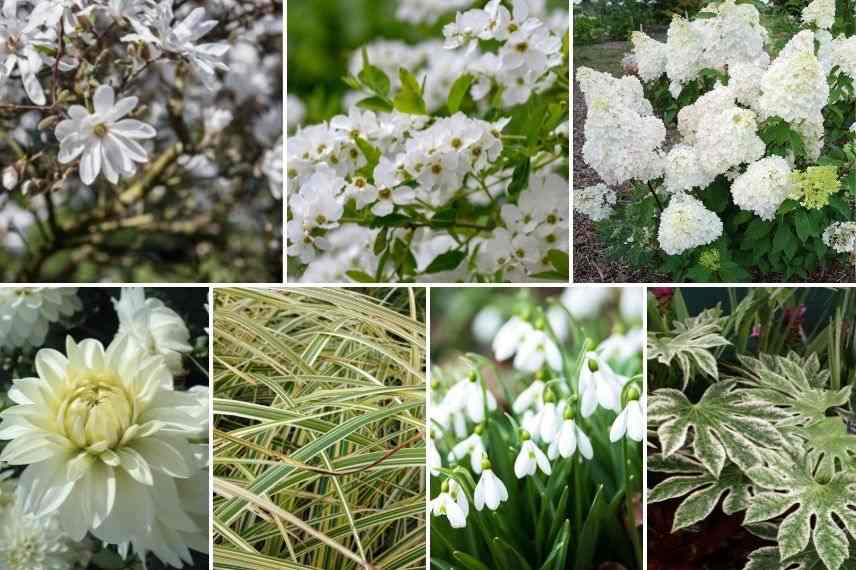
Magnolia stellata, Exochorda serratifolia ‘Snow White’, Hydrangea paniculata ‘Diamantino’, Dahlia ‘Gallery Art Fair’, Miscanthus sinensis ‘Variegatus’, Snowdrop and Fatsia japonica ‘Spider’s Web’
Discover other Exochorda
View all →
Available in 3 sizes
Available in 1 sizes
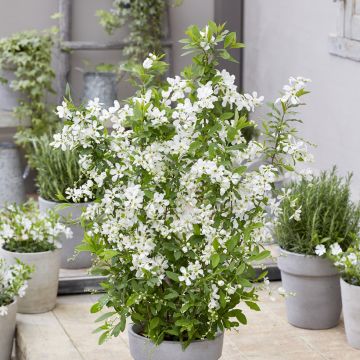
Available in 1 sizes
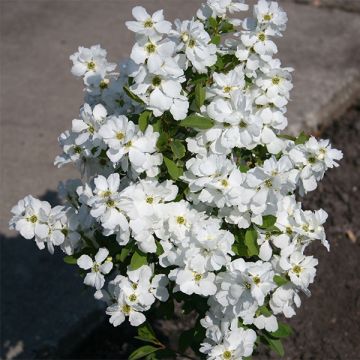
Available in 1 sizes
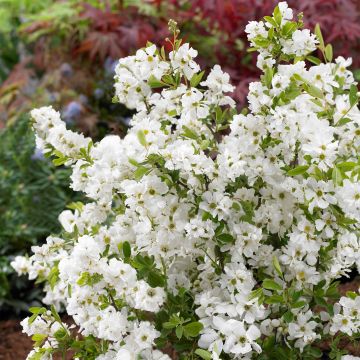
Available in 2 sizes
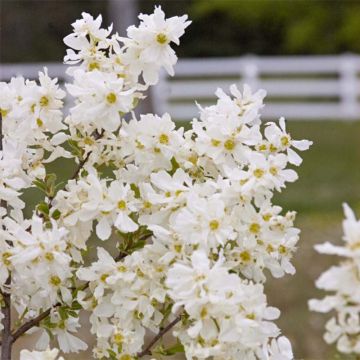
Available in 1 sizes
Available in 1 sizes
A flowering hedge (almost) all year round!
The Exochorda is often used in free-flowing, flowering hedges. You can pair it with bushes that offer their corollas at the same time, but it is also wise to plant companions that enliven the hedge at other times of the year, so that it remains a focal point in your garden for many months. At the very beginning of spring, Forsythias and Japanese Quinces are, of course, reliable choices, bringing bright colours early in the season. Exochorda macrantha ‘The Bride’ then takes over, but it is not the only one: Deutzia, Lilacs, spring Spiraeas (for example, Spiraea ‘Van Houttei’), Weigela, Mexican Orange Blossom, Mock Orange, Berberis or even Physocarpus (some of which have exceptional foliage colours!) are all good candidates, not to mention the fragrances released by certain viburnums during this season, such as Viburnum burkwoodii, which also takes on stunning colours in late season. As summer approaches, it is the turn of Callicarpa (also known as ‘Candy Trees’ due to the colourful berries that adorn the branches after flowering) to come into play, along with some Ceanothus, as well as Hibiscus, summer Spiraeas, Oleanders, Chaste Trees, Crape Myrtles and the famous Hydrangeas. As the season progresses and the first colours tint the foliage, some bushes, known as ‘repeat flowering’, bloom again (for example, the Mexican Orange Blossom), but it is also the time when Eleagnus release the intense fragrance of their discreet flowers for metres around. Winter is not to be outdone, thanks to the little gems that are Mahonias, Laurel-tin or Viburnum bodnantense. Of course, you should consider inserting some evergreen shrubs, others with decorative fruits or with coloured wood. Finally, some roses are also stunning in mixed hedges.
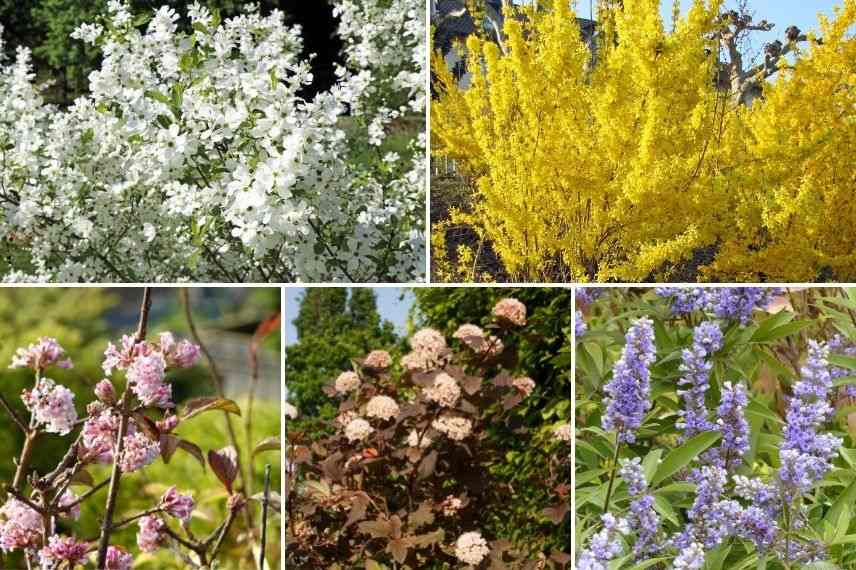
Exochorda, Forsythia intermedia ‘Spectabilis’, Viburnum bodnantense ‘Dawn’, Physocarpus opulifolius ‘Diable D’Or’ and Vitex agnus-castus ‘Latifolius’
Read also
10 bushes with early spring floweringIn a pot, on a terrace or balcony
Welcome a pearl tree such as Exochorda ‘Lotus Moon’ even if you don’t have a garden. Grown in a large container (at least 50 cm in all directions), this recent and compact variety (about 1.50 m) fits perfectly on a terrace or balcony, brightening it up with its very generous flowering. As space is limited, prioritise companion plants that offer interest over a long period or at different times of the year. Container gardening allows you to consider all sorts of plants, the only constraint being to ensure the appropriate exposure and manage watering. Thus, the choice is virtually unlimited. Dress its base with Hardy geraniums, dwarf columbines ‘Ministar’ with delicate blue flowers, Bergenia whose evergreen foliage sometimes takes on a purplish hue in winter, Fleabanes with endless flowering, Heucheras that provide beautiful evergreen foliage all year round, Lungworts whose foliage sometimes appears frosted, or compact Nepeta like the variety ‘Cat’s Pajamas’. A few clumps of Carex with a languid habit can also gently spill over the edge of your container. From this already cheerful mix, bring forth some spring-flowering bulbs: for the very beginning of the season, a few Crocuses or Muscaris are perfect, followed by Daffodils and Tulips, in pastel shades or brighter tones according to your taste. In pots placed alongside your Exochorda, choose beautiful foliage, for example that of Physocarpus ‘Lady in Red’, whose purplish hues enhance the pure white of your bush. A few Cornus with coloured wood warm up the atmosphere with their late-season foliage, then enliven winter with their almost fluorescent stems. Finally, pots of grasses like Pennisetum remain beautiful for nearly 10 months of the year, and the grace of their foliage is further enhanced by their spikes, which gracefully unfurl between late summer and autumn, remaining decorative throughout the “bad” season.
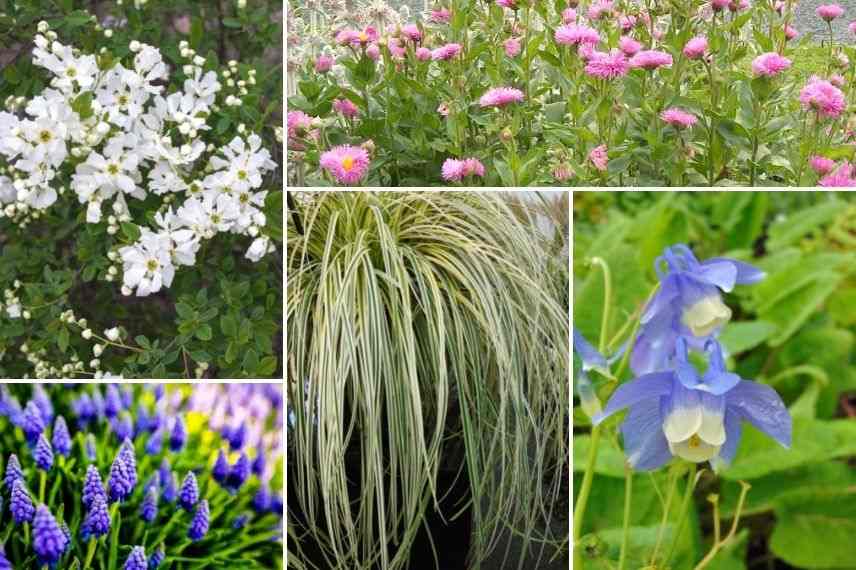
Exochorda ‘Lotus Moon’ (photo F.D. Richards – Flickr), Erigeron ‘Rosa Juwel’ (photo Wikipedia), Muscari, Carex ‘Feather Falls’ and Aquilegia flabellata ‘Ministar’
A low-maintenance bush grove
Among the many qualities of bushes, their low maintenance appeals to numerous gardeners. An annual pruning is often the only intervention they require. Planted in a cluster, they can define the corner of a garden or terrace. Exochorda ‘Magical Springtime’ is one of those low-maintenance plants, and it doesn’t even require pruning for its upright branches to bloom abundantly. Placed against a wall, it can stand out against the dark green foliage of a Star Jasmine, whose intoxicating fragrance is irresistible, or a Ivy, unless you prefer to follow it with an wisteria, whose fragrant clusters can either echo the white of its corollas or bring a touch of mauve. There’s nothing stopping you from pairing it with other climbers like clematis, which can bloom in all seasons depending on the chosen species. As neighbours, offer your Exochorda shrubs with remarkable foliage, colourful and decorative. For intense purple foliage, even nearly black, consider Sambucus ‘Black Lace’, which is also covered in pinkish-white umbels in late spring, or Weigela ‘Alexandra’, a large bush with pink flowers in May (if space is limited, consider Weigela ‘Minor Black’, which is much more compact). Enhance the colour palette with a Berberis like ‘Orange Rocket’, which transitions from orange to bright green, before flaring up again in autumn, the golden yellow of a dwarf conifer like Thuja ‘Golden Tuffet’ (its evergreen foliage maintains a beautiful bronze hue in winter), or the metallic blue of Picea pungens ‘Glauca Globosa’, which is also of low growth. To soften and link the shades together, insert some grey or silver foliage, such as those offered by Santolines, which create a frame for your display. Thus, in addition to the flowering, your cluster takes on the appearance of a bouquet with evolving shades throughout the seasons.
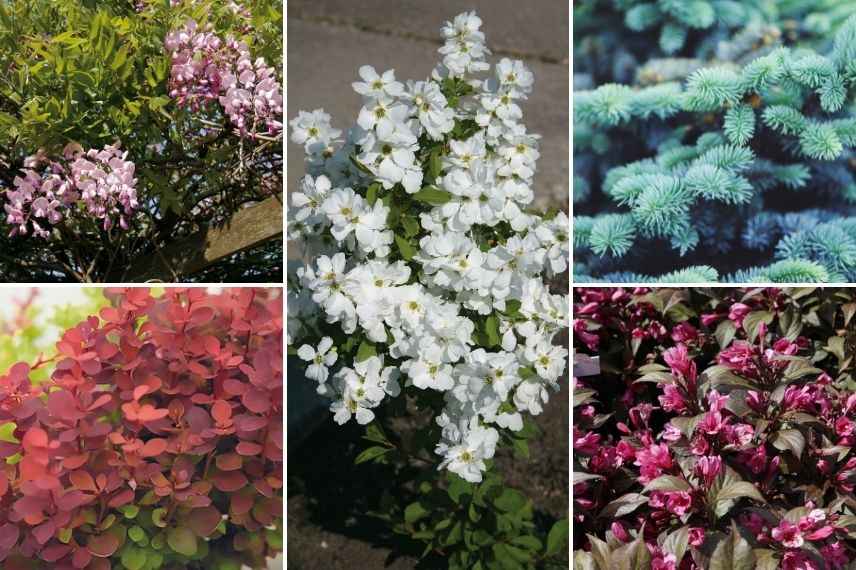
Wisteria floribunda ‘Houberi’, Exochorda ‘Magical Springtime’ (© Kolster), Picea pungens ‘Glauca Globosa’, Berberis thunbergii ‘Orange Rocket’ and Weigela florida ‘Minor Black’ (photo Denolf)
- Subscribe!
- Contents
Comments