





























Pairing ideas with Cytisus
5 pairing ideas for your Laburnum
Contents
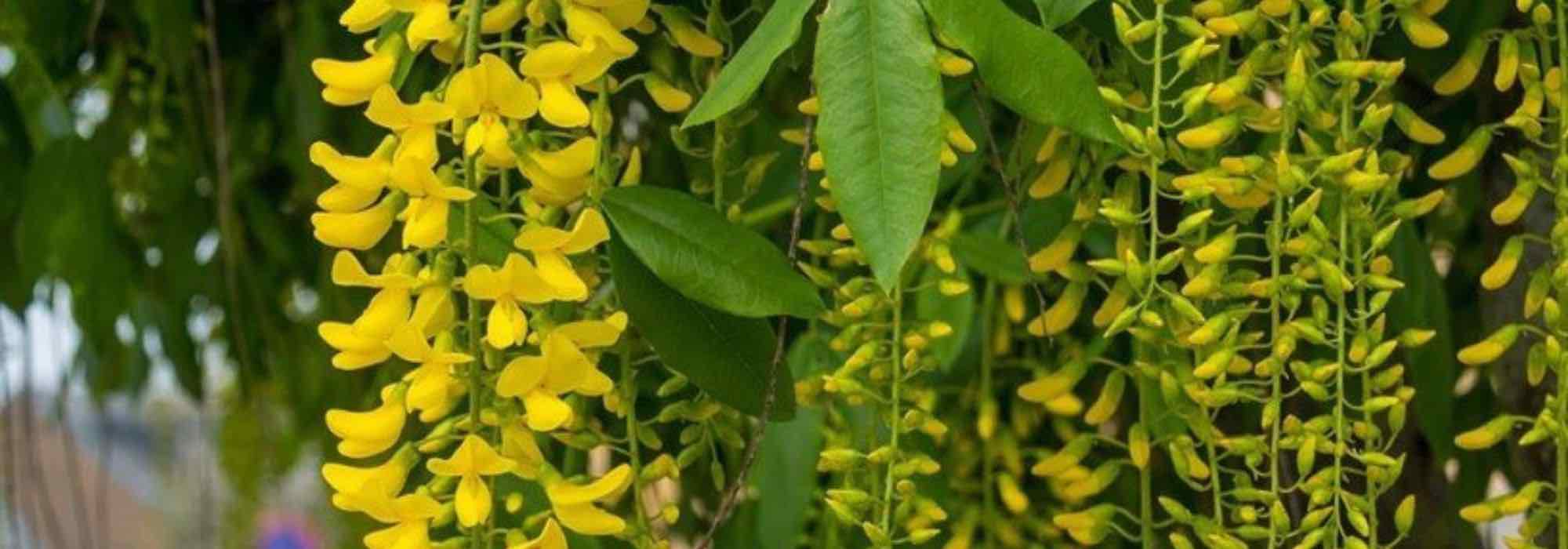
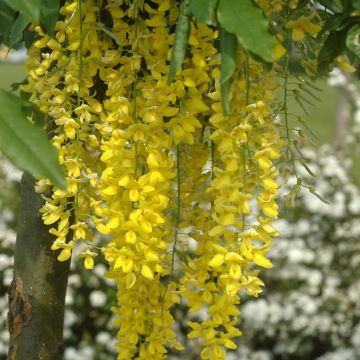
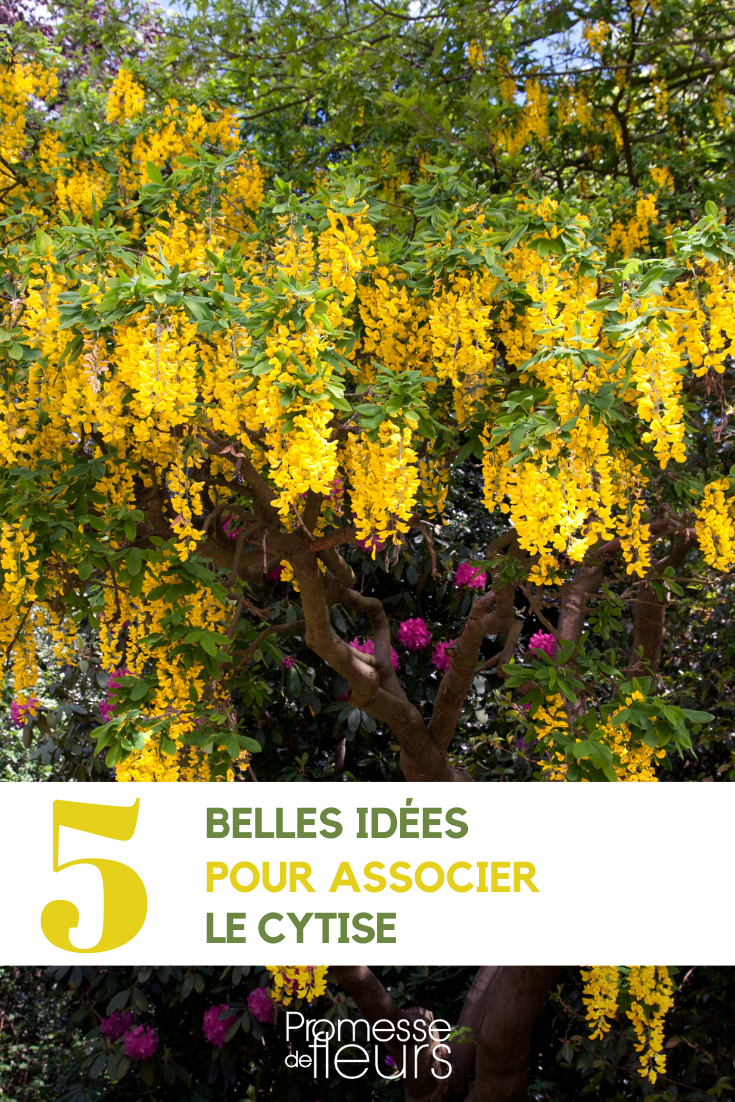
The Laburnums or Laburnum are large deciduous bushes that grow quickly and are very hardy. Tolerant of soil type, they thrive in poor, well-drained, chalky soil but can certainly accept more favourable conditions. Sun-loving shrubs, they can also develop in partial shade. They are valued for their generous, melliferous and fragrant flowering, with pendulous clusters of yellow flowers that sometimes earn them the nickname ‘yellow wisterias’. Mostly grown as multi-stemmed bushes, some gardeners take advantage of the flexibility of their young branches to train them. They can thus be trained as climbing plants to romantically adorn a structure or become the centrepiece of a border, attracting all eyes. Their bold and vibrant colour may seem challenging to pair at first, but many companion plants can be used to create beautiful displays, whether you choose to play with shades or opt for contrasts and complementary colours. I therefore invite you to discover 5 pairing ideas to highlight a Laburnum, regardless of how you wish to use it in the garden.

In a flowering hedge
The Yellow Laburnum is a bush that you can easily incorporate into a wildflower hedge. The pendulous and striking clusters of Laburnum alpinum ‘Pendulum’ are advantageously highlighted alongside other flowering bushes, the colours of which you can select according to your goal. If you wish to enhance the presence of yellow, consider integrating Coronillas. Being shorter, their evergreen foliage will maintain structure in your hedge throughout the year. Their fragrant flowering can display a yellow as intense as that of the Laburnum if you choose Coronilla glauca, but you can also soften the hues with the pale and gentler yellow of the variety ‘Citrina’, which avoids saturation while remaining on theme. For a contrast with blue or mauve, look towards Lilacs, with their well-known fragrances, or a butterfly bush like Buddleia alternifolia. This also adopts a graceful fountain-like habit and plays with contrasts both in its hues and the shape of its spherical inflorescences. Yellow pairs well with purple tones, so the foliage of Physocarpus ‘Midnight’ or ‘Lady in Red’ make good companions. The white of a Mock Orange tempers the scene and links the colours together, while also providing an enchanting fragrance.
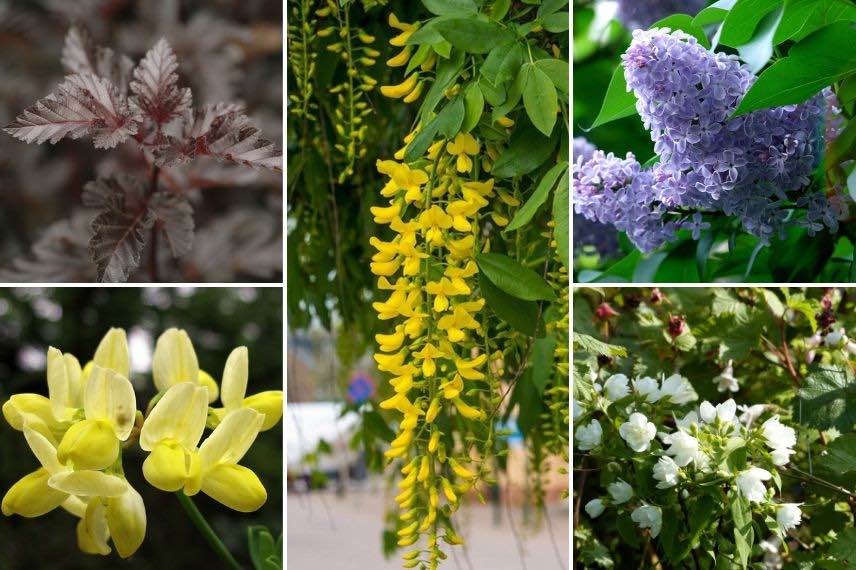
A Physocarpus ‘Midnight’ with almost black foliage, a mauve Lilac, a Mock Orange, and a Coronilla ‘Citrina’ surround the pendulous clusters of Laburnum alpinum ‘Pendulum’
Read also
Laburnum: planting, pruning and careA yellow and blue duo
The Laburnum anagyroides boasts a strong yellow hue, which is not always easy to pair. One solution to harmoniously benefit from it is to offer contrasting blue, mauve, or violet shades, which it also enhances. Among the bushes available to you, in neutral to acidic soil and in a non-burning, semi-shaded exposure, some Rhododendrons and Azaleas provide varied hues. For instance, the dwarf Rhododendron ‘Azurika’ displays corollas of a deep violet-blue that gradually evolve into a mauve-blue. Of similar dimensions, the Rhododendron impeditum ‘Ramapo’ is a softer mauve to lilac. In calcareous soil, apart from Lilacs, consider Ceanothus. Low and groundcover varieties like Ceanothus prostratus or Ceanothus ‘Blue Diamond’ create a beautiful backdrop for the flowering of Laburnum. Taller species and varieties assert themselves more forcefully, such as Ceanothus ‘Trewithen Blue’ or ‘El Dorado’, the latter also reflecting the yellow tones of its neighbour through its variegated foliage. For a grand effect, the tall verticals formed by ornamental alliums are essential. Select varieties that bloom concurrently (between May and June) such as Allium ‘Purple Sensation’ or ‘Ambassador’.
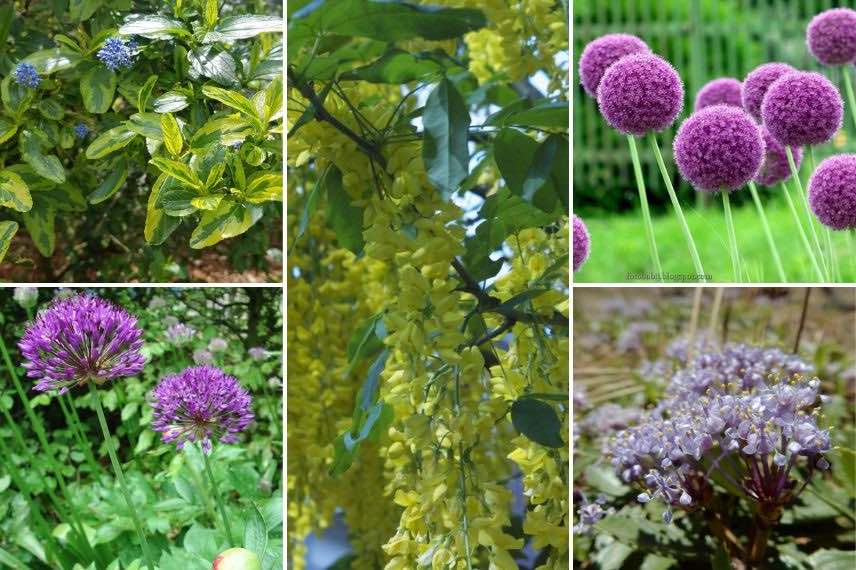
In calcareous soil, companions of Laburnum anagyroides: Ceanothus ‘El Dorado’ with variegated yellow foliage and Ceanothus prostratus with large spherical flowers of ornamental garlic: Allium ‘Purple Sensation’ on the left and ‘Ambassador’ on the right
Discover other Laburnum
View all →
Available in 1 sizes
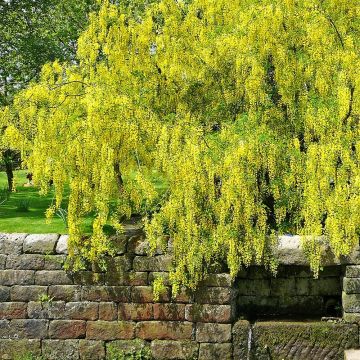
Available in 1 sizes
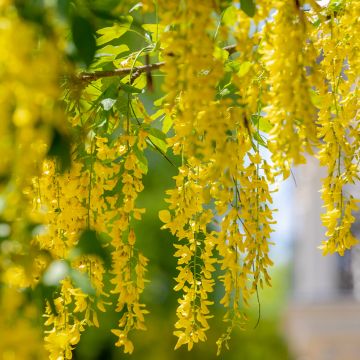
Available in 3 sizes
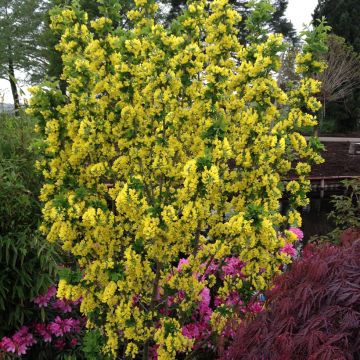
Available in 1 sizes
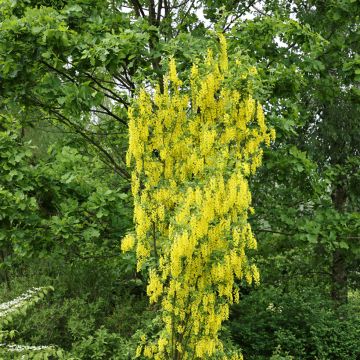
Available in 1 sizes
Available in 1 sizes
Climbing in Contrast
The young branches of the Laburnum are flexible and are therefore well-suited for training. You can lead it along a wall or arch it over a structure like that of a pergola, making it unforgettable during its flowering. Its pendulous cluster of flowers is reminiscent of those of a well-known and very popular climbing plant, the wisteria. It is no coincidence that it is sometimes nicknamed ‘yellow wisteria’. Take advantage of this resemblance by pairing the two. The Wisteria ‘Grande Diva Barbara’ blooms from its early years of cultivation, and its blue and white clusters blend beautifully with those of the Laburnum to create an unforgettable tapestry with a divine fragrance. If you prefer a less pronounced contrast, opt for the Wisteria ‘White Silk’, which adds an immaculate white to your drapery. Roses can also lend themselves to this type of combination. The old rose ‘Phyllis Bide’ is small for a climbing rose, but its apricot-yellow tinged with pink softens the bright yellow of its neighbour without clashing, and its flowering continues into autumn. Extremely fragrant, ‘Etoile de Hollande’ allows for a striking combination of scarlet red and yellow that is full of energy. The clematis and their delicate flowering also make good companions. Some bloom at the same time as the Laburnum, while others extend the interest of the display, just as some fast-growing annual climbers do, which are easy to grow and flower throughout the beautiful season. Don’t forget to dress the base of all these beauties. Nepetas, Geraniums, Irises, and Sages are some ideas to explore.
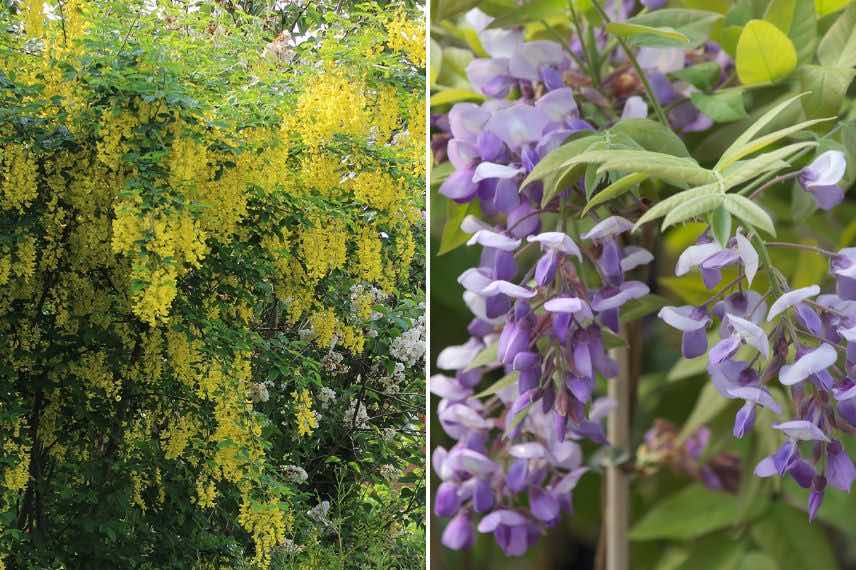
The dazzling mix of a Laburnum and a Wisteria
Read also
7 yellow flowering shrubsA dry soil border
The Laburnum watereri ‘Vossii’ forms a large bush that can stand proudly at the centre of a sunny border, even in dry soil. When used this way, it becomes the centrepiece of your display, its silhouette and hues drawing all eyes in spring. Plant it on a carpet of spring-flowering perennials that thrive in similar conditions, such as Achilleas with their flat inflorescences, Agapanthus with their generous globes available in white or various shades of blue and mauve, and Cerastium which combines silvery grey foliage, white flowers, and excellent ground-covering ability to limit the growth of unwanted plants. Iris, Butterfly Lavender (best suited for mild climates), Nepetas, and Dianthus are also part of the range available for these conditions. For shrubs, choose robust and trouble-free plants such as Abelias, Berberis (those with purple foliage harmonise well with yellow flowers), Butterfly Bushes, Ceanothus, Baptisia, Mexican Orange Blossom, or Cistus. Don’t forget to keep your border attractive in other seasons by incorporating late-flowering plants such as Caryopteris, Ceratostigma, Crape Myrtle, Perovskias, or Anaphalis. A few clumps of ornamental grasses can be planted either in the foreground (Carex, Fescues, Sporobolus, Hair Grass) or further back to allow their silhouettes to sway gracefully in the wind (Giant Stipa, Andropogon, Panic, Schizachyrium). To wake up your border early in the season, nothing beats early-flowering bulbs: Snowdrops, Crocuses, Ipheion, Reticulate Iris, Daffodils, and Tulips are easy to grow, can be integrated among other plants, and are reliable year after year.
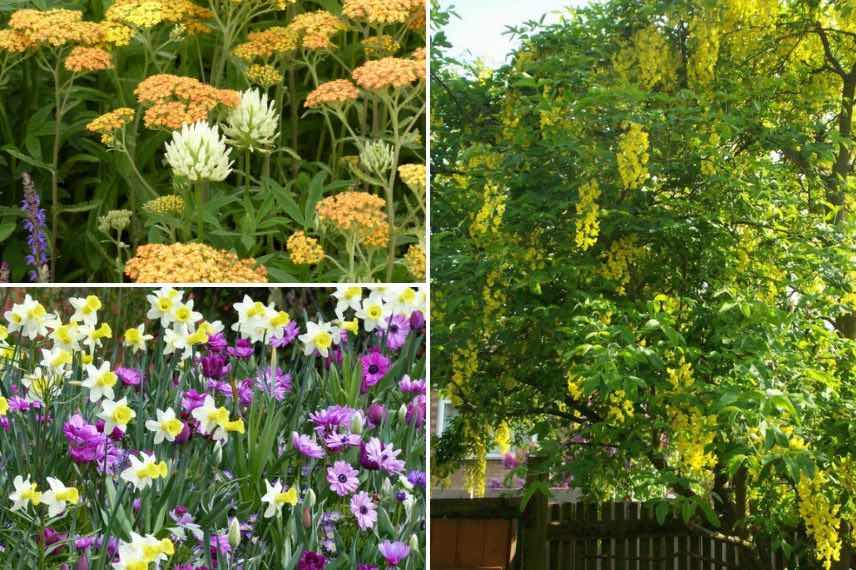
A Laburnum watereri ‘Vossii’, the centrepiece of a border of dry-soil perennials like Achilleas. Early bulbs brighten the end of winter before the perennials and the foliage and flowering of the Laburnum appear.
An original flowerbed
If the only colour offered by Laburnum is yellow, there is, however, a bush that holds a surprising twist! The Laburnocytisus adamii is the astonishing result of a graft between the true Laburnum (Laburnum anagyroides) and a Broom. This chimera has given rise to a slow-growing bush, perfectly hardy and particularly original. Reaching about 5 m in height at maturity, this bush bears leaves that can sometimes appear different and flowerings that are equally varied on the same plant. The curious flowering mixes clusters of pure yellow with others in mauve-pink to purplish-pink shades. This uncommon combination can be enhanced by choosing companion plants in similar tones. One naturally thinks of true brooms, with varieties like Cytisus ‘La Coquette’, which also features bicoloured flowers, between yellow and dark pink. A Potentilla ‘Pink Beauty’ offers rose-like flowers in soft shades of pink. A Berberis ‘Harlequin’ allows for the continuation of these hues through its foliage, which transitions from purplish-pink splashed with silver to red-orange in autumn. Echo these splashes by installing some plants with distinctly grey or silver foliage. A Buddleia ‘Silver Anniversary’ can be considered in not too cold climates. Silver Santolines can emerge here and there, unless you opt for a carpet of Stachys byzantina with foliage as soft as a caress. To fully embrace the theme of dominant colours, install Narcissus ‘Vanilla Peach’ and botanical Tulips ‘Cynthia’ that gently reprise the yellow and pink mix.
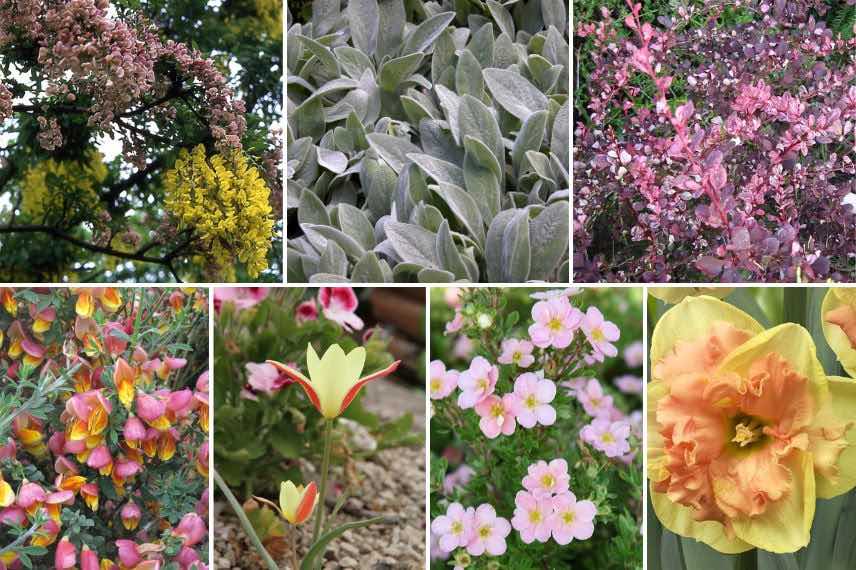
Laburnocytisus adamii with clusters of different colours alongside Cytisus ‘La Coquette’, Tulip ‘Cynthia’, Potentilla ‘Pink Beauty’, Narcissus ‘Vanilla Peach’, and Berberis ‘Harlequin’, tempered by a Stachys Byzantina with grey foliage
- Subscribe!
- Contents
Comments