





























Chervis or skirret, a forgotten perennial vegetable, easy to grow
Skirret is a perennial and ancient vegetable, very easy to grow, with a very subtle flavour
Contents
Chervis is the best-known name, but this vegetable, described as ancient or forgotten, can also be called skirret, crummock, or shepherd’s berle.
Chervis (Sium sisarum) is therefore a perennial vegetable, seldom grown in gardens and allotments, yet it offers a flavour that is truly exceptional and subtle.
Renowned chefs also often include it in their festive menus.
Widely consumed from the late Middle Ages to the eighteenth century, particularly on royal tables, the edible roots of chervis, with a sweet flavour, recall the flavour of carrot, parsnip and salsify.
If, over the centuries, chervis has fallen out of favour, it may be because it is only moderately productive compared with its cousins carrot and parsnip.
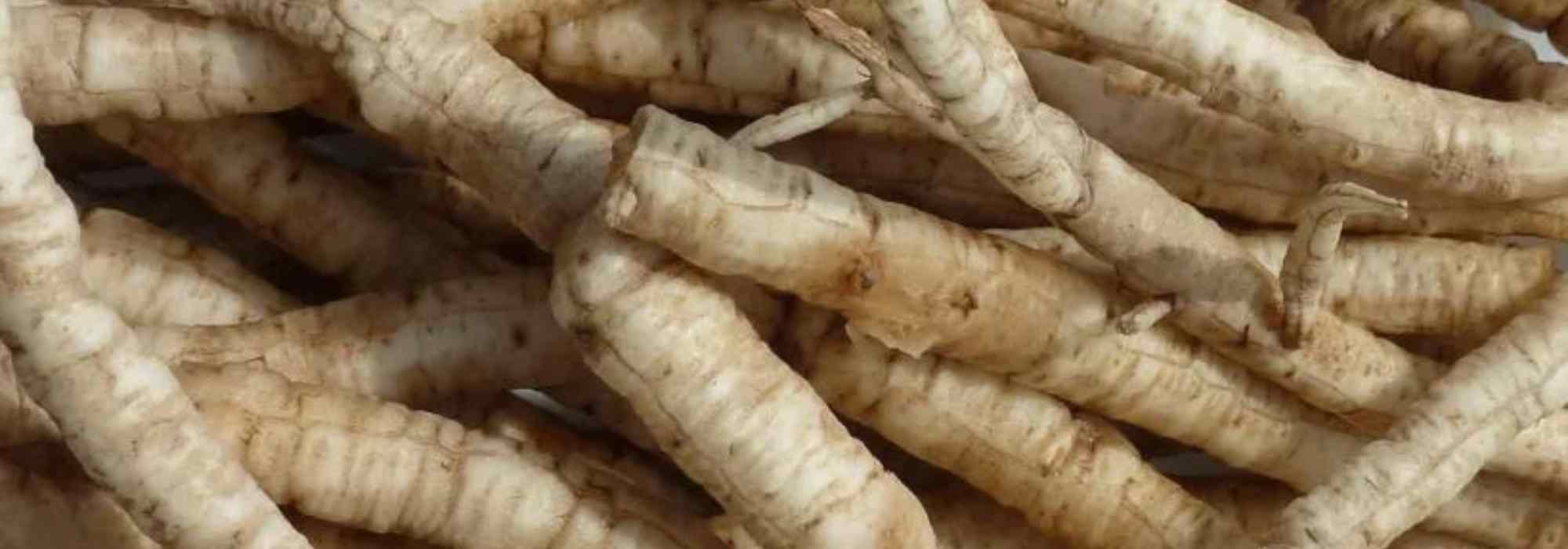
The appearance of its root clusters, claw-like, may also deter the gardener, as well as the cook who prepares it in the kitchen.
Yet, as a perennial vegetable that can stay in the kitchen garden for around a decade, chervis deserves a small place.
Easy to grow, very hardy and delicious, chervis has all the advantages. So, go ahead and plant a few plants in your garden.
Discover everything you need to know about growing chervis, from rhizome planting to tasting.

What is chervis exactly?
Chervis (Sium sisarum) is an old and forgotten vegetable, somewhat neglected by gardeners. That said, it has all the attributes to occupy a very small space in the vegetable plot.
Indeed, chervis, as a perennial vegetable, can be grown for at least ten years. Originating from Eastern Europe, this plant in the Apiaceae family (formerly Umbelliferae) is endowed with a bouquet of tuberous, highly aromatic and edible roots that radiate in a bundle from the collar and extend to a depth of 30 cm in the soil. With their grey-brown skin and claw-like appearance, these roots are not very appealing and tend to be brittle. However, their white flesh, fairly close to that of salsify and scorzonera, and slightly sweet, is tasty.

The chervis forms a handsome perennial vegetable plant
Perennial vegetable, this plant grows to a height of 1.40 to 1.80 m. It forms a clump of grooved, branched and upright stems bearing leaves made up of several dentate, lanceolate leaflets. The foliage displays a dark, fairly glossy green. Flowers about 5 mm in diameter, arranged in very loose umbels, appear from July to August. White or pale yellow, these flowers are very fragrant and slightly spicy. They produce dark brown seeds, striped with small furrows, reminiscent of caraway seeds.
Reputed to be rich in nutrients (potassium, phosphorus, calcium…), vitamin C and antioxidants, chervis is believed to have medicinal properties. It is thought to have digestive, vermifuge, diuretic and anti-inflammatory properties.
Chervis planting
Chervis isn’t a fussy vegetable to grow. You plant it, you forget it, and it comes back year after year. This perennial vegetable prefers deeply worked, well-loosened soil, fairly cool, or even damp and fertile. In terms of placement, you should choose a partly shaded or sunny position, but not blazing hot. Thus, chervis dislikes direct early-afternoon sun. However, it tolerates waterlogged soils, being quite damp.
To have the chance to taste chervis roots, two options are open to the gardener: sowing seed or planting rhizome pieces sold in pots. We would only recommend the latter method, as sowing seed is particularly long and uncertain. For that matter, do note that seeds are sown in late summer and autumn, from September to November. It is worth allowing around six months for the seeds to germinate!
By contrast, planting the plants takes place in spring, in March or April:
- Work the soil carefully with a spade or with a broadfork, then with a hoe to a depth of at least 20 cm
- Carefully remove adventives and stones
- Amend the soil by adding well-rotted compost
- Dig a hole 10 cm deep, or three times the size of the pot, and plant the rootstock piece
- Gently firm and water generously.
If you wish to plant several chervis plants, space them at least 50 cm apart in all directions.
How do you care for chervis?
As chervis prefers moist soils, water as needed, for example during periods of hot summer weather or drought. To keep the soil moist, it is recommended to install a thick mulch, made from well-decomposed compost that nourishes the soil. Another mulch of mulch or of straw or of dead leaves will be added in winter to facilitate the harvest of the roots.
Chervis does not tolerate weed competition, regular hoeing is essential. These hoeings will aid water penetration by aerating the soil.
An application of organic amendment is recommended in spring.
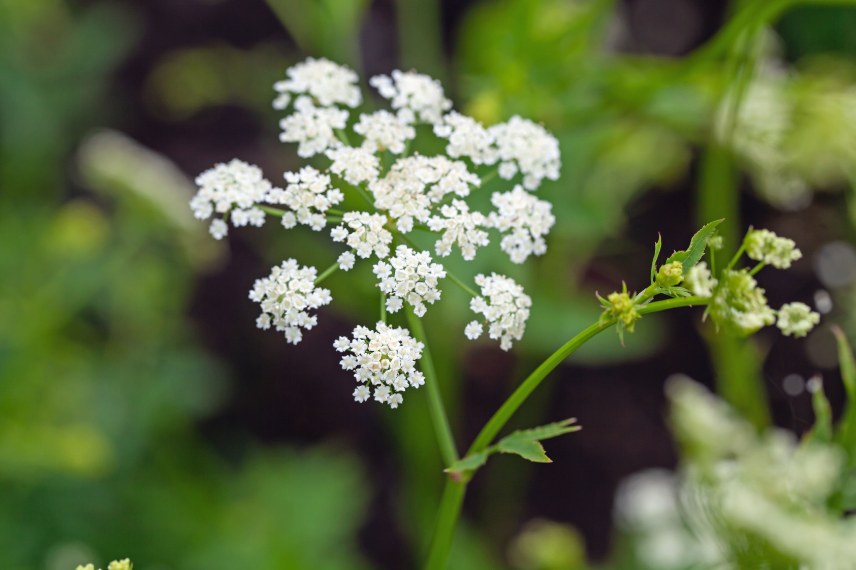
Chervis flowers, typical of the Umbellifers, should be removed to facilitate root development
Remove the inflorescences as soon as they appear if you do not wish to harvest the seeds. Indeed, flowering exhausts the plant to the detriment of root development.
Propagation of chervis
Propagation can be carried out by seed sowing, very unreliable and difficult. The simplest technique lies in the vegetative division of the young shoots that emerge at the collar. It is enough to lift them and plant them in pots in spring, between March and April.
Diseases and pests of chervis
Chervis does not suffer from diseases or parasites. The only danger lies in the presence of wood mice or mole rats. Discover all our tips for deterring wood mice or mole rats.
Chervis: from the harvest of the roots to culinary preparation
Chervis is a winter vegetable that is harvested from September–October to March. Harvesting of the roots is therefore done as needed, as soon as the foliage has dried. When it regrows in spring, the roots become fibrous and less palatable. Moreover, their flavour intensifies with cold and frosts.
To harvest edible roots, simply lift the plant with a fork, then pick the largest roots by cutting them about 3 cm below the collar. Then chervis plants are returned to the ground for another harvest and mulched to facilitate uprooting.
Since roots do not store well, there is no point storing them. They stay in the ground all winter without any problem.
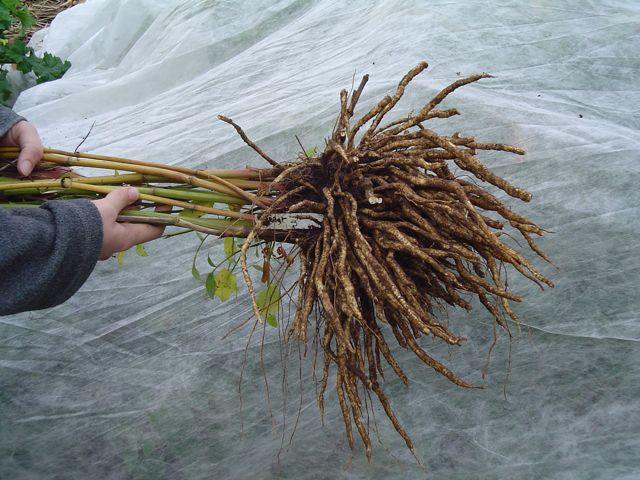
Edible chervis roots are harvested in winter (©Succulentserenity Wikimedia®)
In the kitchen
The tuberous roots of chervis are not peeled (fortunately) but are brushed clean. It is also recommended to incise the roots lengthwise to scrape the fibrous centre. Chervis is steamed, boiled or sautéed in a little olive oil or butter, as you would with salsify or parsnips. A traditional recipe is to roll them in flour and egg before frying.
- Subscribe!
- Contents
Comments