






























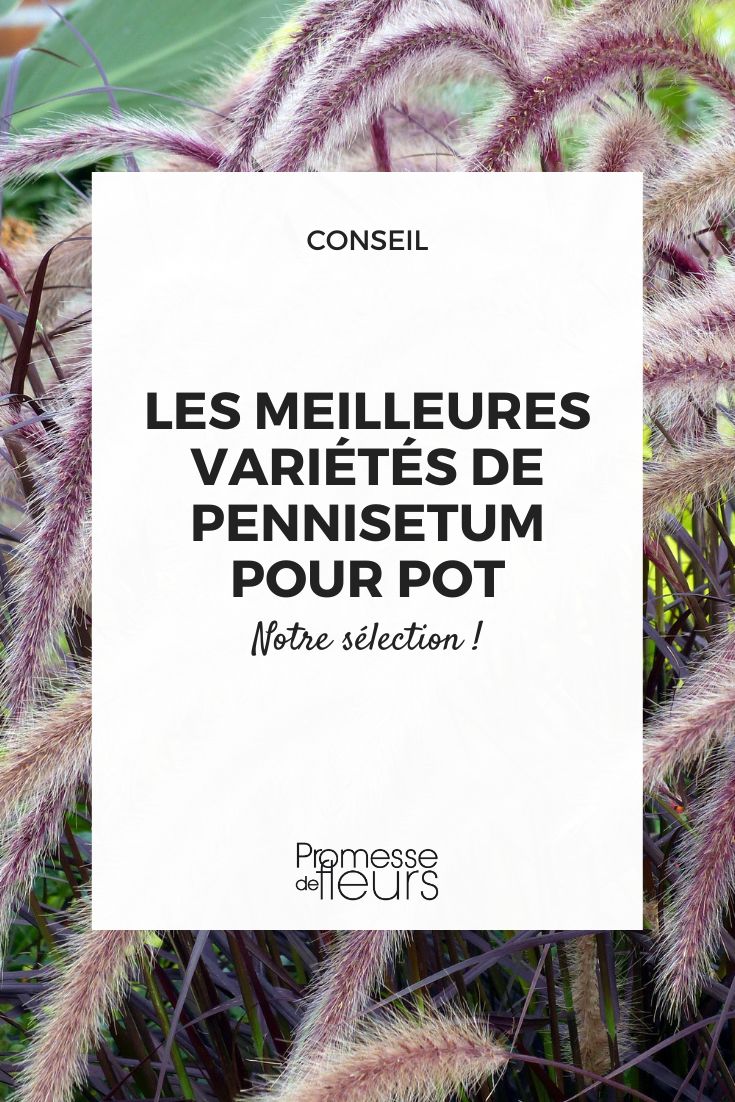
Chinese fountain grass: the best varieties for pots
Bright and colourful, Chinese fountain grasses bring a soft, inviting touch to a balcony or terrace
Contents
Fashionable grasses for several years now, Pennisetums, also known as Chinese fountain grasses, have captured the hearts of many gardeners. Bringing a touch of magical softness to the garden with their distinctive flowering, in the form of small silky, cream-white tufts, they can certainly be grown in pots, as they are generally medium-sized. This also allows you to grow some frost-sensitive species. And also to enjoy their flowering to create beautiful indoor bouquets once the season has passed. For pot planting, in many regions you’ll find dozens of varieties derived from Pennisetum alopecuroides, the hardiest against frost.
Discover the five Pennisetums we recommend for pot planting on the terrace or balcony, in a sunny location, absolutely essential!

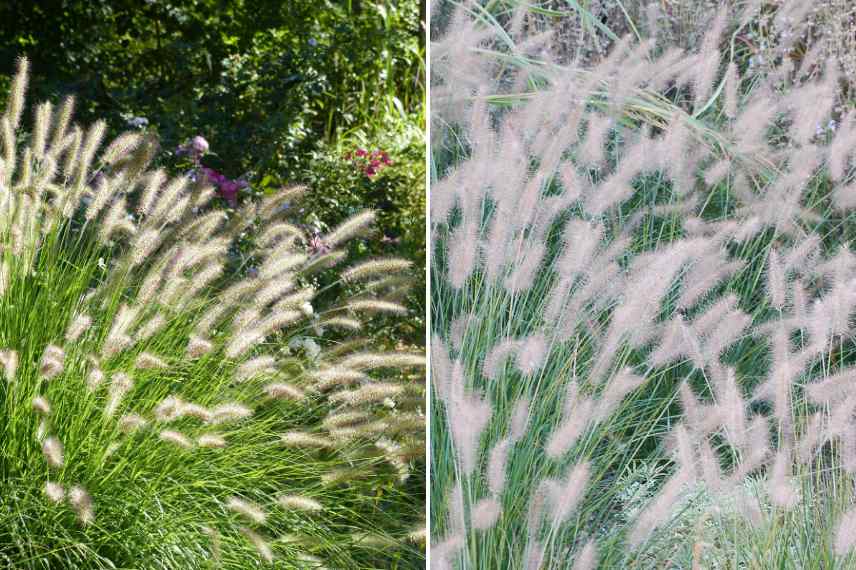
Pennisetum alopecuroides 'Hameln'
The Pennisetum alopecuroides ‘Hameln’ is a must-have among foxtail grasses, thanks to its size and versatility in the garden and when grown in a pot. ‘Hameln’ grows to around 60 cm tall. It forms a beautiful, rounded, spreading tuft, perfect for a pot set directly on the ground or on a slight elevation.
Its silky plumes, cream-coloured, become golden in sunny exposure, especially in the south and particularly in the west, where they will benefit from the low, warm late-afternoon light of midsummer. Its foliage is highly ornamental, particularly fine, taking on beautiful autumn colours.
Hardy; no protection is required for your Pennisetum in winter. When grown in a pot, however, as with all Pennisetum discussed here, the substrate should be well-drained — a good potting mix to which you add sand or small gravel — so it won’t suffer from moisture if your region experiences heavy rain in spring or winter.
Pair it with a lovely pot of blue hardy geranium such as ‘Rozanne’ and white, airy gaura. ‘Hameln’ can also serve as a showpiece plant on a large balcony composed solely of grasses for a wow effect in the heart of the city! Use it in mass, perhaps with a few small Miscanthus.
♥ Its little extra : it flowers earlier than the others, from July, or even June, which makes it a very useful Pennisetum for balconies.
Pennisetum setaceum
A rather different Pennisetum, as this one originates from tropical Africa, Arabia and the south-west of Asia. No need to say that we will protect it in winter! And that is precisely why we grow the Pennisetum setaceum in pots in most regions (its hardiness down to -5°C), all the more as they are particularly drought-tolerant.
What also sets it apart from other Pennisetum is its very arching habit. Its long silvery spikes, tinged pink to purple (about 30 cm) appear from July to October and intensify in the sunniest exposure. Among varieties of interest, the most well-known is undoubtedly the Pennisetum setaceum ‘Rubrum’, with dark purple, almost black, foliage. ‘Skyrocket‘ itself, as its name suggests, provides a real firework display.
This Pennisetum, which we typically grow as an annual here, outside milder regions, is therefore very well suited if you like to refresh the decor of your terrace or balcony each year. You will plant it in spring; it will develop fully in a single season. It is easy to pair it with warm tones for a small outdoor space with a tropical look, such as the contrast of the broad leaves of purple Cannas with orange flowers, for example, or as below with pale blue flowering annuals.
♥ Its little extra: exotic flair!
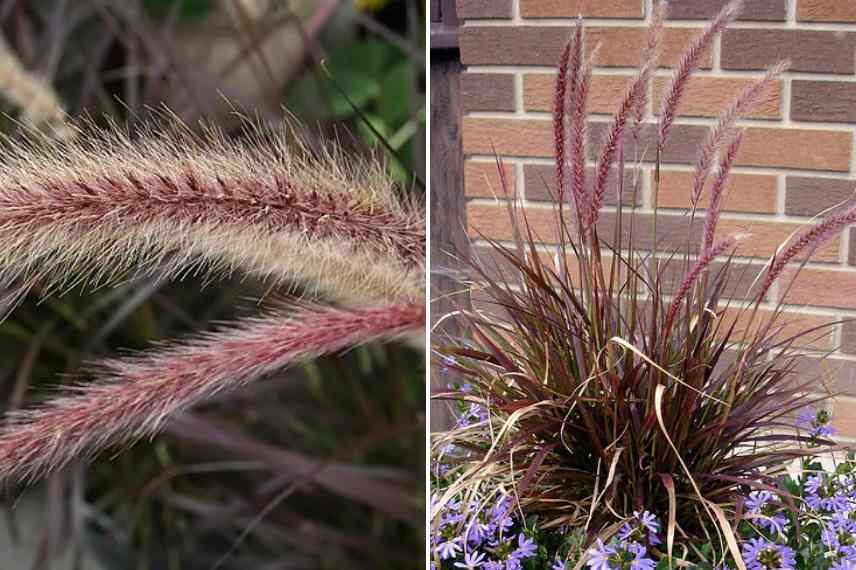
Pennisetum setaceum ‘Rubrum’ (©2006 David J. Stang) ; on the right, an arrangement whose foliage stands out well, surrounded by trailing Scaevola from the pot (©Daryl Mitchel)
Pennisetum alopecuroides 'Little Bunny'
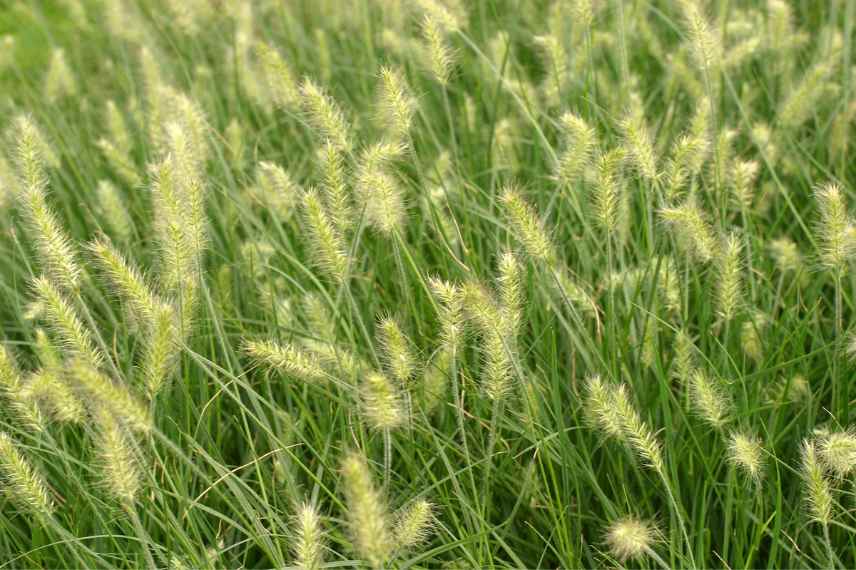
It is a particularly dwarf form, as it grows to a maximum height of 25–30 cm and, for the same width, surely the smallest of all Pennisetum. This is the one you should choose if you have very little space. The Pennisetum alopecuroides ‘Little Bunny’ can even be tucked into a window box, such is how truly compact it is!
Its inflorescences, small but numerous and long for the plant’s compact size (about 15 cm), are a beautiful pearl-white to pink-beige colour and bring a silky texture and a lovely sway in the wind. Its foliage has the advantage of being very fine and bright, in a subtly blue-green colour.
It will be ravishing surrounded by a pot of green Echinacea, such as ‘Green Jewel’ and perhaps the mauve flowering of Buenos Aires Verbena ‘Lolipop’.
♥ Its little bonus: ultra-compact dimensions that let you grow it anywhere in a pot.
Read also
Pennisetum: 7 ideas to pairing themPennisetum alopecuroides 'Moudry'
To add a touch of originality to a terrace or balcony, dark-spiked Pennisetums are not to be overlooked! They differ from pale-spiked Pennisetums and make a striking impact when surrounded by flowering displays in pastel tones, offering real contrast and a great deal of softness.
Among these dark Pennisetums, ‘Moudry’ stands out for its late flowering from mid-August or September. It should therefore be used only in warm regions to ensure it flowers properly. The brown spikes with silvery-grey reflections are sizeable, measuring about 8 cm, and the clump forms a mass around 70 cm tall when grown in a pot. The glossy, trailing green foliage forms a real fountain and remains attractive until December, as does the flowering, magical at the first frosts. Like most Pennisetum alopecuroides, it is hardy enough to be grown almost anywhere, provided you offer it a well-draining growing medium.
Pair the Pennisetum ‘Moudry’ with herbaceous perennials or shrubs grown in pots that also enjoy full sun, in peach tones, such as an oleander ‘Angiolo Pucci’ or with the large flowers of a Hydrangea paniculata, which subtly change colour in late summer.
NB: ‘Black Beauty’, shown a little higher up, is a cultivar just as original thanks to its cylindrical purple spikes that evolve into brown.
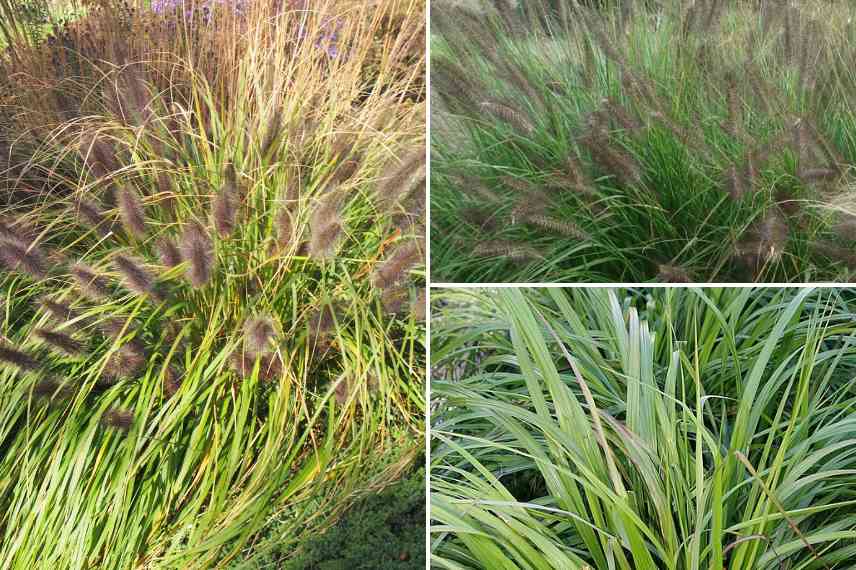
Pennisetum ‘Black Beauty’ (©Agnieszka Kwiecien Wikimedia Commons) and to the right the Pennisetum ‘Moudry’ ©David J Stang Wikimedia Commons)
The Pennisetum alopecuroides 'Lumen Gold'
Here at last is a ‘Lumen Gold’, a Pennisetum that delights with its very bright foliage, a distinctly lime-yellow hue. It is, for this reason, well suited to a balcony or terrace where it provides a welcome splash of colour, surrounded by other perennials. This handsome foliage from spring to autumn (it is all the more golden with cold temperatures) would almost eclipse the interest of its flowering, from August, also gracefully borne by beige, downy spikes.
You can pair it with white yarrow in pots, or insert it into a shrub display with leafy habit and a globe habit for a contrast in volume, such as Pittosporum tobira ‘Nanum’, or place it near a pot of purple Asters to accompany it late into the season.
♥ Its little extra: it slips perfectly into contemporary settings, warming them instantly, and its mid-sized habit makes it suitable for both balconies and larger terraces.
- Subscribe!
- Contents
Comments