

























Choosing a Ginkgo biloba: our buying guide
Find the ideal variety
Contents
Majestic tree, a survivor from prehistoric forests, famed for its longevity of over 1,000 years, the Ginkgo biloba or Maidenhair tree fascinates.
It is prized for its graphic, fan-shaped foliage, fresh green in spring, which takes on a stunning golden-yellow colour in autumn. Its brown-grey bark, which cracks and fissures with age, is another of its attractions. If some specimens can reach over 20 m at maturity, dwarf cultivars make handsome bonsai or enrich collections of miniature conifers. It is a tree to plant as a solitary specimen in the garden or in a pot, for ginkgos well suited to small spaces. It integrates particularly well into Japanese-inspired, exotic or contemporary decor. Its exceptional resistance to disease and pollution, and its hardiness, make it suitable for many uses. It thrives in full sun in ordinary soils, even calcareous soils, provided they are cool and well-drained. Height, leaf colour or growth habit, browse our buying guide to find the Ginkgo that best suits you!

Depending on height and use
With slow growth during the first 10-12 years of its life, the Ginkgo biloba can become very tall (reaching more than 30 m in height at times) and surpass the venerable age of 1000 years. If its growth habit is columnar in youth, its habit spreads with age, spreading to nearly 10 m in diameter for the most imposing specimens. Hence the importance of allocating a space to suit it. Since Ginkgo does not respond well to pruning, mature height is an essential criterion when selecting one. The tallest Ginkgos make a superb display when planted as solitary specimens in the centre of a lawn or as a focal point in a large shrub border, when dwarf varieties are particularly well suited to pot culture, to complement a rock garden, in a collection of miniature conifers, or can be easily grown as bonsai.
The largest Ginkgo varieties
- TheGinkgo biloba ‘Menhir’ naturally forms a 15 m tall column. It is ideal for parks or large gardens.
- The Ginkgo ‘Saratoga’ also reaches up to 15 m in height at maturity, and is perfect as a solitary specimen in a large garden.
- The Ginkgo ‘Autumn Gold’ is notable for its majestic dimensions, reaching up to 24 m in height. It establishes itself as a solitary specimen on the lawn.
Medium-sized varieties
They form handsome specimens, more or less upright, typically 4 to 10 m tall. They bring brightness to a shrub border and to small gardens.
- The Ginkgo biloba ‘Blagon’, with a height of 10 m and a spread of 2 m, can fit into smaller gardens. It is a good avenue tree and shade tree for an urban garden or terrace.
- The Ginkgo ‘Horizontalis’ easily fits into restricted spaces and is suitable for shading a small terrace thanks to its compact dimensions, not exceeding 4 m in height and 6 m in spread at maturity (1.5 m tall by 3 m wide at 10 years).
The smallest Ginkgos
Some dwarf varieties are perfectly suited to pot culture or small spaces.
- The Ginkgo ‘Mariken’: this small form will not exceed 80 cm to 1 m in all directions after 10 years, which makes it suitable for small gardens as well as terraces.
- TheGinkgo biloba ‘Troll’ is a dwarf Ginkgo that barely exceeds 1 m in all directions, perfect for small city gardens or for growing as bonsai.
- Even smaller, theGinkgo biloba ‘Chris Dwarf’ will not exceed 60 cm in all directions at 10 years. This mini ginkgo is stunning in a rockery.
See also: How to grow a Ginkgo biloba in a pot?
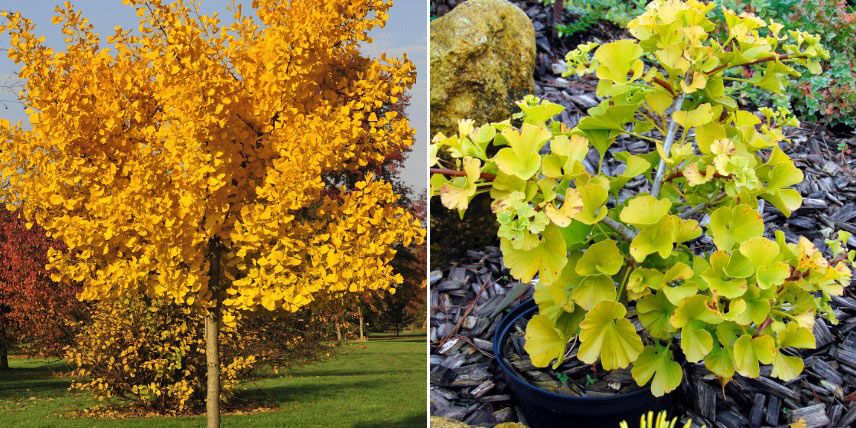
The height of ginkgos varies greatly: ‘Autumn Gold’ (left) becomes particularly large at maturity, while the variety ‘Mariken’ (right) remains dwarf
According to its habit
The growth habit of Ginkgo biloba may vary by cultivar: columnar or globose, and may also exhibit a weeping or table-shaped silhouette.
- The Ginkgo ‘Pendula’ stands out for its weeping habit which, over time, takes on an umbrella-like appearance.
- The variety ‘Gold Flame’ is notable for its particularly narrow habit, eventually reaching 10 m in height and 1.25 m in spread.
- The Ginkgo biloba ‘Eiffel’is another unique selection due to its fastigiate and slender form which adds verticality to any medium-to-large garden.
- The Ginkgo ‘Globus’ delights with its perfectly rounded crown.
- The Ginkgo ‘Horizontalis’ forms a broad, low umbrella with compact dimensions. It has no equal for adding a distinctive touch to a small garden or the centre of a large border.
→ If you would like to learn more about the different tree habits, read Trees and shrubs: the different growth habits.
→ Learn more about umbrella-shaped trees.
 Ginkgo biloba ‘Pendula’ and Ginkgo ‘Horizontalis’
Foliage colour and ornamental interest
Although deciduous, the Ginkgo foliage presents a remarkably luminous display all year round. Its leaves, with the distinctive notched fan shape, emerge green in spring and unfold into sublime, intensely luminous golden-yellow hues at the end of the season. The charm reaches its peak when, in autumn, they blanket the ground with a carpet of golden coins.
- The Ginkgo biloba ‘Saratoga, features long, slender leaves that hang gracefully and transition from light green in spring to golden yellow at the end of the season.
- The Ginkgo ‘Globus’ offers larger leaves than those of the standard variety. Cone-shaped, they take on pretty bluish reflections in summer, then turn to the characteristic golden yellow.
- The Ginkgo ‘Mariken’ stands out for smaller foliage and somewhat more pleated than that of the species, yet just as golden yellow in autumn.
- The Ginkgo ‘Gold Flame’ is known for its foliage turning to beautiful golden colours in autumn. This variety is particularly bright.
- The Ginkgo ‘Autumn Gold’, initially light green, somewhat bluish in summer, its autumn foliage turns to an intense yellow, almost orange. It brings a striking colour to the garden.
- Subscribe!
- Contents
Comments