





























Choosing a Panicum
Our buying guide
Contents
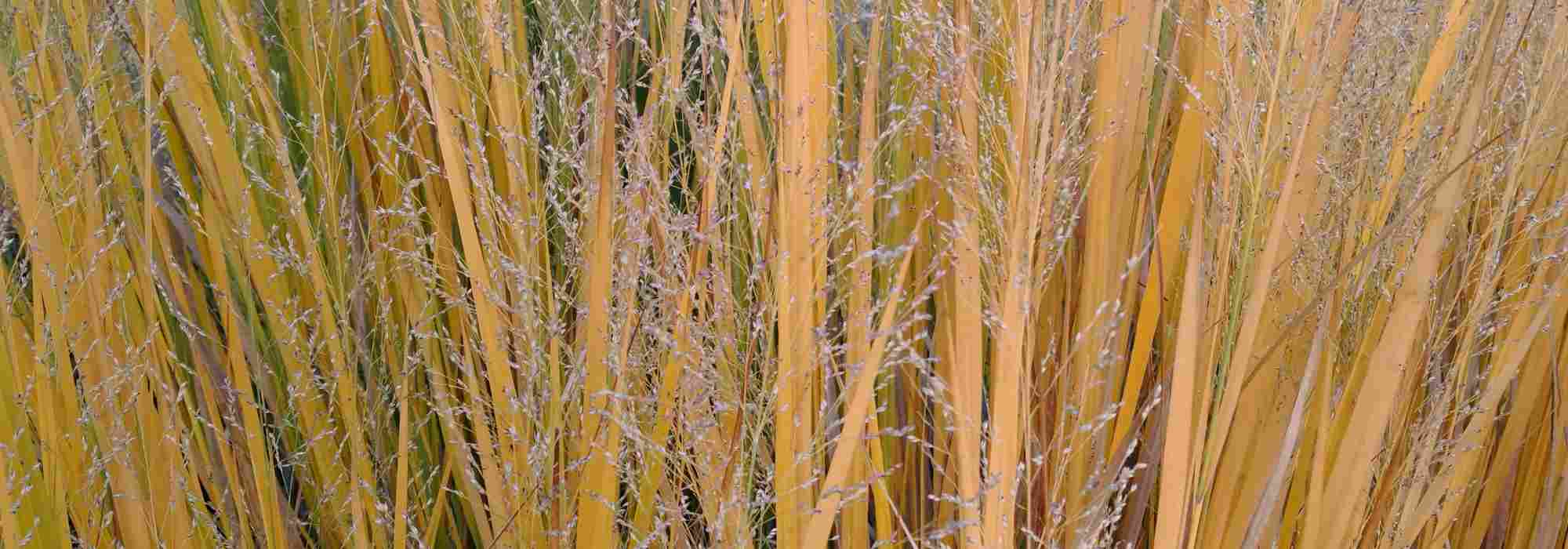
Less common than Miscanthus, Panicum (or switchgrass) is a tall grass that thrives in full sun, distinguished by its more upright habit, creating very interesting vertical effects in the garden. It is this particular silhouette that gives it great appeal even before flowering. The contrast with the soft and airy effect of its feathery inflorescences appearing at the end of summer is delightful.
Panicum is increasingly being integrated into both naturalistic and contemporary plantings, as it also provides an excellent defence against climate change.
There are over 400 species of Panicum native to the vast American prairies, with Panicum virgatum—commonly known as switchgrass or slender panic—being the one used in our gardens, available in numerous ornamental varieties. All are perfectly hardy for use from north to south!
How do you choose the right variety of Panicum for your garden or terrace? We assist you with some important criteria such as its dimensions, the colour of its foliage and inflorescences, and its various uses.
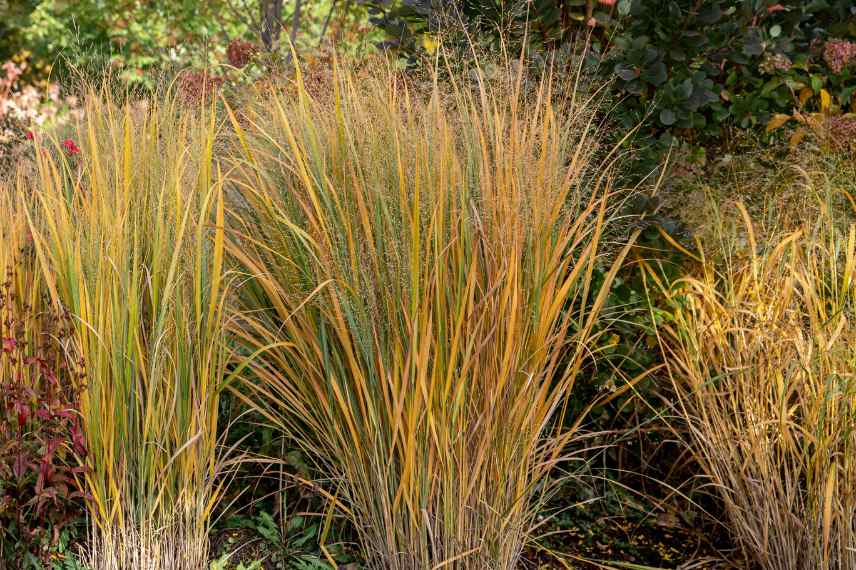
Panicum, with its distinctive upright appearance, is certainly not lacking in interest!

According to the size
All erect panics are large grasses that can structure a border just like a small bush. Generally measuring over 1 m in height, some varieties reach up to 2 m during flowering, while a few cultivars remain quite low. You will choose the variety based on the location and size of your garden. The dimensions also vary in the spreading of the grass.
N.B.: the dimensions we provide are always the dimensions of the grasses in flower.
- The “giant” Panicum: must be placed at the back of the border, with ‘Cloud Nine’ being the tallest at 2.20 m in flower, ‘Thundercloud’ reaching 1.80 to 2 m high with its broad foliage, the stunning ‘Northwind’ also standing at a lovely height of 1.70 m, just like Panicum ‘Dallas Blues’, both having a bluish hue;
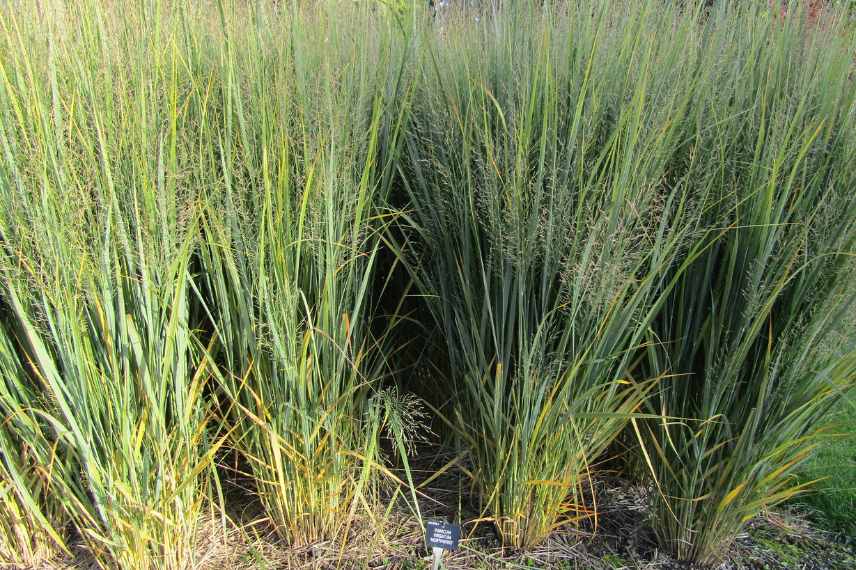
Panicum virgatum Northwind (© Leonora Enking)
- The tall Panicum (between 1 m and 1.50 m): these are most of the Panicum found in these dimensions, such as ‘Heiliger Hain’ (generally growing to 1 m high), or ‘Prairie Sky’ (1.20 m) and ‘Warrior’ (between 1.20 and 1.50 m);
- The medium Panicum (70 to 80 cm): ‘Squaw’, ‘Shenandoah’ (70 cm) and ‘Kulsenmoor’ (80 cm) with beautiful autumn colours, ‘Cheyenne Sky’ (80 cm);
Panicum ‘Squaw’ and ‘Prairie Sky’
- The small Panicum: there are a few, and they are practical for pot planting, such as ‘Sangria’, very compact at 40 cm in all directions, or ‘Cape Breeze’ at 60 cm, which flowers light pink with a delicate touch. (Read also: How to grow a Panicum in a pot?)
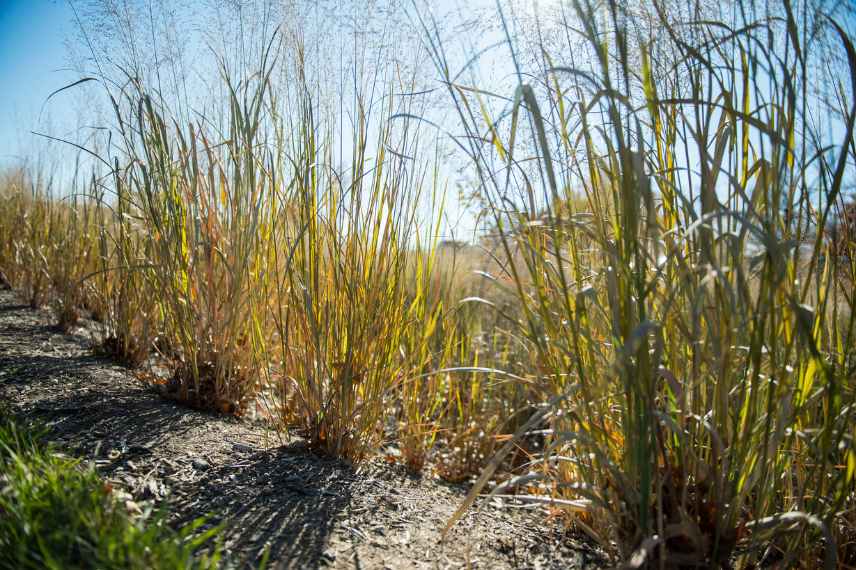
Panicum virgatum ‘Cape Breeze’
According to the colour of the foliage
A great diversity can be found in the leaf colours of Panicum, with the most sought-after varieties displaying glaucous hues. The leaves are always very orderly, standing upright, growing in dense tufts that widen with age. The foliage is dynamic, blue or green in summer, and remains highly decorative in winter, even when it has taken on light yellow or purplish tones.
- Glaucous: ‘Heavy Metal’ with a glaucous grey, highly prized for its metallic reflections, its inflorescences are beige-pink, ’Dallas Blues’ with a slightly more spreading habit and a steel blue colour, ‘Heiliger Hain’ very glaucous and variegated with burgundy in autumn, ‘Kulsenmoor’, ‘Prairie Sky’ with very fine foliage, ’Amarum’, ‘Cloud Nine’ and ‘Northwind’;
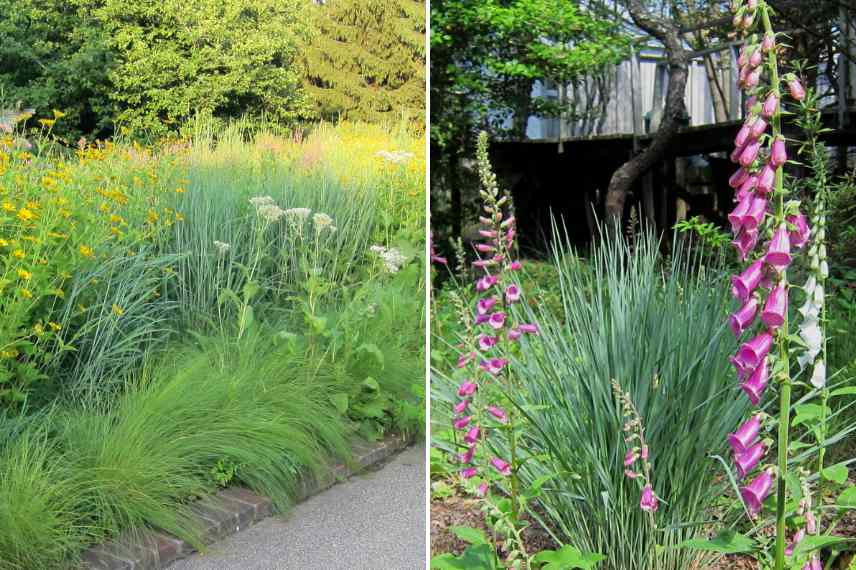
Panicum ‘Cheyenne Sky’ and Panicum amarum ‘Dewey Blue’ (© KM)
- Green: the typical species, Panicum virgatum with a beautiful bright green, ‘Rehbraun’ with a rich green, and Panicum virgatum ‘Warrior’ with broad green foliage
- Purplish: ‘Ruby Ribbons’, ‘Purple Breeze’, ‘Heiliger Hain’, ‘Hänse Herms’ (syn. ‘Rotstrahlbusch’) turn red in summer
- Darker colours: ‘Hot Rod’, evolves to a dark brown, ‘Blue Darkness’ with glaucous green and almost black variegated foliage
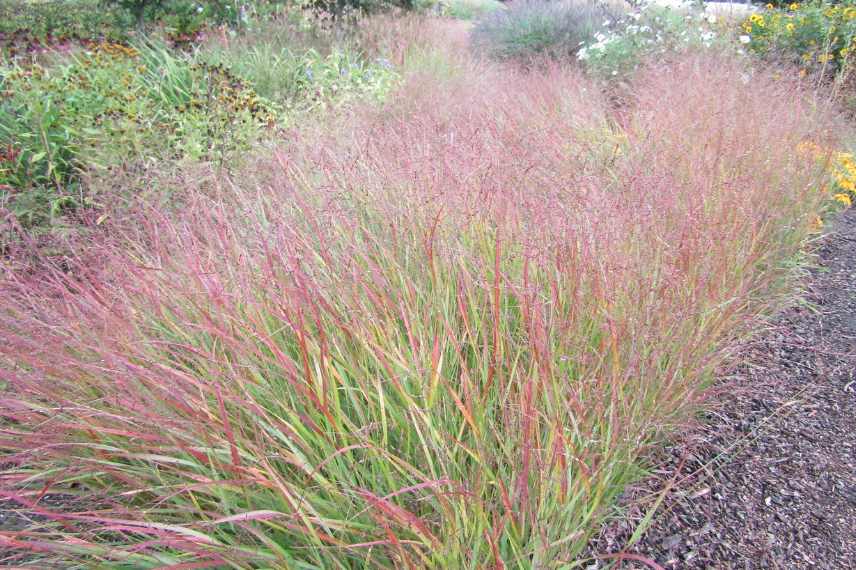
Panicum virgatum ‘Hänse Herms’ (© Leonora Enking)
According to the colour of the inflorescences
Flowering occurs in early August in the south of the country, and later in the north, sometimes earlier during hot summers. It lasts until winter, gracefully enduring rain or the first frosts. The flowering is carried by very light spikelets, in panicles of varying sizes dancing above the borders. One might choose a Panicum for the colour it reveals, as it takes on different shades, often pink or red at the beginning of flowering:
- Blonde and beige inflorescences: ‘Cloud Nine’ with golden spikelets
- Pink inflorescences: ‘Squaw’, ‘Dallas Blues’ in purplish pink, ‘Heavy Metal’, ‘Amarum’ and the species type Panicum virgatum, ‘Warrior’ in a dark pink almost brown, and ‘Heiliger Hain’ in rosy beige
- Red to purple inflorescences: they are particularly striking in borders, arriving late in the season, providing a bright and warm colouration, and pairing especially well with “hot borders”: ‘Prairie Sky’, with fine burgundy spikelets, ‘Dallas Blues’ features large purplish inflorescences, ‘Shenandoah’, ‘Purple Tears’… among others.
Read also
9 grasses for dry soilAccording to the autumn variations
Panicums, like many grasses, display their foliage or inflorescences in sumptuous colours as autumn approaches. The foliage primarily changes at the tips, often in shades of red and crimson, sometimes creating a bicolour effect. Some Panicums soften into straw tones, while others take on more violet hues. These varieties are ideal if the desired effect is particularly focused on the autumn period. Among the most interesting are:
- ‘Cloud Nine’ with glaucous foliage turning straw
- ‘Northwind’ whose blue-green foliage takes on yellow hues in autumn
- Panicum virgatum ‘Rehbraun’: it features orange-red tips
- ‘Heiliger Hain’ with glaucous foliage that becomes variegated with burgundy in autumn
- ‘Purple Breeze’, glaucous green partially turning purple, creating a beautiful contrast
- ‘Kulsenmoor’ takes on a bright blood-red colour on the upper part of the foliage, lasting throughout autumn
- ‘Shenandoah’, whose leaves turn orange-red at the tips while maintaining a blue base
- ‘Hänse Herms’ turns fire-coloured in autumn, reminiscent of the more modest Imperata cylindrica
- ‘Squaw’ dons a tawny coat, with a reddish-brown hue at the tips, becoming even more reddened in the light of the setting sun.
- ‘Cheyenne Sky’ is notable for colouring very early in the season, taking on a wine-red hue as early as July
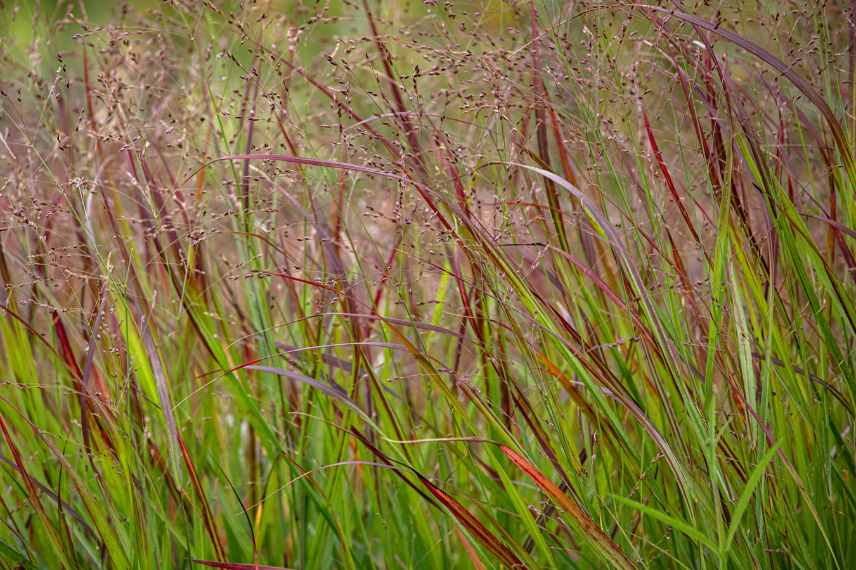 Panicum virgatum ‘Shenandoah’ in early autumn
According to the fineness of the inflorescences
The flowering of Panicum occurs between August and October. It is among the finest of all grasses. Panicums transform their somewhat stiff appearance thanks to the blurred mist of the spikelets, which are among the most elegant.
For the lightness and delicacy of their inflorescences, we particularly recommend: ‘Shenandoah’, ‘Purple Tears’ developed by Piet Oudolf, with broad inflorescences, ‘Squaw’ which creates a blurred and very airy effect, in a beautiful colour between pink and claret, and ‘Heavy Metal’.

Dew or frost enhance the finest inflorescences
According to the habit
Renowned and sought after for their vertical appearance, Panicum grow in upright clumps. However, some Panicum exhibit a slightly looser, more spreading habit, such as ‘Dallas Blues’. This tendency to grow in a less erect and more flexible manner is also due to the often cooler soil.
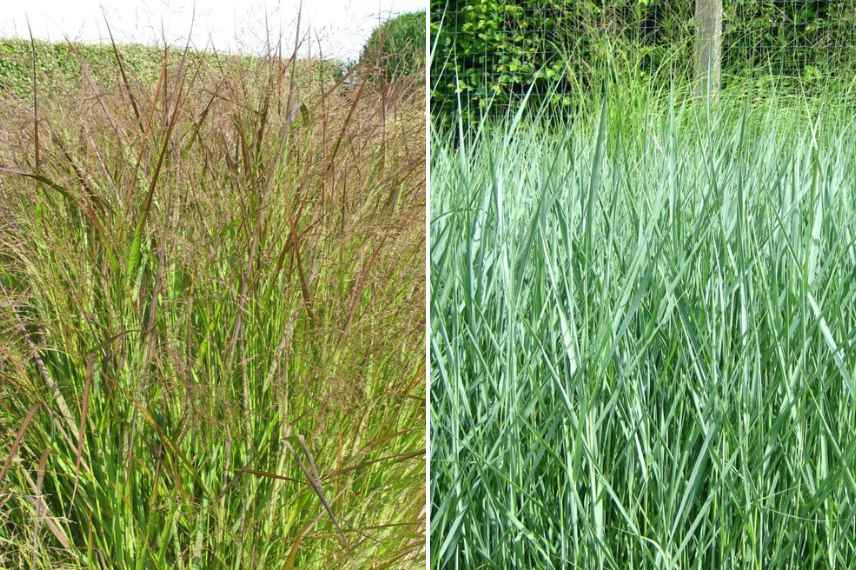
Among the most upright Panicums, which are almost columnar and therefore very graphic: ‘Heliger Hain’, ‘Warrior’, ‘Purple Haze’, ‘Prairie Wind’, ‘Shenandoah’, ‘Northwind’, and ’Heavy Metal’ remain narrow and well-aligned. For these, which are less loose and therefore narrower, expect to plant a few more per square metre.
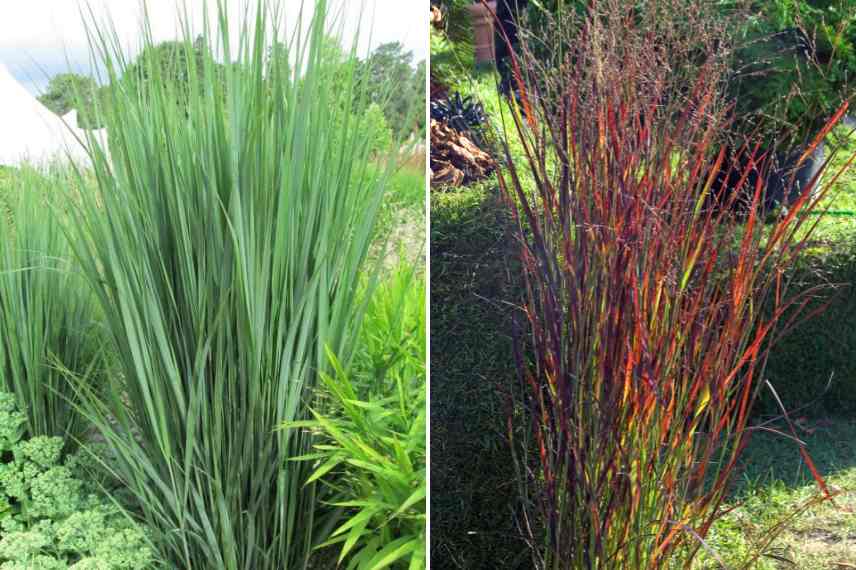
Panicum ‘Northwind’ and on the right the cultivar ‘Heiliger Hain’
Depending on the use
Bringing much-needed verticality to borders, Panicums are generally used primarily in large borders, even in naturalistic meadow areas and grass gardens. They are truly one of the most adaptable grasses:
- They look particularly beautiful in a Winter garden, where the persistence of plants and colour is prioritised: choose the tallest, most structural varieties;
- Of course, they thrive in mixed borders, reaching their peak in autumn alongside tall Asters, Echinaceas, Sedums, and beautifully coloured shrubs like Cotinus: all varieties of Panicum virgatum are suitable depending on their placement within the border;
- Panicums are also stunning in coastal gardens, where they prove to be the perfect grass, requiring no maintenance, tolerating salt spray and sandy soils, as well as dry gardens, gravel gardens, and waterless gardens;
- The contemporary garden appreciates Panicums for their strict, vertical appearance. Paired with a tall perennial like Veronicastrum, they create an effective and understated duo: choose from the narrowest varieties;
- Panicum is also useful for creating a grass hedge or for edging a path. It acts like some other grasses as a windbreak: the tallest or medium-sized Panicums will be effective;
- Their deep root system is remarkably effective when planted on slopes, thus stabilising the soil;
- Finally, it is easy to consider planting a Panicum in a pot on a very sunny terrace or in a city garden. In a pot, just ensure to divide and repot it when it starts to spread too much: favour the smaller Panicums.
→ Discover the Plume garden with Alexandra!
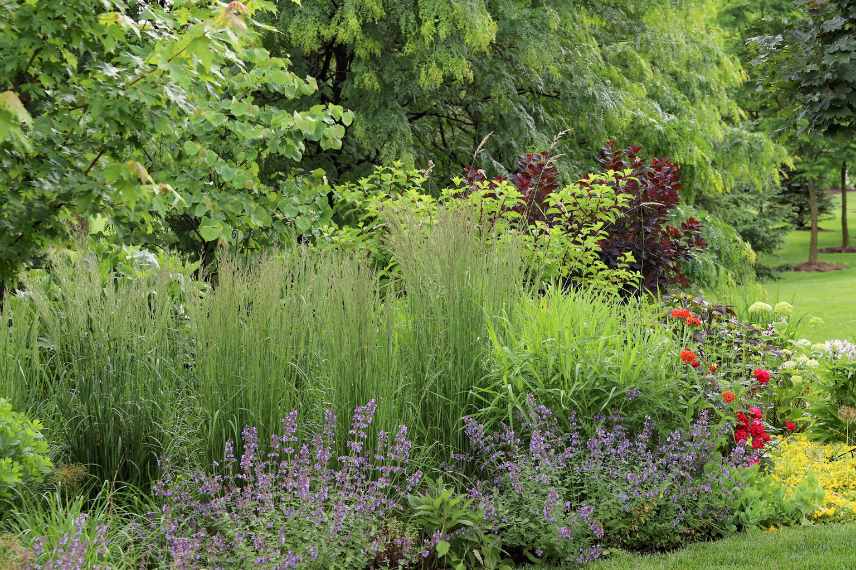 Planted in the middle or back of borders, Panicums provide volume, verticality, and lightness</caption]
According to the soil
Equally at home in well-drained, poor, or even stony soils as in cooler, fertile soils, including clayey lands (its origins see it growing in the wet meadows of central America), Panicum is the ideal candidate for all gardens! It also tolerates saline and sandy coastal soils. The key is always to plant it in sufficiently draining soil.
The drier the soil, the more vibrant colours Panicum will display in autumn. In richer, cooler soil, it may tend to spread more and become invasive. Once well established (it does require watering at the beginning of planting, with follow-up for several months, and is more receptive to autumn planting), Panicum virgatum performs very well, withstanding periods of drought. Do remember to mulch around its base to maintain a certain level of moisture.
Finally, it is worth noting that, like Miscanthus, the pH (acidity or alkalinity) of the soil has no impact on its development, although calcareous soils are more favourable to it.
- Subscribe!
- Contents
Comments