





























Choosing a Pseudopanax
For the garden or the terrace
Contents
Pseudopanax is a little-known shrub, native to New Zealand, with 7 quite different species. The most original and surprising is the Pseudopanax ferox, a true exotic plant with an appearance so unfamiliar to us. It forms a small skeletal tree with strange and graphic foliage. Endangered in its natural habitat, it is a plant that has survived from ancient forests. Other Pseudopanax are aesthetically closer to their family, the Araliaceae, and form lush bushes with exotic and ornamental foliage.
Discover this graphic plant, this very original plant, and how to choose among its different varieties.
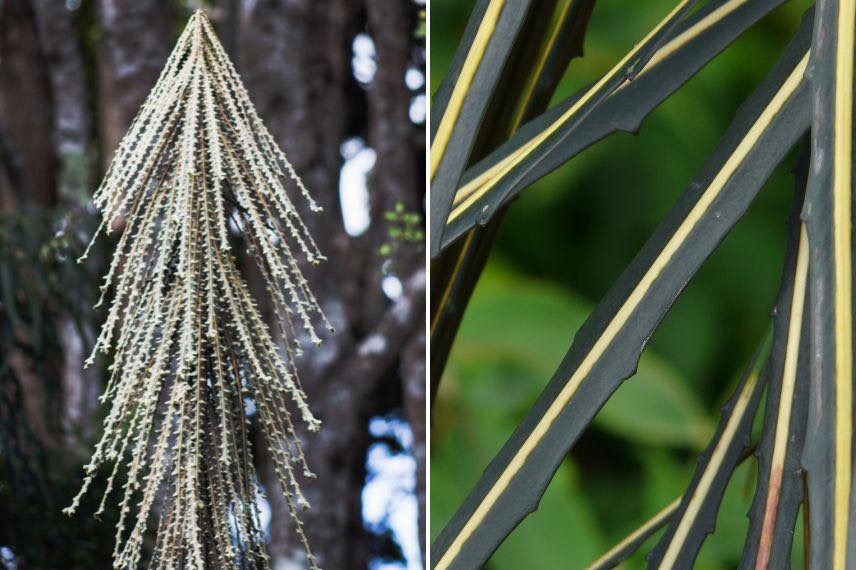
Pseudopanax ferox and detail of the foliage of Pseudopanax crassifolius

According to its height
Pseudopanax ferox is the tallest of all, resembling a small tree, reaching up to 8 m in height at ripeness. Its growth is quite rapid, but it retains its juvenile appearance for a long time. Its slender, straight trunk eventually becomes ramified in adulthood, though it does not exceed 1.5 m in spread.
Pseudopanax crassifolius can reach 5 to 6 m in height at ripeness. Close to Pseudopanax ferox, its crown also does not exceed 1.5 m in spread once mature.
Pseudopanax laetus and the varieties derived from Pseudopanax lessonii, hybridised with P. crassifolius, develop a bushy habit and do not exceed 3 m in all directions. Named ‘Bronze Eagle’, ‘Goldfinger’, ‘Goldspash’, ‘Dark Star’, and ‘Gecko Gold’, they form upright, ramified bushes, often reaching 2.5 m in height with a spread of 1.75 m to 2 m.
According to the colour and shape of the leaves
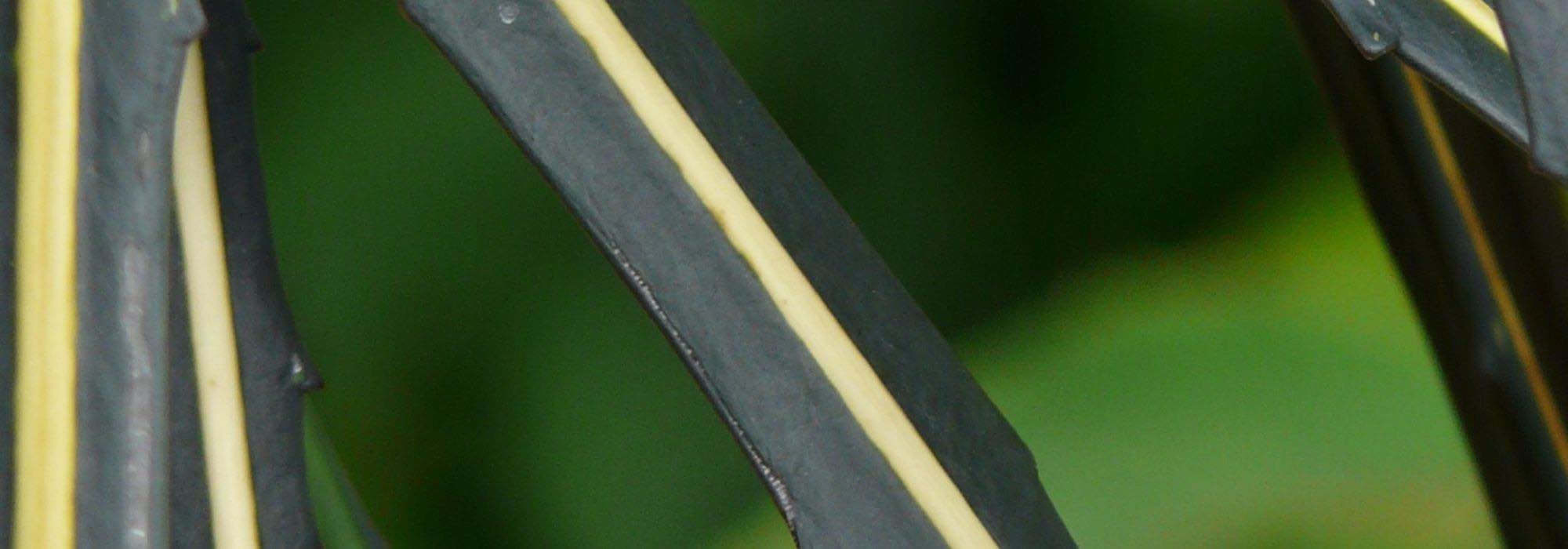
Pseudopanax have a persistent foliage with an exotic appearance, highly ornamental or very original; in any case, remarkable. Both Pseudopanax ferox and Pseudopanax crassifolius have spectacular foliage that changes in appearance as the plant ages. In the juvenile stage, the leaves are long and narrow, drooping downwards, linear, rigid, and dentate on both sides, resembling a saw. They are 45 cm long and inclined at an angle of less than 45°. Over time, the bush becomes bare at the base of the trunk. As it matures, it branches out and the leaves widen, forming a spreading crown at the top of the trunk. They then become shorter, broader, rounded, and have smooth edges. Mature leaves measure 15 cm long and are lanceolate in shape. They are grey-green tinged with bronze-brown, with a lighter central vein. When fully grown, they are dark green.
In other Pseudopanax, the leaves are more akin to their family, the Araliaceae. The Pseudopanax laetus has palmate leaves with a lush appearance. They are divided into 5 to 7 leaflets, thick and leathery, long oval and pointed, coarsely dentate along the edges, measuring up to 30 cm long. They are borne on red petioles and are glossy green.
The leaves of varieties derived from Pseudopanax lessonii exhibit quite different appearances and are very ornamental.
- In the variegated variety ‘Gecko Gold‘, they are palmate, divided into 5 oval and pointed leaflets, slightly dentate along the edges, randomly margined with dark green and splashed and striped with soft green on a yellow background.
- The leaves of ‘Goldspash’ are splashed with light yellow and striped with golden yellow on a green background, with narrower and elongated leaflets.
- ‘Goldfinger’ has leaves divided into 5 very narrow and elongated leaflets, slightly dentate along the edges: golden fingers as its name suggests. They transition from spring golden yellow to dark green in summer and winter.
- In ‘Dark Star’, the leaves are divided into 3 narrow and elongated, leathery leaflets. They are green and margined with bronze, then turn to a purplish-black, with a lighter central vein.
- The leaves of ‘Bronze Eagle’ somewhat resemble those of Pseudopanax ferox. They are divided into 3 very narrow and elongated leaflets, linear, with a thick and rigid texture, dentate on both sides. They are a very dark, metallic bronze, surrounding a light green central vein.
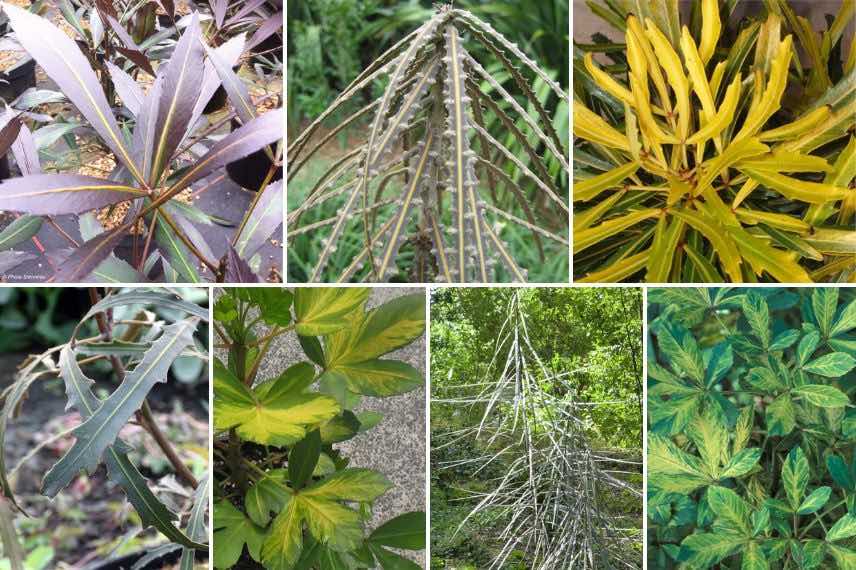
Clockwise: Pseudopanax ‘Dark Star’, Pseudopanax ferox, Pseudopanax ‘Goldfinger’, Pseudopanax ‘Gecko Gold’, Pseudopanax crassifolius, Pseudopanax ‘Goldsplash’, Pseudopanax ‘Bronze Eagle’
According to its habit
Pseudopanax develop two types of habit:
- A very upright, straight habit, resembling a tree with a single trunk, particularly narrow in relation to its height in Pseudopanax ferox and Pseudopanax crassifolius. Their small span makes them very narrow subjects, with foliage directed downwards, enhancing this skeletal appearance, creating a striking and unusual vision.
- In contrast, other species and varieties of Pseudopanax form bushy shrubs, which are upright but not very tall and almost as wide. They are therefore ramified and rounded subjects.
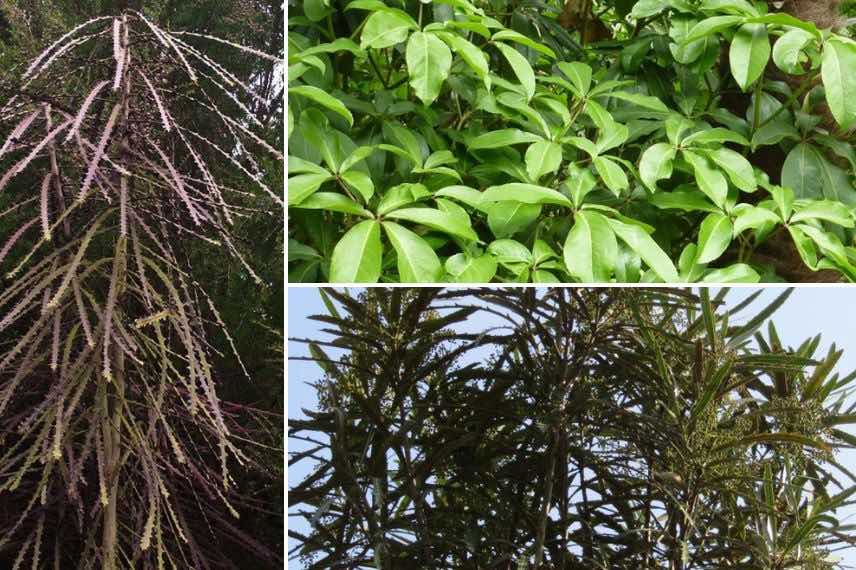
The very narrow habit of Pseudopanax ferox, the bushy habit of Pseudopanax laetus, the crown of Pseudopanax crassifolius
Read also
How to design a tropical garden?Depending on the use
Pseudopanax is a beautiful exotic outdoor plant, but it is tender and prefers mild, humid climates. You can install it:
- In a pot: in many regions, Pseudopanax will be planted in a pot due to its low hardiness. This is also a way to create a substrate that suits it rather than using poorly adapted soil. Indeed, it is a bush of acidic, light, and well-draining soil. It fears limestone and winter moisture in poorly drained soil. It grows well in pots. However, it appreciates humid atmospheres. Don’t hesitate to surround it with other plants to encourage this.
- In a greenhouse: for all these reasons, if you are lucky enough to have a greenhouse, it will thrive all year round in a temperate greenhouse.
- In a modern and graphic garden: Pseudopanax ferox is a trendy plant, a perfect graphic subject in a contemporary garden, a collection specimen that deserves a prime spot.
- In an exotic and lush garden in partial shade: Pseudopanax from lessonii boasts lush foliage that looks stunning with exuberant plants, large ferns, and bamboos.
→ Read our article: Growing Pseudopanax in pots.
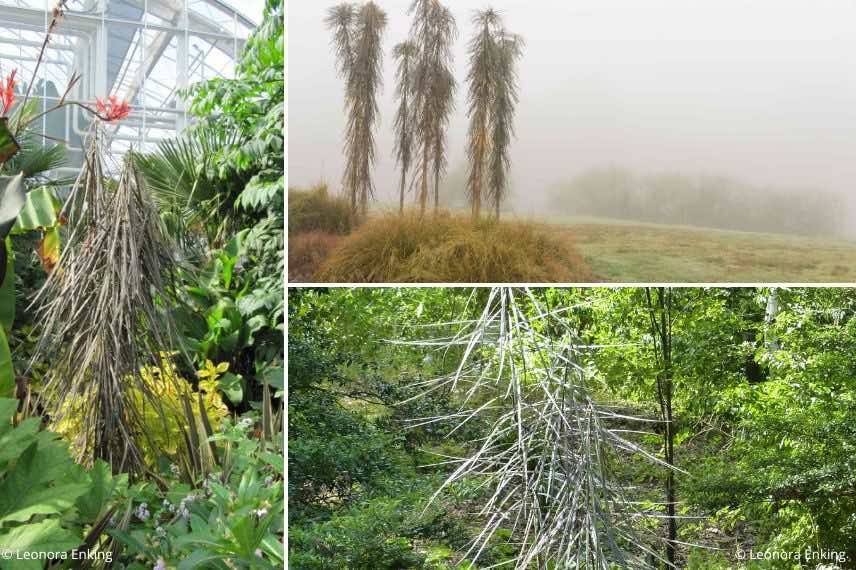
Pseudopanax in greenhouse, Pseudopanax landscape in groups, and Pseudopanax crassifolius in undergrowth
- Subscribe!
- Contents

Comments