


Choosing Oxalis
Our buying guide to find the right variety
Contents
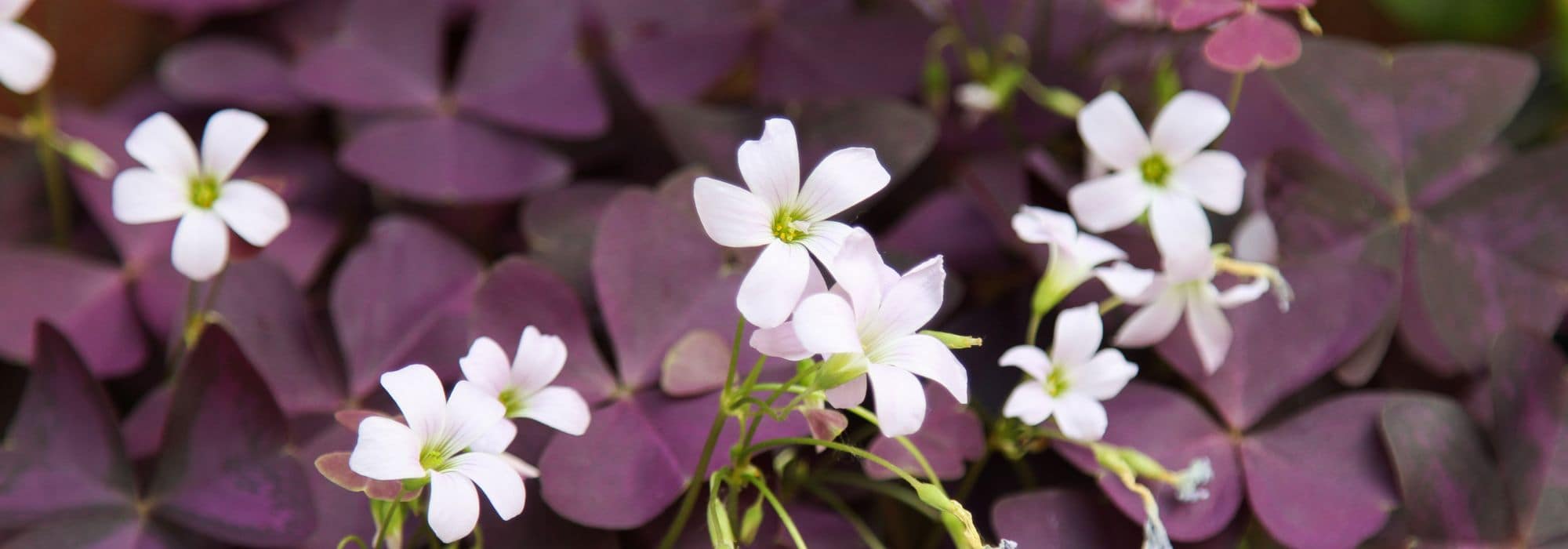
The Oxalis is a small perennial groundcover, highly valued for its attractive foliage resembling that of clover. Its beautiful, unique leaves come in green or purple tones, adding a graphic touch to a garden or terrace. It is also appreciated for its lovely small star-shaped flowers, which can be white, yellow, pink, or red. Easy to grow but somewhat frost-sensitive, Oxalis is perfect as a groundcover in regions with a mild climate or in pots to decorate a terrace elsewhere. Discover our guide to help you choose the right variety of Oxalis, based on your desires and needs!

according to its height
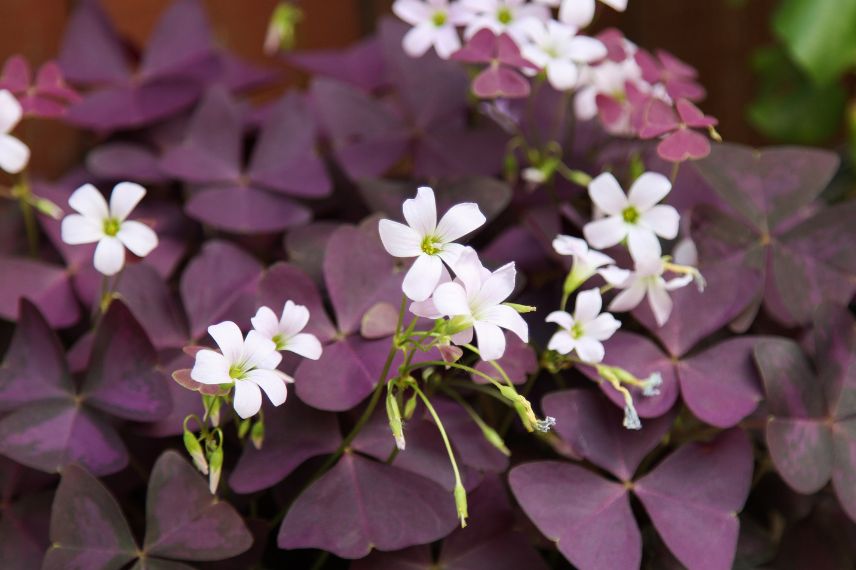
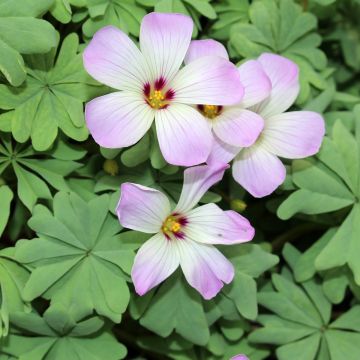
Oxalis, also known as false clovers, are perennial plants that are often creeping. They are primarily used as groundcover, in rockeries, or in pots. Depending on the varieties, they generally measure between 10 and 30 cm in height, but can reach 40 or even 50 cm in the case of Oxalis hirta ‘Gothenburg’. This South African cultivar, still relatively unknown, features a unique, finely cut, dense, and villous foliage, which is rare among oxalis. It is also admired for its small flowers that are pink lilac with a pale yellow centre.
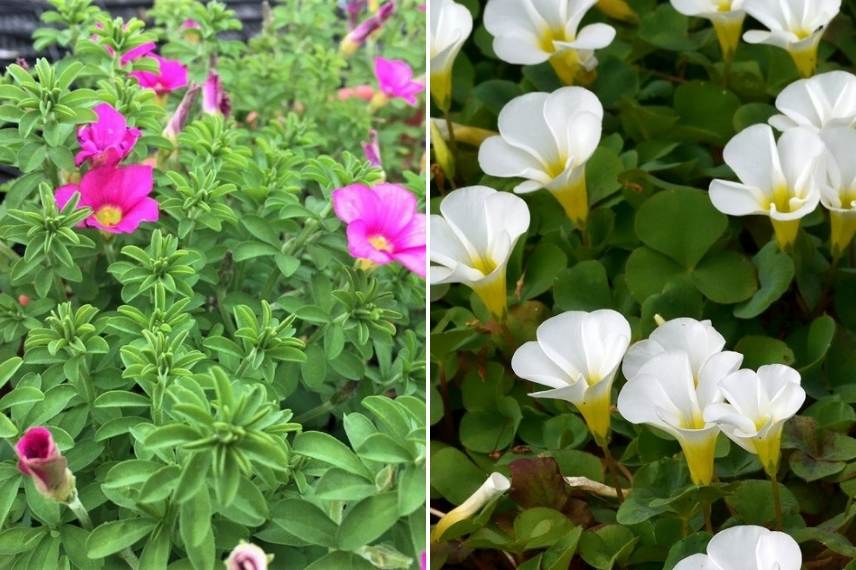
Among the smaller varieties of Oxalis, we appreciate Oxalis obtusa for its lovely pale green foliage, and Oxalis purpurea ‘Garnet’ for its purple colour. Not to forget Oxalis purpurea ‘Alba’ for its small leaves that closely resemble those of clover, but with white flowers that have a yellow centre and a funnel shape.
according to the colour and shape of the flowers
On appreciates Oxalis for their very long flowering period, ranging from pure white to bright pink, including yellow and pale mauve.
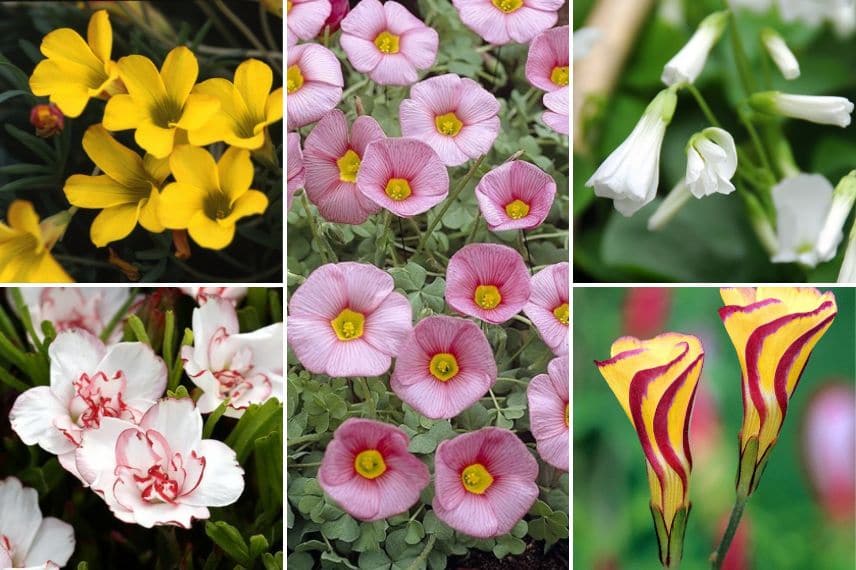
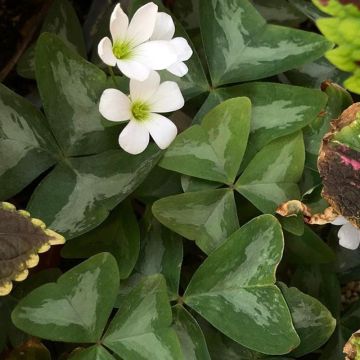
Among the wisest, we find Oxalis triangularis ‘Marmer’ with its delicate little white funnel-shaped flowers. Just as discreet, Oxalis triangularis subsp. papilionacea offers young pale pink flowers that turn white at ripeness. The Oxalis purpurea ‘Alba’ will dare a bit of eccentricity by revealing a dazzling golden yellow centre. The Oxalis ‘Double Pink Wonder’ will compete with its double white flowers edged in red.
To bring sunshine to the garden, one should favour yellow-flowering Oxalis, such as the cultivar ‘Ken Aslet’ and the variety ‘Double Trouble’ for its double flowers.
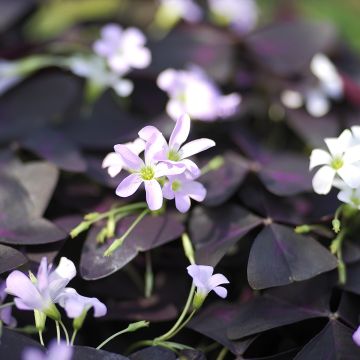
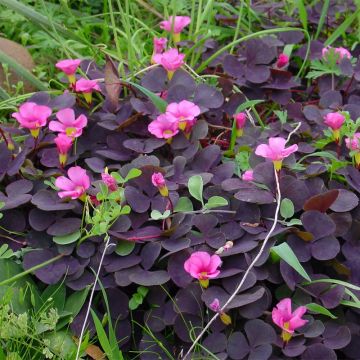
If you appreciate colour, Oxalis obtusa will reveal a golden yellow centre at the heart of its salmon-pink veined petals. To play the tone-on-tone card, Oxalis purpurea ‘Garnet’ will offer a lovely contrast with its bright pink flowers and yellow centre on a cushion of chocolate-purple leaves.
Not to forget the exuberant Oxalis versicolor and O. versicolor ‘Golden Cape’ for their striped flowers of cherry pink like astonishing little candy canes.
Discover other Oxalis
View all →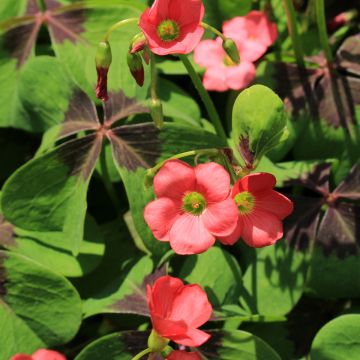
Available in 1 sizes
Available in 1 sizes
Available in 1 sizes
Available in 0 sizes
Available in 1 sizes
Available in 1 sizes
Available in 1 sizes
Available in 1 sizes
Available in 1 sizes
Available in 1 sizes
according to the colour and shape of the foliage
The leaves of Oxalis are generally composed of 3 to 4 heart-shaped leaflets, as seen in Oxalis ‘Double Trouble’, or triangular in shape like in Oxalis triangularis ‘Marmer’. When it has 4 leaflets, the foliage closely resembles that of a four-leaf clover. This is indeed the case for Oxalis deppei, commonly known as “giant clover,” “false clover,” or “lucky plant.” However, oxalis does not belong to the same family as clover. As for Oxalis adenophylla, it stands out for its numerous blue-green silvery leaflets.
The leaves of oxalis are often broad, but can also be narrow and very fine in Oxalis versicolor.
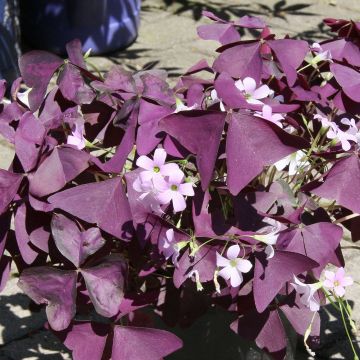
The foliage can be light green, but also silvery as seen in Oxalis obtusa or purple in Oxalis triangularis. Oxalis deppei is also appreciated for its broad green foliage with a brown centre, providing a lovely visual contrast.
Did you know that some oxalis are sensitive to light? Indeed, most have foliage that moves following the sun’s curve. Another peculiarity: the leaves fold in on themselves in the evening or when the sky is dark during the day. This characteristic can be found in Oxalis triangularis subsp. papilionacea, for example.
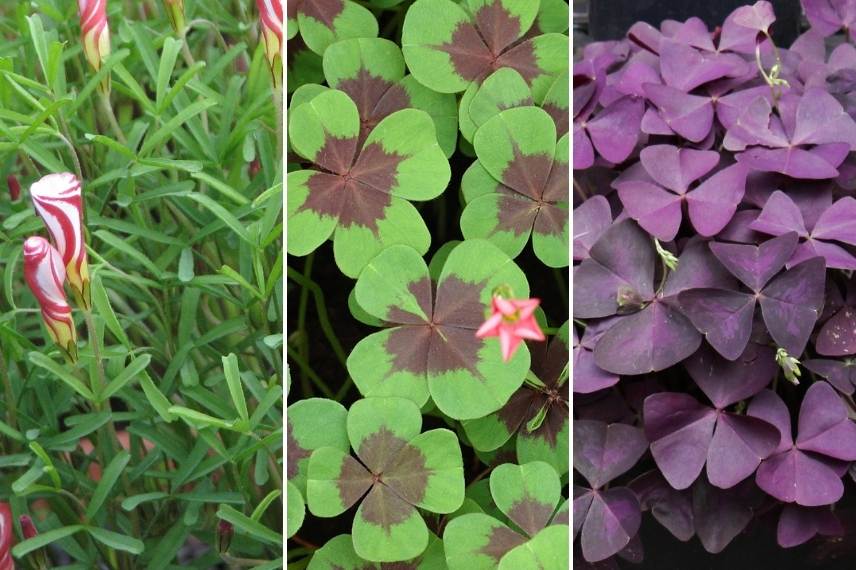
The fine foliage of Oxalis versicolor, bicoloured and resembling clover in Oxalis deppei or purple in Oxalis triangularis
Read also
5 Agapanthus to grow in potsaccording to its hardiness
Hardiness will be a key criterion for choosing your Oxalis based on their use. Indeed, some varieties, such as Oxalis triangularis, are not hardy and fear temperatures below 0 °C. Frost-sensitive varieties will therefore need to be sheltered for the winter. Moreover, these can be grown as indoor plants all year round to beautify a home or apartment.
For garden planting, favour varieties that are more resistant to frost. Oxalis purpurea ‘Alba’, ‘Ken Aslet’, or ‘Garnet’ will acclimatise perfectly to Mediterranean gardens, as well as to regions with mild winters down to -10 °C. In other regions, the choice may lean towards Oxalis deppei or Oxalis adenophylla, native to the Andes mountains and hardy down to -18 °C.
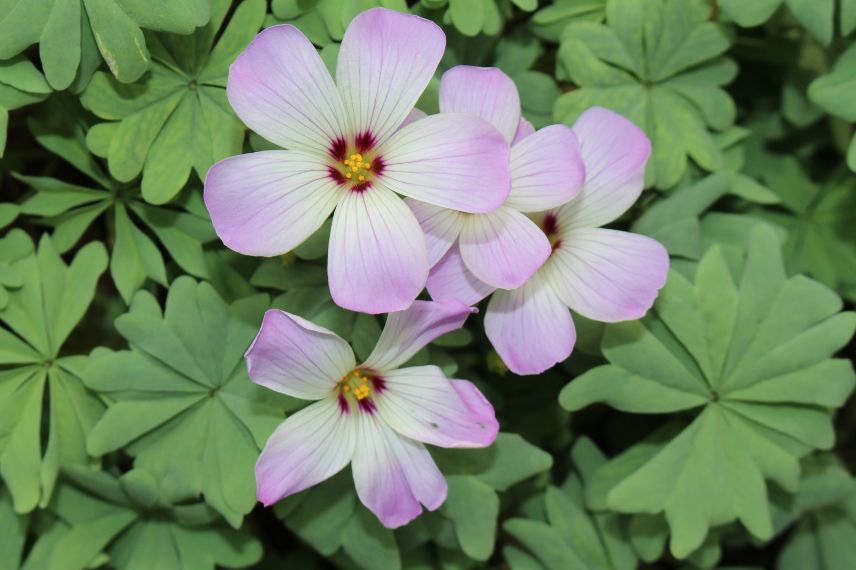
Oxalis adenophylla is one of the most frost-resistant varieties
according to its exposure
Most oxalis thrive in a well-lit position to achieve abundant flowering. However, some varieties tolerate partial shade very well, such as Oxalis triangularis subsp. papilionacea, as well as the varieties ‘Atropurpurea’ and ‘Fanny’. The Oxalis triangularis prefers a bright position, in partial shade, but without direct sunlight, to achieve beautiful, rich hues.
It is worth noting that the flowers of oxalis are sensitive to light. Indeed, they open fully in the sun and then close at night or when the sky is very cloudy.
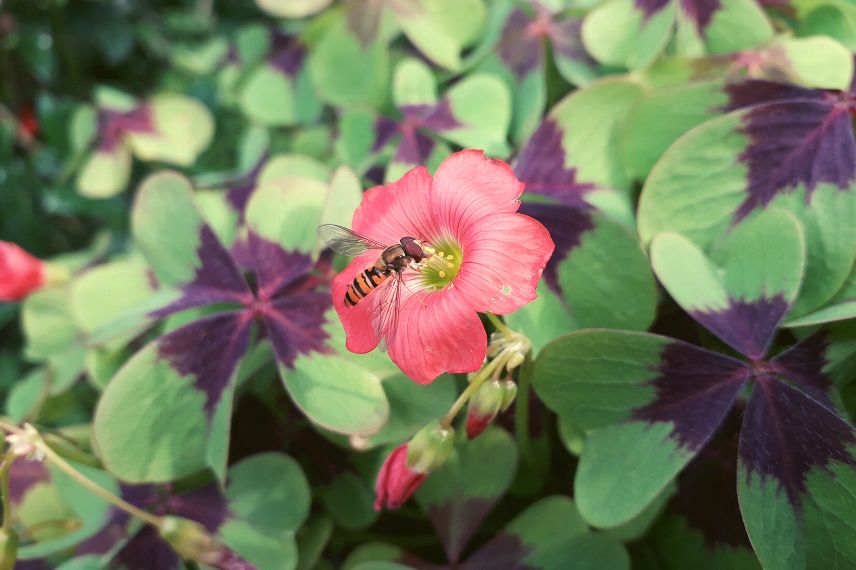
The Oxalis deppei, also known as “false clover”
according to its flowering period
Oxalis are appreciated for their long flowering period. Most varieties bloom from spring, around May and continue until autumn. Among the earliest, you’ll find the dazzling Oxalis ‘Double Trouble’, which kicks off the beautiful season as early as April with its golden yellow flowers.
The Oxalis versicolor and varieties derived from Oxalis purpurea (‘Garnet’, ‘Alba’, or ‘Ken Aslet’) have an inverted cycle and bloom in the heart of winter, from October to March, adding a splash of colour to Mediterranean gardens or pots. Their deciduous foliage then disappears during the summer season.
The Oxalis hirta ‘Gothenburg’ prefers to rest underground from May until the end of summer. In September and until November, its deciduous foliage reappears, followed by its beautiful lilac-pink flowers with yellow centres.
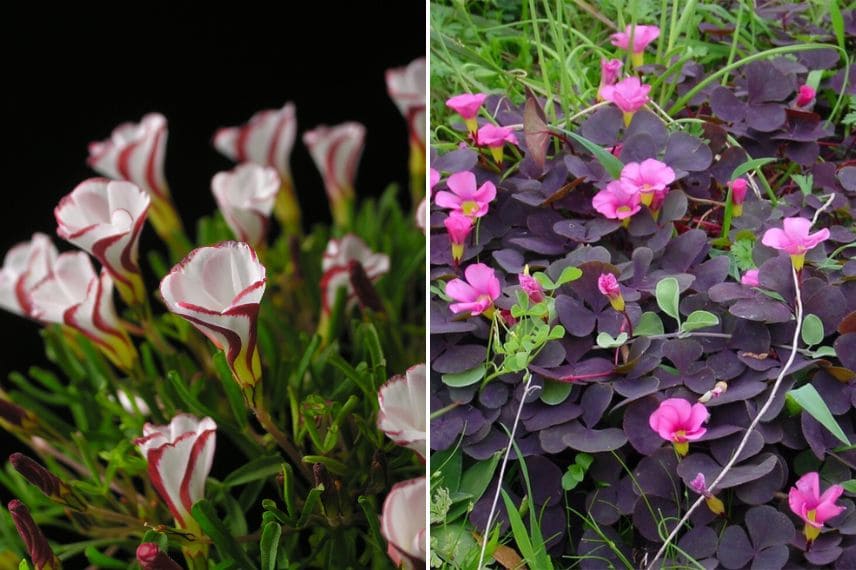
The Oxalis versicolor and Oxalis purpurea ‘Garnet’ have a long winter flowering period
according to its use
Often sensitive to cold, Oxalis are easy to grow indoors all year round and add a graphic touch to our interiors. However, in the garden, it’s a different story, and hardiness must be taken into account.
For a garden by the Mediterranean, most varieties suited to a warm climate can be planted in the ground, such as Oxalis purpurea ‘Alba’ or ‘Garnet’ for its beautiful purple foliage. They will be perfect for enhancing a flowerbed, border, or rockery.
Smaller varieties like Oxalis purpurea ‘Ken Aslet’ will also thrive on a wall and can even colonise the gaps between stones.
In other regions, but still in well-drained soil, it is advisable to choose varieties that are frost-resistant, such as Oxalis deppei or Oxalis adenophylla, which can tolerate temperatures down to -18 °C.
With its lovely graphic silhouette and clover-like appearance, Oxalis is perfect for decorating a pot, container, or window box. Note that potted plants will need to be kept sheltered from the cold during winter but will thrive in a bright room of the house or in a conservatory while waiting for spring to return.
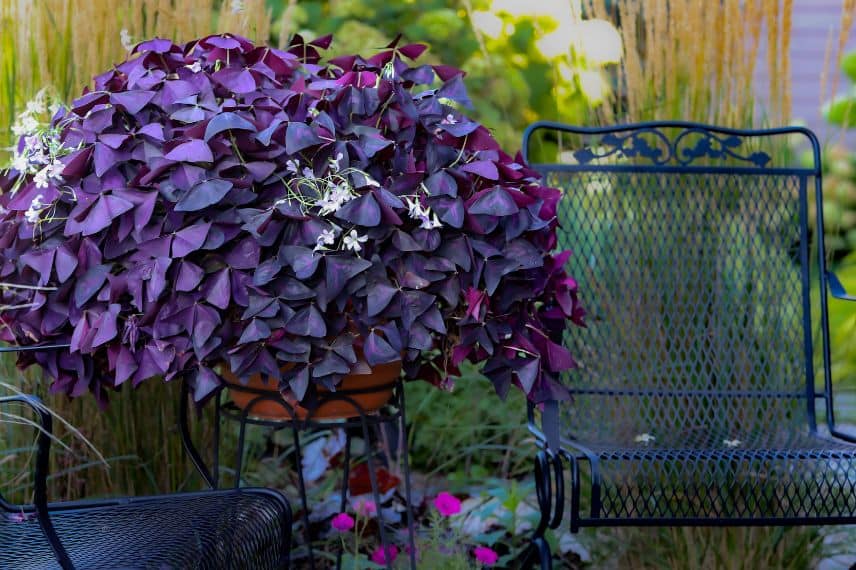
The Oxalis triangularis in a pot on a terrace
For further reading
- Discover our range of Oxalis
- To learn everything, discover our complete sheet on Oxalis: planting, growing and caring for
- Subscribe!
- Contents
![[plant id="oxalis" common_name="Wood Sorrel"]](https://en.promessedefleurs.eu/blogwp/wp-content/uploads/2022/06/Choisir-des-oxalis.jpg "Choose {glossary} Oxalis")
Comments