





























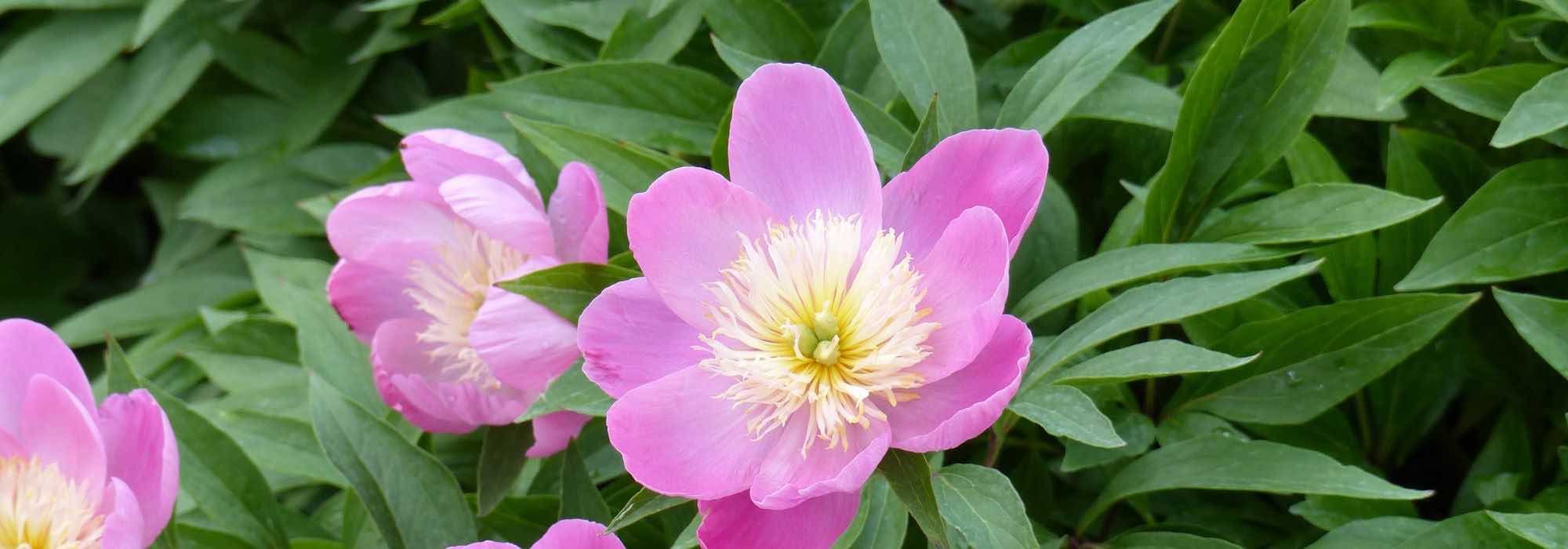
Choosing the Right Peonies
The main criteria for choosing among the many varieties of peony
Contents
A truly beautiful plant that elicits gasps of wonder when in bloom, the peony flower is easily recognisable, even to novices in botany. The peony or Paeonia often takes a few years to flower, but it boasts great longevity, estimated at around fifty years and sometimes up to 100 years. A precious plant of significant ornamental value, it encourages collection. A majestic plant with refined foliage and flowers, it deserves a place in any type of garden if its growing conditions can be met. There are different forms of peonies that influence their behaviour and shape, offering a wide diversity in flower appearance and colour. Some are generous in petals while others display simple, spreading cup-shaped flowers; some are highly fragrant while others are not at all, and some enjoy a bit of shade while others bask in the sun.
Discover the different forms of peonies and the criteria to consider when choosing from the hundred varieties listed in the Promesse de Fleurs catalogue.

Shrubby or herbaceous?
The first essential question when considering acquiring a peony is whether to choose a bush peony or a herbaceous peony.
The bush peony gradually forms a fairly large shrub, with deciduous foliage, reaching heights of 1 to 2 m. Its habit is spreading, sometimes sprawling, with a stout and well-ramified silhouette. Its flowers are large, semi-double to double, even globular (forming a sphere of tightly packed petals), with golden stamens. They measure between 15 and 30 cm in diameter. Bush species are often derived from the species Paeonia suffruticosa, as well as from the species delavayi, lutea, x lemoinei, ostii. It grows slowly but offers a beautiful display after a few years, presenting a majestic shrub with light, finely cut foliage, punctuated by large and beautiful flowers. It is somewhat more delicate to grow than the herbaceous peony.
The herbaceous peony is the most well-known and widely used. It behaves like a deciduous perennial: its herbaceous stems emerge from the ground in spring and disappear the following winter before re-emerging in the spring of the following year. Although it completely disappears each winter, its clump generously thickens year after year. Moreover, only a few weeks pass between the emergence of the first stems and the time it provides its foliage and flowers. Its flowers bloom in May-June, with diameters ranging from 7 to 20 cm. Most cultivars are derived from Paeonia lactiflora. Once it has the right conditions for location and cultivation, it is easy to care for.

The stems of the herbaceous peony emerge from the ground in spring
There is a third category: the Itoh peony, also known as intersectional. It is a hybrid between the herbaceous peony and the bush peony. It is characterised by great robustness and traits from both of its origins. Its behaviour is that of a herbaceous peony, with stiffer stems, and it borrows its substantial flowers from the bush peony. The flowering period is more extended, the beauty of the foliage is maintained throughout the season, and some varieties display unique hues.
Let’s also mention the botanical peonies, whether herbaceous or bush, the ancestors of today’s peonies. They feature simple flowers with prominent bright yellow stamens. They are robust, with a shorter and often earlier flowering duration.
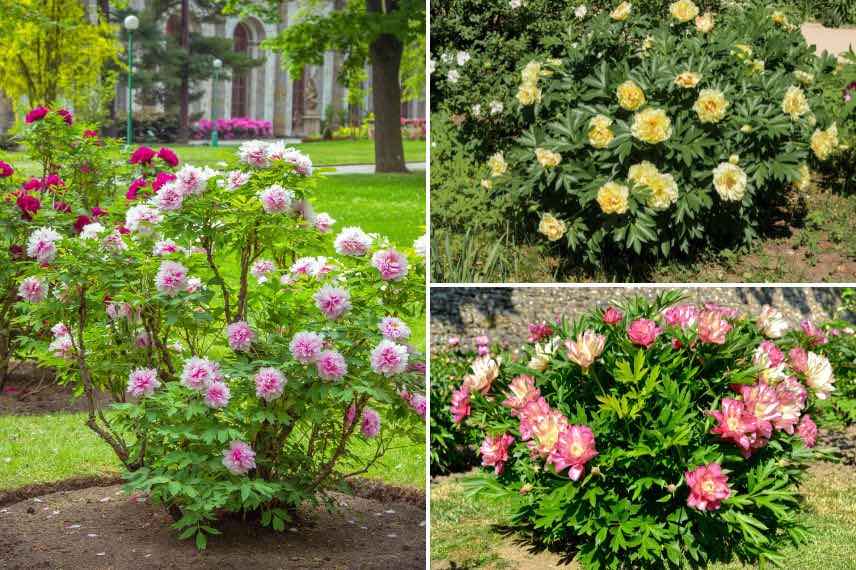
The different forms of peonies: on the left, bush peony or Paeonia suffruticosa, then top right, Itoh peony, and bottom, herbaceous peony or Paeonia lactiflora
The different shapes and colours of flowers
In terms of flower shape, let’s highlight their generosity! The more peonies flourish, the more floriferous they become, and you may need to use stakes to support the weight of these large flowers with their numerous petals! Itoh peonies have sturdier stems.
Peony flowers can be classified into several categories, sometimes with blurred boundaries.
Herbaceous Peonies
We distinguish between Japanese peonies with single flowers and Chinese peonies with double flowers.
- Japanese peonies with single flowers have a graphic, graceful, and delicate appearance. The flower is an open cup measuring 15 to 20 cm in diameter, composed of a corolla of petals surrounding a double heart of stamens transformed into small petals. They are often bicoloured, in shades of white, red, pink, or nearly purple and yellow.
- Chinese peonies have semi-double or double flowers (and occasionally single ones too!), measuring up to 20 cm in diameter, in white, yellow, or all shades of pink to red or purple. It is among Chinese peonies that the most fragrant cultivars can be found.
Botanical Peonies
They most often have single flowers, in shades of red to pink or white, or pure yellow. They resemble large wild rose flowers with their numerous yellow stamens.
Shrub Peonies
They bear large single or double flowers, measuring 10 to 25 cm in diameter, in white, red, pink, orange, or purple. They are sometimes maculate with a purple colour at the centre.
Itoh Peonies
These develop large single or often double flowers, in shades of peach, cinnamon, apricot, salmon, or soft yellow, but also in more vibrant and classic shades of pink or red. They frequently have a darker macule, usually purple, at the centre.
→ Read also: How to choose a peony based on the shape of its flowers?
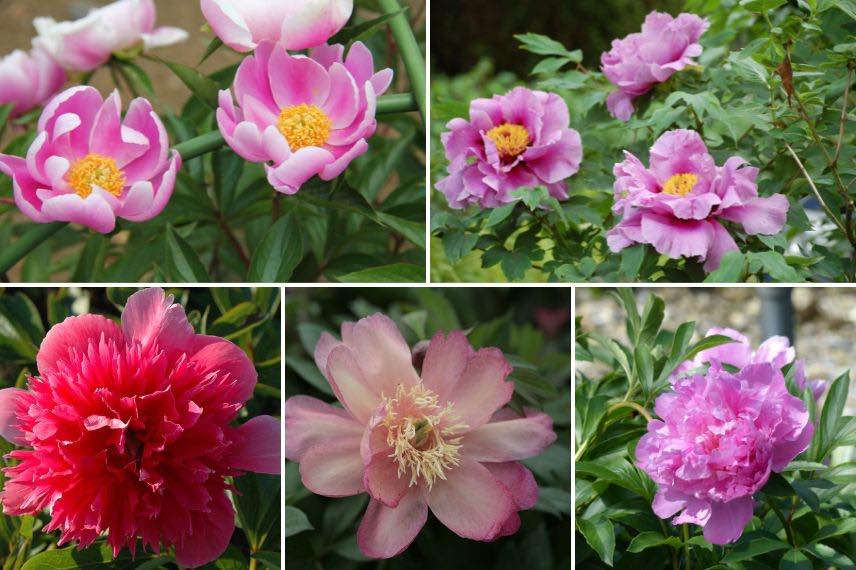
Some flower shapes. Clockwise: Japanese herbaceous peony or Paeonia lactiflora, shrub peony or Paeonia suffruticosa, Chinese herbaceous peony, Itoh peony, botanical peony
Discover other Medieval garden perennials
View all →
Available in 1 sizes
Available in 2 sizes
Available in 1 sizes
Available in 1 sizes
Available in 3 sizes
Available in 2 sizes
Available in 1 sizes
Available in 2 sizes
Available in 3 sizes
Available in 2 sizes
Some examples of varieties based on flower colour
To help you make a choice, here are some cultivars by flower colour, categorised by type, with details on the shape of the peony.
White Peonies
- Paeonia lactiflora ‘Immaculée’ with a large corolla of rounded petals, and a centre of frilled petals and red stigmas.
- Paeonia suffruticosa ‘White’ with semi-double, pearly pale pink flowers and pale yellow stamens.
- Itoh Peony ‘Cora Louise’ with semi-double flowers, white shaded with pale mauve pink and maculate with dark purple.
- Paeonia officinalis (botanical) ‘Alba Plena’ with double, globular flowers, tinged red at the opening, turning pink and then white at ripeness, with crumpled petals.
Pink Peonies
- Paeonia lactiflora ‘Pink Hawaiian Coral’, with large semi-double flowers, coral-tinged pink, fading to cream-white over time.
- Paeonia suffruticosa ‘Pink’, with double flowers, soft pink with a bright pink centre and yellow stamens.
- Itoh Peony ‘Pink Ardour’ with two rows of petals in a strong pink colour and yellow stamens.
- Paeonia mascula (botanical), rare in cultivation, with simple cup-shaped flowers, garance pink with yellow stamens.
Red Peonies
- Paeonia lactiflora ‘Peter Brand’, very double, with shiny cherry red petals.
- Paeonia suffruticosa ‘Wu Jin Yao Hui’, with semi-double flowers of a very dark, lustrous red.
- Itoh Peony ‘Scarlet Heaven’, with simple scarlet flowers and yellow stamens.
- Paeonia tenuifolia (botanical), rare, with fennel-like foliage and scarlet flowers.
Yellow Peonies
- Paeonia lactiflora ‘Clair de Lune’, with very beautiful pale yellow flowers and a large heart of golden stamens.
- Paeonia lutea ‘Alice Harding’, with semi-double light yellow flowers (shrub peony).
- Itoh Peony ‘Yellow Crown’, with semi-double bright yellow flowers and a heart of golden yellow stamens.
- Paeonia lutea (botanical shrub), wild form with simple sulphur yellow flowers.
Some Uncommon Shades of Itoh Peony
- Itoh Peony ‘Julia Rose’, in pink and apricot on a soft yellow background.
- Itoh Peony ‘Old Rose Dandy’ in pale lilac pink, shaded with purple and a copper heart.
- Itoh Peony ‘Callies Memory’ in cream yellow and peach, maculate with blood red.
The most fragrant
Flowers of certain herbaceous peonies are fragrant, either lightly or strongly, with hints of rose or lily of the valley. Double-flowered peonies are often more aromatic than single-flowered peonies, but there are many exceptions. Among the most fragrant varieties are:
Most Fragrant Herbaceous Peony Hybrids
- Paeonia lactiflora ‘White Cap’
- Paeonia lactiflora ‘Duchesse de Nemours’
- Paeonia lactiflora ‘Amabilis’
- Paeonia lactiflora ‘Big Ben’
- Paeonia lactiflora ‘Dr Alexander Fleming’
- Paeonia lactiflora ‘Edulis Superba’
- Paeonia lactiflora ‘Laura Dessert’
- Paeonia lactiflora ‘Marie Lemoine’
- Paeonia lactiflora ‘Françoise Ortegat’
- Paeonia lactiflora ‘Shirley Temple’
- The Paeonia lactiflora ‘Président Taft’ and ‘Top Brass’ are also quite fragrant.
Well-Fragrant Shrub Peonies
Some shrub peonies offer pleasantly fragrant flowers. Notable examples include:
- Paeonia x lutea ‘Hai Huang’
- Paeonia suffruticosa ‘Lu Mu Ying Yu’
- Paeonia (x) suffruticosa 09’Lu He Hong’

Paeonia lactiflora ‘Duchesse de Nemours’, Paeonia lactiflora ‘Edulis Superba’, Paeonia lutea ‘Hai Huang’, Paeonia lactiflora ‘Françoise Ortegat’, Paeonia suffruticosa ‘Lu Mu Ying Yu’
The flowering period
Few differences on this criterion; just know that shrub peonies bloom first, in April and May, while herbaceous peonies, which first had to emerge from the ground and start over, bloom around May and June. As a result, the beautiful flowers of shrub peonies are sometimes affected by late frosts.
Also, be aware that Itoh peonies have a longer flowering period than the other two: between mid-April and mid-June.
The flowering lasts about fifteen days for herbaceous peonies, but up to a month for intersectional peonies.
Each peony flower, once fully open, lasts 1 to 2 days.
Slightly different growing conditions
Golden rule for all peonies: they do not like to be moved. Furthermore, as they have a very long lifespan, it is essential to choose their location carefully.
If you have fairly clayey and heavy soil, this is the preferred ground for herbaceous peonies, provided you ensure adequate drainage. They also like it to be rich and moist to support their beautiful flowering. They appreciate a well-sunny position.
Shrub peonies prefer lighter soil, still rich and moist; they fear winter moisture in heavy soils. They enjoy a warm position, sheltered from cold winds, but the sun should not be too scorching, with 4 to 6 hours of good daily sunlight for optimal flowering. Therefore, depending on your region, they may prefer to be planted in partial shade.
Itoh peonies dislike waterlogged soils and appreciate partial shade. For the rest, they also require fresh, humus-bearing, well-drained, and deep soil.
Ports and Uses
Herbaceous peonies have a perennial habit, with botanical species reaching heights of 50/70 cm, while hybrids typically grow to 80 cm to 1 m, forming a balanced bushy clump with a similar spread.
Shrub peonies form well-ramified and stocky bushes, ranging from 1 to 2 m in height, with a spreading or even sprawling habit.
Uses of peonies:
- All peonies can be planted in perennial borders or colourful mixed borders.
- They are not suited for pot cultivation; their growth, needs, and longevity make them ideal for open ground.
- In fact, in open ground, choose a very durable location for them, free from strong competition and well-highlighted.
- Botanical peonies prefer a warm position and can be planted at the top of a rockery, even limestone.
- In isolation, you can plant a shrub peony or a botanical peony.
- At the edge, in partial shade, you can install an Itoh peony or a shrub peony.
- In a hedge, place a shrub peony or an Itoh peony.
- To create beautiful bouquets, you can incorporate your peony into a cut flower garden, a bouquet garden.

Herbaceous peony at the edge on the left and among tulip bulbs in spring when the first stems appear
- Subscribe!
- Contents
![[plant_selector title="Selecting your peonies" subtitle="Discover our wide range of {glossary}peonies{/glossary} and choose the perfect ones for your garden."]](https://en.promessedefleurs.eu/blogwp/wp-content/uploads/2023/02/Bien-choisir-les-pivoines.png "Choosing the Right Peonies")
Comments