


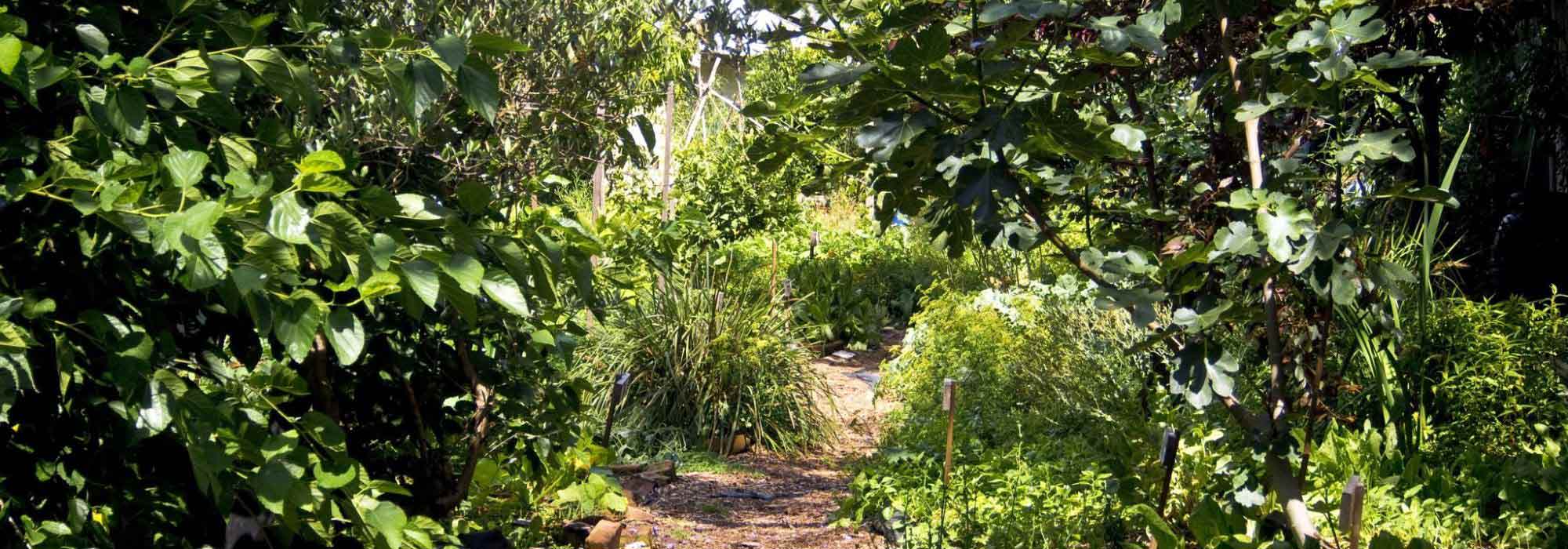
Create a forest garden without breaking the bank using bare roots
Permaculture within everyone's reach
Contents
Whatever its name: “forest garden”, “edible forest”, “nourishing forest” or even “orchard forest”, this permaculture concept draws inspiration from forest ecosystems and their edges to create nourishing gardens, formed of different strata like in a forest. This cultivation method thus increases the productivity of an area and results in a naturally intensive garden, as it is valued across different levels. However, establishing this type of garden, increasingly appealing in the face of climate upheavals where autonomy and resilience will be essential, requires numerous plantings and can therefore be costly.
The solution is to take advantage of the late season to plant bare root plants in autumn and winter, which are both more ecological and more economical. Discover how to create a nourishing garden in the form of a forest garden rich in biodiversity, at a low cost by choosing bare root plants.

What is a forest garden?
Everyone knows that there is no environment richer and more fertile than a forest: plants thrive at different strata and create a beneficial environment for all, where the tallest—trees and large bushes—shade the smaller ones and protect them from the harshness of the elements, where plants communicate with each other, and where preserved moisture and accumulated humus continuously enrich the soil.
In the concept of forest gardening or edible forest, we simply imitate what works well in nature; we plant the plants in different strata with the aim of obtaining varied harvests that require very little intervention:
- the tree stratum, composed of standard trees
- the bush stratum, containing the largest bushes
- the shrub stratum, which includes smaller bushes
- the herbaceous stratum, which consists of groundcover plants
In the forest garden, everything is edible or has a use for the community of plants created.
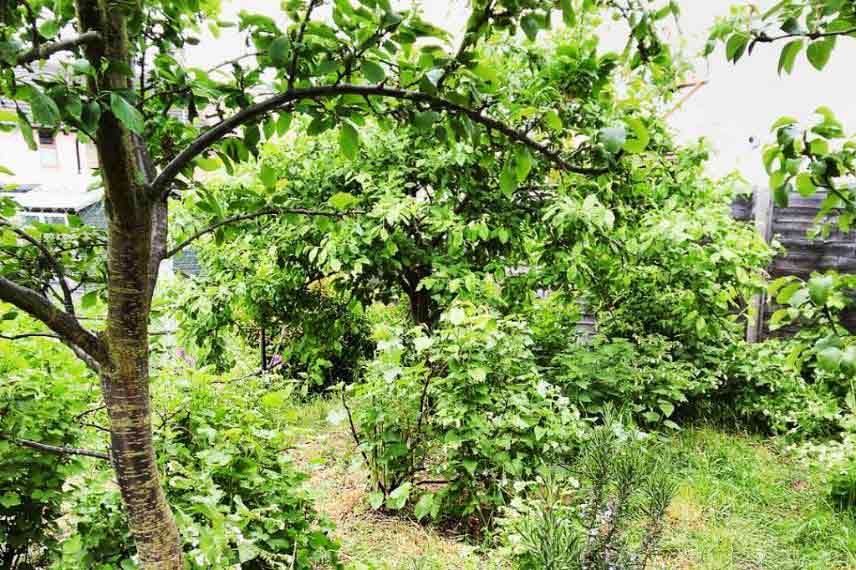
→ Our advice: Remember to diversify the varieties and respect the planting distances by determining the spread at ripeness of each tree and bush you install. This will give you an indication of the distance to maintain, which can be a bit closer than in a traditional orchard.
Read also
How to create a forest garden?When and how to plant bare root plants in a forest garden?
Plant in autumn or at the end of winter (from October-November to March), when deciduous plants are in a period of vegetative rest and sold as bare roots. Avoid planting during frost or snow periods and if the soil is saturated with water.
You can prepare the planting holes a few weeks in advance to aerate the soil.
Before planting, you should carry out the dressing of the plant (light pruning of the aerial part and roots to stimulate the growth of root hairs) and coating the roots (soaking in a mixture of clay soil and manure).
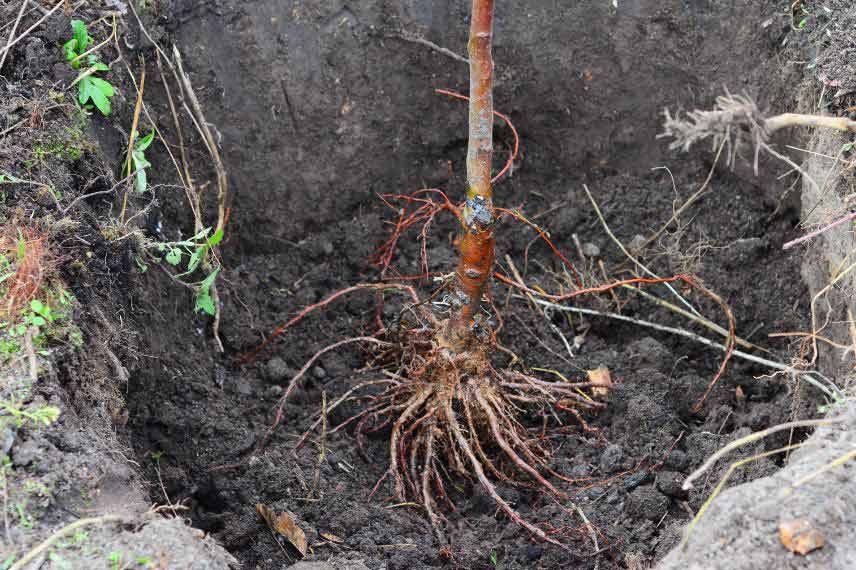
Trees and bushes with bare roots should be planted as soon as possible after receipt to avoid drying out of the roots in the open air. Otherwise, it is possible to heel in the plants before planting.
→ To assist you, find detailed information on the technique for planting trees and bushes in bare roots
The tree stratum of the garden forest
Shade-providing trees naturally protect the lower strata from prevailing winds and attenuate the severity of the elements (hail, frost, snow, heavy rains…). The decomposition of their leaves allows over the years the accumulation of a fertile humus for the entire garden created.
For interesting crops from a nutritional perspective, we favour fruit-bearing species in full sun, and if possible ancient and local varieties, which are more resilient and better adapted to the climate of each region. For this upper stratum, you can choose from all sorts of fruit trees suited to your region and soil:
- pear trees
- apple trees
- almond trees
- cherry trees
- plum trees
- fig trees
- Additionally, trees such as the Honey Locust (Gleditsia triacanthos), Italian Alder (Alnus cordata) or Judah Tree (Cercis) are interesting for their great ability to fix nitrogen in the soil and their melliferous flowers.
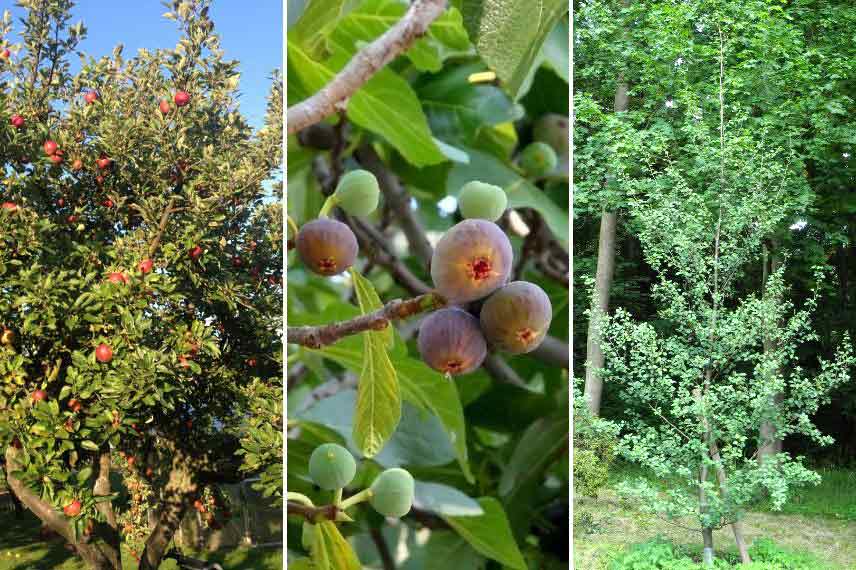 Apple trees, fig trees, and Italian Alders are among the trees to plant in an edible forest; as bare roots, they will be more economical to purchase.
Fruit trees in bare roots are generally offered:
- as whips (grafted plants of one or two years) measuring 90 cm to 1.20 m
- as half-stems: trees of at least 3 to 4 years of cultivation. They are grafted and pruned with generally 3 to 7 branches harmoniously distributed and a trunk measuring about 1.20 m in height
- or as high-stems: trees of at least 4 to 5 years of cultivation, grafted and pruned with generally 3 to 7 branches harmoniously distributed and a trunk measuring over 1.60 metres in height
By comparison, a ‘Monsieur Hâtif’ Plum in half-stem bare roots will cost more than twice less than the same variety in a pot of 7.5 to 10 litres. For some fruit trees offered as whips, you will need to be a bit more patient in the first years, but the robust bare root young plants, which establish more easily than container-grown subjects, will soon make up for the difference.
The bush stratum of the garden forest
This second stratum is adorned with bushes that thrive in partial shade:
-
- the serviceberry whose white spike flowers are followed by juicy, sweet berries
- the male dogwood (Cornus mas)
, whose red, edible fruits, ripening in autumn, can be eaten raw or made into jelly. To learn more, refer to our article: Growing the male dogwood for its fruits
- the Hazel
- the Sea buckthorn (Hippophae rhamnoides) with its pretty bright orange, tangy berries, very rich in vitamin C and with numerous medicinal properties, which can be consumed in jams, jellies, or syrups.
- the Ornamental apple tree (Malus ‘Golden Hornet’) whose miniature apples are highly appreciated by birds
- the Blackthorn (Prunus spinosa) well known for its black, edible fruits, the sloes
- the black elder (Sambucus nigra): its nectariferous, melliferous, and fragrant flowers are followed by black berries, edible when cooked and also much appreciated by birds
- the Autumn olive (Elaeagnus umbellata): its creamy flowering that perfumes the garden in May is followed by round fruits that are harvested in autumn. They are edible, tasty, and highly nutritious. It is also a nitrogen fixer, very suitable for poor soils.
Uprooted from nurseries where they are grown in open ground at the onset of dormancy (in October – November), these bushes have well-developed roots. This will promote their optimal rooting once planted in your edible garden. They will surely have a very good recovery and vigorous growth if their planting is done carefully. Purchased as bare roots, they will cost you between 2 and 4 times less than the same plants in containers of 2 or 3 litres.
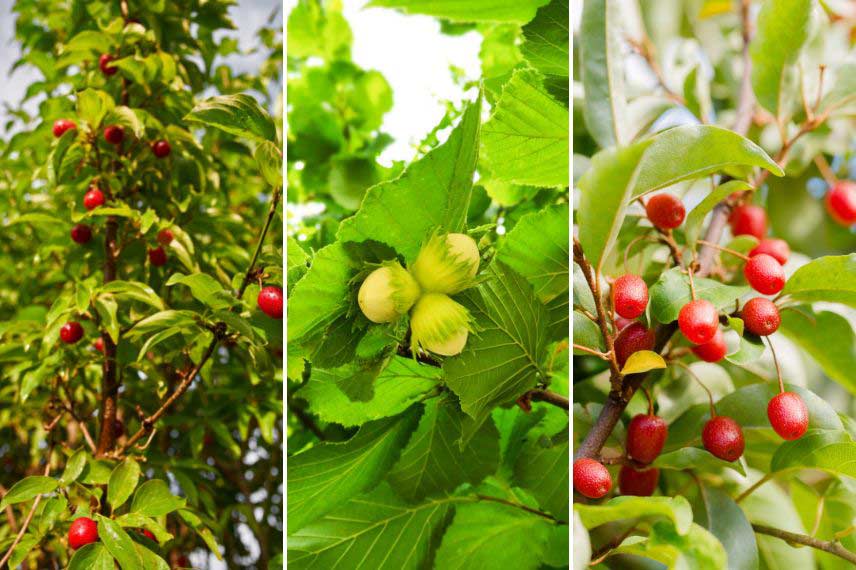 Among the bushes of the edible forest, you will find Cornus mas, hazel, and Elaeagnus umbellata</caption]
The shrub stratum of the forest garden
This stratum features shrubs with edible berries:
- the redcurrant bushes
- the gooseberry bush
- the blackcurrant bushes
- the raspberry plants
- the blackberry bushes
- the Mayberry (Lonicera caerulea ssp. kamtchatica): a variety of edible honeysuckle, producing elongated blue berries as early as May. They have a tart flavour reminiscent of blueberry and kiwi, and can be eaten fresh or made into jams, jellies, or juices.
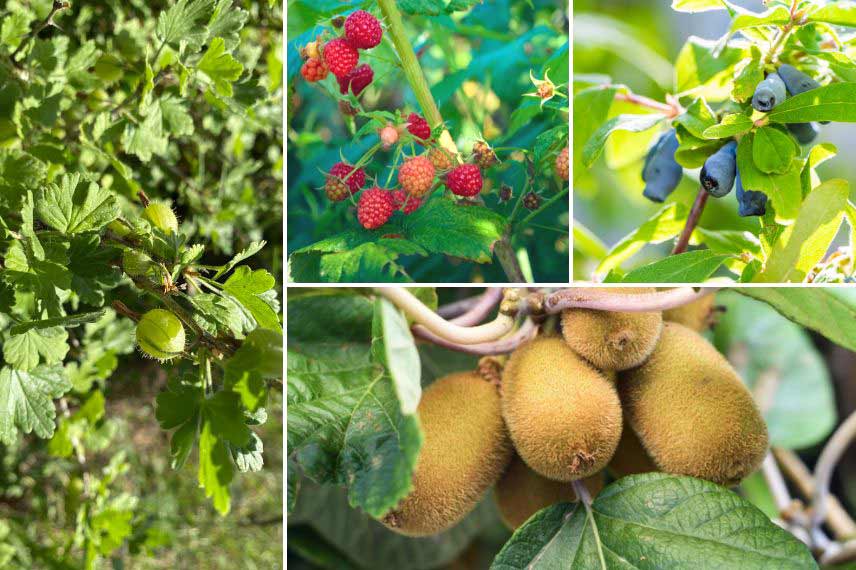
The gooseberry bushes, raspberry plants, and Mayberries should be planted under taller layers that will effectively protect them. They are easy to find as bare roots and will develop quickly when planted in this form. They can be paired with edible climbers like kiwis.
Planted as bare roots, these small fruit trees will be more economical than in containers and will benefit from an ideal planting in open ground. Their low price will allow you to diversify the varieties, as crop diversification is a guarantee of resilience for the garden against potential issues (diseases, pests, climate problems).
You can also add edible climbers (Kiwi, grapevines, Chayote…) that will climb on supports or ascend the trees.
The herbaceous stratum of the forest garden
Soil is never bare in an edible garden; not only is mulching and the accumulation of humus essential, but you can grow soft fruits and edible herbaceous plants. Among bare roots, we naturally think of strawberries, whether it be the famous wild strawberries or other varieties. The Capron Strawberry (Fragaria moschata) is a small wild strawberry particularly suited to cold climates and shaded areas.
Other edible plants will have a prime spot, such as herbs, to be placed according to their needs and the exposure of your forest garden, rhubarb or perennial vegetables (Daubenton Cabbage, tree onion or Rocambole garlic, perpetual leek, sorrel spinach, artichoke…). The well-known Wild Garlic (Allium ursinum), a perennial woodland garlic, will easily naturalise just like the Sweet Cicely (Myrrhis odorata). Edible flowering plants (Daylilies, Tulbaghias, Borage) will beautifully complement your food forest. In the same economic logic as with bare roots, you can find these plants in pots or as plug plants.
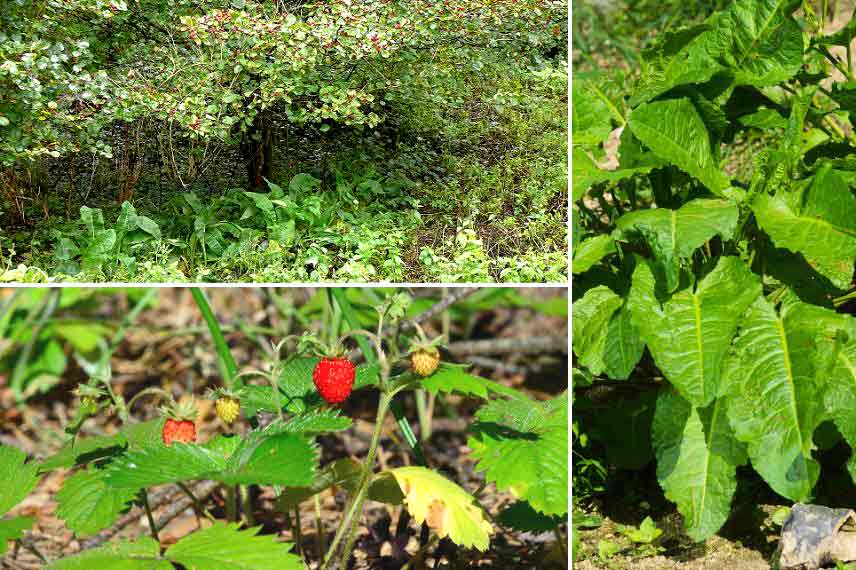
The lower stratum includes edible groundcover plants like strawberries, to be planted as bare roots. Sorrel spinach is among the edible plants to associate with them.
To find out more
- Discover the benefits of mycorrhiza on bare root plantings.

- Subscribe!
- Contents
Comments