






























Making a maze in the garden
How to design and integrate a maze at home?
Contents
The archetype of the French garden, the labyrinth, playful and mysterious, is typically found in large spaces. Many well-known gardens and parks have made the plant labyrinth their highlight. Sinuate and romantic, it is one of the surprising elements in a garden. The labyrinth remains a sophisticated feature, born from the mastery of human hands over plants. The precision of its execution is not within the reach of all gardeners.
What characterises a labyrinth, and what is its history? How can one successfully create a labyrinth in their own garden? What plants make it up? Should one design a small or a large labyrinth? Let us lose ourselves in its meanders to uncover its ultimate secrets…
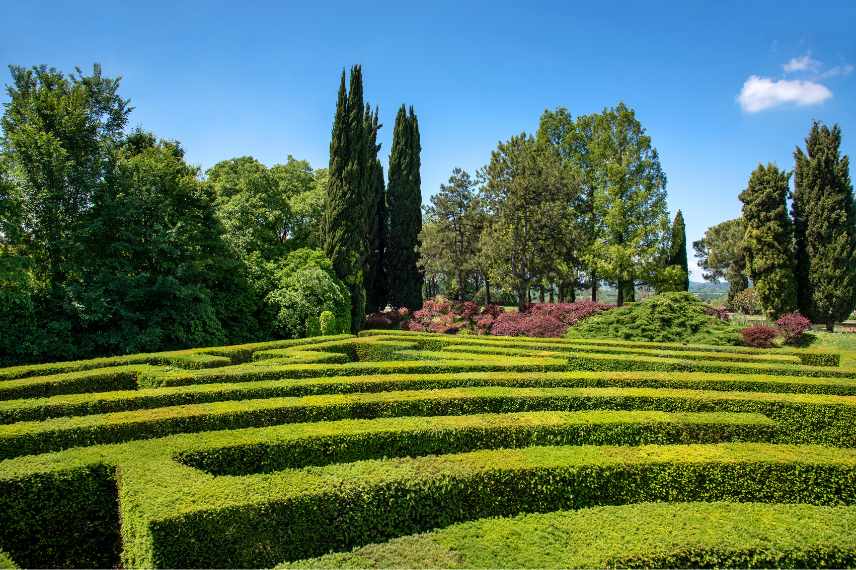

History and symbolism of the labyrinth
The labyrinth (from the Greek labùrinthos and the Latin labyrinthus) is defined as a complicated network of paths. It takes the form of a route made up of intersections, false trails, detours, dead ends, and cul-de-sacs designed to confuse, or at least slow one down. Universal, they have been found since the dawn of time: the oldest known labyrinth drawings are prehistoric, with the oldest discovered to date being an engraving on a mammoth tusk in Siberia.
However, the labyrinth is heavily connoted in our imagination with the myth of the Minotaur, trapped in a labyrinthine prison built by Daedalus, described in these terms by Apollodorus: “a dwelling with tortuous turns, so that one wandered without finding the exit.” Daedalus would be imprisoned there by King Minos, along with his son Icarus, who would burn his wings to escape. The legend of the thread of Ariadne is at least as well-known: a guiding thread for Theseus, the monster’s conqueror, to find his way back, along with the beautiful Ariadne…
All this tells us a lot about the complexity of the labyrinth’s network, but at that time, this maze was a solidly constructed edifice, with walls, an enclosure, a tangle of corridors, stairs, and passages, sometimes a roof. Evidence of this type of labyrinth already existed in Egyptian civilization.
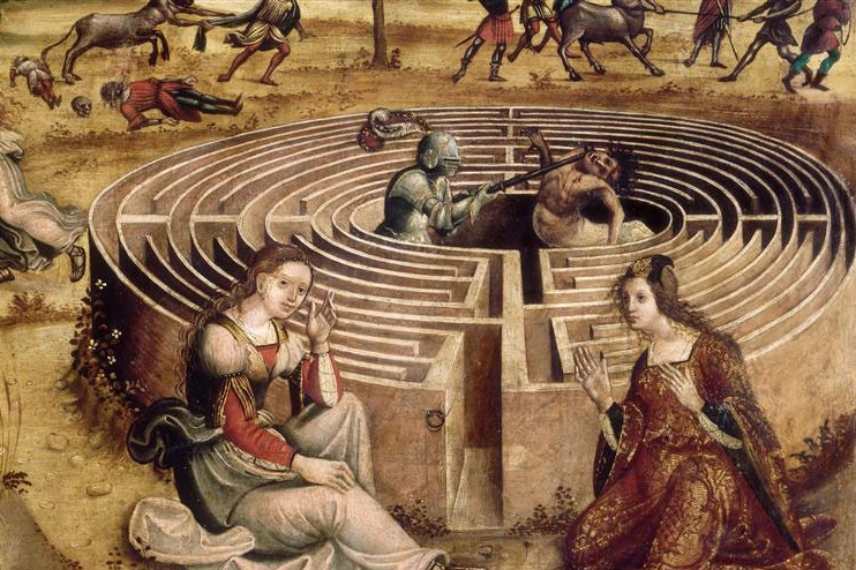
The Minotaur’s labyrinth as seen by the Master of the Cassoni Campana, in the 16th century (detail)
In the Roman garden, a pleasure garden, a labyrinth is sometimes found, like those in low topiary, in the atriums of Pompeii villas: the Villa of the Labyrinth is one of the earliest examples of this type of garden, in a closed space, which foreshadows the medieval garden.
It wasn’t until the Middle Ages that the labyrinth motif appeared on the pavements of religious buildings such as the cathedral of Chartres. This is the era of the medieval garden, which draws spiritual inspiration from it. The path is made difficult, symbolically representing an initiatory journey, a life path with its trials. The medieval garden thus takes on a sacred character.
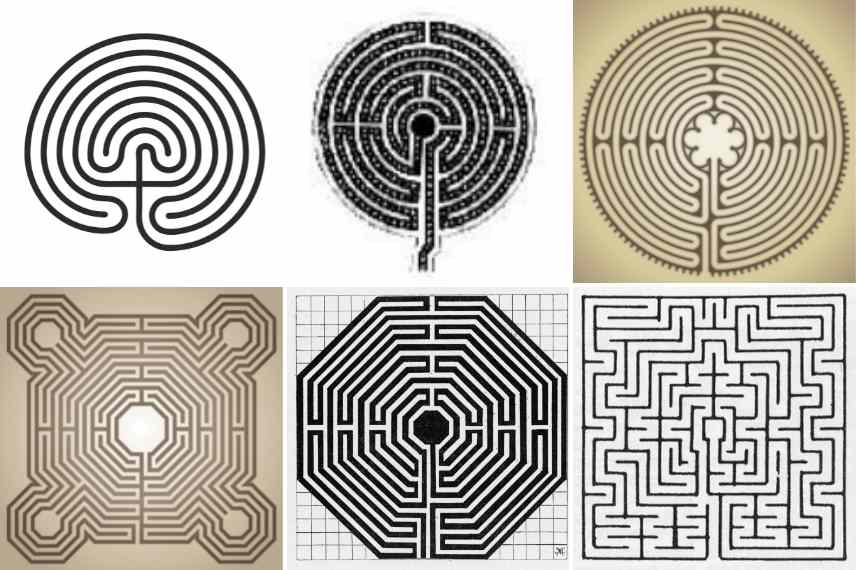
Cretan labyrinth, labyrinth of the San Vitale church in Ravenna (6th century), labyrinth of Chartres (13th century), labyrinth of Reims (13th century), labyrinth of Saint Quentin and labyrinth of Saint Omer (14th century)
Then the Renaissance elevated it to nobility and made it fashionable. A widely disseminated work, The Dream of Poliphilus, published in 1499, would significantly influence garden art during this period: it describes the journey of the main character to reach the beloved, in a dreamlike vision, evoking the labyrinth and the garden-island… From then on, the labyrinth found its way into gardens. Far from the spiritual image of the Middle Ages, it then represented entertainment and the pleasures of play. It remained of reasonable height, often dedicated to strolling. In the 15th and 16th centuries, labyrinths flourished in Italian gardens, then in French ones, becoming taller. The famous labyrinth created by Le Nôtre at Versailles would ultimately be destroyed in the 18th century…
Over the centuries, the maze has become more complex, leading to more free forms today.
Read also
Pruning yew: when and how?The different types of maze
Each era has seen the emergence of a distinct type of maze, which in turn has influenced future gardens. Mazes can be broadly divided into three main families:
- The concentric maze: it is organised around a spiral. It consists of convolutions around a central point. The aim of the walker is to reach the centre of the maze. This maze is one of the origins, in a unicursal configuration, and can be traced back to antiquity, such as the so-called Cretan model;
- The angular maze: it is geometric, with a square or polygonal, even octagonal, structure, and includes many dead ends (Roman maze, maze of Orléansville…)
- The “free” maze: breaking free from perfect symmetry and regularity, reflecting a different perspective on the garden. The interest of this maze often lies in a skillfully controlled undulation, shorter than a classic maze. It can also sometimes take the form of figurative representations (the Cheshire Cat’s head from Alice in Wonderland at the Château du Rivau in France, a butterfly in Colette’s garden…). This free maze can even be envisioned with bushes other than the traditionally used species.
Mazes generally have a single entrance, sometimes two, allowing for a shortened route or a longer journey.
Finally, we will not discuss here the figurative maze, a maze of grass or stone, a modern alternative and interpretation of the classic maze, resulting from patterns created by the passage of a mower or a layout of stones. It is a two-dimensional maze, rather than a 3D one.
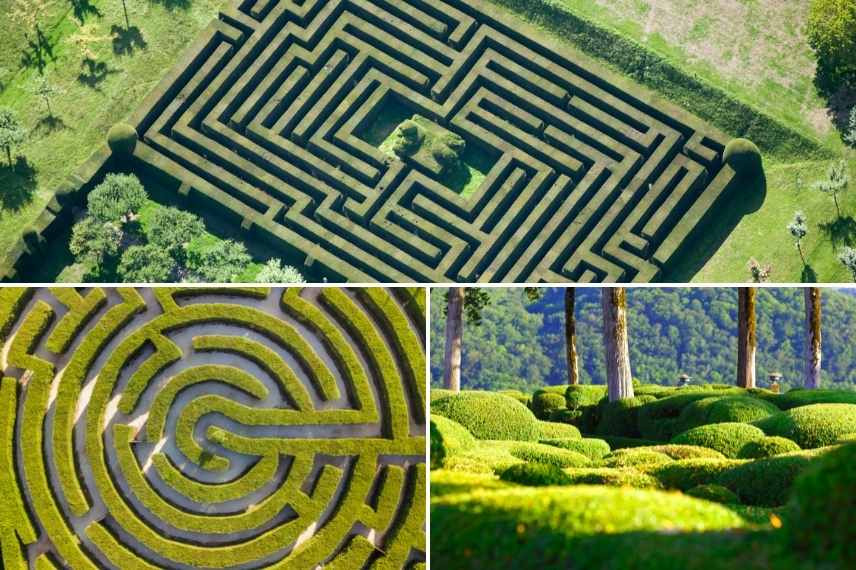 Examples of mazes: rectangular, circular, and free
Discover other Hedge shrubs
View all →
Available in 1 sizes

Available in 1 sizes
Available in 1 sizes
Available in 1 sizes

Available in 1 sizes

Available in 1 sizes

Available in 1 sizes

Available in 1 sizes

Available in 1 sizes

Available in 1 sizes
The maze in landscape design
The maze often becomes the centrepiece of a classic garden, enhancing it with its perfection in design or the carefully orchestrated undulations created by pruning. It forms structured green chambers, expressed in perfect meanders or perpendicular lines.
Complexity of its creation, rigorous arrangement, mastery of lines and perspective… The maze in the garden encompasses all of this… It is therefore not a layout within everyone’s reach. While it is often associated with castle gardens or large parks where space is abundant, it can, in some cases, be considered in more modest proportions at home.
Whether you envision it for its playful aspect, or for purely aesthetic or even meditative reasons, several criteria must be taken into account:
-
The design
More than any other layout, the maze requires prior reflection on the design, as it is this that gives it meaning, beyond the choice of bushes, to the arrangement of plants. The design serves as a motif, which will be repeated in a more or less symmetrical manner, or will be random, like a sinuous lace.
It is essential to put your ideas on paper, drawing inspiration either from ancestral motifs used in architecture and traditional shapes (circular, in a square or rectangular polygon, etc.), or by sketching your own creation (double spiral motif, arabesque, asymmetrical interwoven lines, helicoid pattern interspersed, circulation games enhanced by low walls…). Think of fingerprint patterns; they provide a basis for inspiration for curved mazes. In a castle park, why not draw inspiration from a coat of arms?
The design must always be sufficiently complex to spark interest during the walk. The repetition of motifs and the regularity of the lines are also crucial to introduce confusion and a loss of bearings.
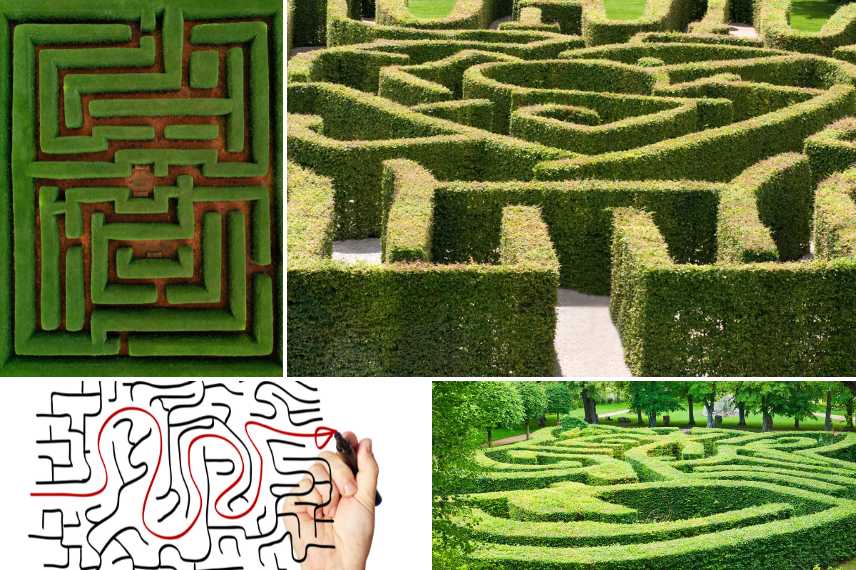
The importance of design in a maze project. In the bottom right, the Cheshire Cat from Alice in Wonderland at the Château du Rivau.
-
The required space
This is a major element that will define the scale of the maze within the garden. It is considered that a large space is needed to install a maze (at least 1 hectare) and to integrate it well, but it can be more limited depending on the height of the bushes: the lower the height, the more it can fit into an average garden.
Beyond the size of your garden, which is crucial for this type of project, also consider the style of your house: a manor or a 16th-century residence enclosed by walls will benefit from using almost the entire garden, transformed into a maze in its low form, where some spaces will be filled with a few plants or elegant pots, or even grassed squares. This is a radical option, but if executed skillfully, it adds a soul to the place, in perfect harmony with the atmosphere of old stones!
-
The technique
Embarking on a maze in the garden is not an easy task. To achieve a worthy result, here are the points to consider:
- The dimensions: certainly, the imagination of the maze often conjures up large parks, but some are smaller. Your plot must still allow for the harmonious integration of the maze. It should also be noted that the taller the hedges, the greater the sense of mystery and the feeling of surprise. A walk should be at least 70 m long to create the sensation of getting lost.
- The height: this depends on the space allocated to the maze, but also on the plants used and the desired atmosphere: low hedges (between 80 cm and 1.20 m high) for much aesthetics, this will be a maze visible from the house or a raised point in the garden; tall hedges – between 2 m and 4 m, or more, like green walls forming corridors – for a labyrinthine effect, placed in an open space or at the back of a very large garden. Remember that beyond 2 m in height, maintaining the maze will become more difficult.
- The shape: As mentioned earlier, it will be more or less sophisticated depending on your desire to adhere to classicism or to deviate from it.
- The use: A play area for children? Purely aesthetic effect? It will be positioned differently depending on its use:
- The location: integrated into a thoroughfare… or as a final point in the garden, like a last surprise? The maze should integrate with the other spaces, as a sub-space, or one might consider a low maze across the entirety of a garden if one desires an atypical garden with a strong identity. But most of the time, it is chosen to place it on the periphery. If you have an elevated location, a maze placed below allows for admiration. The maze can also consist of a series of 4 hedges, shaped in waves, opened to allow passage and to infiltrate to the back of the garden, in a smaller garden. Consider this as well to utilise a large, unproductive space, a meadow, or a large unused area.
- The implementation: this is a precise layout, which generally requires the help of a landscaper for a large area. A grid layout of the terrain is essential to accurately transfer the design to the correct scale. The area will be staked out according to the design: one can use large hoses for curved lines if the maze remains modest, or spray paint and stakes placed at strategic points. The planting stage should ideally take place in October or November, using plants with bare roots for deciduous shrubs, and all year round in clumps for evergreens. The planting hole should be carefully prepared along the entire length. The planting distances should be slightly closer than those for a hedge, about 50 cm apart. Plan pathways between 0.80 m and 1.20 m wide. The surface of the paths often consists of crushed limestone, gravel, or clay-limestone aggregates, always ensuring good drainage.
One can integrate an ornament along the path, or in its centre: a statue, a small bridge, a little treehouse, a platform, or a mound for height. Benches fit well into low mazes, and a few trees, a piece of greenery, or a grove enhance it even more.
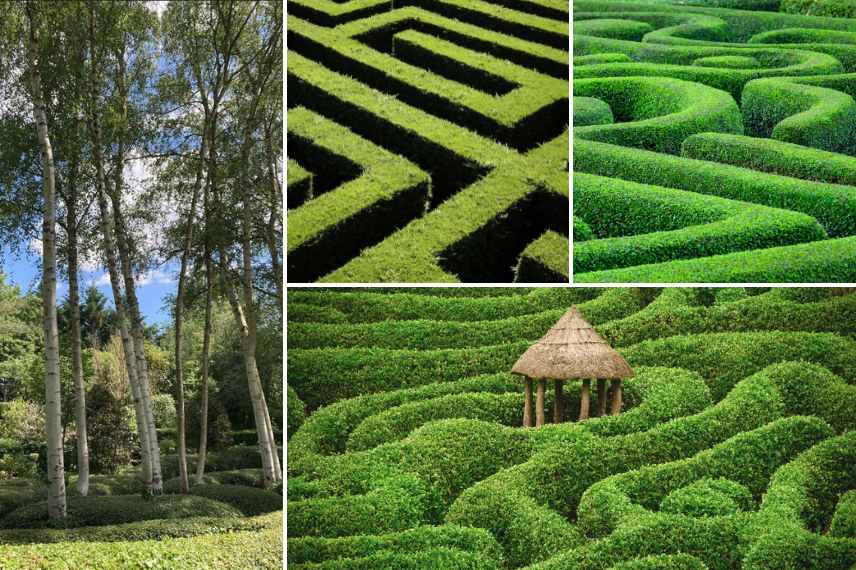
The designs are diverse and depend greatly on the location and desired style: winding in a free maze like here on the left at the Jardin du Petit Bordeaux, highlighting the bark of birches, or below at the Glendurgan gardens in England; perfectly straight or mixing curves and straight lines in a more formal style above.
-
Maintenance
This is certainly the crucial point, and a question to consider well in advance of the project: will I have enough time to dedicate to the pruning of boxwoods/privets/yews, etc.? The art of pruning over significant lengths is also to be taken into account: it occurs twice a year and requires a certain know-how and professional equipment, including scaffolding in case of tall hedges. Only meticulous and repeated pruning will maintain the neat and aesthetic appearance of a maze. Pruning is also essential to keep the plants within their proportions.
→ Consult our range of maintenance tools for cutting, and the pruning and cutting tools for boxwoods and topiaries
Read also
Boxwood: when and how to prune?Which plants for a maze?
To create a permanent maze, the bush used must be evergreen and particularly tolerant of repeated pruning. Dense foliage and a bushy habit are the desired qualities.
In the execution of a permanent maze, it is no surprise that the same noble species with small leaves have been used for centuries, which are also employed for shaping topiary: box, yew, and cypress. The Ilex crenata, privet, spindle, osmanthus, and Portuguese laurel are other traditional options, equally ornamental. The stunning Glendurgan garden in England even uses the palm laurel! An exception is the hornbeam, which is marcescent, and can form a maze in its own right, taking on a beautiful rust colour in winter. Beech will be used for the tallest mazes. All these plants have the advantage of being hardy, suitable for planting throughout the country (the cypress is preferably planted south of the Loire).
A more original maze can be composed of quite different plants, such as tall grasses, with which a winding and undulating path can be designed over a large area. Miscanthus sinensis lends itself beautifully to this, forming original mazes that are stunning after a few years. Pennisetum creates a lower maze, about 1 m in height. Both integrate wonderfully into a naturalistic garden. Again, a beautiful space should be planned. → See Jean-Christophe’s article on this: How to create a grass hedge?
In all cases, only one species should be favoured to maintain a unity of colour and texture. In free mazes, it is possible to mix 2 or 3 closely related bushes, such as spindle and privet, for example.
N.B.: With the appearance of the box tree moth a few years ago, we recommend choosing alternatives to box for new creations.
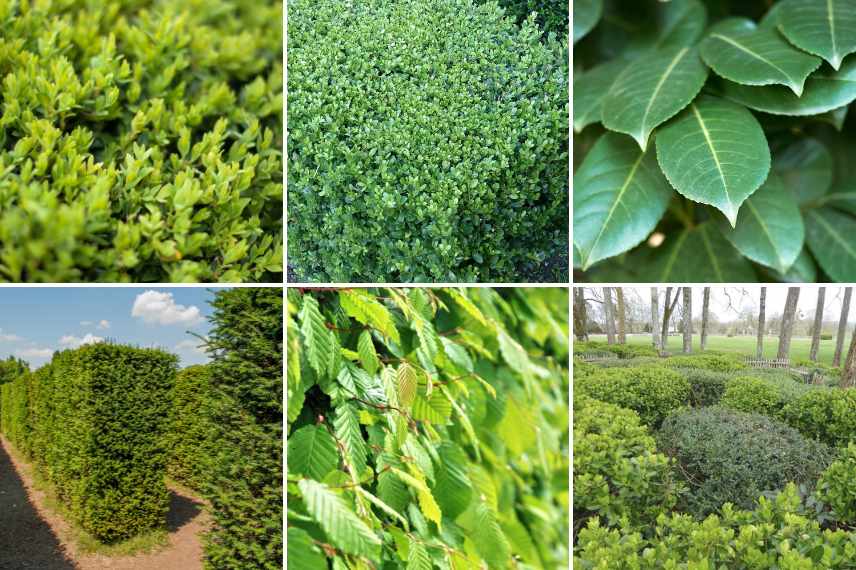
Box, Ilex crenata, palm laurel, yew, and hornbeam. In the bottom right, the wild maze of the Château du Lude, mixing spindle and privet (photo by Gwenaëlle David)
Learn more
For inspiration on this technical layout, there’s nothing like wandering among the most beautiful mazes in France:
- The maze of the Château de la Ballue with its 1500 yews (Ille-et-Vilaine)
- The Gardens of Rivau and its Alice maze made of hornbeams (Indre-et-Loire)
- The maze of Château de Merville, the largest boxwood maze in Europe covering 6 km of paths and 25 hectares (Haute-Garonne)
- The sculptural gardens of Etretat (Seine-Maritime) with their meticulously designed pathways and topiaries
- The Artmazia maze made of beeches and hornbeams over 3.6 km of paths
- The giant maze of Guéret: 2.5 km of paths over more than 2 hectares (Creuse)
- Two maze approaches visible at the Château du Lude (Sarthe): one classic boxwood, the other free-form mainly made of spindle trees
- The Miscanthus maze of La Baie (Manche)
- The suspended gardens of Marqueyssac (Dordogne), with their almost labyrinthine topiaries
- The giant maze of Colette’s garden in the shape of a butterfly (Corrèze)
… and the most beautiful mazes in the world!
It is worth noting that the largest maze in Europe is Longleat in England, set on a 1.5-hectare site, formed of over 16,000 yews, with a pathway length of 8 km!
- Subscribe!
- Contents
![[plantes type="labyrinthe" utilisation="jardin"]
[construire type="labyrinthe"]
[amenager type="labyrinthe"]](https://en.promessedefleurs.eu/blogwp/wp-content/uploads/2022/12/creer-un-labyrinthe-au-jardin.jpg "Create a maze in the garden")
Comments