





























Discover 9 herbaceous Clematis plants with beautiful blue flowers
Shrubs of splendour
Contents
Among gardeners’ favourite herbaceous clematis are not the most well-known nor the most used. Barely climbing, or not climbing at all, they are used more as perennials that form a large clump. Most are deciduous, hardy and require pruning, the only maintenance requirement they have.
The many species and varieties of blue-flowered herbaceous clematis are a real treasure for any garden, terrace or balcony. In this article, we explore nine exceptional varieties, with a splendid palette of blues, from soft azure to deep blue, each with its own characteristics and care tips to ensure spectacular flowering every year.

Clematis - Clematis integrifolia
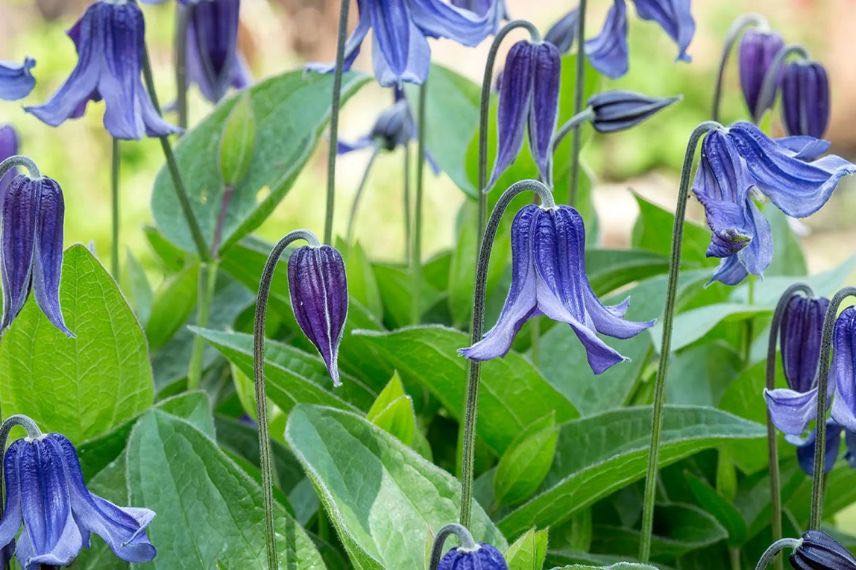
The Clematis integrifolia or simple-leaved clematis is a botanical species native to southern Europe, Central Europe, Russia and China, with small campanulate blue bell-shaped flowers formed from four fused petals and slightly twisted. Delicately scented, they are as fine as porcelain. The flowers bloom abundantly in late spring, then more sporadically throughout the summer among the foliage. Far from forming a tangled climber, the plant grows into a handsome, luxuriant clump with only a light climbing habit, not exceeding 1 m in height with a similar spread.
It is a somewhat slow starter at first, as it takes time to establish its roots. Deciduous, its stems emerge directly from the base each spring. They bear small leaves that are oval to elliptical, a deep and glossy green.
Plant Clematis integrifolia in a mixed border, in a rock garden or along a border, or to dress the base of rambling roses, for example.
Read also
Designing a blue gardenClematis - Clematis 'New Love'
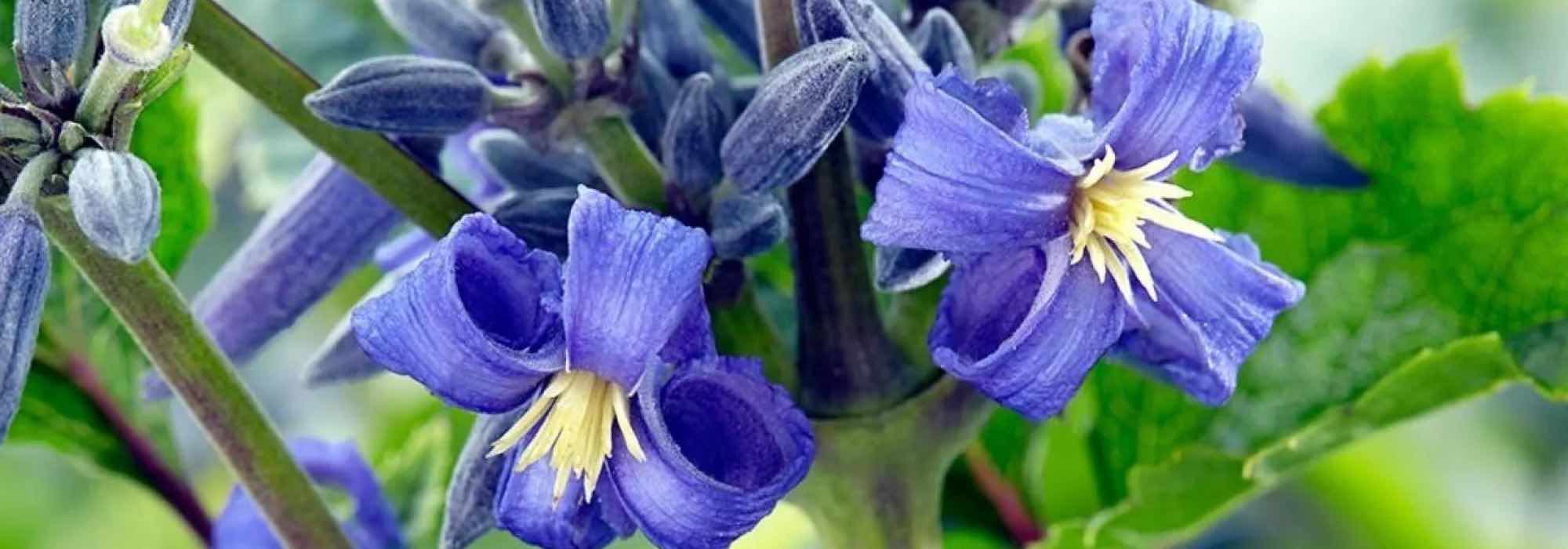
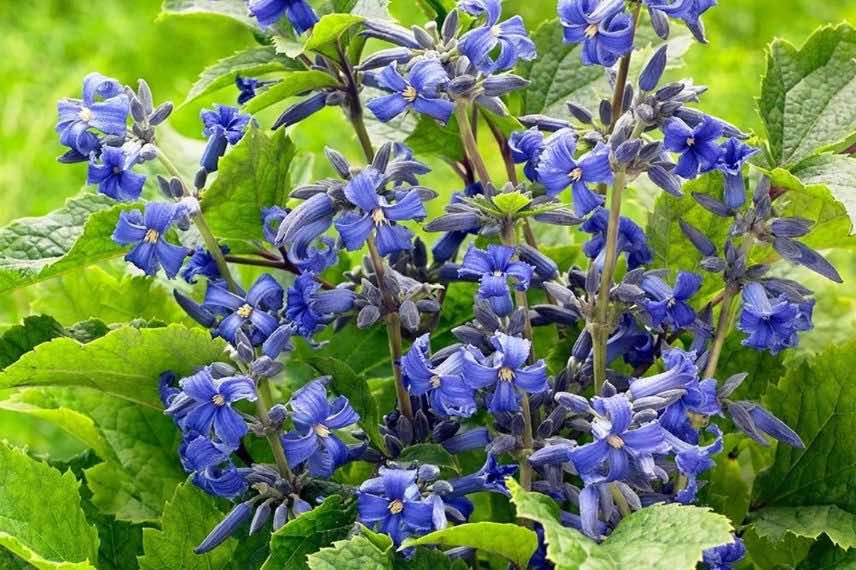
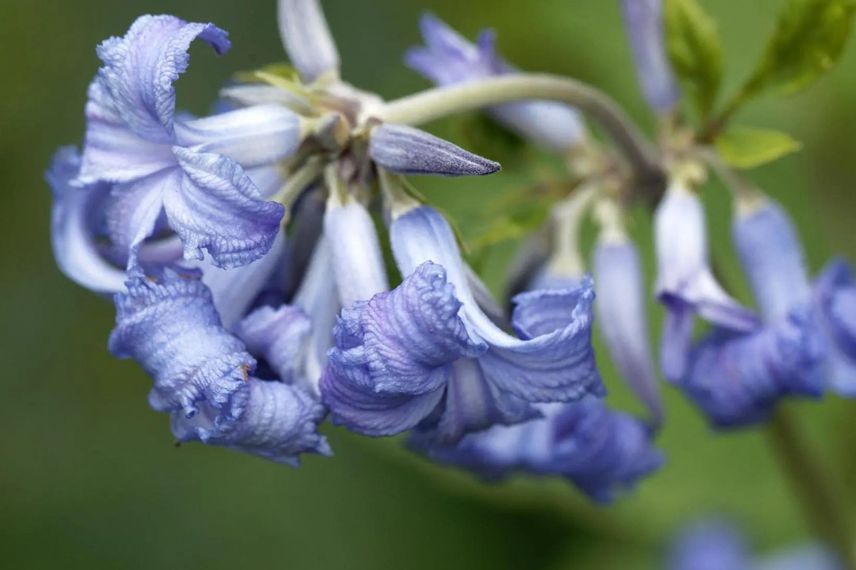
Clematis ‘New Love’ is a cultivar derived from the species Clematis heracleifolia, or large-leaved clematis, native to China and little known. It grows and is used as a perennial, gradually forming a flowering ball. Its very long summer flowering is an enchanting blue, almost unreal for a clematis. The architecture of its flowering is remarkable, with inflorescences in spherical clusters, borne toward the tops of bare stems rising from a dense tuft of foliage, bell-shaped, 2–3 cm long. The flowers are scented, and consist of four recurved petals in ultramarine blue, paler toward the centre, revealing a throat endowed with stamens bearing yellow anthers.
Its foliage does not disappear completely in winter, but takes on a greyish tint. Like other clematis, its fruits form small green and silvery plume-like tufts, but their arrangement in balls around the stem enhances the decorative effect.
This variety prefers semi-shaded, not scorching sun positions. It is ideal for container planting.
Clematis - Clematis integrifolia 'Twinkle'
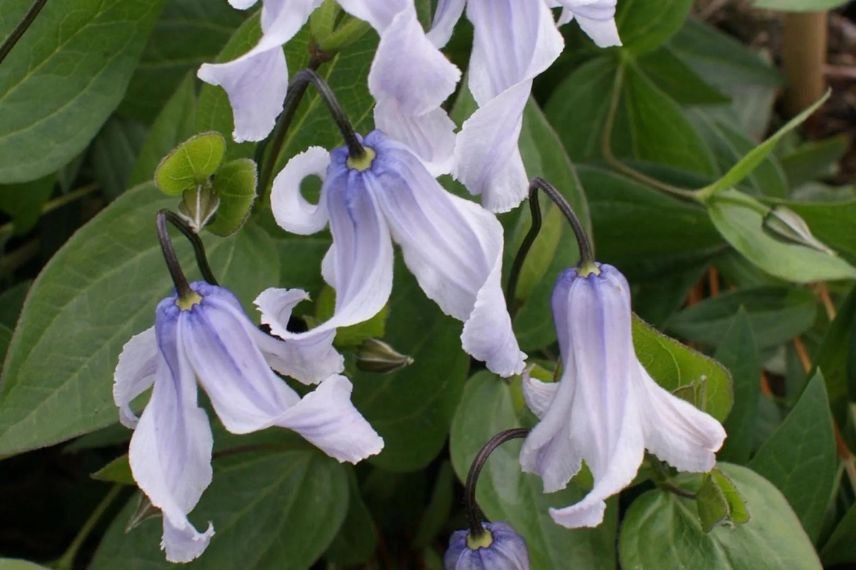
The Clematis integrifolia ‘Twinkle’ is a rare variety in cultivation, with white, bi-coloured, bell-shaped flowers tinged blue-mauve at the base, gracefully inclined. They are 4–5 cm long and conceal in their throats stamens with yellow anthers, campanulate in shape, with petals slightly twisted. Its foliage re-emerges each spring on a multitude of dark-green leafy stems, and the flowers come into bloom in late spring amongst the foliage.
The Clematis ‘Twinkle’ prefers sunny spots that are not scorching and tolerates drought fairly well once established. To give a bohemian touch to a border or bank, plant it together with ivy and periwinkle, for example.
Read also
Clematis: planting, pruning and careClematis - Clematis 'Saphyra Indigo'
The Clematis ‘Saphyra Indigo’ stands out from the herbaceous clematis featured in this selection for its large, open flowers with six petals that are slightly reflexed. As the name suggests, they are an intense indigo blue, with deep violet stamens. Its long flowering period extends from June to September.
Derived from Clematis diversifolia, this plant has a climbing habit, reaching 1.5–2 m in height with a 60 cm spread.
‘Saphyra Indigo’ can be planted in full sun or partial shade, with its base kept cool and well-mulched. In the ground, it will cloak a small wall, a trellis or a fence, or even a tree. Plant silver-leaved Artemisia or white Gaura at its base. You can also grow it in a pot on the terrace or balcony.
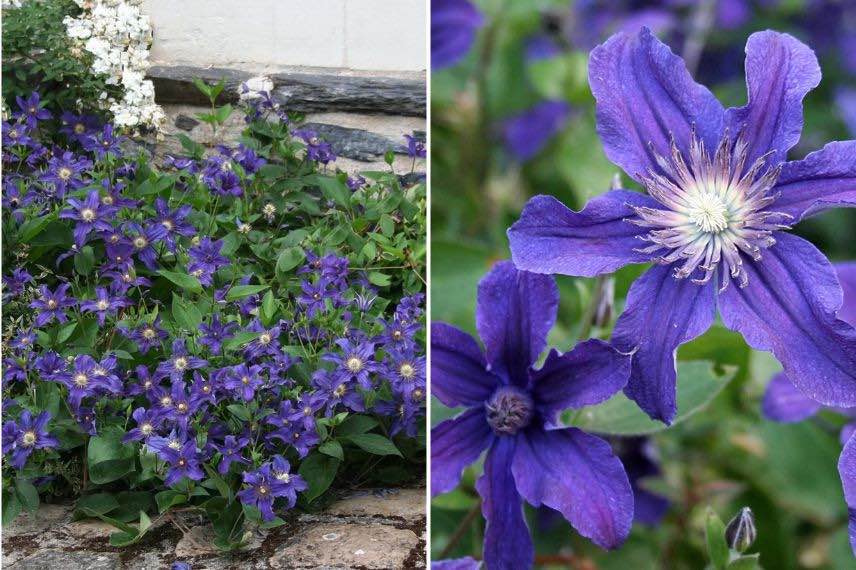
Clematis - Clematis 'I am Stanislaus'
Derived from the species Clematis heracleifolia, this cultivar ‘I am Stanislaus’ offers bell-shaped flowers 2 cm in diameter, with reflexed petals forming a star when open. The flowers are adorned with long white pistils at the centre, fragrant. The overall impression is slightly bi-colour, with petals of a blue tinged with mauve.
It flowers in midsummer, July and August, on large dark-green dentate foliage, characteristic of the species named Large-leaved Clematis. This foliage does not disappear completely in winter, but becomes somewhat grey. The whole gradually forms a flowering ball about 1 m tall.
Like the type, this variety prefers locations not in scorching sun, ideally semi-shaded. If you are not planting it in a pot on a balcony, you can plant it in the ground with Coreopsis and Euphorbias.
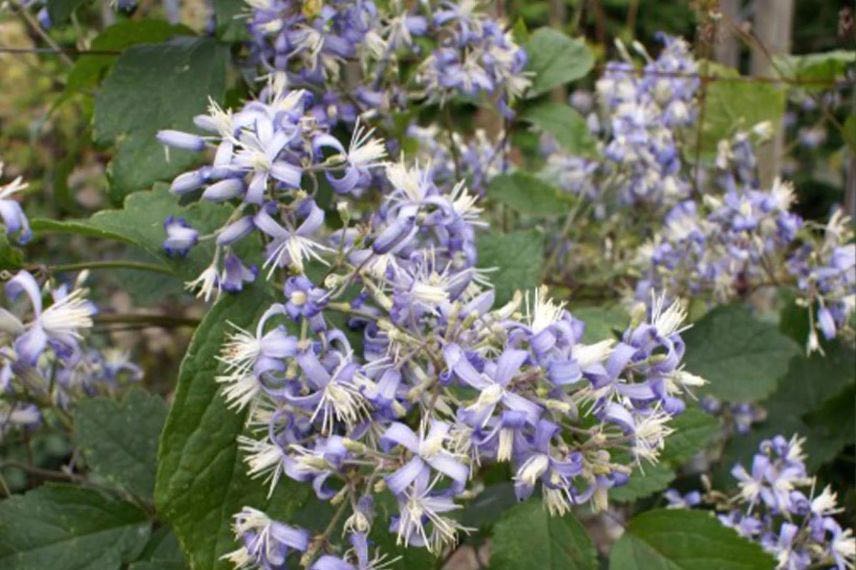
Clematis - Clematis stans
The Clematis stans is another superb herbaceous species of clematis, discovered and named in 1845 and native to Japan, not climbing. In August and September, it displays a multitude of tube-shaped flowers in a lovely pale blue colour, very fragrant, with a scent reminiscent of lily of the valley. Inflorescences are arranged in whorls. It reaches 50 to 70 cm in height at maturity, sometimes more. Its small leaves, remaining light-green all season, are opposite and dentate, pointed.
This plant develops a woody structure similar to that of a bush and produces long annual shoots. In spring, it is advised to prune the previous year’s shoots back to the wood. It thrives in light shade as well as full sun, as long as the latter is not too intense, in deep, well-drained garden soil, but not too dry. It is a remarkable addition to the garden.
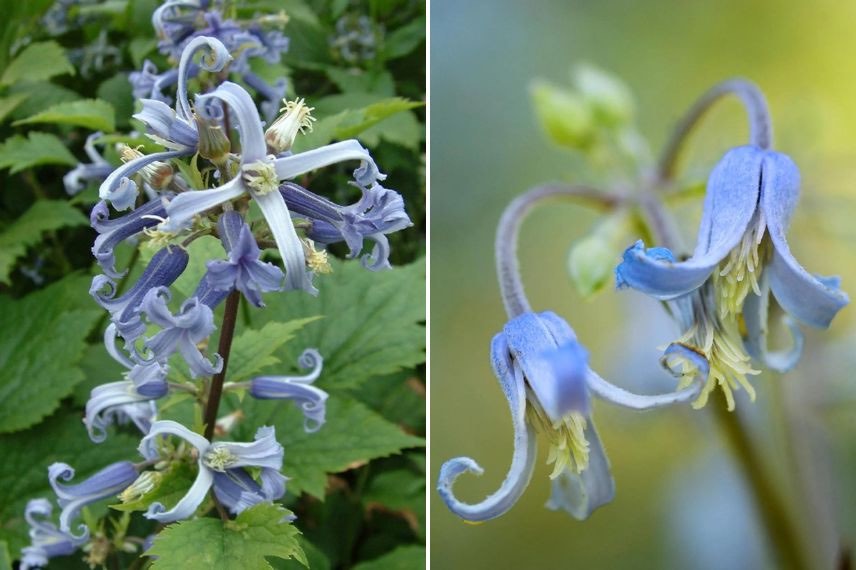
Clematis - Clematis integrifolia 'Durandii'
The Clematis integrifolia ‘Durandii’ is an old French hybrid variety. Semi-woody, it produces bell-shaped flowers that open into broad, star-shaped blooms, almost flat, towards the sky, reaching 6 to 10 cm in diameter. They are indigo-blue in colour, rich and striking, with in their centre a large cluster of cream-white stamens. Not widely used in gardens, it is nevertheless well worth a look.
‘Durandii’ forms a deciduous, not particularly climbing perennial with long, leafy stems, forming a bushy, tangled tuft 1 to 2 m tall, with a spread of at least 1 m². The flowers bloom in abundance from June to September among the foliage. The flowering is followed by the formation of feathery and silvery fruits, very decorative late in the season.
Not fussy about climate or soil, this clematis prefers sunny, not scorching locations. On a slope, it blends with sweet peas or campanulas, for example.

Clematis - Clematis heracleifolia 'China Purple'
In the dark-blue-flowered varieties, Clematis heracleifolia ‘China Purple’ enchants us with splendid indigo-violet lanterns, rich and intense. Fragrant, the slender, bell-shaped flowers with curved edges about 2 cm across reveal a throat bearing stamens with yellow anthers. They also evoke hyacinth flowers.
‘China Purple’ develops a fairly broad, erect shrub with large dark green leaves, growing to a height of 80 cm to 1 m, and about 80 cm wide. The prolific flowering occurs between July and September, in dense clusters at the axils and the tops of sturdy stems.
This clematis should be planted in fertile soil, not too dry, well-drained, in partial shade. With a somewhat wild appearance, it is ideal in borders, containers or on banks with other border plants such as the refined variegated ivy ‘White Ripple’ and woodland euphorbias.
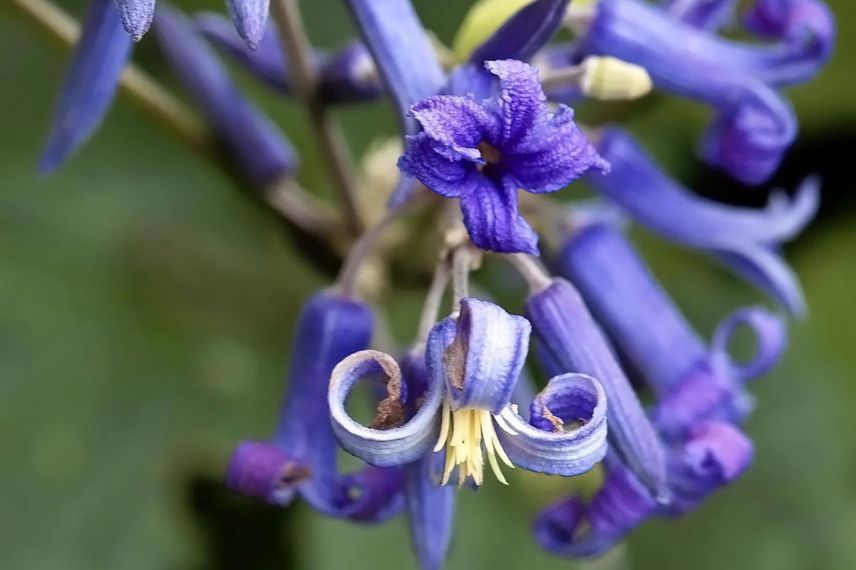
Clematis - Clematis heracleifolia
Finally, here is the Clematis heracleifolia (also called Clematis davidiana), this well-known Chinese species, of which we have already presented several derived cultivars. If one finds the same tubular, recurved flowers as in ‘China Purple’ from the previous paragraph, the colour of the original species is different, in sky-blue bell-shaped flowers with throats bearing cream-white stamens, always pleasantly scented.
This semi-herbaceous clematis with velvety, semi-evergreen foliage in green-grey flowers in autumn, in step with the asters. It thrives in cold and damp climates and in heavy, clay soils, preferably kept consistently moist. Pair it with small ornamental crabapples such as the famous Malus ‘Everest’ for a charming duo.
- Subscribe!
- Contents
Comments