






























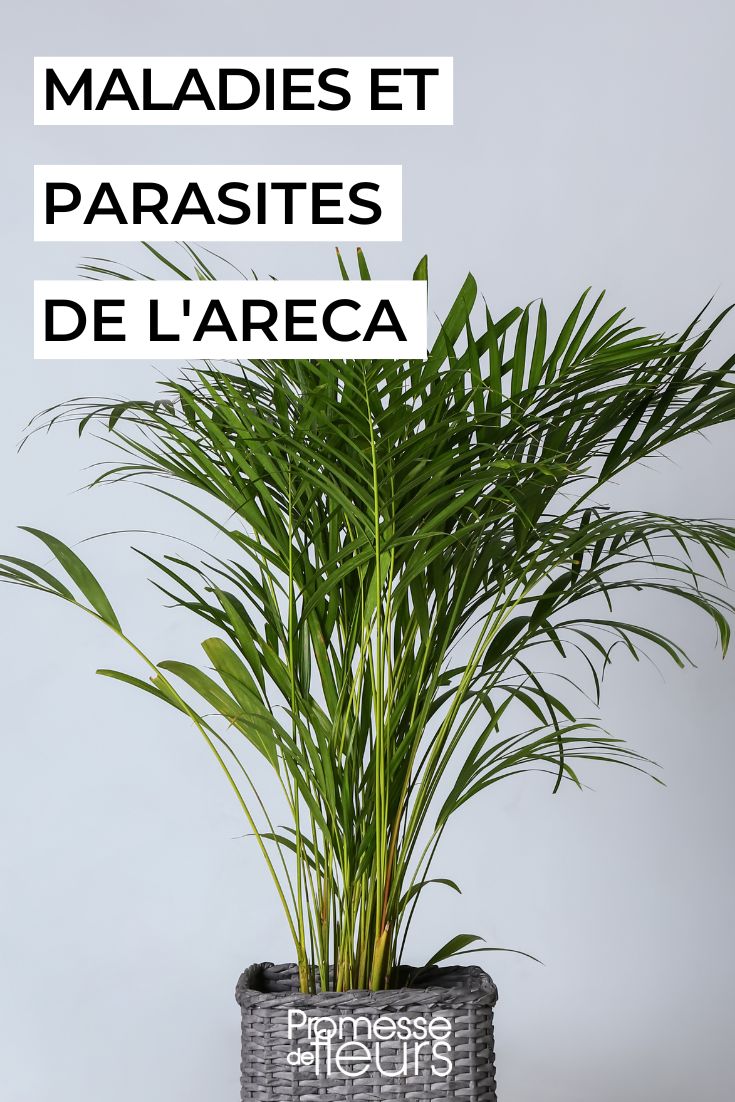
Diseases and parasitic pests of the Areca palm
How to care for an indoor palm?
Contents
An indoor palm? Of course, it’s the Areca lutescens we’re talking about, also known as the golden palm or multiplying palm. With luxuriant, imposing, yet light and delicate foliage, this indoor palm displays an exotic look that suits any home. Moreover, it is fairly low-maintenance. The essential thing is that it receives sufficient light and regular watering.
However, a few small growing problems can arise, especially if the growing conditions are not optimal. Why are my Areca leaves turning yellow? Why are they dropping prematurely?
Discover the various pests and potential diseases that can affect the Areca, but also the solutions to treat and prevent.
Further reading: Indoor palm: how to grow Areca?

A quick reminder of the Areca palm's growing requirements
Among houseplants, most diseases and pests are linked to poor care. Indeed, an atmosphere that is too dry or too humid, a lack of light, or too much or too little watering are all conditions that can have a direct impact on the health of a houseplant. That is why it is essential to meet a plant’s needs as closely as possible, since they vary from species to species.
Thus, Areca lutescens is a plant native to tropical to subtropical habitats that will thrive in ordinary potting mix for indoor plants, perfectly drained by gravel or clay pellets. Nevertheless, it needs plenty of light and, above all, warmth. It should therefore be placed in a room with good light, but not necessarily behind a window where the sun’s scorching rays could damage the foliage. As for the warmth of homes, it is perfectly suited to indoor palms. In winter, the temperature should not fall below 15°C, and in summer a brief spell outdoors in the garden suits it perfectly.
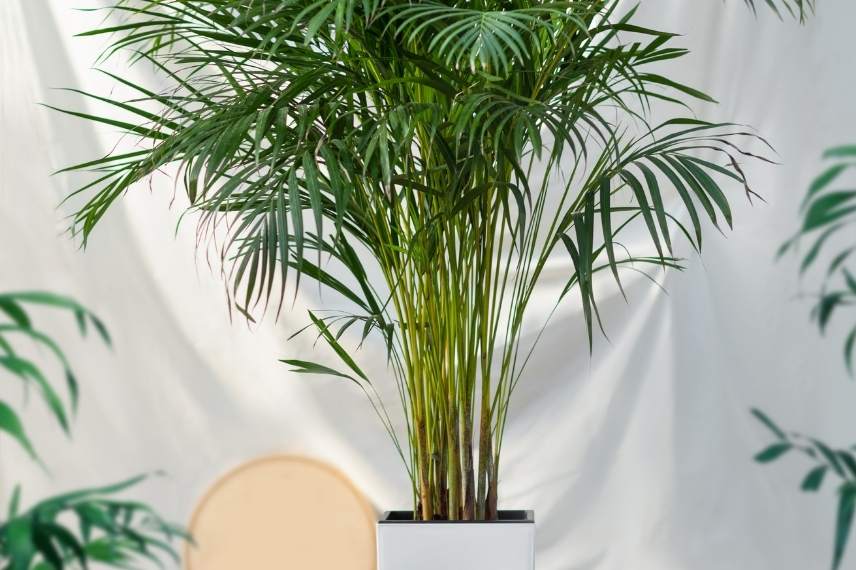
The Areca palm should benefit from moderate watering and regular foliage misting
In terms of care, Areca should be watered regularly, at a rate of 2 to 3 times a week, in summer. In autumn and winter, watering should be spaced out. The substrate should be fresh, not waterlogged. Misting the foliage is advised to maintain a certain level of humidity, favourable to this plant
Parasitic pests that attack the foliage of indoor palm trees
In an atmosphere that is often too dry, many pests can appear. As the Areca palm requires a certain level of humidity, and cold and draughts can also trigger these pest infestations. It is essential to act at the first signs of infestation, as some pests can prove particularly stubborn to eradicate.
Scale insects
On the Areca palm, and more generally on indoor plants, the most common are soft scale insects or mealybugs. They are recognisable by the white, powdery masses that build up at the base of the leaves and on the stems. Under this waxy, powdery film lie small, slow-moving woodlice that feed by piercing the foliage to extract sap. 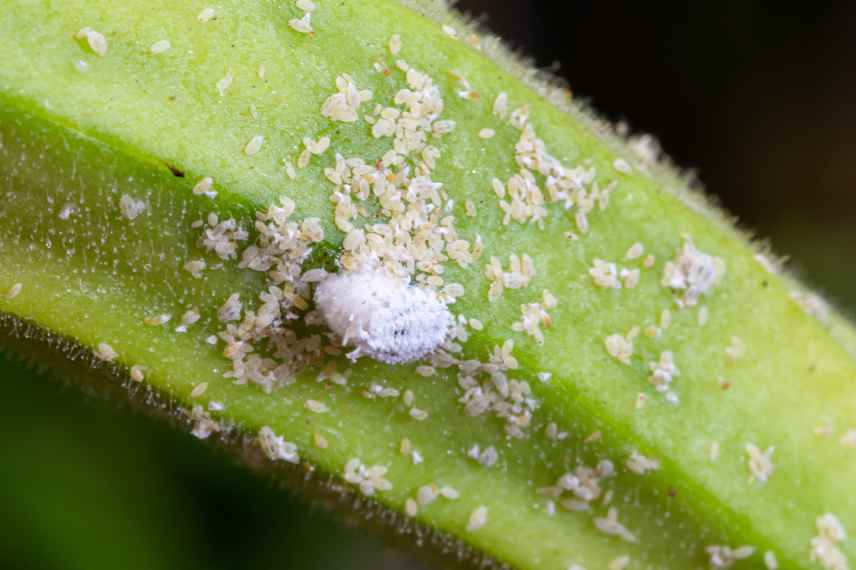
Symptoms
Visible to the naked eye, scale insects weaken the Areca palm, stunting its growth. The leaves distort, yellow and drop. A severe infestation can lead to the death of the plant.
How to act?
- Quarantine your Areca to prevent spread to other plants
- Scrape the powdery masses with a brush or soft-bristled brush, or with a fingernail. You can also use a cotton bud dipped in alcohol
- Spray a solution prepared with one litre of water, 50 g of Marseille soap or black soap, and 100 g of denatured alcohol, onto the underside and topside of the foliage. This spray can be repeated weekly. For greater effectiveness, you can add rapeseed oil to this preparation
Prevention
- Maintain a humid and well-ventilated atmosphere by regularly airing the room containing your Areca palm. Likewise, mist and water your indoor palm regularly
- Avoid crowding indoor plants to allow air to circulate
- Take your indoor palm outdoors in summer into partial shade. Scale insects dislike hot, dry environments. Additionally, beneficial insects such as ladybirds, lacewings or true bugs can be very effective against scale insects.
Red spider mites
Other common Areca pests, red spider mites, also called spider mites, are mites measuring barely 0.5 mm in length, ranging from reddish to yellowish. Difficult to see, they are often noticed by the fine webs spun around the foliage. They are sap-sucking pests. They also thrive in conditions that are too warm and dry for the Areca.
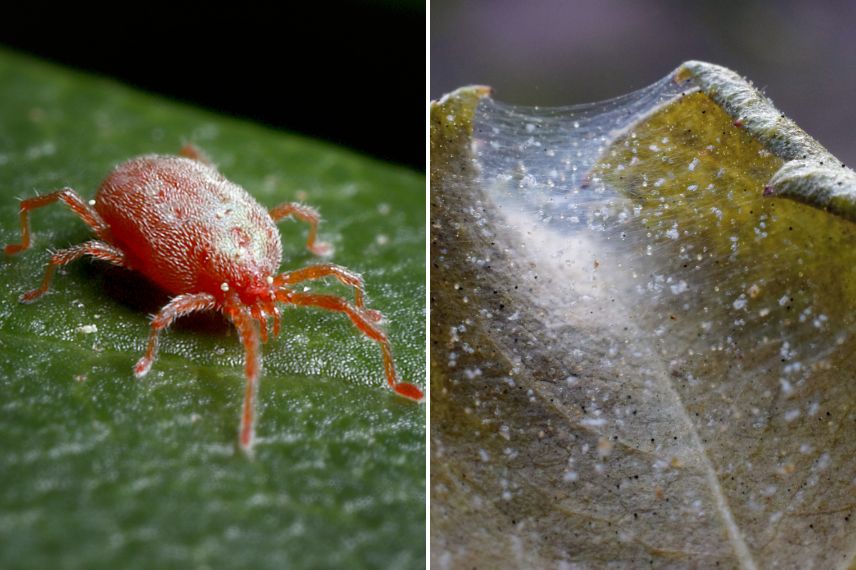 Red spider mites multiply rapidly
Symptoms
The first signs of attack are difficult to see, as these are tiny white specks on the foliage. Then, the leaves discolour, take on a silvery sheen, then dry out and fall.
How to act?
- Rinse the Areca palm’s foliage with a jet of water in a shower or outdoors
- In case of severe infestation, apply three to four sprays, at 48‑hour intervals, of a garlic decoction diluted to 30% (70 g per litre of water)
Prevention
The essential measure to prevent a red spider mite infestation is regular misting of the foliage. The room’s ventilation is also indispensable.
Whiteflies
Commonly known as whiteflies, these insects are actually aleurods. The adults and the larvae, resembling pale green discs, suck sap from the foliage. They excrete honeydew, a sticky and shiny liquid that spreads under the plant.
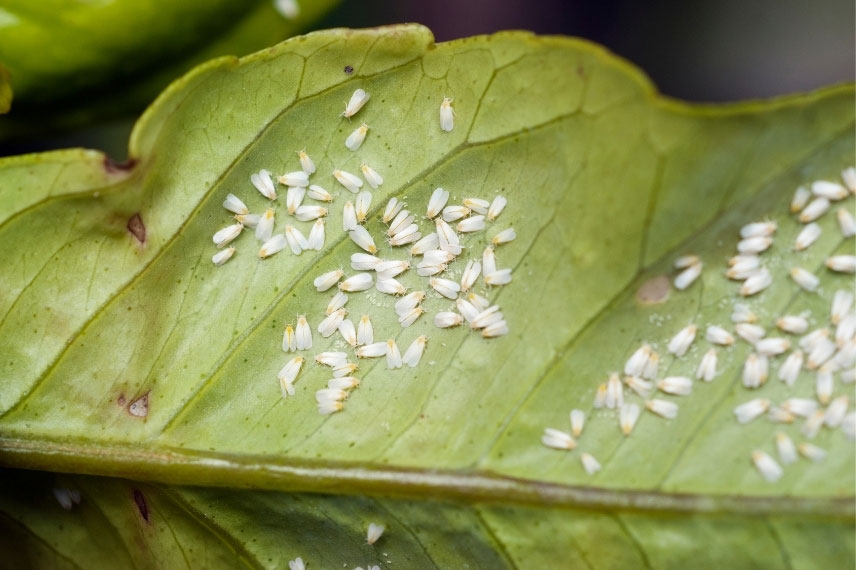 Aleurodes
Symptoms
The plant will weaken and die. In the event of a heavy infestation, the sooty mould, identifiable by a black coating, will develop, favoured by the presence of honeydew.
How to act?
- Spray a solution consisting of one litre of water, 30 g of black soap and a tablespoon of vegetable oil such as rapeseed oil. This spray can be repeated three to four times, spaced a few days apart
- The tansy decoction is also effective against whiteflies. Simply boil 10 litres of water with 400 g of fresh tansy leaves, then let it boil for 10 minutes. Once strained and cooled, the decoction can be sprayed onto the foliage. Do this preferably outdoors
Prevention
To prevent whitefly attacks, it is important to maintain some humidity by regularly misting the Areca palm’s foliage. Likewise, room ventilation is essential.
Growing problems affecting the Areca palm
The Areca palm is not very susceptible to diseases. However, its good health can be upset by small cultivation mishaps that mainly affect its foliage.
- If the Areca palm’s foliage browns prematurely, there can be several factors: too little or too much water, or an atmosphere that is too dry: simply mist the foliage once a week and water regularly, but not excessively. And above all, remove any residual water. Placing the plant on a bed of moistened clay pebbles can also be a solution. In the case of overwatering, stop watering for at least 10 days
-
Why are my Areca leaves turning yellow?If the foliage yellows, it may be due to a lack of light. You simply need to move your Areca to a room that is sufficiently bright and with a temperature of at least 15–16 °C. Water stress, caused by a lack of water, can also cause the yellowing of the leaves
- If the leaves turn black, it’s a sign that your Areca is suffering from cold drafts. Move it quickly to another location, but only after removing the damaged leaves
- The tips of the leaves turn brown and dry. Your Areca is lacking humidity. Once again, misting helps.
Read also
Misting indoor plantsTo learn more about Areca
Discover our other articles:
- Subscribe!
- Contents
Comments