





























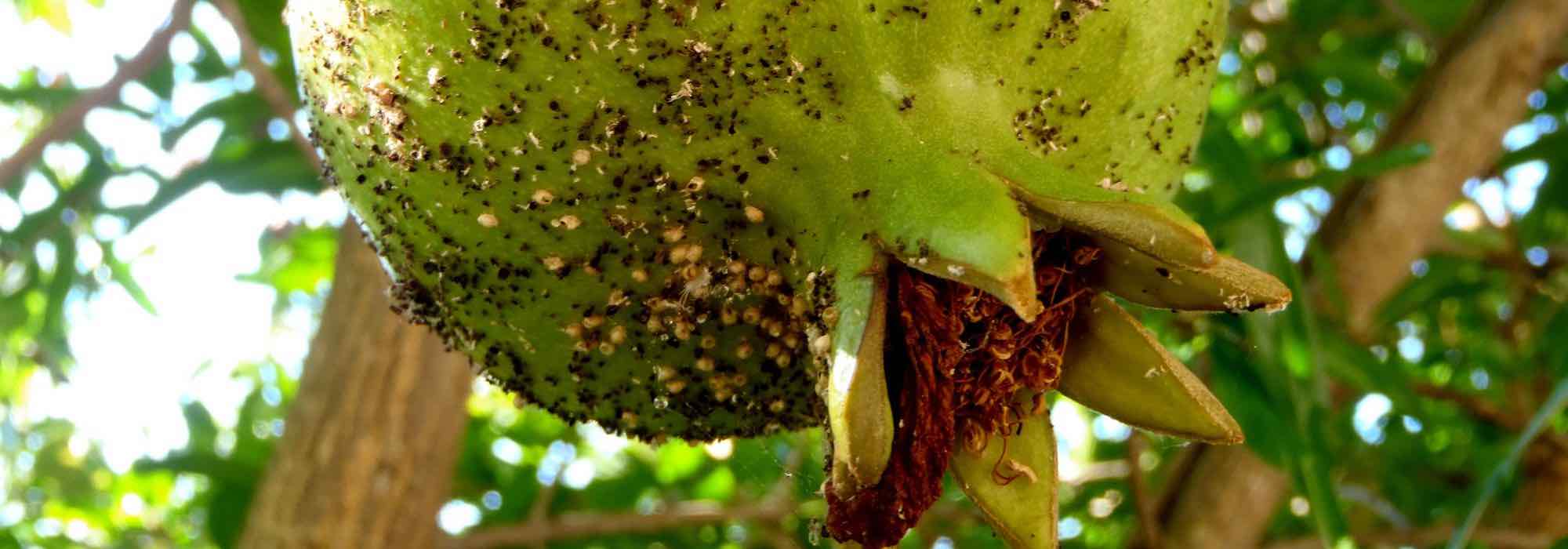
Diseases and pests of the pomegranate tree
Identification, prevention and natural treatments
Contents
Pomegranates (Punica granatum) are valued for their stunning summer flowering and, in some varieties, for their fruits that are as good as they are beautiful. These bushes from the Mediterranean region are easy to cultivate, both in the ground and in pots.
Robust, they are not particularly sensitive, but can be affected by diseases or pests. Fruit-bearing varieties are generally more susceptible than flowering varieties. Fortunately, the health of the plant is rarely endangered.
Let’s see how to identify diseases or pests, prevent risks, and which natural treatments to use for healthy pomegranates.

Aspergillus castaros
Description and Symptoms
The Aspergillus castaros is a fungus responsible for a cryptogamic disease. By settling in the heart of the fruits, it alters the colour of the seeds, can decrease their sugar content and, ultimately, cause them to rot.
The Aspergillus castaros is mainly found in warm and humid areas.
Prevention
A few preventive measures can help limit the occurrence of this cryptogamic disease:
- quickly collect fallen fruits to avoid any risk of disease spread;
- wait for the growing medium to dry on the top few centimetres between waterings;
- avoid wetting the foliage and fruits during watering;
- always use clean cutting tools, previously disinfected with alcohol during pruning;
- ensure good growing conditions by promoting proper soil drainage, essential for a healthy pomegranate tree.
Natural Treatments
In case of infection, quickly remove the affected parts to limit the risk of spread.
In spring, at the time of vegetative resumption, treat your pomegranate tree with Bordeaux mixture, which has antifungal properties. This is a powder, usually blue, to be diluted in water before spraying. This sulphur-based product is still used in organic farming. However, note that in large quantities over time, it can cause soil imbalance and pollution.
You can also use plant manures. While their action against fungi is not scientifically proven, many gardeners use them to combat cryptogamic diseases, both preventively and as treatment. Choose for example horsetail manure, often used for fruit trees. You can buy it in stores or easily make it yourself (see our tutorial “How to make horsetail manure?”). Use it diluted in rainwater for spraying, in spring and up to the fruit harvest. The nettle manure is also valued for its natural properties and is used in the same way. You can easily find it in garden centres or online. You can also try a homemade recipe (see our tutorial “How to make nettle manure”).
For more information, check out our additional articles:
– “Everything you need to know about cryptogamic diseases”
– “Bordeaux mixture and other copper-based treatments in the garden”
Fruit fly
Description and Symptoms
The fruit fly (Ceratitis capitata) is a small insect primarily found in Mediterranean regions and during warm weather. It is a pest that targets the pomegranates of the common pomegranate and other fruit varieties.
The fly appears in early summer to lay its eggs in the fruit. Once hatched, they reveal small white larvae that feed on the pulp of the pomegranates. The fruit discolours, changes texture, and rots from the inside, while the surface appears unaffected. They eventually fall prematurely to the ground.
Prevention
As a preventive measure, install a fine insect net to protect the pomegranate tree from fruit fly attacks. Set it up by the end of spring.
Quickly collect any fallen fruit from the ground.
Natural Treatments
If you have identified the pest, you can set up pheromone traps, which attract them with their colour and the substance released. Trapped, the insects cannot reproduce, and therefore cannot lay eggs in the fruit. The advantage of these traps is that they do not require the use of chemical insecticides, but they are not always perfectly selective.
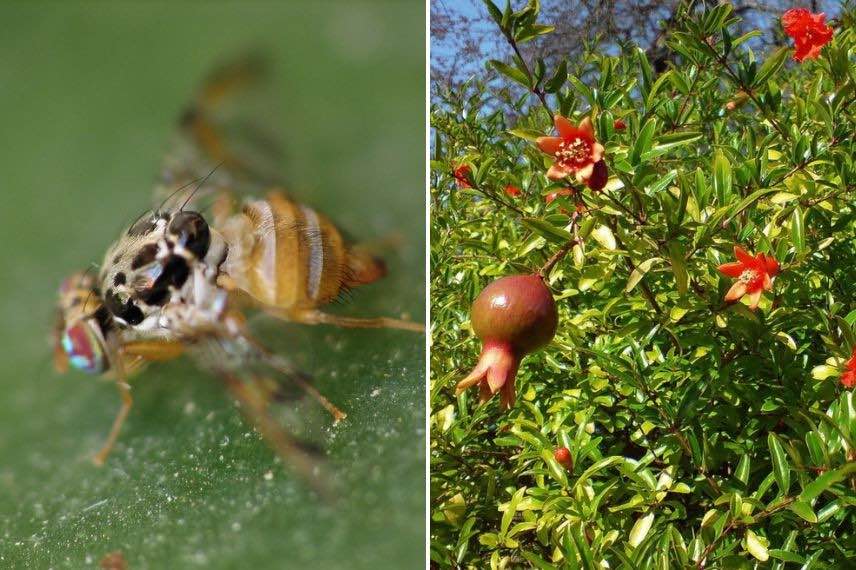
Ceratitis capitata, the fruit fly, targets fruiting pomegranates
Aphids
Description and Symptoms
Aphids, these small, widespread and well-known insects, can attack the young shoots of pomegranate in spring. While their presence is not necessarily problematic, it can affect the younger plants.
By piercing the plant to feed on the sap, aphids can cause:
- a slowdown in growth;
- deformation of leaves and young stems;
- the development of sooty mould, a fungus recognised by its black, sticky substance;
- a decrease in fruit production;
- the development of other diseases in a context of general weakening.
Prevention
Encourage and sustain the presence of garden auxiliaries, known to be natural predators of aphids: ladybirds, lacewings, earwigs, hoverflies, etc.
To do this:
- diversify crops and areas in the garden (meadows, hedges…);
- install natural shelters (dead wood, perforated logs) or, if not possible, insect hotels;
- ban the use of chemical products;
- install a pond;
- etc.
If necessary, you can also introduce these auxiliaries by obtaining breeding kits or by purchasing larvae.
To learn more, consult our articles:
- “Organic pest control in the garden and vegetable patch: beneficial insects”
- “The lacewing, a useful green insect in the garden”
- “The earwig, an overlooked ally for the garden”
- “Welcoming garden insects: 7 shelters to build yourself”
Finally, plant trap plants near your pomegranate that naturally attract aphids and divert them from other crops, such as the nasturtium.
Natural Solutions
In case of a low infestation, dispersing the colony with a simple jet of water may be sufficient. You can also remove them by hand.
In the case of a more advanced infestation, use a natural insecticide:
- mix one tablespoon of black soap in 1 litre of warm water;
- spray on the affected parts at the end of the day.
Note: this treatment, even if natural, is not selective and may impact other insects, including auxiliaries. Use it judiciously.
Setting up a glue collar around the trunks may also be recommended. It stops ants, which love to farm aphids for their honeydew and thus protect them from predators. Again, this device is not selective and may impact other beneficial insects. Use only occasionally.
For more information: “Aphid: identification and treatment”
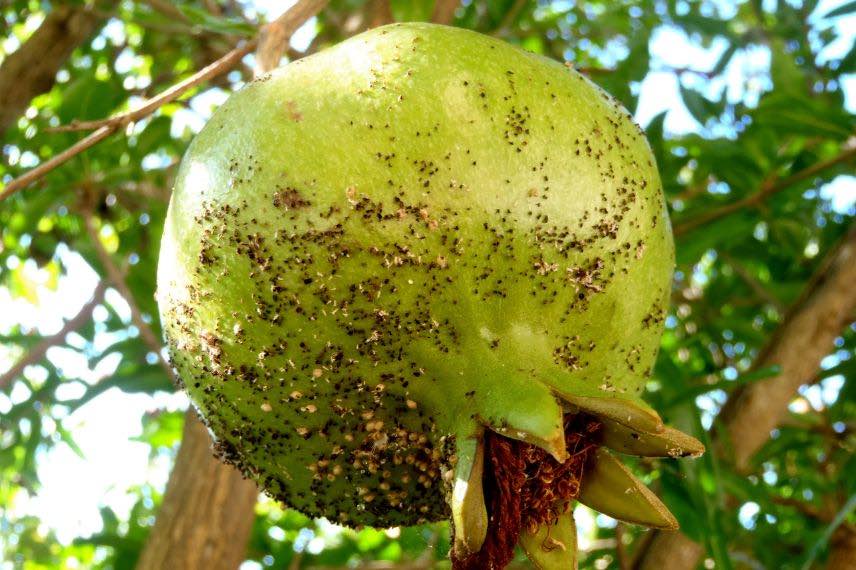
A pomegranate fruit infested with aphids
- Subscribe!
- Contents
Comments