





























Canopy Effect Garden trend, or how to recreate a forest at home
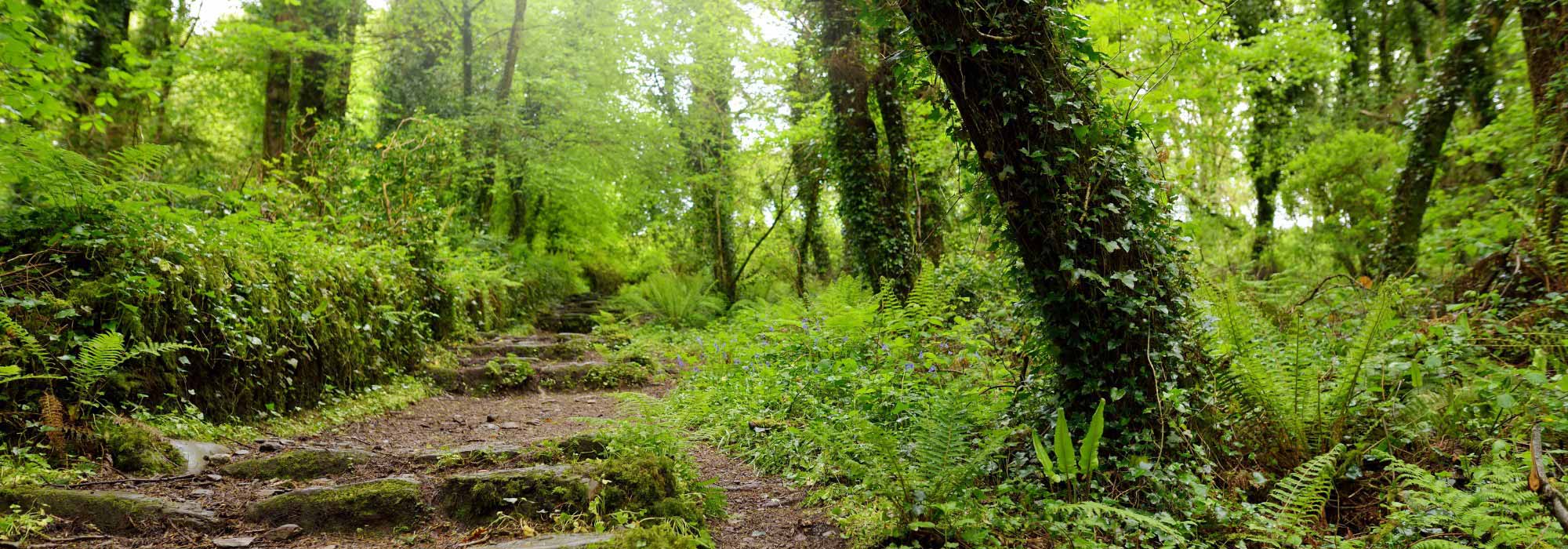
A lush garden inspired by the natural forest
Contents
Once regarded as a force to be mastered, nature is now reassessed and reintegrated, as the perfect setting to showcase our own Eden. Facing an increasingly urbanised world, the renaturalisation trend: mossy vales, tapestries of ferns, birch and hazel clearings, gardens draw inspiration from natural woodlands, and the micro-forest becomes a soothing and refreshing refugium. This type of garden favours wild, organic planting, with shaded areas and miniature undergrowth. Inspired by the principles of the Japanese botanist Miyawaki and Shinrin-Yoku (forest bathing), this approach invites you to create a genuine canopy at home, where biodiversity can flourish freely.
Discover how to create your own canopy and which species to prioritise to create a forest ecosystem, thriving and beneficial to biodiversity!

What is the canopy?
The canopy refers to the uppermost stratum of forests, formed by the treetops. This stratum, bathed in light, constitutes an essential habitat for numerous species and plays a key role in climate regulation. In a garden, creating a “canopy effect” means planting a multitude of trees and bushes in order to reproduce the density and diversity of a natural forest ecosystem. The aim? To provide shade and coolness, foster biodiversity and establish a natural, open and luxuriant landscape.
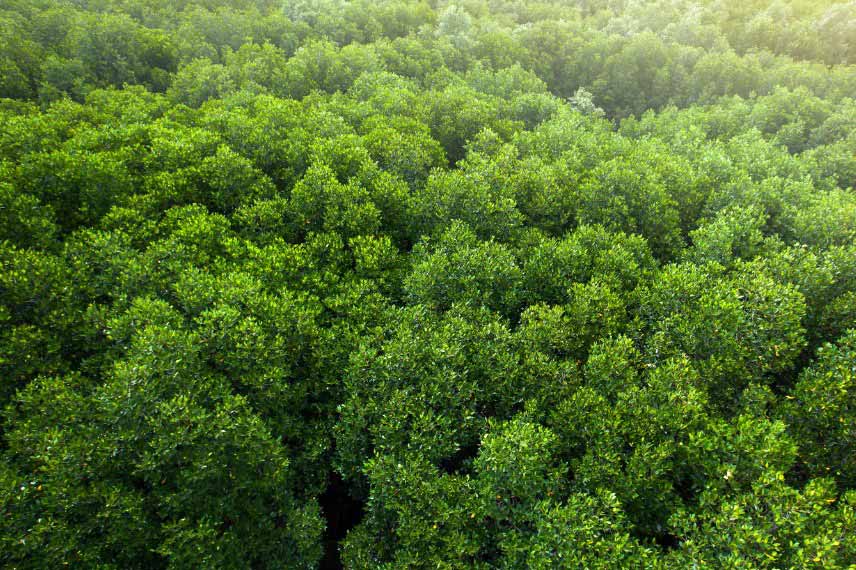
The canopy refers to the uppermost stratum of the forest, at the level of the treetops
Read also
7 Must-have shrubs for a Forest gardenWhere does this trend come from?
This trend sits within a broader movement of renaturalisation of green spaces, inspired by the need to recreate more resilient environments and to foster biodiversity. 67% of millennials already attribute spaces left to nature in their gardens, and 84% wish to grant even more space to this renaturalisation. At the Chelsea Flower Show 2024 (RHS), one of the world’s most prestigious horticultural events, we have identified this integration of forest elements in gardens, in the image of the garden for the National Garden Scheme which celebrated the native British forest, the “Forestbathing Garden” or the “Size of Wales Garden”, which reproduced with 313 plant species a micro-forest tropical. Proof that today the garden tends toward a wilder and more spontaneous appearance. The canopy effect draws on several converging influences:
- The Miyawaki micro-forest concept: Developed by the Japanese botanist Akira Miyawaki, this method involves densely planting trees to accelerate the reconstitution of a forest ecosystem in just a few decades. This approach has gained popularity worldwide, notably in urban environments, to combat deforestation and climate change.
- The return to natural landscapes: Once seen as a force to tame, nature is today rehabilitated. In pursuit of a freer and more spontaneous garden, gardeners now draw inspiration from natural woodlands to recreate a balance where vegetation evolves autonomously.
- The need for well-being and the Shinrin-Yoku trend: Facing the growing stress of our lifestyles, the concept of sylvotherapy, forest bathing (Shinrin-Yoku in Japanese, an ancient relaxation and well-being practice) has heavily influenced this approach. By favouring shade, calm and plant diversity, planting a micro-forest in one’s own garden transforms the garden into a haven of peace that regenerates, where you can enjoy the benefits of a wooded environment every day.
- A response to climate challenges: With rising temperatures and the scarcity of green spaces in cities, creating a canopy in one’s garden becomes an effective solution to cool the air, improve soil quality and promote the absorption of CO₂.
Why planting a mini-forest in your garden?
In 2025, this trend is only accelerating, driven by a growing desire to reconnect our gardens with natural cycles, while creating plant refugia that are soothing and beneficial for the planet as well as for us! This approach helps reintroduce biodiversity and fosters a precious ecological balance. Trees play a key role in storing CO₂, in purifying the air, and in regulating the climate, thus offering a cool refuge, particularly during heatwaves. But beyond its environmental impact, the micro-forest also transforms the garden into a calming space, conducive to relaxation and reconnection with the living world. It allows you to enjoy daily the benefits of a wooded environment without leaving home. This thriving, free and spontaneous space requires little maintenance and promotes a living, fertile soil, making the garden more resilient to climate change.
Read also
How to create a forest garden?Choosing the right location for a canopy
To ensure the success of your mini-forest and promote its harmonious development, site selection is essential. It is not simply a matter of planting trees at random, but of making the most of light and space. Light is a key element in the growth of trees and the structure of a forest garden. That is why it is essential to know the site’s orientation and to adapt to the cardinal directions. Generally, the south is the sunniest area, while the north is shadier. To avoid depriving the smaller plants of light, it is recommended to place the largest trees on the north side of the plot. Whether it is an oak, a chestnut, or a high-stem apple tree, their imposing size allows them to capture enough sunlight, while avoiding casting too much shade on smaller plants.
Then, layer by layer, we proceed, progressively reducing the height of plantings from north to south. Medium-sized trees are placed just in front of the large trees, followed by shrubs and bushes, then low-growing plants and groundcovers, such as ferns and mosses.
It is important to assess the available area, because even in a small garden, it is possible to recreate a wooded effect by playing with heights and plant strata. The quality of the soil also plays a key role; rich, well-drained soil promotes rooting, but some species also adapt to tougher terrains. The creation of a forest litter layer is an essential step. By covering the base of your trees with an organic layer consisting of dead leaves, decomposing wood, twigs, and organic matter, you recreate a favourable forest climate.
To enhance the forest effect, it is preferable to group plantings in a single area rather than dispersing them throughout the garden. Thus, the trees grow together, creating a natural dynamic where each species benefits from the proximity of the others.
→ The Forest Garden by Martin Crawford provides all the keys to creating an edible forest garden in permaculture.
In what form should you present your trees?
Depending on your preferences and budget, you can plant your trees in several ways:
- In pots or containers: Ideal for rapid establishment and a high rate of rooting.
- In bare roots: More economical, but requires autumn or winter planting.
- By sowing (Miyawaki method): A longer-term approach, but very natural and environmentally friendly. Sowing is the method most faithful to the natural process of forest regeneration. Inspired by Japanese botanist Akira Miyawaki, this technique involves sowing directly into the ground seeds of trees and shrubs, thereby recreating a dense and diverse forest biotope. The first step is to select native species seeds adapted to the soil and climate of your region. Initial results are visible after two or three years, and in less than a decade, you can enjoy a genuine mini-forest.
The tip: Opt for fairly dense planting. The closer the young trees are, the more they stimulate each other, growing upwards and developing a forest canopy in record time! Caution: ensure you maintain planting distances between each species (a minimum spacing of 5 to 6 metres for large trees) and anticipate the growth rate of the species; fill empty spaces with understory perennial plants and dry-shade perennials.
Trees in abundance
To recreate a true canopy effect, it is essential to vary species diversity and the strata of vegetation in order to imitate the balance of a natural forest. The tall trees form the backbone of the garden, providing height and structure while casting a beneficial shade. Around them, medium-sized trees and shrubs densify the landscape and ensure a smooth transition to the lower strata. Their varied foliage, deciduous or evergreen, enriches the visual palette and offers a staggered flowering across the seasons.
At their feet, the woodland comes alive with shorter vegetation, where hazel, dogwoods and elderberries intertwine with ease. To reinforce the forest atmosphere, groundcover plants, such as mosses and ferns, which cloak the soil in a green and fresh carpet. The mossy stones and the fern tapestries create soft and immersive transition zones, emphasising this impression of spontaneous and unspoilt nature.
This abundance of vegetation transforms the garden into a dynamic and resilient ecosystem, where each element, from the tree canopies to the ground-covering plants, plays a role in regulating moisture, soil conservation and biodiversity. By judiciously combining different species and letting nature evolve freely, you obtain a living and soothing garden, where you can rediscover the magic of a true forest understory.
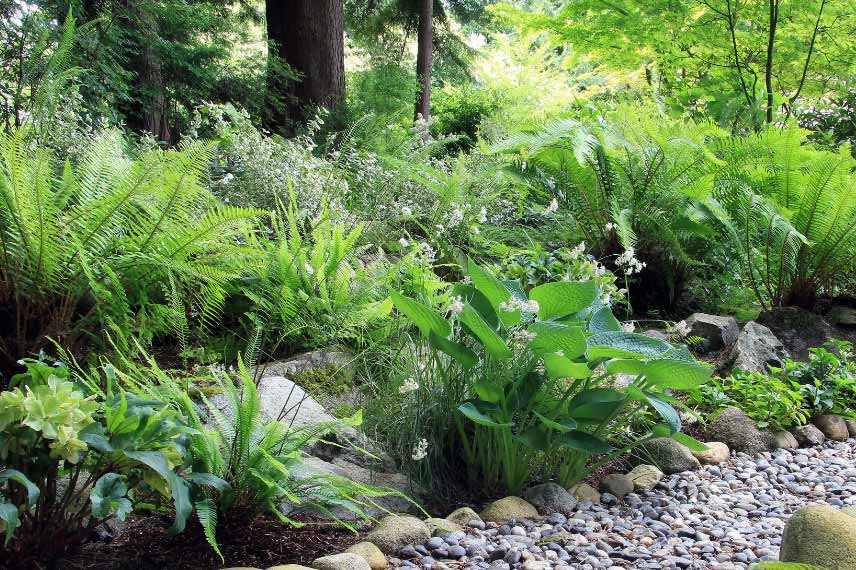
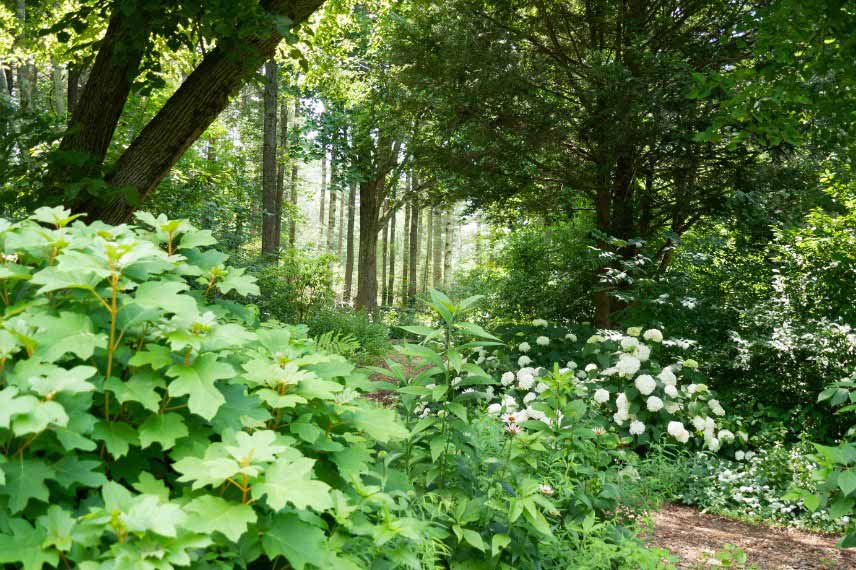
At the base of trees and shrubs, install understorey perennials, such as ferns and hostas
Which trees should you plant to create a forest?
To recreate an authentic forest ambience, it is essential to structure your canopy with different plant strata. Here is a selection of the best species suited to creating a home canopy.
Trees for height and shade
- Oaks (Quercus)
- Maples (Acer)
- Birches (Betula)
- Poplars (Populus alba, Populus tremula)
- Black locust (Robinia pseudoacacia)
- Willows (Salix alba, Salix caprea)
Shrubs to structure the woodland
- Hazel (Corylus avellana)
- Black elder (Sambucus nigra)
- Bloodthorn (Cornus sanguinea)
- Cornelian cherry (Cornus mas)
- Aubépines (Crataegus)
- Blackthorn (Prunus spinosa)
- Wild privet (Ligustrum vulgare)
Woodland plants for a forest ambience
- Male fern (Dryopteris filix-mas)
- Hart’s tongue fern (Asplenium scolopendrium)
- Natural mosses (Polytrichum, Hypnum, Dicranum…)
- Wood anemone (Anemone nemorosa)
- Sweet woodruff (Galium odoratum)
- Melica altissima
- Boehmeria platanifolia
- Geranium sylvaticum
My tip : Plant these plants densely and in varied combinations to recreate a natural balance and an immersive ambience worthy of a true understorey. The greater the diversity, the more resilient your mini-forest will be and the more welcoming it will be to local fauna and flora.
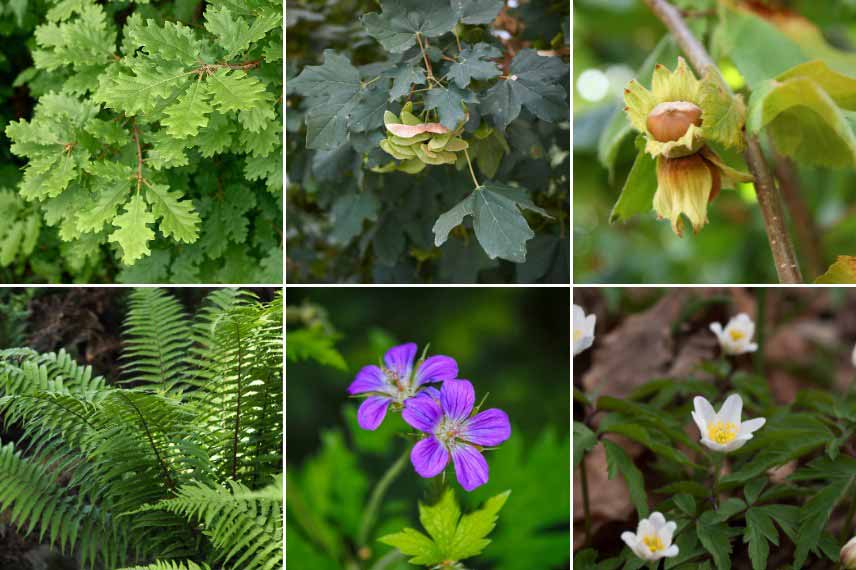
A few ideas of plants to incorporate to create a woodland garden: pedunculate oak (Quercus robur), field maple (Acer campestre), hazel (Corylus avellana), ferns (Dryopteris wallichiana), wood cranesbill (Geranium sylvaticum) and wood anemone (Anemone nemorosa)
- Subscribe!
- Contents
Comments