





























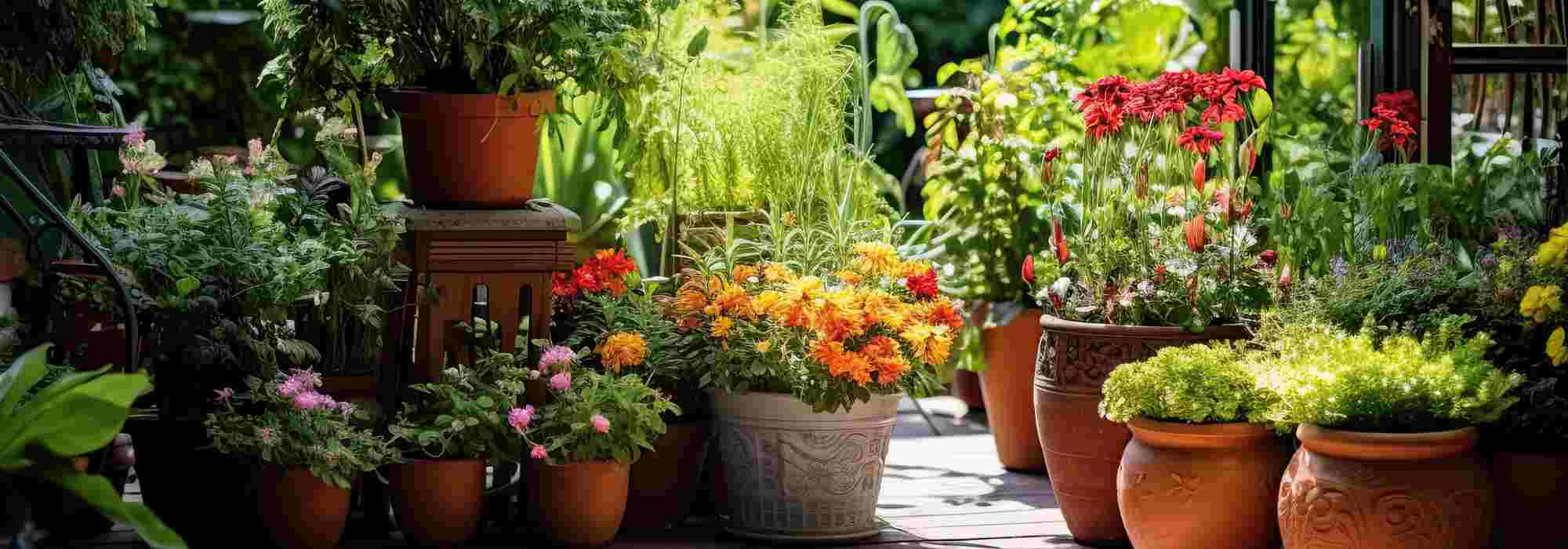
Gardening on a budget: the best plants and tips
Tips for cost-effective and profitable gardening
Contents
Stingy? Miserly? Tightfisted? Penny-pinching? Holes in your pockets? Nonsense! We’re just thrifty.
Many are looking to cultivate their garden without exhausting their savings. Gardening, far from being a luxury, can become an adventure accessible to everyone, rich in discoveries and rewards. You will discover how the wise choice of budget-friendly plants, mastering simple propagation techniques, and the importance of community exchanges can transform your garden into a haven of peace without requiring large investments. From budget-friendly perennials and annuals to propagation tips, and the wealth of exchanges among gardeners, get ready to dive into a world where thrift goes hand in hand with ecology and conviviality. Join us on this verdant journey, and discover how your passion for gardening can flourish without straining your wallet.

We opt for affordable plants
One of the first steps in cost-effective gardening is to choose plants that are inexpensive to buy. Opting for perennials, inexpensive annuals and bare-root shrubs can prove to be a wise strategy to beautify your garden without burdening your budget.
Perennial plants
Perennial plants are an ideal choice for budget-conscious gardeners. Their longevity and their ability to regrow year after year offer an excellent return on investment. Among the most affordable options, you can find perennial daisies (Leucanthemum), the little periwinkle, sedums or orpins, the bugles, gaura or hardy geraniums. These plants are not only economical to buy, but they also require little maintenance, which helps you save in the long term. Of course, prices depend on the pot size, but also on the chosen variety.
→ Find all our low-cost perennials.
Did you know? More and more perennials are offered as bare roots in autumn and spring, a sure-fire deal!
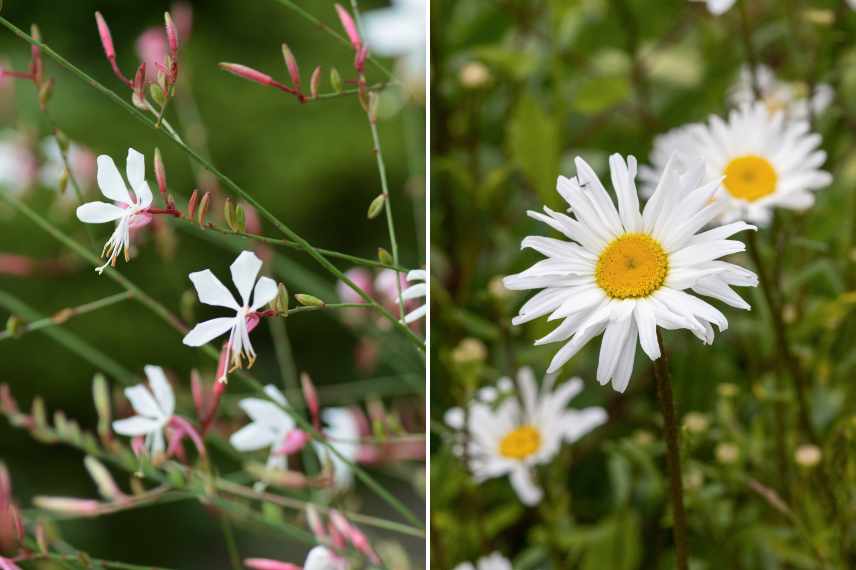
Gaura and daisies
Annuals
Annuals, for their part, are perfect for adding colour and variety to your garden without spending much on seeds. Species such as calendula (Calendula officinalis), nasturtium (Tropaeolum majus), cosmos (Cosmos bipinnatus), Damask Nigella (Nigella damascena) and the zinnia (Zinnia elegans) offer excellent value for money. They are sown directly in place and bloom abundantly all season, providing a spectacular display of colour for a minimal investment.
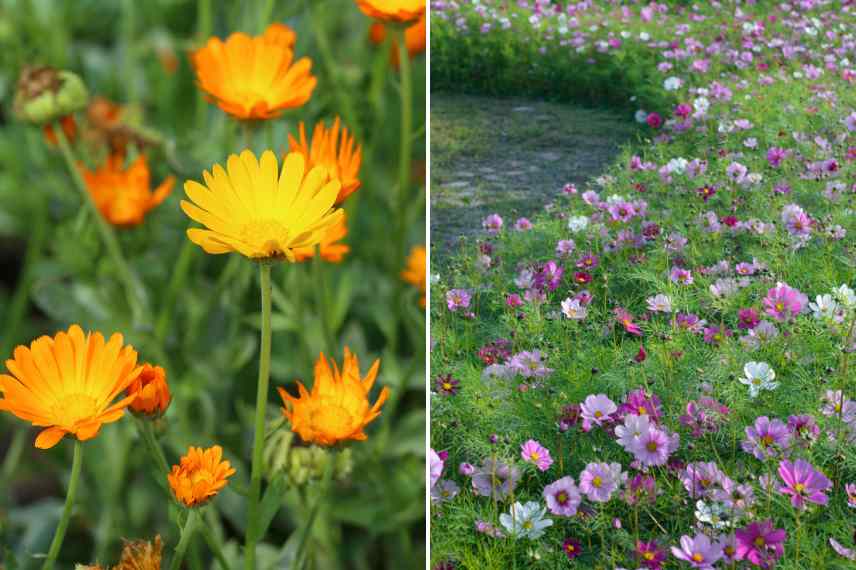
Calendulas and cosmos
Bulbs
Among the cheapest bulbs, the best-known spring bulbs include Galanthus (snowdrops), narcissus, muscari, crocus, and some tulips…
→ We offer a wide range of affordable spring bulbs, discover them quickly.
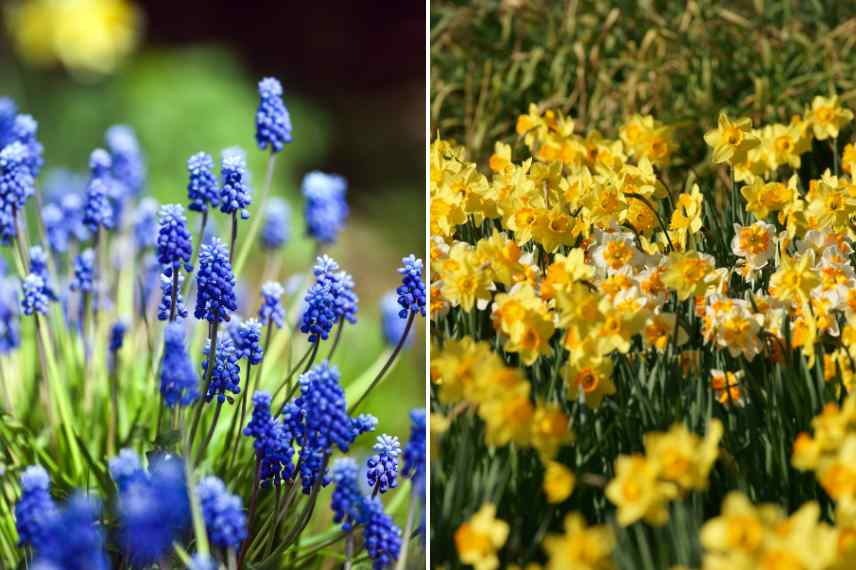
Muscari and narcissi
Trees and shrubs
Finally, bare-root shrubs and trees represent a cost-effective option compared with those sold in containers. Buying bare-root shrubs during their dormancy period (autumn to early spring) can significantly reduce costs. Alternatively, choose younger specimens, thus in a small container volume (1 L pot or even a 9 cm pot) is also a good option for fast-growing shrubs. Among the economical and hardy shrubs, forsythia (Forsythia x intermedia), common lilac (Syringa vulgaris), Amelanchier lamarckii or dogwood are sensible choices. These bare-root shrubs adapt well once planted, promising growth and spectacular flowering with a modest initial investment.
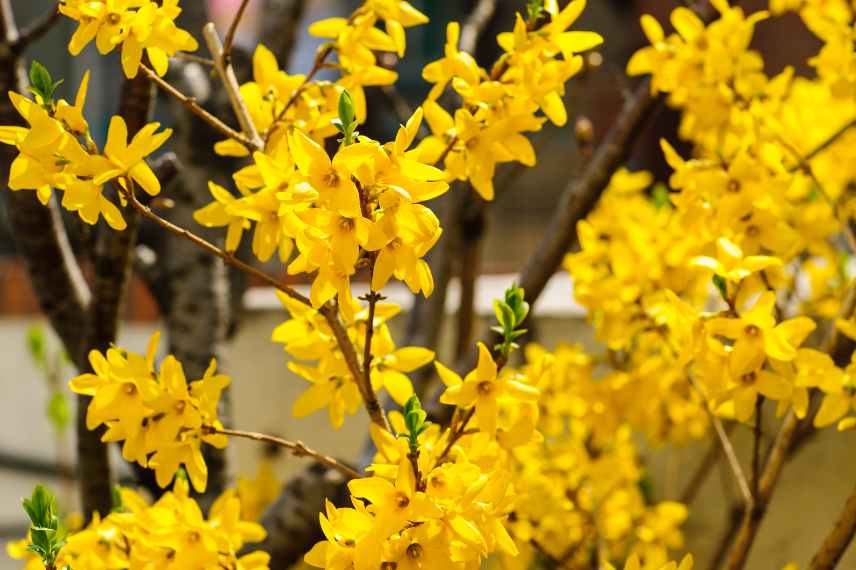
Forsythia x intermedia affordable shrubs
→ Discover our selection of affordable trees and shrubs.
In the vegetable garden and orchard
To keep costs to a minimum in the vegetable garden, we will opt to sow seeds rather than buy plants. Moreover, if you can save your own seeds year after year, it will be even better. Finally, perennial vegetables represent an excellent investment.
In the orchard, if possible, opt for bare-root plants.

Encore mieux : récoltez vos propres graines !
We choose profitable plants
Some plants are inexpensive to buy, but others stand out for their ability to offer either an excellent yield for vegetables and fruit crops, or a tendency to colonise space in a short time: they are said to naturalise. We’ll mainly discuss these latter ones, while setting aside invasive species.
This is the case for plants that thrive in your garden, including the Erigeron karvinskianus, Buenos Aires Verbena, Geranium macrorrhizum, lily of the valley, Red valerian, Cyclamen coum, the comfrey (Symphytum officinale), hellebores… and many more… A small tip: when browsing our online shop, feel free to tick “naturalise” in the filter “ornamental interest”.
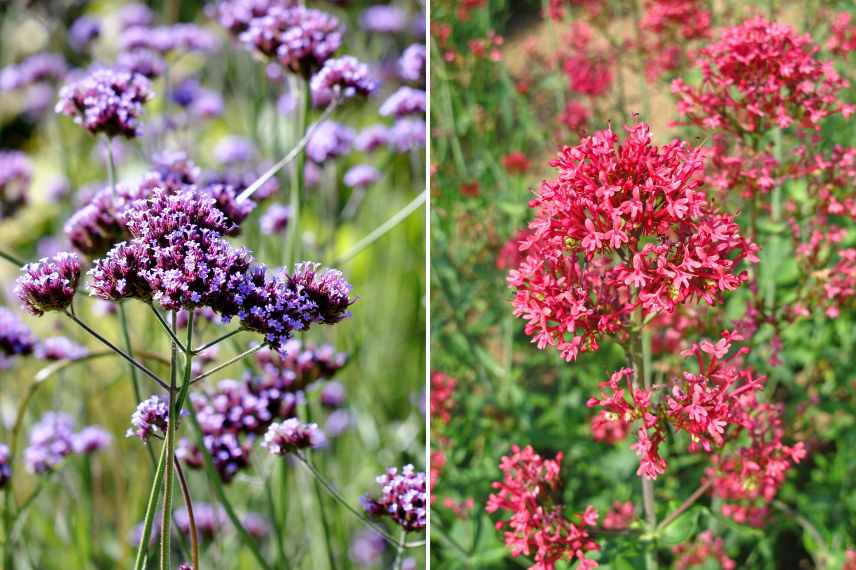
Verbena bonariensis and Centranthus ruber
We propagate like mad!
Sowing is often the starting point for many plants. This technique, simple and inexpensive, allows producing a large number of young plants from seeds harvested the previous year or exchanged with other gardeners. It offers the satisfaction of watching a plant grow from its very beginning, in addition to enabling natural selection of the hardiest and best-adapted specimens for your environment.
The propagation by cuttings, for its part, involves faithfully reproducing a mother plant from its parts (stems, leaves or roots). This method is particularly useful for species that do not readily germinate from seed or for those from which we wish to preserve the precise characteristics.
The layering, though less well known, is an effective technique for plants difficult to propagate. It involves the formation of new roots on a part of the plant still attached to the mother plant, thereby ensuring a smooth transition to independence.
These multiplication methods reduce the costs associated with buying new young plants and enable more thorough customization of the garden by selecting and propagating the most desirable or best-suited plants.
Oli’s little note : Nature is generally well made. Keep an eye out for trees, shrubs and perennials that have self-seeded (like giants!) in your garden. It’s always a bonus, and if they have self-seeded in your soil, it means they are well adapted to your soil. You’ll simply need to move them (or not!) to the spot that suits you.
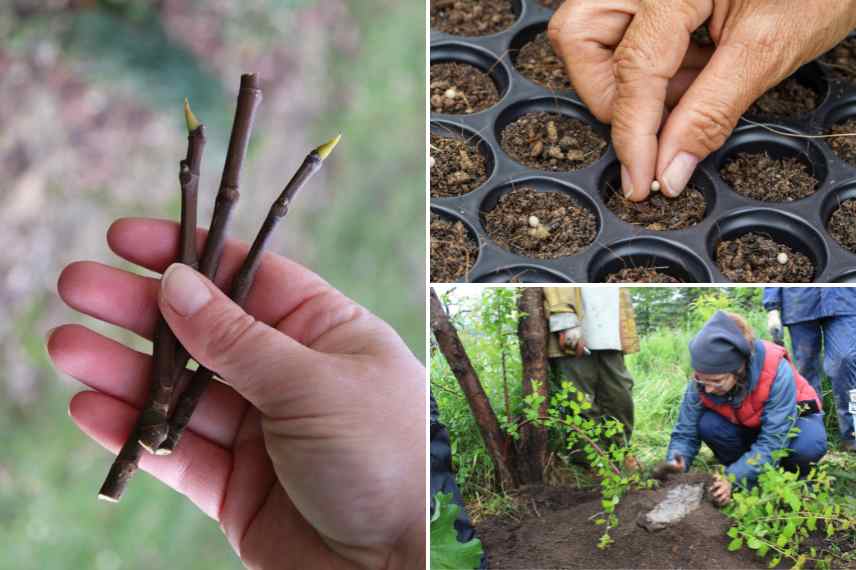
Cuttings, sowing, layering: three techniques to multiply your plants for free
We swap tips among gardeners
It’s well known that gardeners are friendly and generous. The exchange between gardeners is rooted in tradition and is growing today thanks to initiatives such as seed libraries, plant swaps, and cuttings exchanges, which facilitate the sharing of resources and knowledge among enthusiasts.
Seed libraries, often located in public spaces such as libraries or community gardens, allow gardeners to drop off and take seeds for free. This system promotes the conservation of local varieties and encourages gardeners to experiment with new species without any financial outlay.
Plant swaps and cuttings exchanges, for their part, are convivial events where participants swap plants, cuttings or seeds. These gatherings are not only opportunities to acquire new plants at no cost, but they also provide a space for exchanging tips and tricks among gardeners, thereby strengthening the community bond.
By sharing resources, knowledge and experiences, gardeners contribute to a mutual-aid system that broadens access to a wider diversity of plants for all, while reducing the costs associated with maintaining and expanding gardens. This collective approach encourages a more sustainable and cooperative approach to gardening, where resources are optimised and experiences shared, thereby enriching gardens and the relationships between gardeners.
Oli’s little note: we can also consider upcycling and donations from environmental organisations. Some plants that are more saleable for various reasons are sometimes given away or sold at a reduced price by nurseries or garden centres, whereas these plants deserve a good life in our gardens rather than ending up in the compost heap. Don’t hesitate to ask the professionals near you; it costs nothing to ask. Moreover, every year, environmental conservation organisations donate native trees and shrubs in autumn as part of hedgerow and orchard replanting projects… Keep an eye out for these awareness days!

- Subscribe!
- Contents
Comments