


Growing a Pieris in a pot
Our tips for successfully growing Japanese Andromeda on a terrace or balcony
Contents
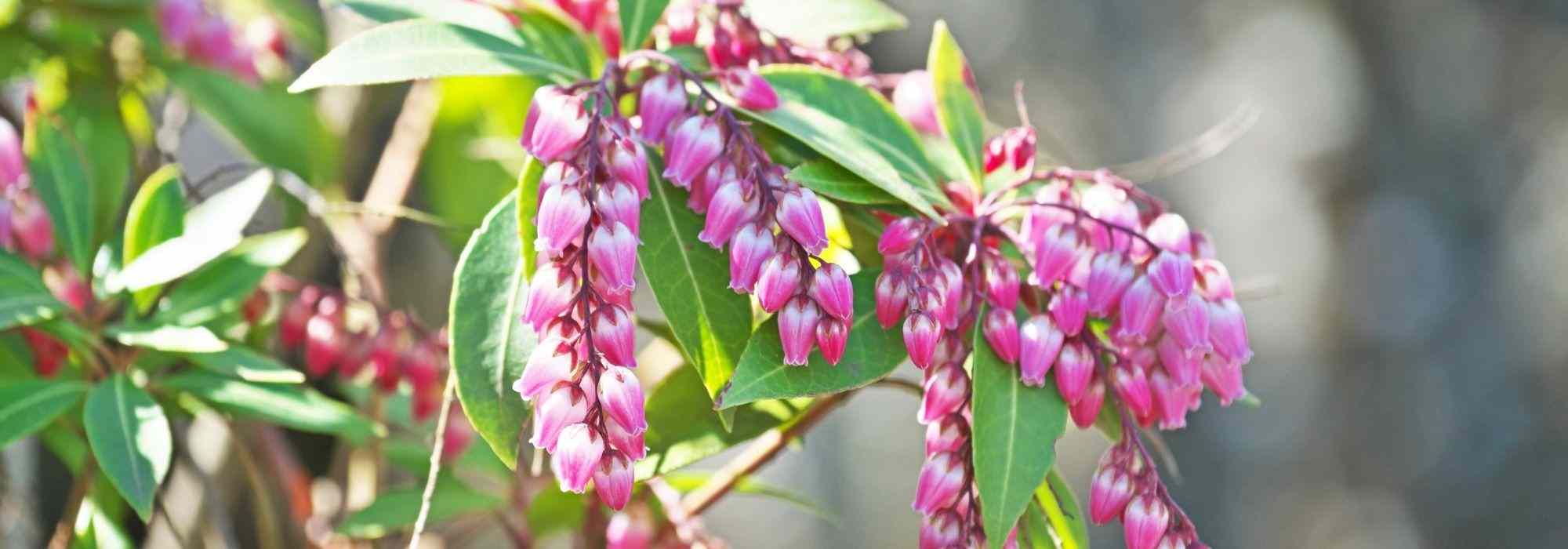
Very ornamental, Pieris, also known as Japanese Andromedas, are heather soil shrubs that are very easy to care for and belong to the Ericaceae family, boasting numerous advantages.
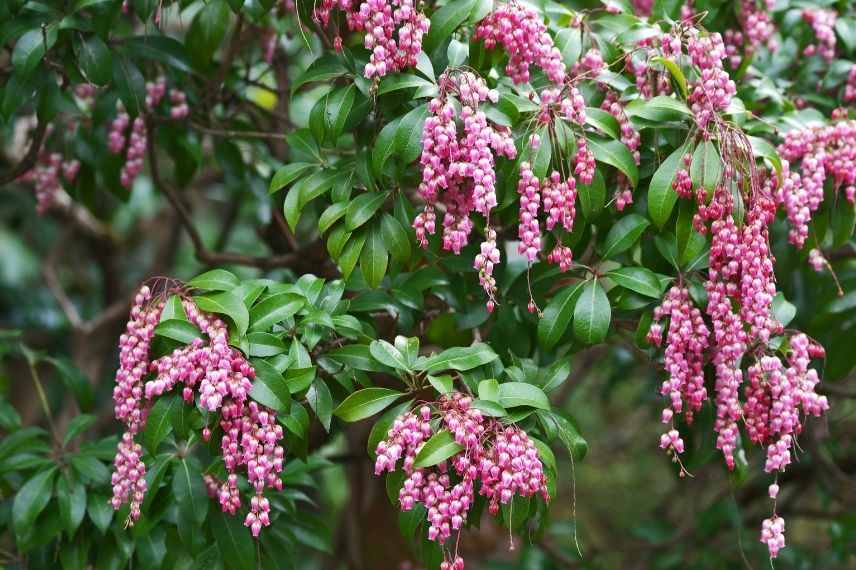
Fairly drought-resistant and able to withstand frost down to -15°C, they are also extremely decorative in the garden or on a terrace, provided they are placed in partial shade. In spring, the young leaves of many varieties display vibrant colours, followed in April-May by an abundant flowering of bell-shaped blooms, usually white or slightly pink. The oblong leaves of Pieris are also evergreen, giving the bush an ornamental appearance throughout the year.
In short, Pieris is a small bush ideal for growing in a pot on a terrace!

When and how to grow Pieris in pots?
As with most bushes, the ideal planting seasons for Japanese Andromeda are spring and autumn. The temperatures are neither too hot nor too cold, and the humidity is generally sufficient to promote good rooting of the plant.
You should place the pot in partial shade to keep the soil cool, especially in the south of the country. In the northern part, it can tolerate non-burning sun. Be aware that if you place it in the shade, its flowering will be somewhat less abundant. On the other hand, it prefers sheltered situations from the wind.
Read also
Diseases and pests of PierisPot type and dimensions
You can choose from different types of containers. The important thing for Pieris is that the soil around its roots remains moist, meaning it should not dry out. However, ensure that the chosen pot has adequate drainage.
The most important aspect regarding the pot is to size it according to the mature height of the variety you have selected, which will save you the hassle of repotting. For example, for a small Pieris like Pieris japonica ‘Little Goldy’, which reaches 50 cm in height at maturity, a pot that is 40 cm in height and diameter will be suitable. For a larger specimen, such as Pieris japonica ‘Purity’ with its stunning white flowers, opt for a larger and deeper container to allow for proper growth. That said, it is important to know that Pieris is a shrub with relatively slow growth. If you place it in a pot that is modest in size compared to its adult dimensions, it may not develop as well and remain quite small.
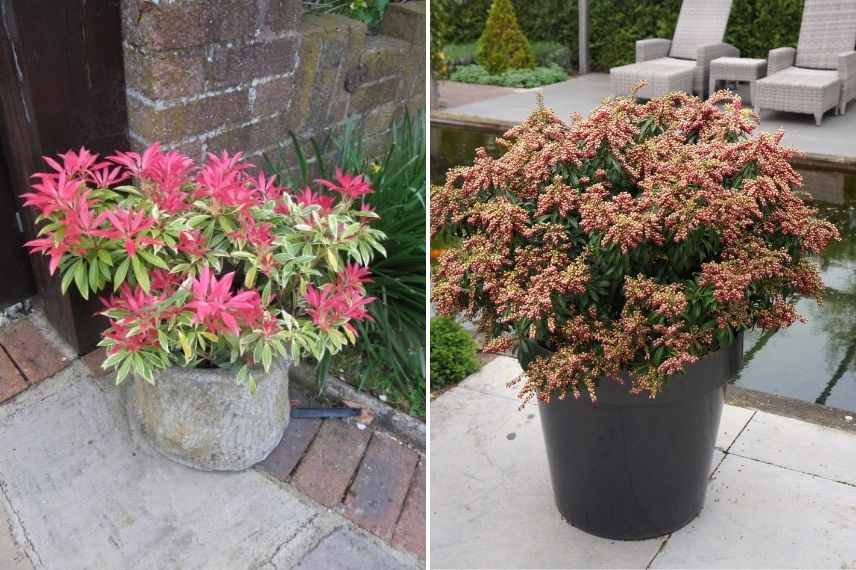
Adjust the size of the container according to the chosen variety (photo left Leonara Enking – Flickr; photo right Denolf)
Discover other Pieris
View all →
Available in 0 sizes
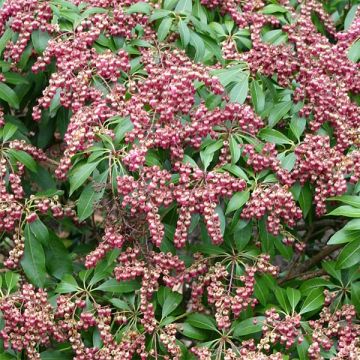
Available in 2 sizes
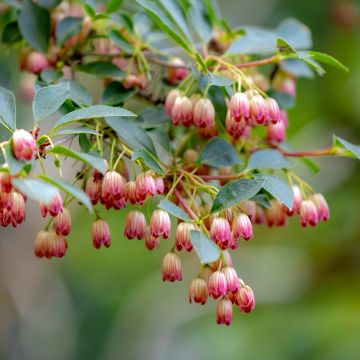
Available in 2 sizes
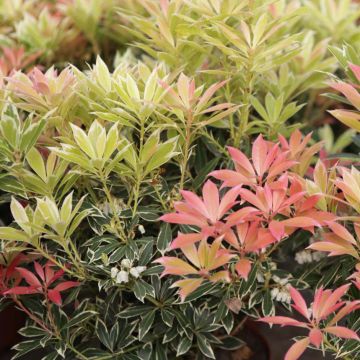
Available in 2 sizes
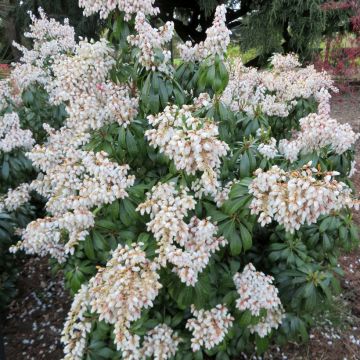
Available in 1 sizes
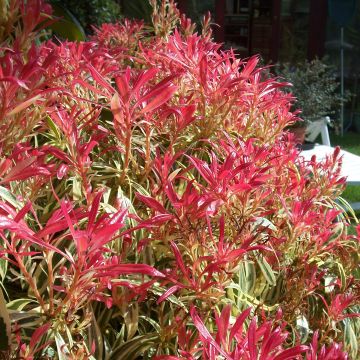
Available in 2 sizes
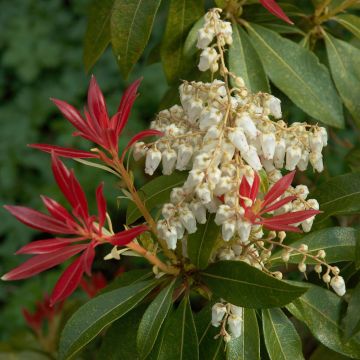
Available in 3 sizes
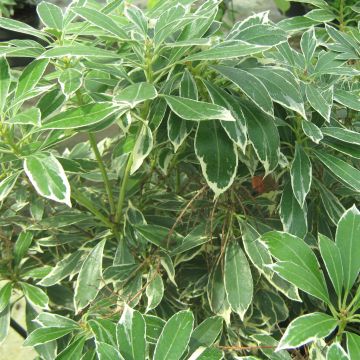
Available in 1 sizes
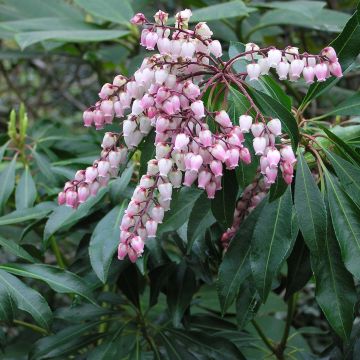
Available in 1 sizes
Available in 1 sizes
Substrate
As we mentioned, Pieris japonica is a heather soil bush that therefore prefers slightly acidic soils.
At the bottom of the container or pot, provide a drainage layer made up, for example, of clay balls.
Then fill the container with a mix of potting soil and heather soil. There is no need to use only heather soil, as the pH of potting soil is generally slightly acidic itself.
How to plant Pieris in a pot
Once the drainage layer is placed at the bottom of the container – pot or trough – start filling with a mixture of potting compost and heather soil, place your Pieris and fill around the root ball with the same soil mixture.
Feel free to add some homemade or commercial compost to the planting, as Japanese Pieris appreciate rich, humus-bearing soils. A shovelful on the surface will do.
Finally, water generously at the base and mulch with 5 good cm of bark or pine needles, as this material is particularly suitable for ericaceous plants because it adds acidity as it decomposes very slowly. Other organic mulches may also be suitable.
Varieties of Pieris for Container Cultivation
Pieris japonica, or Japanese Andromeda, is a relatively small bush, rarely exceeding 2 m in height. Most varieties are therefore suitable for pot cultivation for smaller specimens or in containers for larger ones.
For a small balcony, you might choose dwarf varieties such as Pollium-leaved Andromeda Andromeda polifolia ‘Blue Ice’, which reaches only about 30 cm in height and 40 cm in spread at maturity, featuring beautiful fine foliage with bluish tones, or the Japanese Andromeda ‘Little Heath’, which has a compact habit reaching 60 cm at maturity and is distinguished by its stunning variegated foliage of green and cream white, with young shoots that are coppery pink in spring.
In a container on a terrace, you will have the option to choose larger varieties that can reach 1 to 1.5 m in height. The Pieris japonica ‘Flaming Silver’, for example, can serve as a small screen at 1.2 m, notable for its variegated evergreen foliage whose colours change with the seasons and its abundant spring flowering. The Pieris japonica ‘Forest Flame’ is slightly taller at maturity, reaching 1.5 m, and its young foliage, before turning green, will be red and then coral pink in spring. Additionally, it rewards us with its abundant white bell-shaped flowers in spring.
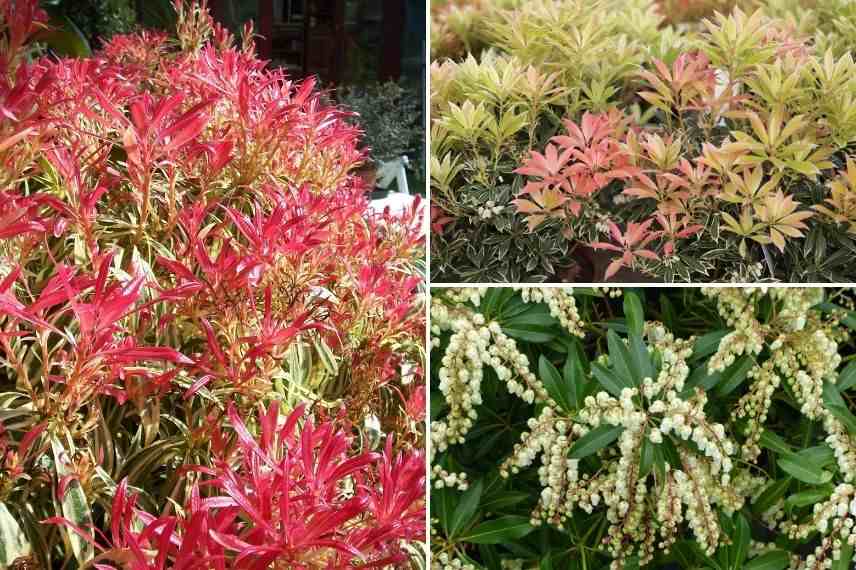
Pieris japonica ‘Little Heath’ (photo Leonora Enking), Pieris japonica ‘Flaming Silver’ (photo Denolf) and Pieris japonica ‘Forest Flame’
Watering, fertilising and maintenance
Pieris loves coolness. It will therefore need to be watered regularly. This is especially true for potted specimens where the soil tends to dry out more quickly. Water on average every 15 days, or even weekly during hot weather. And above all, remember to generously mulch around the base of the Pieris to minimise evaporation. Be meticulous with watering, especially in the first year, to ensure the plant establishes well.
In autumn, a feed specifically designed for heather soil bushes will be welcome. You can also simply add homemade or commercial compost. Japanese Andromedas need rich soil to thrive.
You will notice that over time, the soil in the pot compacts. Add heather soil to help maintain the acidity of the soil’s pH.
As Pieris have a slow growth rate, it is not really necessary to prune them. However, you can shorten the stems that have flowered by a third to prevent the plant from exhausting itself and to maintain a compact habit.
For everything you need to know about growing Japanese Andromeda, check our guide Pieris japonica: Planting, pruning and maintenance.
- Subscribe!
- Contents
Comments