


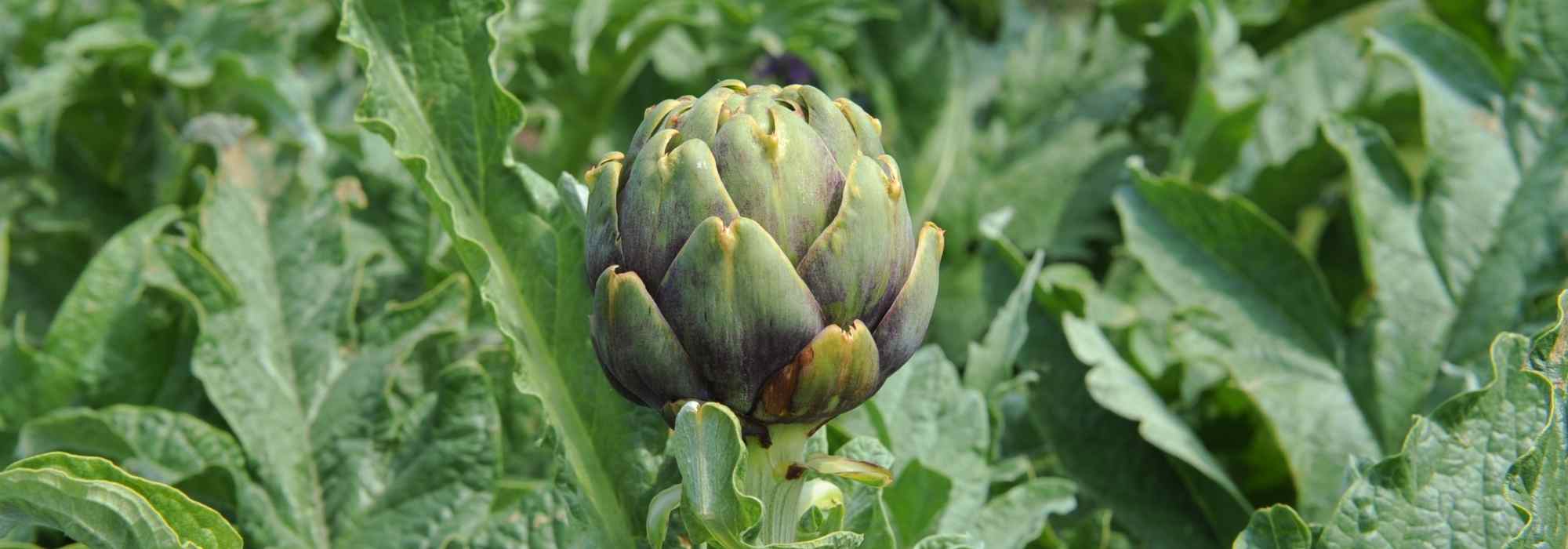
Growing artichokes: a medicinal plant with numerous health benefits
Discover the health benefits of artichokes
Contents
Artichoke (Cynara scolymus), we enjoy its leaves—or rather its bracts!—and its heart, eaten hot in barigoule or cold with a vinaigrette. But did you know that this edible perennial plant in the Asteraceae family has benefits for the body’s balance? Indeed, while the artichoke has long been regarded as an aphrodisiac, and also a remedy for digestive troubles, in the early 20th century doctors confirmed its value in phytotherapy, among other things for the hepatobiliary system.
Let’s discover the health benefits of artichoke for the body, the different preparations and uses, and its contraindications.
Further reading : Artichoke: planting, sowing, growing and care.

What are the nutritional benefits of artichokes?
Eating artichokes is good for the taste buds, and also excellent for wellbeing! In fact, Artichokes are a vegetable containing a remarkable cocktail of micronutrients, vitamins and minerals:
- It is a good source of vitamins, including vitamin B9 (folate), but also vitamins K, B1, B2, B3, B5 and B6, and C
- It is rich in minerals, particularly potassium, calcium and magnesium, but also iron, copper and manganese, with antioxidant properties
- It contains a wide range of antioxidants and, in particular, phenolic compounds (chlorogenic acid, cynarine…), flavonoids and anthocyanin derivatives
- It contains inulin, a non-digestible sugar, considered a prebiotic
- It is extremely rich in dietary fibre, soluble and insoluble
- It is nutritious while being low in calories (47 kcal per 100 g), as it is low in macronutrients (protein, carbohydrates, fats). It is therefore ideal for those who are overweight or have diabetes.
- It is rich in water (86%), making it beneficial for hydration of the body. Its high water content and its potassium level also make it a diuretic food.
Consuming artichoke flower buds is therefore a good idea. Moreover, whether raw or cooked, they pair with many ingredients. But it is important to note that a cooked artichoke should not be kept for more than 24 hours. Indeed, it oxidises very quickly and becomes indigestible, even toxic.
By contrast, the active constituents of artichoke are mainly contained in its leaves.
How to use artichoke in phytotherapy?
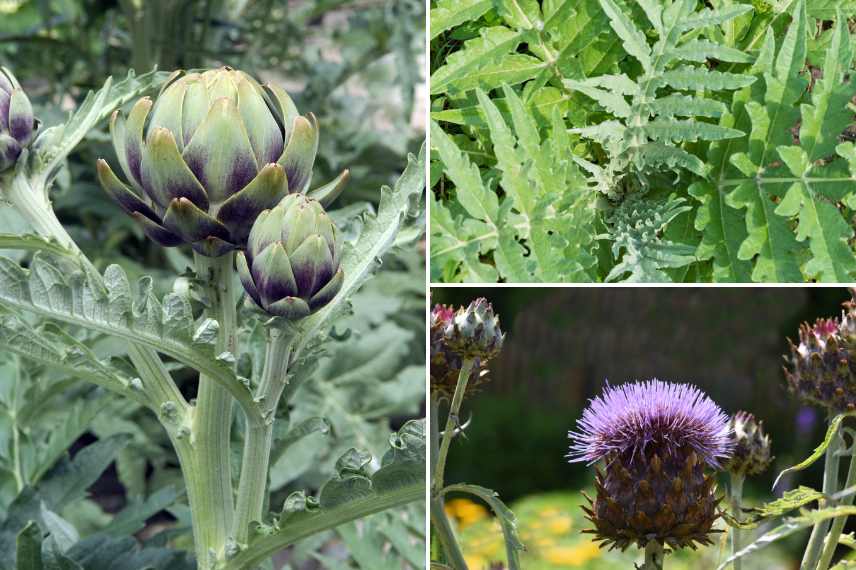
In phytotherapy, only the leaves and, occasionally, the stems are dried for use. Naturally, this refers to the true, finely divided leaves, grey-green in colour, that arise from the base of the plant. And not the bracts on the flower heads, which are eaten before the heart.
These leaves are harvested in spring, before flowering, on a dry morning. They can be air-dried in a dark, well-ventilated room. First spread them on racks and regularly check that there is no sign of mould. The oven can also be used, set to 40°C with the door ajar, or a dehydrator.
After drying, the leaves should retain their grey colour. For easier storage, they can be crumbled.

The active constituents of artichokes are contained in the leaves (left), not to be confused with the bracts of the flower buds (right)
For more information : When and how to dry artichoke leaves?
Now, to their use:
- Artichoke leaf infusion: one tablespoon of dried artichoke leaves in a large cup of water. Let infuse for 15 minutes in boiling water, then, if desired, add a little honey to counter the bitterness. Three cups daily before meals
- Artichoke leaf lotion for skin prone to itching, irritation or eczema: one tablespoon of dried artichoke leaves, one tablespoon of dried burdock leaves and 250 ml cold water. Add the leaves to the water and bring to a boil. Simmer gently for 10 minutes, then infuse, covered, for five minutes. Strain by pressing the leaves and allow to cool. To be used as a lotion, or as compresses for thirty minutes.
- Diuretic juice with fresh leaves: harvest one leaf and pass it through a juicer to obtain one tablespoon of liquid. To be drunk morning, noon and night, before meals, diluted in a glass of water sweetened with agave syrup
- Consuming the cooking juice of artichokes: simply keep the water in which the artichoke heads are cooked. It can be consumed hot or cold, within 24 hours of cooking.
What are the health benefits of artichokes for the body?
Artichoke offers numerous benefits. It is a plant rich in phenolic compounds (caffeic acid, chlorogenic acid, cynarine…) with antioxidant properties, in anthocyanins, in flavones, in numerous minerals, in soluble fibres (notably inulin) and in vitamins.
Liver disorders :
Dry artichoke leaves are recognised for their hepatoprotective properties. Indeed, they support liver function by stimulating bile production and its discharge, meaning they are choleretic and cholagogic. They thus enable liver detoxification, and thereby protect the body from infections. These large leaves with a very bitter flavour have long been known for these virtues.
Digestive disorders :
Artichoke is also known to aid intestinal transit, reduce bloating, constipation or diarrhoea through its fibre content. Among these fibres, inulin is believed to be effective in reducing pain associated with irritable bowel syndrome. Specifically, inulin has the ability to “nourish” the bacteria present in the gut microbiota, and thus restore the proper balance of intestinal fibre.
More simply, it can relieve digestive discomfort, for example after a festive meal, or the heaviness of the stomach.
Lowering blood cholesterol levels :
Again, the action of soluble fibres such as inulin, but also cynarine, can lead to a reduction in the levels of “bad” cholesterol in the blood. Cynarine, which promotes bile production, helps to eliminate cholesterol from the body. In so doing, it plays a non-negligible role in protecting against cardiovascular diseases.
Relief from rheumatism and gout :
It is artichoke juice, consumed as a herbal infusion, that helps relieve pain associated with rheumatism or gout.
Effects on the skin :
Artichoke is an excellent tissue-renewing agent, thanks to its polyphenols. These compounds protect the lymphatic vessels and improve the elasticity and drainage of the skin. It therefore helps combat ageing of the skin and helps prevent the appearance of acne.
What are the contraindications for artichoke?
Because it inhibits milk production, artichoke is not recommended for pregnant women. In addition, it could make the milk taste bitter.
People with biliary obstruction or gallstones should avoid consuming artichoke leaves.
And while it is recognised for alleviating digestive disturbances, it can also cause bloating or gas in some people.
Finally, artichoke, belonging to the Asteraceae family, alongside ragweed, leopard’s bane (Arnica montana) or feverfew (Tanacetum parthenium), artichoke leaves can be allergenic. They cause dermatitis and respiratory allergies.
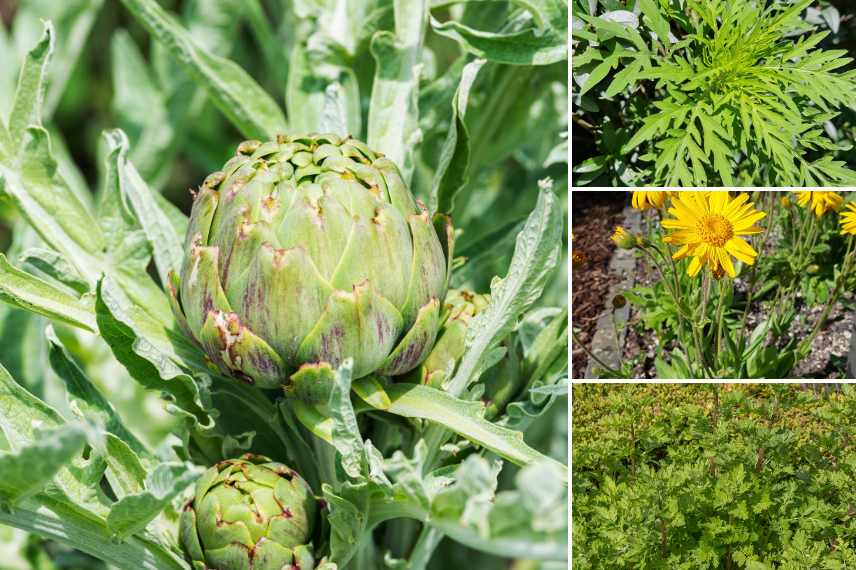
As a member of the Asteraceae family, artichoke presents a potential allergy risk (as with ragweed, leopard’s bane (Arnica montana) or feverfew (Tanacetum parthenium))
Did you know?
At the origin of the artichoke, the thistle! Prehistoric men already extracted the capitules, the edible heart with a very delicate flavour. Gradually, these thistles were domesticated and consumed throughout Antiquity. Before falling into obscurity until the Middle Ages. Gardeners then sought new cultural techniques to develop, on the one hand, the flower and the head, and, on the other hand, the petiole and the main vein. Thus the artichoke and the cardoon came into being as we know them today. Moreover, the Latin names of these vegetables still underline their kinship: The artichoke is named Cynara scolymus, the cardoon Cynara cardunculus.
But let us focus on the artichoke, which is said to have arrived via Naples or Sicily, and then reached the south of France around 1466. It was a rare, even prized and refined delicacy, widely consumed by Catherine de’ Medici. In the sixteenth century, they were regarded as fruits. In the nineteenth century, the artichoke finally reaches its zenith. Today, it remains widely consumed in Italy.
Beyond its medicinal virtues, the artichoke is also a plant with strong dyeing potential. Indeed, its leaves of this plant in the Asteraceae family produce a very stable and bright lime-yellow colour.
- Subscribe!
- Contents
Comments