





























Growing Pseudopanax in pots
To enjoy this exotic and tender bush
Contents
The Pseudopanax is an original and rarely grown bush with 7 quite different species. The Pseudopanax ferox is the most well-known and unusual, with its very straight trunk and linear leaves pointing downwards. The various Pseudopanax species prefer mild and humid climates, drawing from their New Zealand origins. Pot cultivation allows for careful selection of their substrate, as they do not appreciate either calcareous or heavy soils. This also enables them to be brought indoors during winter, as they are quite sensitive to cold. They can also be grown in a temperate greenhouse all year round.
Very graphic, the Pseudopanax ferox is one of the strongest choices among outdoor plants for contemporary terraces and modern decor. Discover our tips for successfully growing this plant in a pot.

Which variety of Pseudopanax to choose?
Pseudopanax are beautiful outdoor plants for balconies and terraces. Their evergreen foliage is ornamental and quite robust.
If you have a garden, pot planting of Pseudopanax can be wise if your soil is heavy and chalky and/or if you live in a region where temperatures drop below -5 °C to -7 °C in winter.
Pseudopanax have a fairly rapid growth rate. Both Pseudopanax ferox and P. crassifolius retain their juvenile form for quite a long time, for many years. In pots, their growth is also more limited than in the ground. Based on this principle, all Pseudopanax can be planted in pots.
The Pseudopanax ferox, with its astonishing skeletal appearance, or the Pseudopanax crassifolius, only take up space vertically.
The Pseudopanax laetus and P. lessonii are, on the contrary, already ramified when young, having a broader and bushier form than other species. The Pseudopanax lessonii ‘Goldsplash’ features bright variegated foliage of yellow and green, while the variety ‘Dark Star’ has fine, dark green to purple leaves that are beautifully graphic. The Pseudopanax lessonii ‘Goldfinger’ develops very golden, fine foliage. The foliage of ‘Bronze Eagle’ resembles that of Pseudopanax ferox.
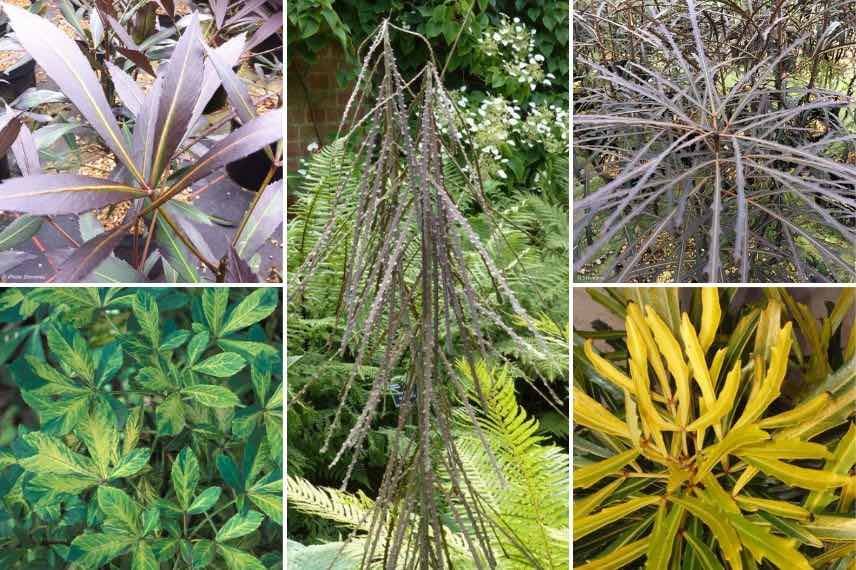
Clockwise: Pseudopanax lessonii ‘Dark Star’, Pseudopanax ferox, then the lessonii cultivars: ‘Bronze Eagle’, ‘Goldfinger’, and ‘Goldsplash’
What type of pot? What size?
For Pseudopanax, avoid terracotta pots, as they are porous and water will evaporate more quickly. It is a very good material, suitable for many plants, but for Pseudopanax, opt for a plastic or resin pot to keep the substrate cool for longer and reduce watering. The pot must always have drainage holes at the bottom to prevent standing water.
Choose a container that is about three times the size of the root ball. For bushes, it is important to think big, around 50 cm in diameter and nearly the same in depth.
What substrate?
Compose a draining substrate, incorporating a soil mix with good moisture retention and fertile components. A mixture of compost, soil and sand is well suited. For example, mix 1/3 of river sand with 1/3 of well-decomposed compost and 1/3 of high-quality soil. You can adjust these proportions, but do not go below 20% sand. If you do not have access to compost, replace it with soil. The quality of the soil is a crucial ingredient for successful pot planting.
Ensure drainage at the bottom of the pot using clay balls, pumice, or gravel. Also, consider an organic mulch for the top of the pot, as this will help keep the substrate fresh for longer.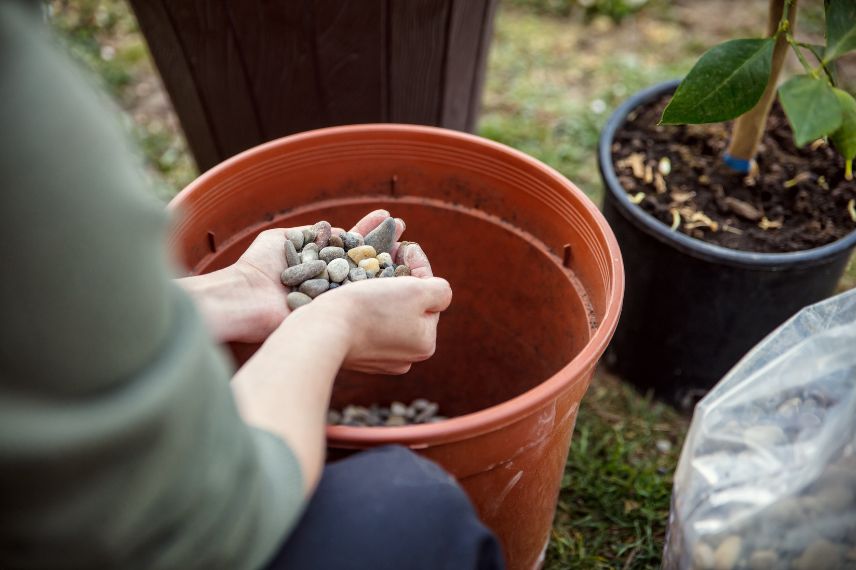
Read also
How to design a tropical garden?When and how to plant?
Plant the Pseudopanax in spring, when frosts are no longer a concern, starting from May.
For planting, proceed as follows:
- Remove the root ball from its nursery container and untangle the roots if necessary.
- Soak it in a basin of water while preparing your pot.
- Pour a drainage layer of a few centimetres at the bottom of the pot using clay balls, gravel, or pumice.
- In a separate container, mix the various components of the substrate.
- Pour your substrate to about 1/3 of the pot.
- Position the root ball of your Pseudopanax, ensuring that the collar of the bush is level with the surface of the pot.
- Check that the appearance and orientation of the bush are to your liking and that it is standing upright.
- Fill in with substrate, pressing down lightly and evenly.
- Fill to a few centimetres below the rim of the pot and press down once more.
- Water generously.
- Once the water has been absorbed, add a bit more substrate if necessary, if any gaps have appeared.
- Mulch to a thickness of a few centimetres.
Where to place your Pseudopanax?
Although Pseudopanax enjoys sunlight, in a pot, it is best to place it in partial shade, in a sheltered position away from the wind.
Pseudopanax thrives in humid environments, so if possible, surround your young plant with plenty of other plants, in a more green than mineral area, to provide beneficial extra humidity.
Alternatively, it can also be perfectly suited to a temperate greenhouse all year round.
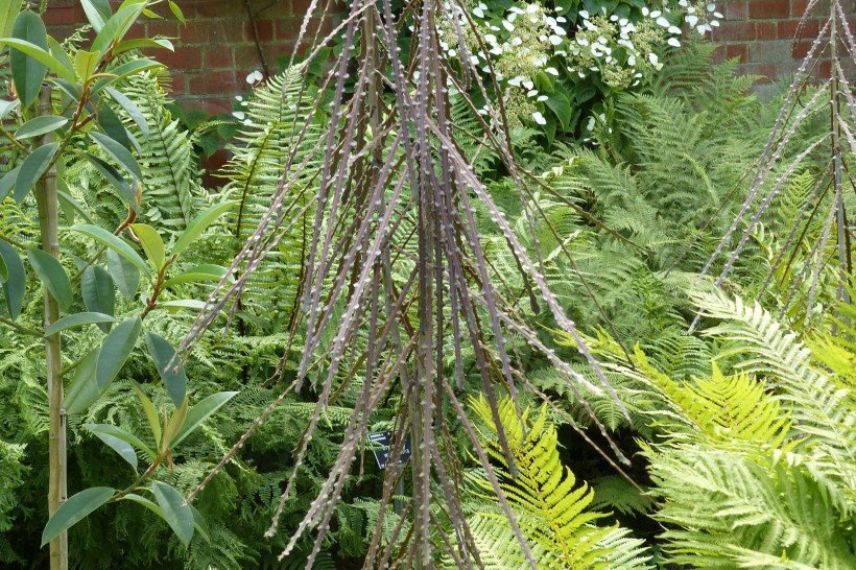
Place your Pseudopanax in a sheltered position surrounded by plants for increased ambient humidity
Watering and fertilising
Water the Pseudopanax ideally with rainwater, or with low-calcium water. Plan for generous watering once a week in spring and probably twice in summer. In autumn, space out the waterings, and in winter, limit to once a month.
These figures are guidelines, to be adjusted according to your observations during the growth period. Allow the substrate to dry out between waterings.
The Pseudopanax will appreciate a liquid fertiliser added to the watering water once a month during the growth period.
Maintenance and Wintering
Maintenance
Aside from careful watering, Pseudopanax in pots requires little maintenance.
- During the first few years, install a stake to help it form a straight trunk.
- Do not prune Pseudopanax ferox and Pseudopanax crassifolius as they are not ramified.
- If necessary, for example if it takes up too much space in a greenhouse or indoors, you can prune Pseudopanax lessonii.
- Every year, top up the pot by adding some potting soil on top. Every three years, as long as it’s still possible, repot.
Wintering
It is useful to remember that plants grown in pots suffer from frost more quickly than those grown in the ground because the stump and roots are less protected. Thus, while Pseudopanax is considered hardy down to about -5 °C to -7 °C, reduce this tolerance by 2 to 3 degrees for a potted plant. Bring the Pseudopanax indoors in autumn in regions subject to winter frost. Place it in a bright, frost-free room. Take it back outside in spring.
In regions with a mild climate, still protect your bush from frost by adding a layer of organic mulch on top of the pot. Wrap the pot with cardboard, hessian, or bubble wrap and cover the aerial parts with a winter fleece.
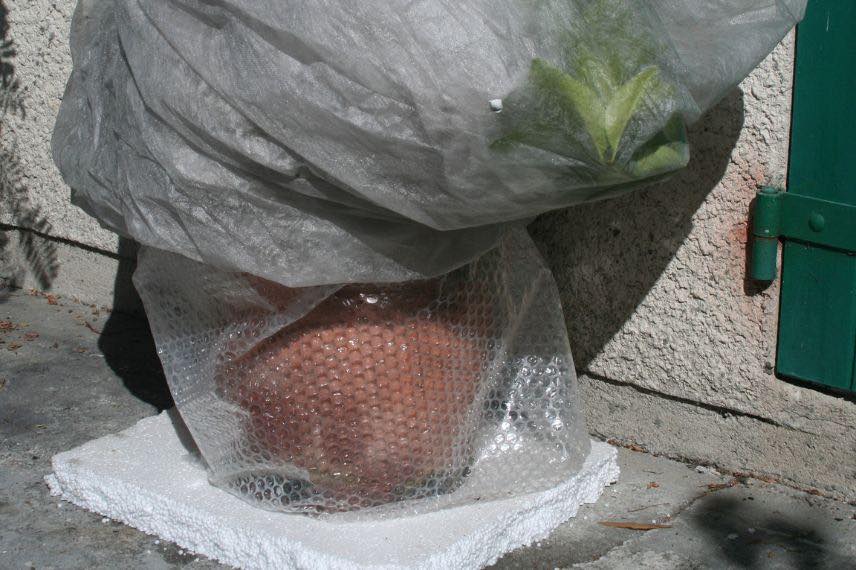
Complete setup of a well-protected plant: cold insulation with a polystyrene board under the pot, bubble wrap around the pot, and winter fleece over the aerial parts
- Subscribe!
- Contents
Comments