


Hostas: the reliable choices
Our selection of 5 easy-care Hostas!
Contents
Choosing a hosta is not an easy task when you see the number of varieties often available on the market: over a hundred cultivars, all more attractive than the last! This shade perennial is increasingly popular as it enhances the shaded areas of our gardens with its large, solid or variegated, crinkled and veined foliage.
We offer a small selection of 5 reliable choices, from generous Hostas to the more modest ones, which are the easiest to grow and prove resistant to gastropods, their little Achilles’ heel.
→ Learn all about Hostas in our comprehensive guide: Hosta: planting, growing and maintenance.

Hosta sieboldiana 'Frances Williams'
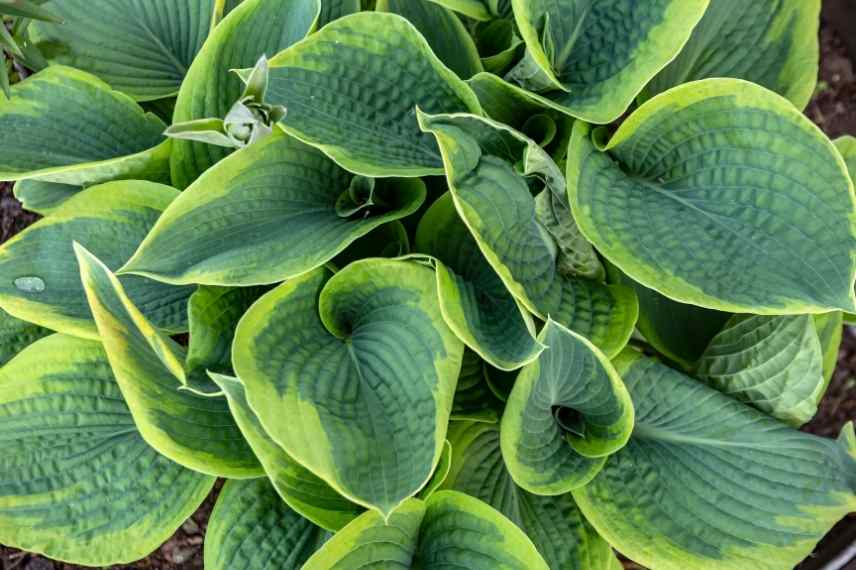
The Hosta sieboldiana ‘Frances Williams’ is a remarkable variegated hosta.
It combines several advantages that make it a reliable choice, a must-have for cool gardens: a stunning bicolour of blue-green edged with light green to yellow-green on its margins, making it quite luminous. It boasts broad, well-proportioned leaves (approximately 20 cm), beautifully wrinkled and veined, in addition to being particularly thick and suffering little from the fierce appetite of slugs on rainy days. It reaches a height of 60 cm after a few years, with a wider spread of 80 cm.
Additionally, ‘Frances Williams’ is a cultivar derived from the sieboldiana species, known for its particularly spreading foliage. It looks splendid in a border where it can serve as groundcover when planted in masses or accompanied by other Hostas sieboldiana, or Hostas plantaginea, which are also spreading, such as Hosta sieboldiana var Elegans.
Its pure white flowers are beautiful, rising on tall spikes above the foliage, appearing in July, but it is truly for its hues and the texture of its foliage that it is cultivated in the garden.
Hosta ‘Frances Williams’
Read also
Choosing HostasHosta tardiana 'Halcyon'
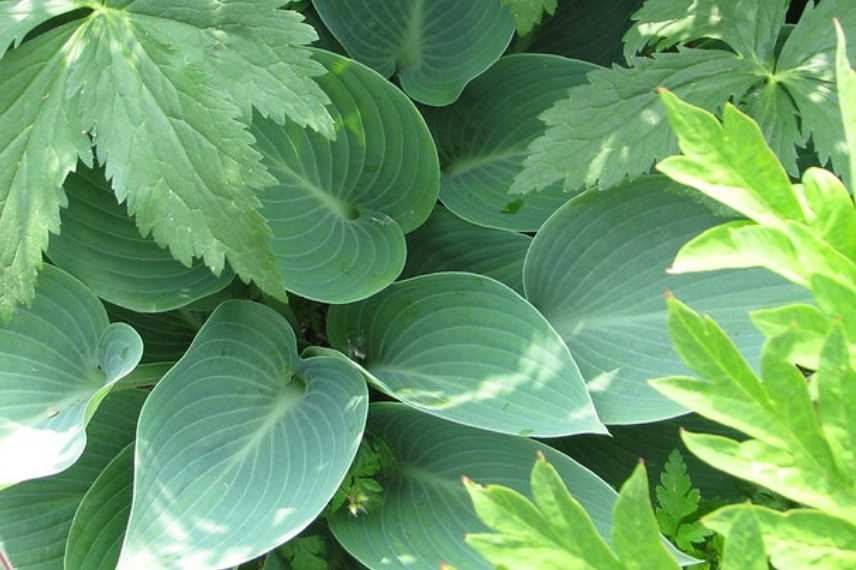
It is one of the great classics among small hostas and blue-leaved hostas. It is certainly also one of the easiest to find commercially. The popularity of Hosta ‘Halcyon’ is due as much to its foliage, one of the bluest, thanks to a fine waxy coating, as to its very small size, which allows it to be planted at the edge of the garden or in a pot on the terrace. It will form no more than a dense clump of 35 to 40 cm in all directions, and will therefore integrate just as well into a border or a pot alongside other greener hostas to create a beautiful contrast. Its ash-purple flowering, although less sought after than its thick, metallic blue foliage, generally appears in mid-July, sometimes at the end of June.
Plant ‘Halcyon’ in the shade, as its blue foliage is particularly sensitive to sunlight. Like all blue hostas, it proves to be quite resistant to slug and snail attacks.
Hosta ‘Halcyon’
Discover other Hostas - Plantain Lilies
View all →
Available in 1 sizes
Available in 1 sizes
Available in 1 sizes
Available in 2 sizes
Available in 1 sizes
Available in 1 sizes
Available in 1 sizes
Available in 1 sizes
Available in 2 sizes
Available in 2 sizes
Hosta 'Sum and Substance'
There are several giant Hostas, offering their spectacular and almost exotic appearance within a flowerbed.
The Hosta ‘Sum and Substance’ is one of the oldest and is a must-have in the garden. Standing at 80 cm to 1 m tall, it is less spectacular than ‘Jurassic Park’ or ‘Empress Wu’, two varieties known for their extraordinary stature, but it boasts a chartreuse green, almost golden colour, which is stunning in the shade. With this lighter hue, it can actually tolerate a bit more sun than the others. Its rounded leaves are huge and thick, and finely veined. Its flowers have a soft hue, a lovely light lilac, making it truly eye-catching and instantly brightening up a dull flowerbed.
‘Sum and Substance’ requires, like all Hostas, soil that remains cool in summer and rich in nutrients.
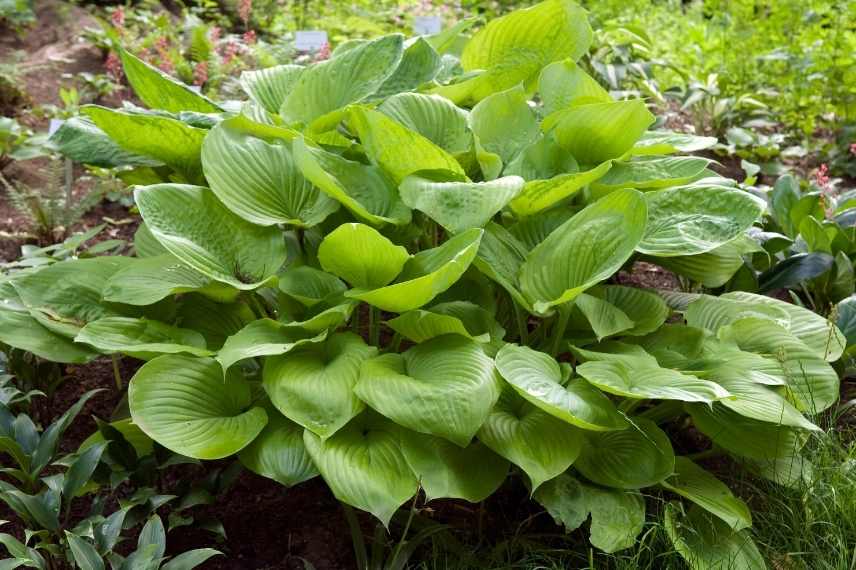
Hosta ‘Sum and Substance’
Read also
Growing hostas in potsHosta fortunei var. hyacinthina
Here is another hosta that deserves to be planted in the garden for its many qualities: the Hosta fortunei var. hyacinthina. It is a vigorous hosta, growing relatively quickly for this type of perennial, which generally takes its time to thrive. It displays leaves of an elegant grey-green, with a velvety matte appearance, beautifully edged. They will evolve into a greener colour as summer progresses. Its ease of cultivation, its medium yet generous dimensions (it will take on the appearance of a lovely clump of 75 cm in flower with a wide spread of nearly 1 m), and its fine, well-defined veins make it a particularly attractive variety for any gardener. It will flower in June or July, bringing its tall spikes of very pale lavender.
Plant it in rich, humus-rich, cool, and well-drained soil. It thrives beautifully in partial shade.
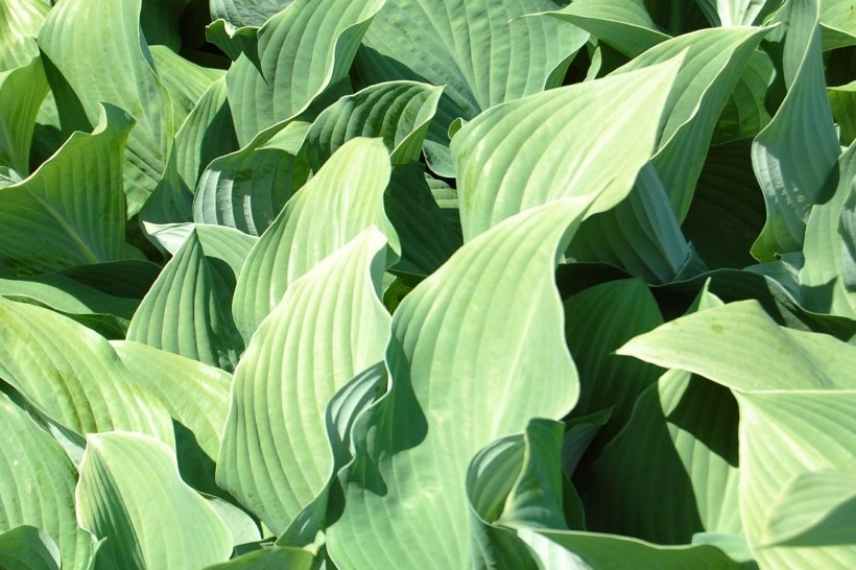
Hosta fortunei var. hyacinthina
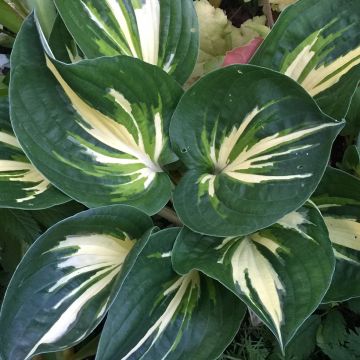
Hosta tardiana 'June'
Even though it is one of the smallest varieties readily available, Hosta ‘June’ is also a little gem and one of the easiest Hostas to grow. It belongs to the tardiana species, like the previously mentioned small ‘Halcyon’, and retains this very compact appearance as, after a few years, it maintains its almost dwarf proportions of 40 cm in height with a more substantial spread of about 60 to 70 cm.
It is also quite resistant to slugs and snails. Therefore, it is stunning and ultra-decorative in pots, but can also be confidently placed in a shady garden bed. We especially love its variegated leaf with a cream colour almost yellow at the centre, and its irregular margins wavering between blue and pale green, providing a magnificent contrast, along with its matte texture and the beautiful ovate shape of its leaves. It is perfect in a semi-shaded position, with morning or late afternoon sun.
Its light lavender flowering will further brighten the beginning of summer.
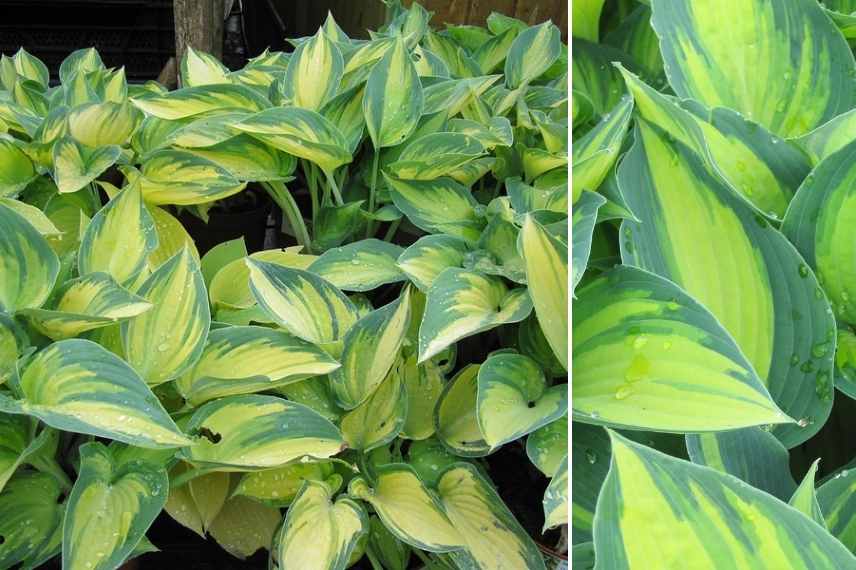
Hosta June (© Leonora Enking)
- Subscribe!
- Contents
Comments